
Maximize your score with these resources:
- Albert.io AP® Business with Personal Finance question banks
- Free AP® Business with Personal Finance score calculator
A landscaping company finishes a huge $80,000 job for a new office park in June. On paper, it is the company’s most profitable month ever. But the client will not pay for 60 days, and payroll, fuel, and equipment payments are due this Friday. The owner has a profit and no cash. This is how profitable businesses can still fail. Topic 3.8 covers the cash flow statement, the report that tracks the actual money moving in and out of a business’s accounts.
This article covers Topic 3.8: The Cash Flow Statement in Unit 3, Part 2, Business Finance and Accounting. The topic asks you to determine and describe the components of a cash flow statement and explain how stakeholders use it.
By the end, you should be able to:
- Define a cash flow statement and explain why businesses watch cash balances closely.
- Classify transactions as cash inflows or cash outflows.
- Calculate net cash flow and an ending cash balance.
- Explain why negative cash flow is dangerous even when net income is positive, and how businesses respond.
What a Cash Flow Statement Shows
A cash flow statement shows how cash inflows and outflows change a business’s cash balance over a reporting period. Businesses monitor cash closely to make sure they can:
- Pay recurring expenses such as payroll and rent.
- Repay lenders.
- Handle unforeseen expenses.
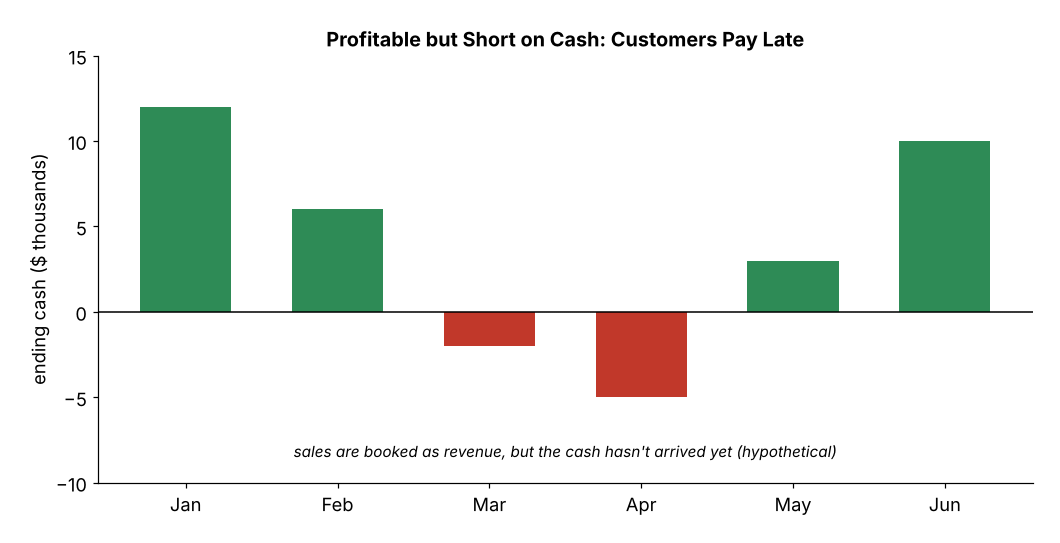
The reason cash needs its own statement is timing. A sale counts as revenue when it is made, but the cash may arrive weeks later. Bills, on the other hand, often must be paid right away. The gap between the two is where cash problems start.
Cash flow for a period can be positive (more cash came in than went out) or negative (more went out than came in).
Cash Inflows and Outflows
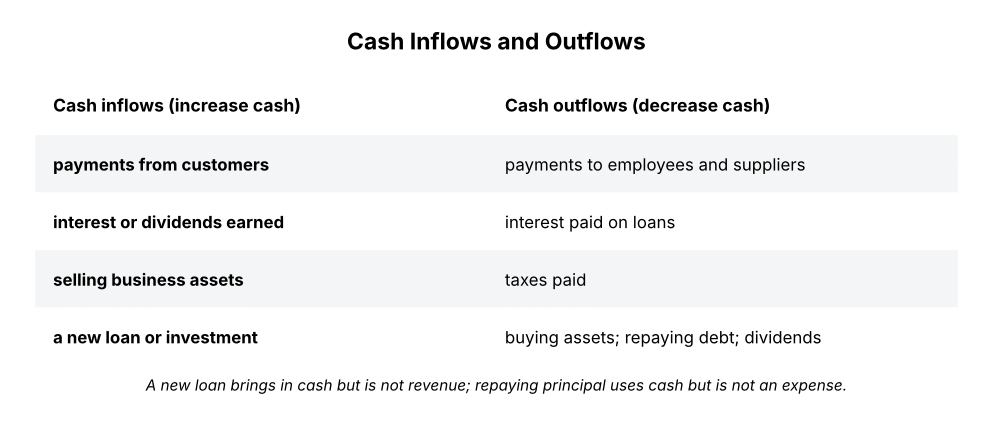
| Cash inflows (increase cash) | Cash outflows (decrease cash) |
|---|---|
| Payments from customers | Payments to employees and suppliers |
| Interest or dividends earned on investments | Interest paid on existing loans |
| Proceeds from selling business assets | Taxes paid to the government |
| New financial capital, such as a new loan | Money spent to buy assets |
| Debt repayment | |
| Dividends paid to shareholders |
Notice that some items appear on the cash flow statement but not as revenue or expenses on the income statement. A new loan brings in cash but is not revenue. Repaying the loan’s principal uses cash but is not an expense.
Worked Example: Profitable but Short on Cash
A landscaping company starts July with $20,000 in cash.
| July cash inflows | Amount | July cash outflows | Amount |
|---|---|---|---|
| Customer payments | $50,000 | Payroll | $30,000 |
| New bank loan | $10,000 | Suppliers (fuel, plants, mulch) | $25,000 |
| New mower | $15,000 | ||
| Loan interest | $2,000 | ||
| Total | $60,000 | Total | $72,000 |
- Net cash flow: \(60{,}000-72{,}000=-\$12{,}000\). Cash flow is negative.
- Ending cash balance: \(20{,}000-12{,}000=\$8{,}000\).
- The problem: The company is still owed $80,000 from June’s job. Its income statement may show a large profit, but with only $8,000 in the bank and $30,000 in payroll due next month, it is in danger.
How Stakeholders Use Cash Flow Information
The cash flow statement shows whether a business can meet its obligations to employees, suppliers, creditors, and shareholders. Negative cash flow may signal that a business cannot pay current expenses, which could lead to a shutdown or bankruptcy even if net income is positive.
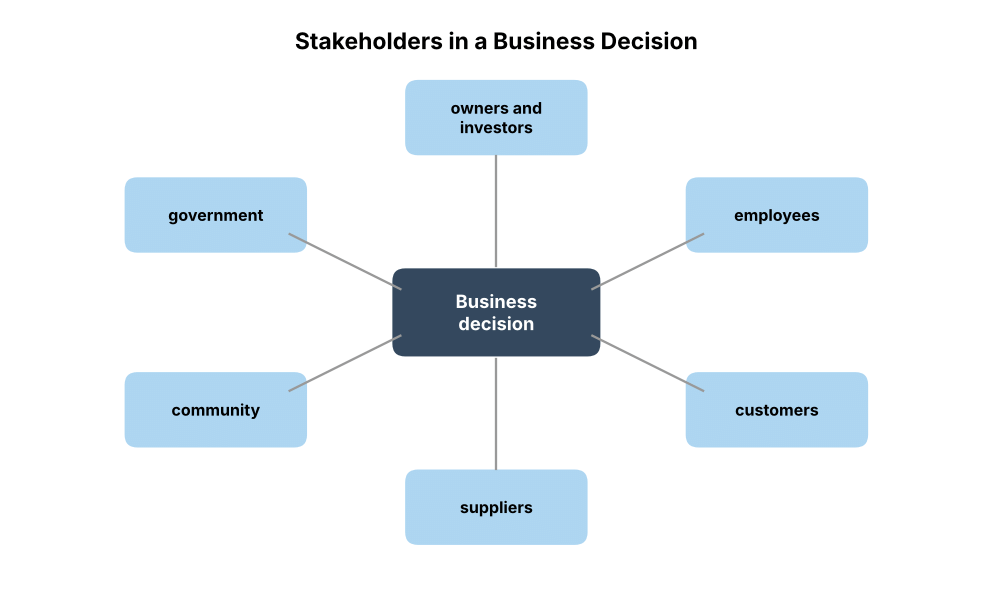
The CED lists three responses:
| Response | Landscaping example |
|---|---|
| Raise more funds | Open a business line of credit to cover payroll |
| Collect accounts receivable faster | Offer the office park a 2% discount to pay within 10 days |
| Get better terms from suppliers and lenders | Ask the plant nursery for 60 days to pay instead of 30 |
Why does this matter? Many exam scenarios hinge on the difference between profit and cash. If a question says a business is profitable but cannot pay its bills, the cash flow statement is the key, and faster collection or better payment terms are the classic fixes.
Test-Taking Strategies
Mnemonic Devices and Memory Shortcuts
Remember “Profit is an opinion, cash is a fact.” For the formula: beginning cash + inflows − outflows = ending cash.
Cross-Topic Connections
- Topic 3.6: The Income Statement shows profit, which can differ sharply from cash flow.
- Topic 3.7: The Balance Sheet and Net Worth lists accounts receivable and the working capital that cash flow affects.
- Topic 3.5: Financial Capital explains why businesses borrow to manage irregular cash flow.
- Topic 3.4: Business Expenses covers the recurring costs that drain cash every month.
Common Question Formats
- A transaction asking whether it is a cash inflow or outflow.
- Beginning cash, inflows, and outflows asking for the ending balance.
- A profitable business with cash problems asking for the best response.
Frequent Student Mistakes
- Counting a new loan as revenue. It is a cash inflow, not revenue.
- Assuming positive net income means positive cash flow.
- Forgetting that buying equipment is a cash outflow even though it creates an asset.
Test-Day Shortcuts
Ask “Did money actually move today?” If yes, it belongs on the cash flow statement. If a sale was made but not yet paid, cash has not moved.
Time Management Tips
The AP Business with Personal Finance Exam on May 4, 2027, is fully digital in Bluebook, and calculators are permitted. On cash flow tables, total each column before reading the answer choices. The answer is usually the difference between the two totals.
Check for Understanding
Think you’ve got it? Complete the quiz below to make sure. Download your results at the end.