
Maximize your score with these resources:
- Albert.io AP® US Government question banks
- Free AP® US Government cheat sheets
- Free AP® US Government score calculator
The Constitution divides power between the national government and the states, but it never draws the line precisely. A handful of clauses are written broadly enough that each generation argues about what they allow. The Supreme Court settles those arguments case by case, and its answers have shifted power toward Washington in some eras and back toward the states in others. On the AP® U.S. Government and Politics exam, that back-and-forth shows up in stimulus questions, in the SCOTUS comparison FRQ, and in two required cases: McCulloch v. Maryland and United States v. Lopez.
This article covers Topic 1.8: Constitutional Interpretations of Federalism in Unit 1, Foundations of American Democracy. The learning objective reads:
LO 1.8.A: Explain how the balance of power between national and state governments has changed over time based on interpretations of the Supreme Court of the United States.
By the end, you should be able to:
- Identify the four constitutional provisions the Court keeps returning to when it decides federalism cases.
- Explain the facts, holding, and reasoning of McCulloch v. Maryland (1819) and United States v. Lopez (1995).
- Trace how the Commerce Clause expanded national power for most of the 20th century and where the Court started pushing back.
- Compare two cases and explain which way each one moved the balance of power.
The Four Clauses at the Center of Every Federalism Fight
Almost every federalism case comes down to one of these provisions. Learn what each says and which side usually cites it, and you’ll be able to sort most exam questions quickly.
| Provision | What It Says | How It Affects the Balance |
|---|---|---|
| Necessary and Proper Clause (Article I, Section 8) | Congress may make all laws “necessary and proper” for carrying out its listed powers. | The source of implied powers. A broad reading lets Congress act in areas the Constitution never names. |
| Commerce Clause (Article I, Section 8) | Congress may regulate commerce “among the several States.” | The most used tool for expanding national power, from labor laws to civil rights. |
| Supremacy Clause (Article VI) | The Constitution and federal laws are “the supreme Law of the Land.” | When a valid federal law conflicts with a state law, the federal law wins. This is called preemption. |
| Fourteenth Amendment (1868) | No state may deny due process or equal protection, and Congress may enforce these guarantees. | Gives the national government a way to protect individual rights against state action. |
The Tenth Amendment is the counterweight. It reserves powers not delegated to the national government “to the States respectively, or to the people.” States and their supporters cite it whenever they argue that Congress has reached too far.
Why does this matter? The exam rarely asks you to recite a clause. It asks you to recognize which clause a case turned on. If a stimulus mentions a law regulating guns near schools, think Commerce Clause. If it mentions a national bank, think Necessary and Proper. If it mentions a state law that conflicts with a federal one, think Supremacy Clause.
McCulloch v. Maryland (1819): Implied Powers and National Supremacy


In 1816, Congress chartered the Second Bank of the United States. Many states resented it, and Maryland passed a tax on any bank operating in the state without a state charter. James McCulloch, who ran the bank’s Baltimore branch, refused to pay. The case reached the Supreme Court with two questions attached:
- Could Congress create a bank at all? The Constitution lists no power to charter a bank.
- Could a state tax a branch of that bank?
Chief Justice John Marshall wrote for a unanimous Court and answered yes to the first question and no to the second.
On the first question, Marshall read the Necessary and Proper Clause broadly. Congress has enumerated powers to tax, borrow, and regulate commerce, and a bank is a reasonable way to carry them out. “Necessary,” he argued, means useful or appropriate, not absolutely essential. His test is worth knowing in his own words:
Let the end be legitimate, let it be within the scope of the constitution, and all means which are appropriate, which are plainly adapted to that end, which are not prohibited, but consist with the letter and spirit of the constitution, are constitutional.
On the second question, Marshall relied on the Supremacy Clause. If states could tax a federal institution, they could tax it out of existence. In his phrase, “the power to tax involves the power to destroy.” A state cannot interfere with a legitimate exercise of national power.
Why does this matter? McCulloch established two ideas that still drive federalism today. Congress has implied powers beyond the list in Article I, and national law beats conflicting state law. Nearly every later expansion of federal power rests on this case. If a question asks which case “strengthened the power of the national government” in the early republic, McCulloch is the answer.
The Commerce Clause: How Far Can Congress Reach?
The Commerce Clause gives Congress power over trade “among the several States.” For most of American history, the fight has been over one word: what counts as interstate commerce? The Court’s answer has swung widely.
| Case | What Happened | Direction of Power |
|---|---|---|
| Gibbons v. Ogden (1824) | Struck down a New York steamboat monopoly because it conflicted with a federal license. Commerce includes navigation. | Toward the nation |
| Wickard v. Filburn (1942) | Upheld federal limits on wheat a farmer grew for use on his own farm, since millions of farmers doing the same would affect the national market. | Strongly toward the nation |
| Heart of Atlanta Motel v. United States (1964) | Upheld the Civil Rights Act’s ban on discrimination in hotels because they serve interstate travelers. | Toward the nation |
| United States v. Lopez (1995) | Struck down a federal ban on guns in school zones. Carrying a gun is not economic activity. | Toward the states |
| United States v. Morrison (2000) | Struck down part of the Violence Against Women Act for the same reason. | Toward the states |
| Gonzales v. Raich (2005) | Upheld federal power to ban homegrown medical marijuana, even where state law allowed it. | Toward the nation |
United States v. Lopez: The Court Draws a Line
In 1992, Alfonso Lopez Jr., a senior at a high school in San Antonio, Texas, brought a handgun to school. He was charged under the Gun-Free School Zones Act of 1990, a federal law. His lawyers argued that Congress had no power to pass it.
The government defended the law under the Commerce Clause. Guns in schools lead to violence, the argument went, violence raises insurance costs and discourages travel, and a poor learning environment hurts the national economy. In a 5–4 decision written by Chief Justice William Rehnquist, the Court rejected that chain of reasoning. Possessing a gun near a school is not economic activity, and accepting the government’s logic would leave almost nothing Congress couldn’t regulate.
Why does this matter? Lopez was the first time since the 1930s that the Court struck down a federal law for exceeding the Commerce Clause. It signaled that the power has limits and that some areas, like school safety and ordinary criminal law, belong mostly to the states. Pair it with McCulloch on the exam: one expanded national power, the other pulled it back.
The Fourteenth Amendment and the Supremacy Clause
The Commerce Clause isn’t the only route to national power. Two other provisions have shaped the balance just as much.
The Fourteenth Amendment
Before 1868, the Bill of Rights limited only the national government. The Fourteenth Amendment changed that by forbidding states to deny “due process of law” or “the equal protection of the laws.” Over the 20th century, the Court used the Due Process Clause to apply most of the Bill of Rights to the states, a process called selective incorporation. You can review it in our article on selective incorporation.
The effect on federalism was enormous. States that once controlled their own criminal procedures, school policies, and voting rules now have to meet national constitutional standards. Brown v. Board of Education (1954) used the Equal Protection Clause to strike down state-mandated school segregation, one of the clearest examples of national power overriding state policy.
The amendment’s Section 5 also lets Congress pass laws to enforce these guarantees. The Court has limited that power too. In City of Boerne v. Flores (1997), it ruled that enforcement laws must be proportional to an actual pattern of state violations.
The Supremacy Clause and Preemption
When Congress acts within its powers, conflicting state laws give way. In Arizona v. United States (2012), the Court struck down most of the challenged parts of an Arizona immigration law because federal law already controls immigration enforcement.
The Supremacy Clause has limits of its own. Under the anti-commandeering doctrine, Congress cannot order state officials to carry out federal programs. Printz v. United States (1997) struck down a requirement that local sheriffs run background checks for gun purchases. Murphy v. NCAA (2018) struck down a federal law that barred states from legalizing sports betting. Congress can regulate people directly, but it cannot turn state governments into its agents.
How the Balance Has Shifted Over Time


Put the cases in order and a pattern appears. Political scientists describe federalism in eras, and the exam expects you to know the labels.
- Dual federalism (roughly 1789 to 1930s). The national and state governments operate in separate spheres, like the layers of a cake. The Court often read the Commerce Clause narrowly, striking down federal child labor laws in Hammer v. Dagenhart (1918).
- Cooperative federalism (1930s to 1970s). After the New Deal, the Court accepted a far broader Commerce Clause, and the levels of government blended like a marble cake. Federal grants, regulations, and civil rights laws reached deep into state policy.
- New federalism and devolution (1980s onward). Presidents from Nixon to Reagan pushed to return power to the states, and the Rehnquist Court followed with Lopez, Printz, and Morrison. National power remains large, but the Court now enforces some limits.
The long-term trend still favors the national government. Even the “pro-state” decisions leave Congress with more power than the Framers likely imagined. The swings happen at the edges, and those edges are what the exam tests. For the basics of how powers are divided in the first place, see our review of the relationship between the states and the federal government.
Test-Taking Strategies
Mnemonic Devices and Memory Shortcuts
- “McCulloch = More Congress. Lopez = Less Congress.” The first letters match the direction each case moved power. This is the fastest way to handle a comparison question.
- “Tax is to destroy.” Marshall’s line in McCulloch explains why states can’t tax federal institutions. If you remember the phrase, you remember the Supremacy Clause half of the ruling.
- Layer cake, marble cake. Dual federalism keeps the levels separate like layers. Cooperative federalism mixes them like a marble cake.
- “Guns aren’t groceries.” In Lopez, carrying a gun wasn’t economic activity, so it wasn’t commerce. That’s the core of the holding.
Cross-Topic Connections
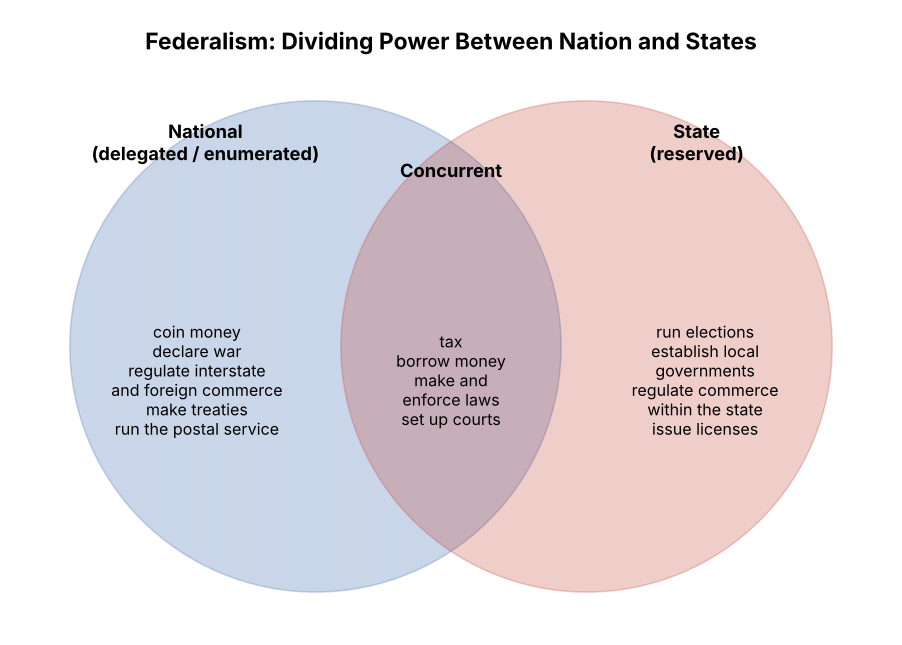
- Topic 1.7: This topic builds on the basic division of powers, including enumerated, reserved, and concurrent powers. Know the Tenth Amendment from 1.7 before you study the cases here.
- Topic 1.9: Federal grants and mandates show how Washington influences states without a court case. The two topics together explain how the balance moves in practice.
- Topic 3.7: Selective incorporation is the Fourteenth Amendment’s biggest federalism effect. Expect a question linking the two.
- Topic 1.6: Judicial review lets the Court referee federalism disputes, and it’s the check behind every case in this article. See our review of the principles of American government.
Common Question Formats
- SCOTUS comparison FRQ. You’ll read a summary of a non-required case and compare it to a required one, often McCulloch or Lopez. You need to identify the shared constitutional clause, explain how each ruling affected the balance of power, and sometimes describe how Congress or the states could respond.
- Clause identification MCQ. A stimulus describes a federal law or a state challenge and asks which clause the Court would apply. Match the subject (banks, guns, trade, rights) to the clause.
- Direction-of-power MCQ. “Which of the following decisions expanded the power of the national government?” Sort each answer choice into “toward the nation” or “toward the states.”
- Argument essay. Prompts about whether power should rest with the states or the national government can use McCulloch, Lopez, and the Tenth Amendment as evidence.
Frequent Student Mistakes
- Thinking McCulloch was about banking policy. The bank was only the vehicle. The ruling is about implied powers and national supremacy. Write about those in an FRQ, not about whether a national bank was a good idea.
- Saying Lopez was a gun rights case. It wasn’t a Second Amendment case at all. The Court said nothing about a right to bear arms. It ruled that Congress lacked Commerce Clause power, and states remained free to ban guns in schools. Most already did.
- Assuming the Tenth Amendment always wins for states. The Tenth Amendment reserves only powers not delegated to the national government. If the Court finds a federal law valid under the Commerce or Necessary and Proper Clause, the Tenth Amendment offers no protection.
- Mixing up preemption and commandeering. Preemption means federal law overrides state law. Commandeering means forcing state officials to enforce federal law, which the Court forbids.
Test-Day Shortcuts
- Find the clause, then find the direction. For any federalism case, answer two questions: which clause, and did the ruling expand or limit national power? Those two answers usually eliminate three choices.
- Look for “economic activity.” If a question about the Commerce Clause mentions whether the regulated activity is economic, it’s pointing you toward Lopez reasoning.
- Use the year as a clue. Cases from 1937 to 1994 almost always upheld federal power under the Commerce Clause. Cases after 1995 are where limits appear.
Time Management Tips
- Multiple choice: Federalism case questions are quick once you know the two required cases. Aim for under a minute, and save time for longer data and text-based stimuli.
- SCOTUS comparison FRQ: Budget about 20 minutes. Spend the first two reading the case summary and underlining the constitutional clause and the holding. Then write one focused paragraph per part.
- Argument essay: If you use a federalism case as evidence, name it, state the holding in one sentence, and spend the rest of your space explaining how it supports your claim.
Check for Understanding
Think you’ve got it? Complete the quiz below to make sure. Download your results at the end.