
Maximize your score with these resources:
- Albert.io AP® US Government question banks
- Free AP® US Government cheat sheets
- Free AP® US Government score calculator
In 1980, a California mother named Candace Lightner lost her 13-year-old daughter to a drunk driver who had multiple prior arrests. She founded Mothers Against Drunk Driving (MADD). Four years later, Congress passed the National Minimum Drinking Age Act, and every state eventually raised its drinking age to 21. A single organized group changed national policy in less than a decade. The AP® U.S. Government and Politics exam wants you to explain how groups like MADD, and larger movements like the civil rights movement, turn public pressure into policy.
This article covers Topic 5.7: Groups Influencing Policy Outcomes in Unit 5, Political Participation. The topic asks you to explain how different kinds of groups, from single-issue organizations to mass protest movements, influence what government does.
By the end, you should be able to:
- Distinguish single-issue groups, ideological groups, social movements, and protest movements.
- Explain the main strategies groups use: lobbying, grassroots mobilization, litigation, elections, and protest.
- Use real examples to show how groups have changed policy.
- Explain why some groups have more influence than others.
Types of Groups That Shape Policy
Not every group works the same way. The exam expects you to recognize the major types and what makes each one distinct.
| Type | What It Is | Examples |
|---|---|---|
| Single-issue group | Focuses intensely on one policy area. Members often vote based on that issue alone. | MADD (drunk driving), the National Rifle Association (gun rights) |
| Ideological group | Pursues a broad liberal or conservative agenda across many issues. | Americans for Prosperity (conservative), MoveOn (liberal) |
| Economic and professional group | Represents the interests of a business sector, workers, or a profession. | U.S. Chamber of Commerce, AFL-CIO, American Medical Association |
| Public interest group | Seeks benefits for the public at large, not just its own members. | League of Women Voters, Sierra Club |
| Social movement | A broad, often loosely organized effort by many people and groups to change society and policy. | The civil rights, women’s rights, and environmental movements |
| Protest movement | Uses marches, demonstrations, and civil disobedience to draw attention and pressure officials. | The 1963 March on Washington, the Tea Party rallies of 2009 and 2010 |
The categories overlap. The civil rights movement was a social movement that included formal interest groups like the NAACP, protest campaigns like the Montgomery bus boycott, and legal strategies that reached the Supreme Court. Recognizing that overlap is part of what the exam tests.
How Groups Influence Policy
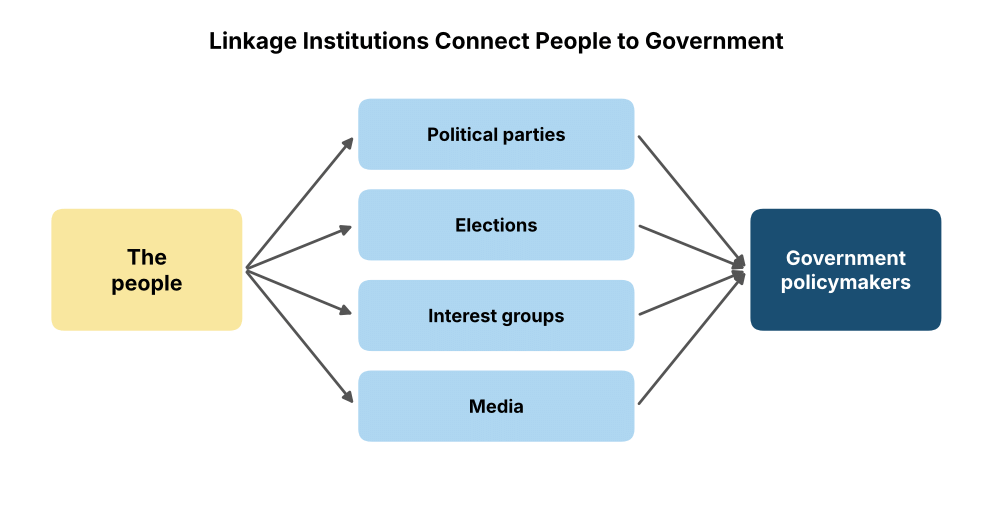
Groups use several strategies, and most successful ones use more than one. Each strategy targets a different part of government, which is possible because separation of powers and federalism create so many access points.
- Direct lobbying. Lobbyists meet with members of Congress and their staffs, testify at hearings, and supply research and draft language for bills. Lobbying also targets agencies, since that’s where regulations get written.
- Grassroots mobilization. Groups urge members to call, write, and visit their representatives. A flood of constituent calls tells a member of Congress that voters are paying attention.
- Litigation. Groups bring test cases and file amicus curiae briefs. The NAACP Legal Defense Fund, led by Thurgood Marshall, spent years building the cases that led to Brown v. Board of Education (1954).
- Electoral activity. Groups endorse candidates, register voters, and spend money through political action committees (PACs). After Citizens United v. FEC (2010), a required case, corporations, unions, and other groups can spend unlimited amounts on independent political advocacy, often through super PACs. You can review the details in our article on campaign finance.
- Participating in rulemaking. Groups submit comments on proposed regulations and meet with agency officials. See our review of discretionary and rule-making authority.
- Protest and civil disobedience. Public demonstrations draw media coverage, shift public opinion, and signal to officials that an issue can’t be ignored.
Why does this matter? Groups choose strategies based on where they have the best chance. A group without money for lobbying may turn to protest or the courts. A group that loses in Congress may try a state legislature or a federal agency. On the exam, if a scenario describes a group switching tactics, the concept being tested is multiple access points.
Case Studies: Groups That Changed Policy


The Civil Rights Movement
The civil rights movement used every strategy at once. The NAACP won in court with Brown. Activists organized the Montgomery bus boycott (1955–1956), lunch counter sit-ins, and the Freedom Rides. In 1963, Martin Luther King Jr. wrote his Letter from Birmingham Jail, a required foundational document, defending nonviolent civil disobedience against critics who told him to wait. “Injustice anywhere is a threat to justice everywhere,” he wrote.
That August, about 250,000 people joined the March on Washington for Jobs and Freedom. Televised violence against peaceful protesters in Birmingham and later in Selma shifted public opinion and put pressure on Congress. The result was the Civil Rights Act of 1964 and the Voting Rights Act of 1965, two of the most important laws of the 20th century.
MADD and the Drinking Age
MADD combined grassroots organizing with personal stories that drew heavy media attention. It pushed states to toughen drunk driving laws and lobbied Congress for a national standard. Because Congress couldn’t set a drinking age directly, the 1984 law withheld part of states’ federal highway funds unless they raised their age to 21. The group’s success shows how a single-issue organization can use federalism and the power of the purse to reach its goals.
The Tea Party
Beginning in 2009, the Tea Party movement held rallies against federal spending, bank bailouts, and the Affordable Care Act. It combined protest with electoral activity, backing candidates in Republican primaries. In the 2010 midterm elections, Republicans gained 63 House seats and took control of the chamber, with many new members elected on Tea Party themes. The movement shows how protest energy can turn into electoral power.
| Group or Movement | Main Strategies | Policy Result |
|---|---|---|
| Civil rights movement | Litigation, protest, civil disobedience, lobbying | Brown, Civil Rights Act (1964), Voting Rights Act (1965) |
| MADD | Grassroots pressure, media, lobbying | National Minimum Drinking Age Act (1984) |
| Tea Party | Protest, primary elections | A new House majority after the 2010 midterms |
Why Some Groups Have More Influence
Groups don’t compete on equal terms. Several factors shape how much influence a group has.
- Resources. Money pays for lobbyists, research, advertising, and campaign contributions. Business groups consistently spend the most on lobbying.
- Size and intensity. A large membership gives a group votes to offer. Intensity matters too. A smaller group whose members vote on one issue can outweigh a larger group that cares less.
- The free-rider problem. People can benefit from a group’s success without joining or paying dues. Economist Mancur Olson argued this makes large, diffuse interests, like consumers, hard to organize. Groups overcome it with selective incentives, benefits only members get. AARP, for example, offers discounts on insurance and travel.
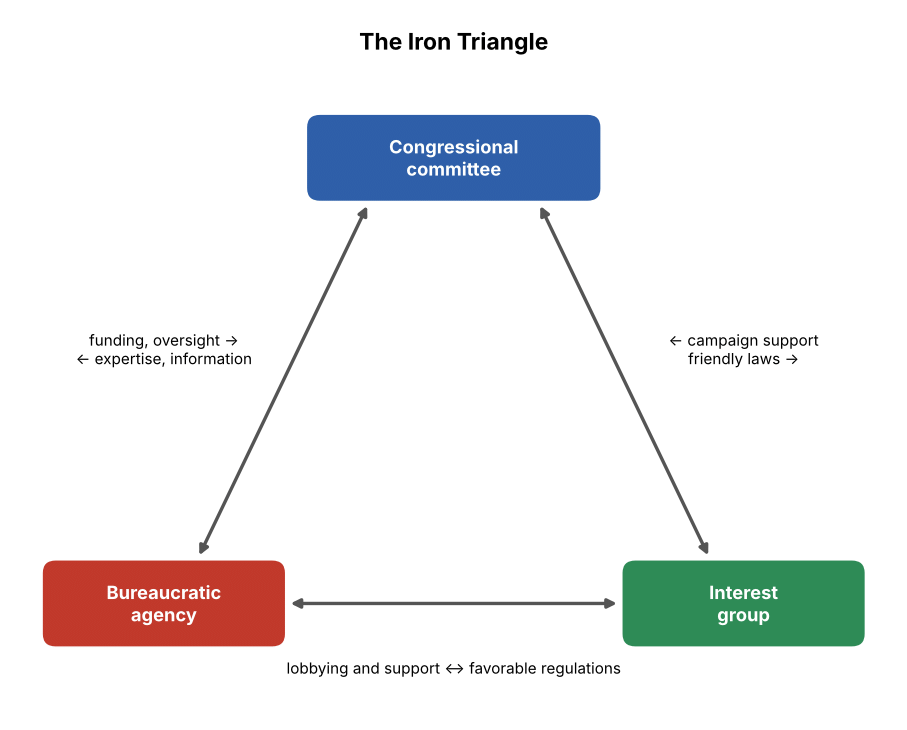
- Access. Groups with long relationships with committee members and agency officials can become part of an iron triangle, a stable alliance that shapes policy in one area. Read more in our review of interest groups and iron triangles.
- Public opinion. A group whose goals match the public mood has an easier time. Movements often succeed by changing public opinion first.
Groups also compete with other actors. In the federal budget process, interest groups, professional organizations, the military, and agencies all push for funding, while the president’s budget proposal and Congress’s priorities set the limits. No single group controls the outcome.
Political scientists disagree about what all this means for democracy. Pluralists argue that competition among many groups produces balanced policy. Elite theorists argue that wealthy, well-organized interests dominate. James Madison’s Federalist No. 10 is the starting point for this debate. He expected factions to form and argued that a large republic with many competing groups would keep any one of them from taking over.
Test-Taking Strategies
Mnemonic Devices and Memory Shortcuts
- “Four doors and the street.” Groups lobby Congress, sue in the courts, comment to agencies, and campaign in elections. When those doors close, they take to the street and protest.
- “One issue, one vote.” Single-issue group members often vote based on that issue alone, which gives the group power beyond its size.
- “Free riders need a perk.” Selective incentives solve the free-rider problem by giving members something non-members don’t get.
Cross-Topic Connections
- Topic 5.6: Interest group basics, including lobbying and iron triangles, set up this topic.
- Topic 3.10: The civil rights movement and the Letter from Birmingham Jail are central to social movements and equal protection. See our review of social movements and equal protection.
- Topic 1.6: Separation of powers and federalism create the multiple access points groups use.
- Topic 5.11: Citizens United and super PACs changed how groups participate in elections.
Common Question Formats
- Group type MCQ. A description of an organization’s goals and tactics, and you identify it as single-issue, ideological, or a social movement.
- Strategy MCQ. A scenario describes a group filing an amicus brief or organizing a phone campaign, and you name the strategy.
- Concept application FRQ. A passage describes a movement pushing for a policy change. You explain the strategy it’s using and how a branch of government might respond.
- Argument essay. Prompts about whether interest groups help or hurt democracy draw on Federalist No. 10 and the Letter from Birmingham Jail.
Frequent Student Mistakes
- Treating social movements and interest groups as the same thing. Interest groups are formal organizations with members and staff. Social movements are broader efforts that often include many groups and unaffiliated individuals.
- Assuming bigger groups always win. Intensity, resources, and access often matter more than size. The free-rider problem makes large, diffuse groups hard to mobilize.
- Forgetting the courts and agencies. Groups don’t only lobby Congress. Litigation and rulemaking comments are major strategies.
- Describing lobbying as bribery. Lobbying is legal and protected by the First Amendment right to petition the government. Giving officials money in exchange for votes is bribery and is a crime.
Test-Day Shortcuts
- Match the target to the tactic. Congress means lobbying or grassroots pressure. Courts mean litigation or amicus briefs. Agencies mean rulemaking comments. Voters mean elections or protest.
- Look for “unlimited independent spending.” That phrase points to super PACs and Citizens United.
- Tie outcomes to specific laws. In FRQs, connecting a movement to a named law, like the Civil Rights Act of 1964, earns more credit than a general claim that it “made progress.”
Time Management Tips
- Multiple choice: Group type and strategy questions should take 30 to 45 seconds. Save time for data questions about lobbying spending or PAC contributions.
- Concept application FRQ: Spend about 20 minutes. Name the strategy in the first part and explain how it targets a specific branch in the next.
- Argument essay: If you use the Letter from Birmingham Jail, pair it with a concrete policy result like the Civil Rights Act or the Voting Rights Act. Plan your rebuttal around Federalist No. 10’s warning about factions.
Check for Understanding
Think you’ve got it? Complete the quiz below to make sure. Download your results at the end.