
Maximize your score with these resources:
- Albert.io AP® Human Geography question banks
- Free AP® Human Geography cheat sheets
- Free AP® Human Geography score calculator
Why is Spanish the main language of Argentina, 6,000 miles from Spain? Why is cricket a national obsession in India and Pakistan? Why is Indonesia, thousands of miles from Arabia, the country with the most Muslims in the world? Each answer traces back to historical processes, mainly colonialism, imperialism, and long-distance trade, that carried culture across oceans centuries ago. The AP® Human Geography exam asks you to connect today’s cultural map to those processes.
This article covers Topic 3.5: Historical Causes of Diffusion in Unit 3, Cultural Patterns and Processes. The topic asks you to explain how historical processes like colonialism, imperialism, and trade shaped the cultural patterns we see today.
By the end, you should be able to:
- Explain how colonialism and imperialism spread languages, religions, and customs.
- Describe how trade routes diffused religions and cultural practices without conquest.
- Connect specific present-day cultural patterns to their historical causes.
- Identify the type of diffusion, such as relocation or hierarchical, involved in each process.
Colonialism and Imperialism
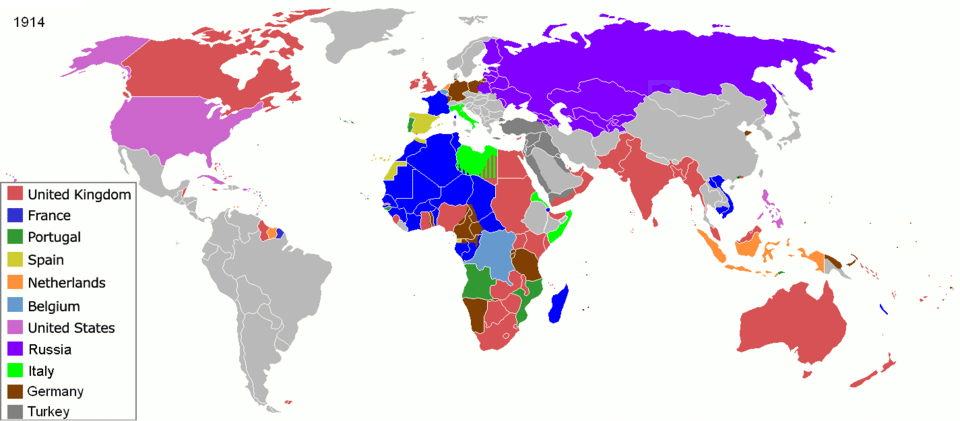


Colonialism is the practice of one country establishing settlements and political control in another territory. Imperialism is the broader extension of a country’s power over other lands, whether through direct rule, economic control, or influence. From the 1500s to the mid-1900s, European powers used both to control most of the world, and they carried their cultures with them.
Colonizers spread culture in two main ways:
- Through settlers. Colonists moved to new lands and brought their language, religion, and customs. This is relocation diffusion. British settlers in North America, Australia, and New Zealand made English the dominant language there.
- Through institutions. Colonial governments made their language the language of courts, schools, and administration. Local elites learned it to gain power and education, and it spread downward. This is a form of hierarchical diffusion.
Language
Colonial history explains most of the world’s language map outside Europe.
| Colonial Power | Where Its Language Spread | Lasting Pattern |
|---|---|---|
| Spain | Most of Central and South America, Mexico, the Philippines | Spanish is the official language of about 20 countries. |
| Portugal | Brazil, Angola, Mozambique | Brazil is the largest Portuguese-speaking country in the world. |
| Britain | North America, South Asia, much of Africa, Australia | English is an official language across much of Africa and South Asia. |
| France | West and Central Africa, Quebec, Haiti | French remains an official language in many African countries. |
In many former colonies, the colonial language still works as a lingua franca, a common language between groups that speak different native languages. Nigeria has hundreds of languages, and English lets speakers of Hausa, Yoruba, and Igbo communicate with one another. For more on language patterns, see our review of linguistic diversity.
Religion
Missionaries traveled with colonial powers. Spanish and Portuguese colonization made Latin America overwhelmingly Roman Catholic, and today the region has more Catholics than any other part of the world. Protestant and Catholic missions spread Christianity across sub-Saharan Africa during the 1800s and 1900s. The Philippines, colonized by Spain for more than three centuries, is the largest Catholic country in Asia.
Other Cultural Traits
- Sports. Cricket spread across the British Empire and is now most popular in India, Pakistan, Australia, and the Caribbean.
- Legal and political systems. Former British colonies often use common law and parliamentary systems. Former French colonies often use civil law modeled on France’s.
- Urban landscapes. Spanish law required colonial towns to be built around a central plaza with a church and government buildings on a grid. That layout still defines city centers from Mexico to Peru.
Why does this matter? Colonialism explains patterns that look puzzling at first. When an exam question asks why a language or religion is common far from its hearth, colonialism is often the answer. The borders drawn by colonial powers, covered in Unit 4, also grouped rival cultures into single states, which still shapes politics today.
Trade Routes as Paths of Diffusion
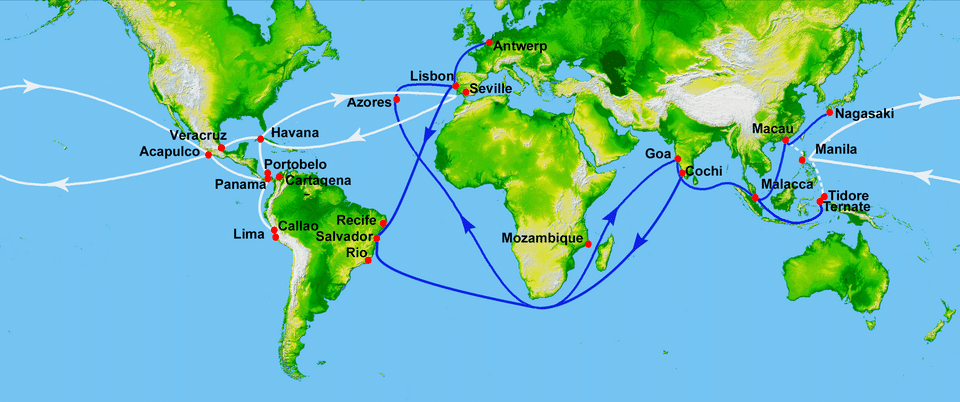
Culture also spread without conquest. Merchants who traveled long distances carried goods, ideas, and beliefs, and people along the route adopted them.
- The Silk Road. This network of routes linked China with Central Asia, the Middle East, and the Mediterranean. Buddhism spread from India into China along these routes in the early centuries CE, and from China to Korea and Japan.
- The Indian Ocean trade. Muslim merchants from Arabia, Persia, and India traded across the Indian Ocean for centuries. Their contact with coastal communities spread Islam to East Africa and Southeast Asia. That’s why Indonesia, not any Middle Eastern country, has the world’s largest Muslim population. The Swahili language of East Africa blends Bantu grammar with many Arabic loanwords, a product of the same trade.
- The trans-Saharan trade. Camel caravans carrying gold and salt linked North Africa with West Africa. Islam spread south with the traders, and cities like Timbuktu in the Mali Empire became centers of Islamic learning.
This kind of diffusion was often voluntary. Rulers and merchants in trading cities sometimes adopted a new religion because it eased trade with powerful partners. Once leaders converted, the religion often spread down to the wider population, another example of hierarchical diffusion.
Forced Migration and Global Diasporas
Colonial economies also moved people, and those people carried culture.
- The transatlantic slave trade took about 12 million Africans from Africa to the Americas. African religious traditions blended with Christianity in practices like Candomblé in Brazil and Vodou in Haiti. African rhythms shaped music across the hemisphere, from samba to jazz.
- Indentured labor replaced slavery on many plantations after abolition. Britain sent more than a million workers from India to its colonies in the Caribbean, East Africa, Fiji, and South Africa. Today, people of Indian descent make up large shares of the population in Trinidad and Tobago, Guyana, and Fiji, and Hindu temples and Indian foods are part of those landscapes.
The Columbian Exchange, the transfer of plants, animals, and diseases between the Americas and the rest of the world after 1492, also reshaped cultures. Potatoes became a staple in Ireland and Eastern Europe. Chili peppers from the Americas transformed the cooking of India, Thailand, and Korea. Horses changed life for Plains peoples in North America.
| Historical Process | What It Spread | Type of Diffusion |
|---|---|---|
| Colonial settlement | Languages, religions, legal systems | Relocation |
| Colonial administration | Official languages among elites | Hierarchical |
| Trade routes | Buddhism, Islam, Swahili | Relocation and hierarchical |
| Slavery and indentured labor | African and South Asian religions, music, foods | Relocation |
Test-Taking Strategies
Mnemonic Devices and Memory Shortcuts
- “Colonies carry culture.” Settlers spread culture by relocation. Colonial governments spread it by hierarchy.
- “Silk for Buddha, sea for Islam.” The Silk Road spread Buddhism into East Asia. The Indian Ocean trade spread Islam to Southeast Asia and East Africa.
- “CIT” for historical causes. Colonialism, Imperialism, Trade. These are the three processes the CED names.
Cross-Topic Connections
- Topic 3.4: Relocation and hierarchical diffusion are the mechanisms behind every example here. See our review of types of diffusion.
- Topic 3.7: Universalizing religions like Christianity, Islam, and Buddhism spread widely through these processes. Ethnic religions generally didn’t.
- Topic 4.4: Colonial powers drew superimposed boundaries, as at the Berlin Conference of 1884 to 1885. See our review of defining political boundaries.
- Topic 3.6: Contemporary diffusion through technology and globalization builds on these historical patterns.
Common Question Formats
- Map-based MCQ. A map shows where Portuguese or French is spoken, and you identify colonialism as the cause.
- Explanation MCQ. A question asks why Islam is widespread in Indonesia, with trade routes as the correct answer and conquest as a tempting wrong one.
- FRQ with a stimulus. A map of the British Empire or a photo of a colonial building asks you to explain a cultural pattern it helped create.
- No-stimulus FRQ. You explain how a historical process diffused a specific cultural trait, then describe its effect on the cultural landscape.
Frequent Student Mistakes
- Assuming all religious spread came from conquest. Islam reached Southeast Asia and West Africa mainly through trade, not military conquest.
- Confusing colonialism and imperialism. Colonialism involves settlement and direct control. Imperialism is broader and includes economic and political domination without settlement.
- Naming the process but not the diffusion type. FRQs often reward connecting the historical process to relocation or hierarchical diffusion.
- Treating colonial culture as replacing local culture outright. Local traditions often blended with colonial ones, producing new forms like Swahili or Candomblé.
Test-Day Shortcuts
- Look for a long-distance mismatch. If a language or religion appears far from its hearth, look for colonialism, trade, or forced migration.
- Match the empire to the region. Spanish and Portuguese in Latin America, British in South Asia and East Africa, French in West Africa.
- Link trade to cities. Port and caravan cities like Timbuktu, Malacca, and Zanzibar were hubs where cultures mixed.
Time Management Tips
- Multiple choice: Map questions about colonial languages should take under a minute. Read the map title and legend first.
- Free response: Budget about 25 minutes per FRQ. For “explain” parts, name the process, name the diffusion type, and give one place-specific example.
- Prepare three examples. Spanish in Latin America, Islam in Indonesia, and Indian communities in the Caribbean cover colonialism, trade, and forced migration.
Check for Understanding
Think you’ve got it? Complete the quiz below to make sure. Download your results at the end.