
Maximize your score with these resources:
- Albert.io AP® Physics C: Mechanics question banks
- Free AP® Physics C: Mechanics cheat sheets
- Free AP® Physics C: Mechanics score calculator
The International Space Station circles Earth about every 90 minutes, falling toward the planet the entire time but moving sideways fast enough that it never hits the ground. Comets swing close to the Sun at high speed and drift slowly at the far ends of their orbits. Both behaviors follow from two conservation laws, energy and angular momentum, applied to gravity. Topic 6.6 brings them together for orbiting satellites.
This article covers Topic 6.6: Motion of Orbiting Satellites in Unit 6, Energy and Momentum of Rotating Systems. The topic asks you to analyze circular and elliptical orbits using Newton’s law of gravitation, conservation of energy, and conservation of angular momentum.
By the end, you should be able to:
- Derive the speed and period of a circular orbit.
- Calculate the total mechanical energy of an orbiting satellite.
- Use angular momentum conservation for elliptical orbits.
- Find escape speed from conservation of energy.
Circular Orbits
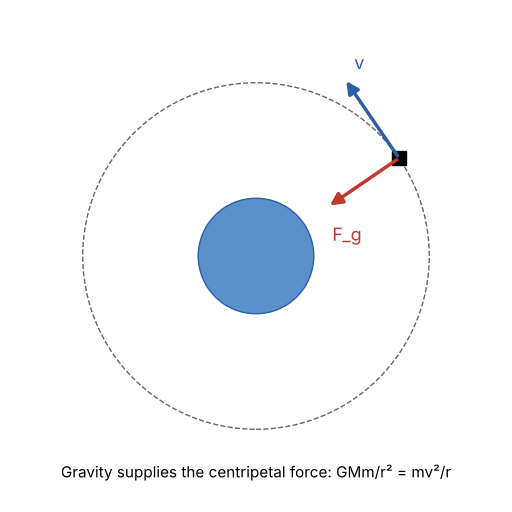
For a satellite of mass \(m\) in a circular orbit of radius \(r\) around a planet of mass \(M\), gravity supplies the centripetal force:
\(\dfrac{GMm}{r^2} = \dfrac{mv^2}{r} \quad\Rightarrow\quad v = \sqrt{\dfrac{GM}{r}}\)
The period is the circumference divided by speed:
\(T = \dfrac{2\pi r}{v} = 2\pi\sqrt{\dfrac{r^3}{GM}}\)
Squaring gives Kepler’s third law: \(T^2 = \dfrac{4\pi^2}{GM}r^3\). Notice that the satellite’s own mass cancels. A tiny satellite and a large space station at the same radius move at the same speed.
Worked Example
Find the speed of a satellite orbiting 400 km above Earth’s surface. Use \(M_E = 5.97\times10^{24}\) kg and \(R_E = 6.37\times10^6\) m.
- Orbital radius: \(r = 6.37\times10^6 + 4.0\times10^5 = 6.77\times10^6\) m.
- Speed: \(v = \sqrt{\dfrac{(6.67\times10^{-11})(5.97\times10^{24})}{6.77\times10^6}} \approx 7.67\times10^3\) m/s.
- Period: \(T = \dfrac{2\pi(6.77\times10^6)}{7.67\times10^3} \approx 5.5\times10^3\) s, about 92 minutes.
Energy in Orbit
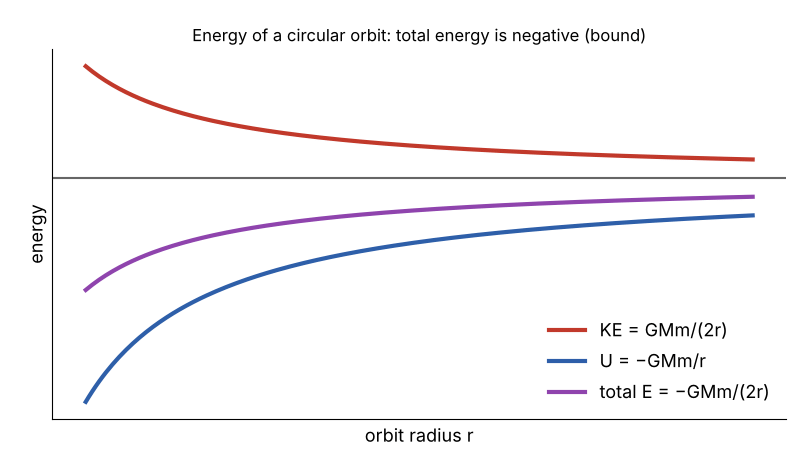
With the zero of potential energy at infinite separation, gravitational potential energy is negative:
\(U = -\dfrac{GMm}{r}\)
For a circular orbit, \(K = \tfrac{1}{2}mv^2 = \dfrac{GMm}{2r}\). So the total energy is:
\(E = K + U = \dfrac{GMm}{2r}-\dfrac{GMm}{r} = -\dfrac{GMm}{2r}\)
| Quantity | Circular Orbit Value | As Radius Increases |
|---|---|---|
| Kinetic energy | \(\dfrac{GMm}{2r}\) | Decreases |
| Potential energy | \(-\dfrac{GMm}{r}\) | Increases (less negative) |
| Total energy | \(-\dfrac{GMm}{2r}\) | Increases (less negative) |
A surprising result: moving a satellite to a higher orbit requires adding energy, yet it ends up moving slower. The extra energy goes into potential energy, and some kinetic energy is converted too.
Elliptical Orbits and Angular Momentum
Gravity points toward the planet’s center, so it exerts no torque about that point. That means the satellite’s angular momentum is conserved:
\(L = mvr\sin\theta = \text{constant}\)
At the closest point (perigee) and the farthest point (apogee), velocity is perpendicular to the radius, so:
\(v_p r_p = v_a r_a\)
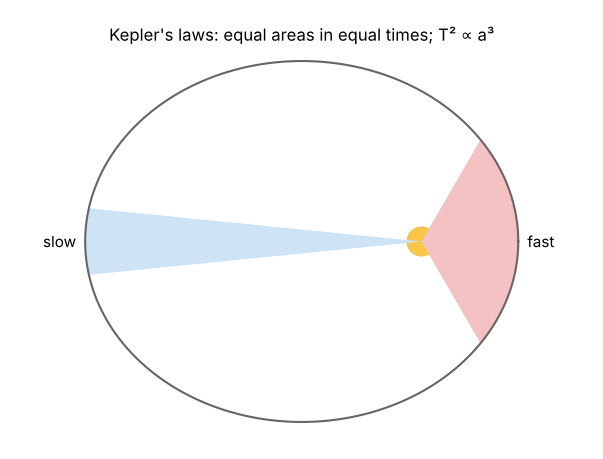
The satellite moves fastest when closest. This is equivalent to Kepler’s second law: the line from the planet to the satellite sweeps out equal areas in equal times.
Worked Example
A satellite’s perigee is \(7.0\times10^6\) m from Earth’s center, where it moves at \(8.7\times10^3\) m/s. Its apogee is \(1.4\times10^7\) m. Find its speed at apogee.
\(v_a = \dfrac{v_p r_p}{r_a} = \dfrac{(8.7\times10^3)(7.0\times10^6)}{1.4\times10^7} \approx 4.4\times10^3\ \text{m/s}\)
Energy is also conserved along the orbit, so \(\tfrac{1}{2}mv_p^2-\dfrac{GMm}{r_p} = \tfrac{1}{2}mv_a^2-\dfrac{GMm}{r_a}\). Combining the two conservation laws lets you solve for unknown speeds or distances.
Escape Speed
To escape completely, an object needs enough kinetic energy to reach infinity with zero speed, so its total energy must be at least zero:
\(\tfrac{1}{2}mv_{\text{esc}}^2-\dfrac{GMm}{R} = 0 \quad\Rightarrow\quad v_{\text{esc}} = \sqrt{\dfrac{2GM}{R}}\)
From Earth’s surface, that’s about 11.2 km/s. Escape speed is \(\sqrt{2}\) times the circular orbit speed at the same radius.
Why does this matter? Orbit problems combine almost every major idea in mechanics: Newton’s laws, circular motion, energy conservation, and angular momentum conservation. FRQs often ask you to derive an expression symbolically, then explain which quantities are conserved and why. Stating “gravity exerts no torque about the planet’s center” is a reasoning point graders look for.
Test-Taking Strategies
Mnemonic Devices and Memory Shortcuts
- “Higher and slower.” Larger orbits mean lower speeds and longer periods.
- “Close and fast, far and slow.” Angular momentum conservation in elliptical orbits.
- “Half the potential.” In circular orbits, \(E = \tfrac{1}{2}U\) and \(K = -\tfrac{1}{2}U\).
Cross-Topic Connections
- Topic 2.6: Newton’s law of gravitation supplies the force. See our review of gravitational force.
- Topic 2.10: Circular motion sets gravity equal to centripetal force. See our review of circular motion.
- Topic 3.3: Gravitational potential energy uses \(-\frac{GMm}{r}\). See our review of potential energy.
- Topic 6.4: Angular momentum conservation explains elliptical orbits. See our review of conservation of angular momentum.
Common Question Formats
- Ratio MCQ. The orbital radius quadruples, and you find the new speed or period.
- Energy MCQ. You rank kinetic, potential, and total energies for different orbits.
- Ellipse MCQ. You find the speed at apogee from perigee data.
- Mathematical routines FRQ. You derive orbital speed and period, then find the energy needed to change orbits.
Frequent Student Mistakes
- Using altitude instead of orbital radius. Add the planet’s radius.
- Treating orbital energy as positive. Bound orbits have negative total energy.
- Assuming speed is constant in an ellipse. It changes, but angular momentum doesn’t.
- Including satellite mass in orbital speed. It cancels.
Test-Day Shortcuts
- Use proportions. \(v \propto r^{-1/2}\) and \(T \propto r^{3/2}\).
- Escape equals root two times orbit. \(v_{\text{esc}} = \sqrt{2}\,v_{\text{orbit}}\) at the same radius.
- State why \(L\) is conserved. Gravity is a central force with zero torque.
Time Management Tips
- Multiple choice: Section I has 40 questions in 80 minutes, about 2 minutes each. Ratio questions are fastest with proportional reasoning.
- Free response: Section II has 4 questions in 100 minutes, roughly 25 minutes each. Start derivations from a labeled force or energy equation.
- Keep \(G\) symbolic. Plug in numbers only at the end to avoid arithmetic errors.
Check for Understanding
Think you’ve got it? Complete the quiz below to make sure. Download your results at the end.