
Maximize your score with these resources:
- Albert.io AP® Business with Personal Finance question banks
- Free AP® Business with Personal Finance score calculator
Many famous products started with someone noticing an annoyance. A parent struggling with a stroller, a student tired of losing earbuds, a chef frustrated by a dull knife. But noticing a problem is only the first step. Before spending real money, smart entrepreneurs check that other people share the problem, sketch a simple solution, and test it with real customers. Topic 1.4 walks through where business ideas come from and how to test them before betting on them.
This article covers Topic 1.4: How Do Business Ideas Originate? in Unit 1, Businesses, Competition, and New Ideas. The topic asks you to describe strategies for generating product ideas, explain the risks of bringing a new product to market and why people accept them, and apply an entrepreneurial design-thinking process.
By the end, you should be able to:
- Define an entrepreneur and describe strategies for generating new product ideas.
- Explain why launching a new product is risky and what motivates people to take that risk.
- Walk through the design-thinking process from problem validation to an MVP.
- Explain what “validation” means at each stage.
Entrepreneurs and Where Ideas Come From
An entrepreneur is an individual who develops a new business and assumes its risks and potential rewards. Both entrepreneurs and existing businesses generate new product ideas. The CED names three groups of strategies:
| Strategy | What it looks like |
|---|---|
| Talk to potential customers | Observing, interviewing, and surveying people to find unmet needs |
| Research | Investing in market and technical research to find gaps in the market |
| Build new capabilities | Experimenting to develop skills or technology that make new products possible |
Risk and Reward
Bringing a new product to market is risky because it requires financial, physical, and human resources, all of which cost money. There is no guarantee the product will earn enough revenue to cover those costs, let alone a profit.
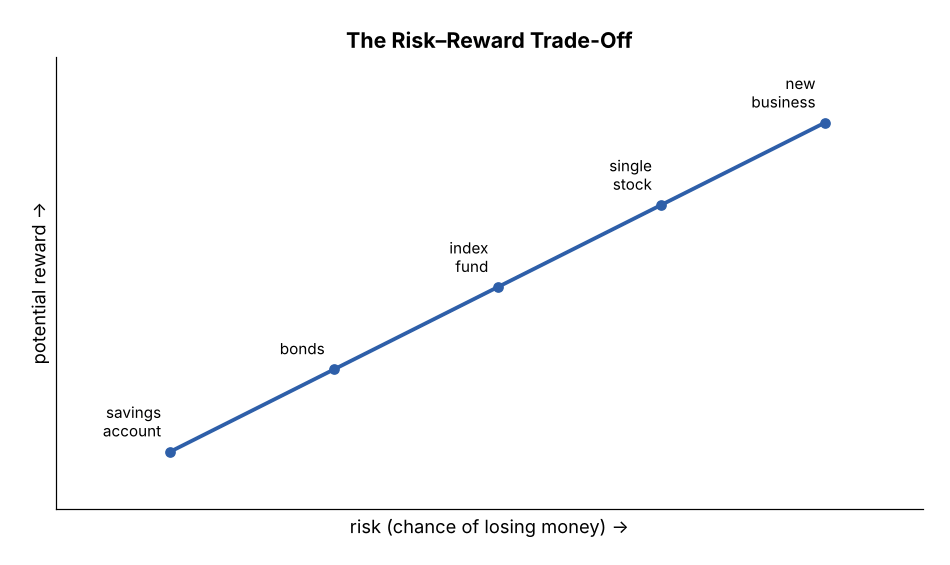
So why do people take the risk? The CED lists three incentives:
- The potential to earn future profits.
- The satisfaction of solving a problem.
- The ability to pursue a passion.
The CED’s personal finance link adds a fourth angle: owning and running a business is one way to earn income, an alternative to working for someone else.
The Entrepreneurial Design-Thinking Process
| Step | What happens | What “validation” means here |
|---|---|---|
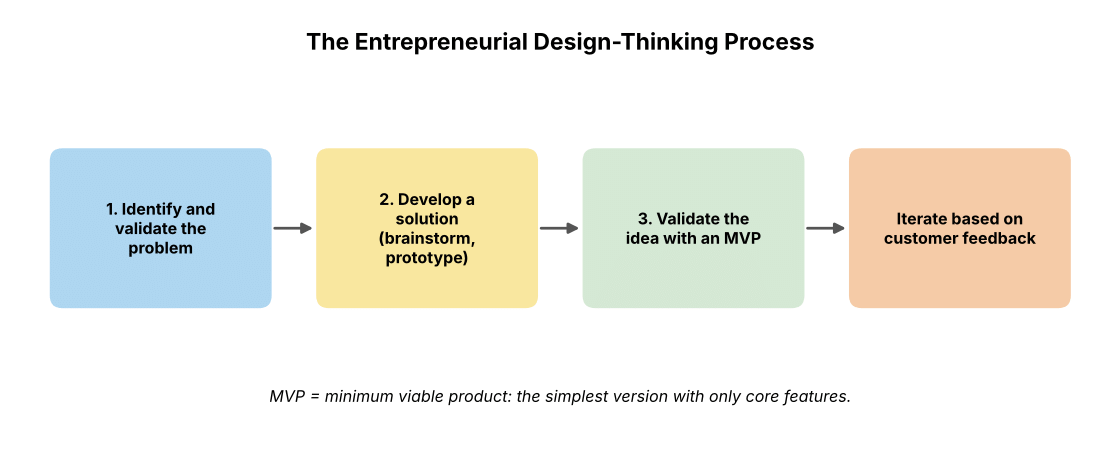
| 1. Identify and validate the problem | Observe, interview, or survey potential customers | Evidence that the problem, need, or want exists, can be clearly defined, and is shared by multiple potential customers |
| 2. Develop a solution | Brainstorm, sketch, and prototype a product idea | Not yet validated; this is the idea stage |
| 3. Validate the idea with an MVP | Gather feedback from potential customers on a minimum viable product | Evidence that customers respond to the core idea |
A minimum viable product (MVP) is the simplest version of the idea, with only its core features. It does not have to work. The CED says an MVP may be a sketch, a description, or a model. The point is to learn from customers cheaply before building the real thing.
Why does this matter? These steps map directly onto Business Canvas Project Tasks 3 through 5: interview customers to validate the problem, develop a solution, and formulate and test a business hypothesis about problem-solution fit. Free-response Question 1 asks how you used hypothesis testing to inform a decision, so keep notes on what your evidence showed.
Worked Example: A Locker Organizer
- Observe: Jordan notices classmates digging through messy lockers between periods.
- Validate the problem: Jordan interviews 20 students. Fifteen say they are late to class at least once a week because they cannot find things. The problem is real, defined, and shared.
- Develop a solution: Jordan brainstorms and sketches a magnetic organizer with slots sized for laptops and binders.
- Hypothesis: “At least half of students who see the design will say they would buy it for $15.”
- Test with an MVP: Jordan shows a cardboard model to 30 students. Twelve say yes, which is 40%.
- Decide: The hypothesis is not supported. Jordan asks follow-up questions, learns that price is the main objection, and redesigns a simpler $10 version to test next.
Notice that the “failed” test was useful. It saved Jordan from manufacturing hundreds of organizers at the wrong price.
Test-Taking Strategies
Mnemonic Devices and Memory Shortcuts
Remember the process as “Problem, Prototype, Proof”: validate the problem, prototype a solution, and get proof from customers with an MVP. For the reasons people take risks, think “Profit, Problem, Passion.”
Cross-Topic Connections
- Topic 1.1: What Is a Business? defines the customer problems, needs, and wants that ideas address.
- Topic 1.2: Markets and Competitive Advantage explains how a new idea must stand out from rivals.
- Topic 1.3: PESTEL Factors helps judge whether a market suits a new idea.
- AP® Microeconomics Topic 1.5: Cost-Benefit Analysis shows how to weigh the costs and benefits behind a launch decision.
Common Question Formats
- A scenario asking which design-thinking step an entrepreneur is on.
- A question asking whether a description counts as an MVP.
- A question asking why bringing a specific product to market is risky.
Frequent Student Mistakes
- Thinking an MVP must be a working product. A sketch or description can qualify.
- Calling a problem “validated” after talking to only one person.
- Skipping straight to building a product before confirming the problem exists.
Test-Day Shortcuts
If a scenario involves gathering feedback on an early version of a product, the answer usually involves an MVP. If it involves confirming that customers share a problem, it is problem validation.
Time Management Tips
The AP Business with Personal Finance Exam on May 4, 2027, is fully digital in Bluebook. Free-response Question 1, the Business Canvas Project validation question, gets its own 25 minutes and is worth 15% of your score. Practice explaining one hypothesis you tested and what you changed because of it in about five sentences.
Check for Understanding
Think you’ve got it? Complete the quiz below to make sure. Download your results at the end.