
Maximize your score with these resources:
- Albert.io AP® Business with Personal Finance question banks
- Free AP® Business with Personal Finance score calculator
Say you want a $3,000 used car by graduation, two years from now. You could hope the money appears, or you could set aside $125 from every paycheck into an account that pays interest. Most people agree saving is smart, yet many struggle to do it: income is uneven, bills pile up, and that new pair of shoes is right there in the app. Topic 3.1 opens the personal finance side of Unit 3 by explaining why people save, what gets in the way, and how to choose where to keep the money.
This article covers Topic 3.1: Saving for Future Purchases in Unit 3, Part 1, Personal Saving and Borrowing. The topic asks you to describe why consumers save and what makes it hard, explain how PESTEL factors affect saving, and develop or evaluate a savings plan.
By the end, you should be able to:
- Describe sources of income and the main reasons people save.
- Identify financial and psychological barriers to saving and programs that encourage it.
- Explain how inflation, tax policy, and regulation affect savings.
- Compare savings accounts, money market accounts, CDs, and checking accounts.
Income and Reasons to Save
Most people earn income by working for a business, nonprofit, or government. Others receive income from self-employment, rental properties, government programs, investments, or retirement accounts.
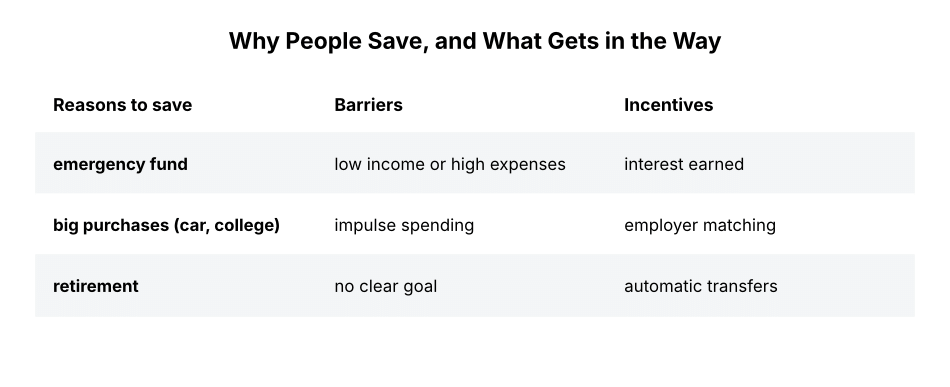
People save for three main reasons:
- Significant future purchases, such as a car, a home, or college tuition.
- Emergencies, such as job loss or illness.
- Retirement income.
Savings is a personal asset, and it may earn interest. The amount of interest depends on the interest rate, the amount saved, the type of savings vehicle, and economic conditions. For example, $2,000 in an account paying 4% a year earns \(2{,}000\times 0.04=\$80\) in one year.
Barriers and Incentives
| Barriers to saving | Programs that encourage saving |
|---|---|
| Financial: inconsistent income; recurring expenses that exceed income | Automated savings plans move a set amount into savings every pay period |
| Psychological: instant gratification, lifestyle inflation (spending more as income rises), impulse buying | Retirement savings plans and health savings accounts let people save on taxes |
How PESTEL Factors Affect Saving
- Economic: A weak economy can cut income; a strong one can raise the cost of living. Either can leave less money after necessary expenses. Inflation erodes the purchasing power of savings, because money buys less in the future, which can discourage saving.
- Political: Tax policies may reward saving, such as letting people skip income taxes on money placed in designated retirement, health care, or childcare accounts.
- Legal: Government agencies regulate banks and credit unions to protect consumers and keep institutions stable.
Inflation example: If prices rise 3% in a year and your savings earn only 1%, your money grows, but it buys less than it did a year ago.
Choosing Where to Keep Savings
People decide how much to save based on their goals, income, and expenses. They are likely to save more when they have defined goals and face fewer barriers. Then they choose an institution and account by comparing interest rates, fees, minimum deposits, risk, location, convenience, and reputation.
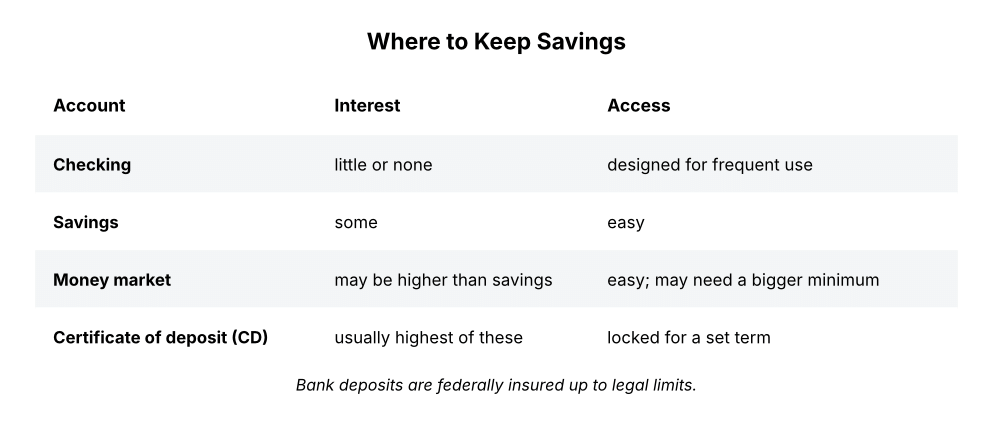
| Account | Interest | Access | Other features |
|---|---|---|---|
| Savings account | Typically pays some interest | Easy | Federally insured up to $250,000 (as of 2024); fees and minimums vary |
| Money market account | May pay more than a savings account | Easier access to cash | Federally insured; may need a larger minimum and charge higher fees |
| Certificate of deposit (CD) | Typically the highest of the three | Locked for a set term, usually one month to five years | Federally insured; larger minimum but usually no monthly fee |
| Checking account | Little or none | Designed for frequent transactions | Federally insured; may charge maintenance or overdraft fees |
Federally insured means you do not lose your deposit, up to the limit, if the bank fails. Mobile payment accounts and cryptocurrency accounts are generally not federally insured unless offered by an insured institution, and they typically pay no interest.
Worked Example: Evaluating a Savings Plan
Dani earns about $900 a month from a part-time job and wants $3,000 for a car in two years.
- Goal math: \(\dfrac{3{,}000}{24}=\$125\) per month.
- Barrier: Dani’s hours vary, so income is inconsistent. An automated transfer of $125 on each payday helps beat impulse spending.
- Vehicle: A CD pays more but locks the money, which is risky if an emergency hits. A savings or money market account keeps the money accessible while earning interest, so it fits a two-year goal with uncertain income better.
Why does this matter? Free-response Question 2 gives a household’s financial situation and goals and asks how they could reach them. Savings plans like this one are exactly the reasoning it rewards.
Test-Taking Strategies
Mnemonic Devices and Memory Shortcuts
Rank accounts by interest with “CD > Money Market > Savings > Checking,” then flip it for access. For barriers, remember “Gratify, Inflate, Impulse.”
Cross-Topic Connections
- Topic 1.3: PESTEL Factors introduces the framework applied to saving here.
- Topic 2.2: Consumer Behavior explains the impulse and habitual buying that make saving hard.
- AP® Macroeconomics Topic 2.4: Price Indices and Inflation shows how inflation is measured.
- AP® Macroeconomics Topic 4.2: Nominal v. Real Interest Rates explains why interest minus inflation is what really grows savings.
Common Question Formats
- A saver’s goal and situation asking which account fits best.
- A scenario asking which barrier to saving is described.
- A question asking how inflation affects the value of savings.
Frequent Student Mistakes
- Recommending a CD for emergency savings. The money is locked for a set term.
- Assuming every app that holds money is federally insured.
- Ignoring fees when comparing accounts with different interest rates.
Test-Day Shortcuts
Match the time frame: money needed any time points to savings or money market accounts; money not needed for a fixed period points to a CD.
Time Management Tips
The AP Business with Personal Finance Exam on May 4, 2027, is fully digital in Bluebook, and calculators are permitted. The College Board suggests about 12 to 13 minutes for the personal finance free-response question. Do the goal math first, then explain the plan in plain sentences.
Check for Understanding
Think you’ve got it? Complete the quiz below to make sure. Download your results at the end.