
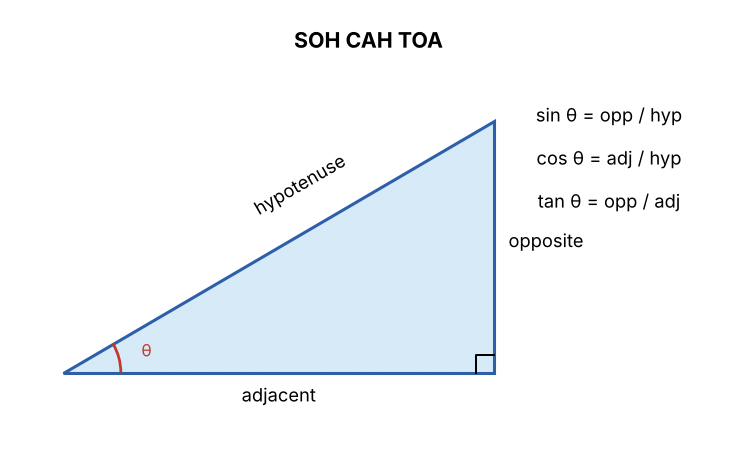
SOH-CAH-TOA only works in right triangles. Most triangles in the real world, like the triangle formed by two hikers and a mountain peak, have no right angle. The Law of Sines and the Law of Cosines extend trigonometry to every triangle, so you can find missing sides and angles in any shape.
This article covers Topic 8.5: The Law of Sines and the Law of Cosines in Unit 8, Right Triangles and Trigonometry. The topic asks you to choose the correct law for a given set of information, find missing sides and angles in non-right triangles, and find the area of a triangle using two sides and an included angle.
By the end, you should be able to:
- State the Law of Sines and the Law of Cosines using standard labels.
- Decide which law applies based on the given information.
- Find missing sides and angles in non-right triangles.
- Find a triangle’s area using \(\frac{1}{2}ab\sin C\).
Standard Labeling
In \(\triangle ABC\), lowercase letters name the sides opposite the matching capital-letter angles. Side \(a\) is opposite \(\angle A\), side \(b\) is opposite \(\angle B\), and side \(c\) is opposite \(\angle C\). Both laws depend on these opposite pairs, so label carefully before you substitute anything.
The Law of Sines
The Law of Sines states that the ratio of each side to the sine of its opposite angle is the same throughout the triangle:
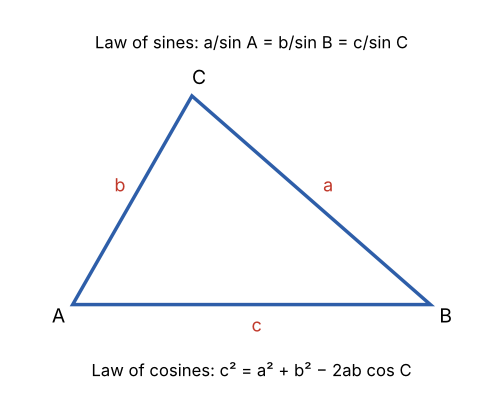
\(\frac{a}{\sin A}=\frac{b}{\sin B}=\frac{c}{\sin C}\)
Use it when you know a side and its opposite angle, plus one more piece: the AAS, ASA, or SSA cases.
Worked example 1: In \(\triangle ABC\), \(m\angle A=40^{\circ}\), \(m\angle B=75^{\circ}\), and \(a=12\). Find \(b\).
- Set up: \(\frac{12}{\sin 40^{\circ}}=\frac{b}{\sin 75^{\circ}}\).
- Solve: \(b=\frac{12\sin 75^{\circ}}{\sin 40^{\circ}}\approx\frac{12(0.9659)}{0.6428}\approx 18.03\).
Why does this matter? The SSA case, two sides and a non-included angle, can produce two different triangles, one, or none. This is called the ambiguous case, and it is the same reason SSA fails as a congruence shortcut. If a problem gives SSA, check whether a second angle, \(180^{\circ}\) minus your first answer, also fits.
The Law of Cosines
The Law of Cosines generalizes the Pythagorean Theorem:
\(c^{2}=a^{2}+b^{2}-2ab\cos C\)
Use it when you know two sides and the included angle (SAS) or all three sides (SSS). When \(C=90^{\circ}\), \(\cos C=0\), and the formula becomes \(c^{2}=a^{2}+b^{2}\), the Pythagorean Theorem.
Worked example 2: Two sides of a triangle measure 8 and 11, and the included angle is \(52^{\circ}\). Find the third side.
- Set up: \(c^{2}=8^{2}+11^{2}-2(8)(11)\cos 52^{\circ}\).
- Simplify: \(c^{2}=64+121-176(0.6157)\approx 185-108.36=76.64\).
- Take the square root: \(c\approx 8.75\).
Worked example 3: A triangle has sides 7, 9, and 12. Find the largest angle.
- The largest angle is opposite the longest side, 12.
- Set up: \(12^{2}=7^{2}+9^{2}-2(7)(9)\cos C\).
- Simplify: \(144=130-126\cos C\), so \(\cos C=-\frac{14}{126}\approx-0.1111\).
- Solve: \(C=\cos^{-1}(-0.1111)\approx 96.4^{\circ}\). The triangle is obtuse.
Why does this matter? A negative cosine signals an obtuse angle. Finding the largest angle first with the Law of Cosines avoids the ambiguous case entirely, because the remaining angles must then be acute.
Choosing the Right Law
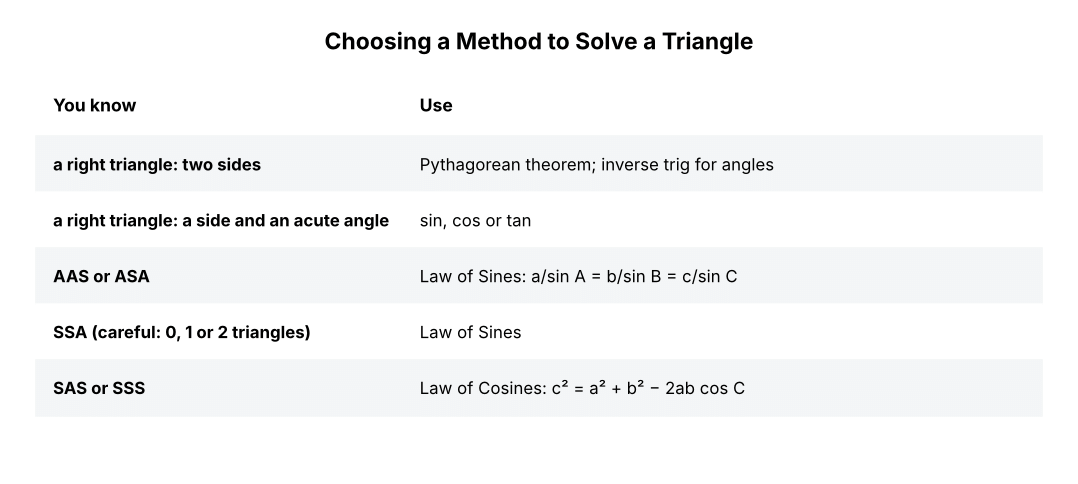
| Given | Use |
|---|---|
| AAS or ASA | Law of Sines |
| SSA | Law of Sines, checking the ambiguous case |
| SAS | Law of Cosines |
| SSS | Law of Cosines |
Area With Two Sides and an Included Angle
The height of a triangle is \(b\sin C\) when \(a\) is the base, so the area formula becomes:
\(\text{Area}=\frac{1}{2}ab\sin C\)
For sides 8 and 11 with an included angle of \(52^{\circ}\), the area is \(\frac{1}{2}(8)(11)\sin 52^{\circ}\approx 34.67\) square units.
Why does this matter? This formula finds area without ever computing a height. It is especially useful for land surveying, where two boundary lengths and the angle between them are easy to measure but the perpendicular height is not. It also works for right triangles: with \(C=90^{\circ}\), \(\sin C=1\), and the formula becomes the familiar \(\frac{1}{2}ab\).
Test-Taking Strategies
Mnemonic Devices and Memory Shortcuts
“Sines need a pair”: you need a side and its opposite angle. “Cosines handle the sandwich and the full set”: SAS and SSS. The Law of Cosines is “Pythagoras with a correction term.”
Cross-Topic Connections
- The Law of Cosines extends Topic 8.1: The Pythagorean Theorem and Its Converse.
- Sine and cosine are defined in Topic 8.3: Sine, Cosine, and Tangent Ratios.
- Inverse trig finds the angles, as in Topic 8.4: Solving Right Triangles.
- The SSA ambiguity mirrors Topic 5.2: Triangle Congruence: SSS and SAS.
Common Question Formats
- Find a missing side using the Law of Sines or Cosines.
- Find a missing angle given three sides.
- Choose which law applies to a given set of information.
- Find the area of a triangle using two sides and an included angle.
Frequent Student Mistakes
- Pairing a side with an angle that is not opposite it.
- Subtracting \(2ab\) before multiplying by \(\cos C\).
- Ignoring the ambiguous case in SSA problems.
Test-Day Shortcuts
Sketch and label the triangle with \(a\), \(b\), \(c\) opposite \(A\), \(B\), \(C\) before choosing a law. If you see a matching side and angle pair, use sines; if not, use cosines.
Time Management Tips
Law of Sines and Cosines items on Geometry unit tests and end-of-course exams take two to four minutes. Keep full calculator precision until the final answer, then round as instructed.