
How long is the crust on a slice of pizza, and how much pizza is in the slice? Those two questions are arc length and sector area. Both come from the same idea: a slice is a fraction of the whole circle, and that fraction is the central angle divided by \(360^{\circ}\). Once you see that, both formulas follow naturally.
This article covers Topic 9.5: Arc Length and Sector Area in Unit 9, Circles. The topic asks you to find arc lengths and sector areas from a central angle and radius, work backward to find a missing angle or radius, and connect arc length to radian measure.
By the end, you should be able to:
- Find the length of an arc given its central angle and the radius.
- Find the area of a sector given its central angle and the radius.
- Solve for a missing radius or central angle.
- Explain radian measure as the ratio of arc length to radius.
The Fraction-of-a-Circle Idea
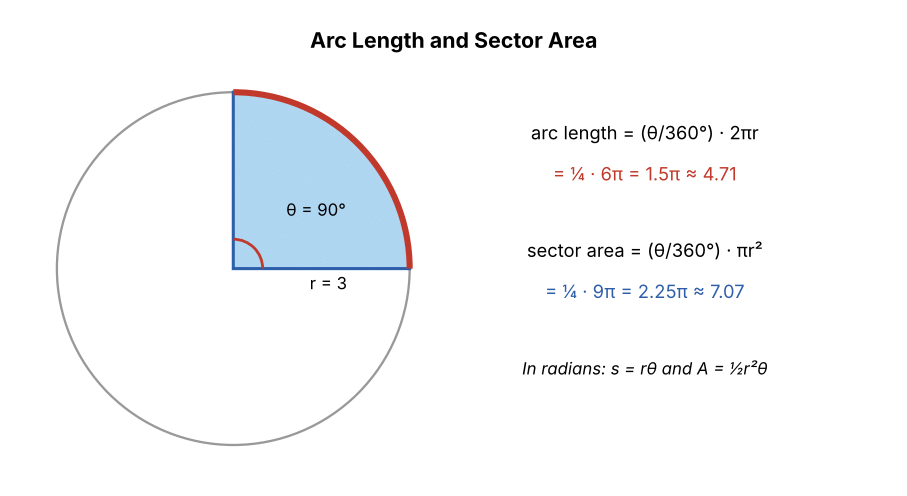
A central angle of \(\theta\) degrees cuts off \(\frac{\theta}{360}\) of the circle. Multiply that fraction by the whole circumference to get arc length, or by the whole area to get sector area.
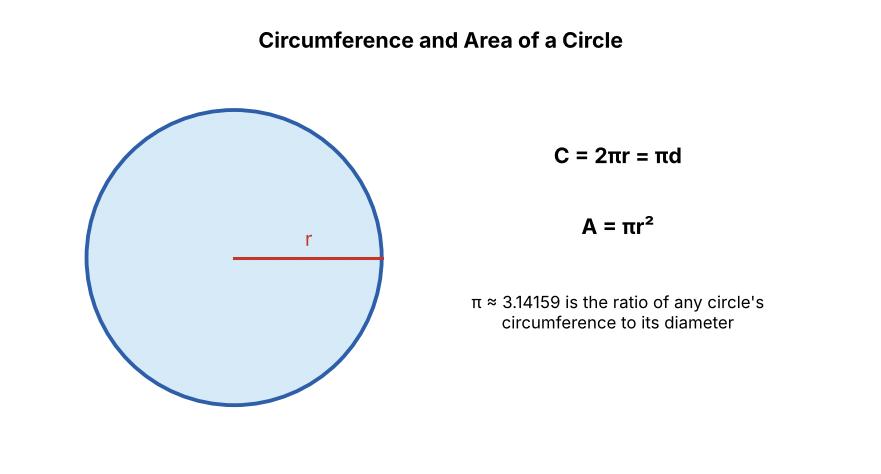
| Measure | Whole Circle | Part of the Circle |
|---|---|---|
| Length | Circumference \(C=2\pi r\) | Arc length \(=\frac{\theta}{360}\cdot 2\pi r\) |
| Area | Area \(A=\pi r^{2}\) | Sector area \(=\frac{\theta}{360}\cdot\pi r^{2}\) |
Why does this matter? You don’t need to memorize two separate formulas. Remember “fraction times whole.” If the angle is \(90^{\circ}\), the fraction is one quarter, so the arc is a quarter of the circumference and the sector is a quarter of the area.
Arc Length
Worked example 1: Find the length of an arc with a central angle of \(120^{\circ}\) in a circle of radius 9.
- Fraction: \(\frac{120}{360}=\frac{1}{3}\).
- Circumference: \(2\pi(9)=18\pi\).
- Arc length: \(\frac{1}{3}\cdot 18\pi=6\pi\approx 18.85\).
Worked example 2: An arc has a length of \(5\pi\) and a central angle of \(75^{\circ}\). Find the radius.
- Set up: \(5\pi=\frac{75}{360}\cdot 2\pi r\).
- Simplify the right side: \(\frac{75}{360}\cdot 2\pi r=\frac{5}{12}\pi r\).
- Solve: \(5\pi=\frac{5}{12}\pi r\), so \(r=12\).
Arc length is a distance, so it is measured in units like centimeters or inches. Arc measure, from Topic 9.2, is in degrees. A question that asks for the length of an arc wants a distance, not a degree measure, so check the units before you answer.
Sector Area
A sector is the region bounded by two radii and their arc, shaped like a pizza slice.
Worked example 3: Find the area of a sector with a central angle of \(45^{\circ}\) in a circle of radius 8.
- Fraction: \(\frac{45}{360}=\frac{1}{8}\).
- Circle area: \(\pi(8)^{2}=64\pi\).
- Sector area: \(\frac{1}{8}\cdot 64\pi=8\pi\approx 25.13\).
Worked example 4: A sector of a circle with radius 6 has an area of \(15\pi\). Find the central angle.
- Circle area: \(36\pi\).
- Fraction of the circle: \(\frac{15\pi}{36\pi}=\frac{5}{12}\).
- Central angle: \(\frac{5}{12}\cdot 360=150^{\circ}\).
Why does this matter? Example 4 shows the fastest way to work backward: compare the part to the whole to get the fraction, then multiply by \(360^{\circ}\). This avoids solving a messy equation.
Segment of a Circle
The region between a chord and its arc is called a segment of a circle. To find its area, subtract the area of the triangle formed by the two radii and the chord from the sector area. For a \(90^{\circ}\) sector of radius 4, the sector area is \(4\pi\), the triangle area is \(\frac{1}{2}(4)(4)=8\), and the segment area is \(4\pi-8\approx 4.57\).
Connection to Radians
A radian is the central angle whose arc length equals the radius. Because the whole circumference is \(2\pi r\), a full circle measures \(2\pi\) radians, which equals \(360^{\circ}\). So \(\pi\) radians equals \(180^{\circ}\).
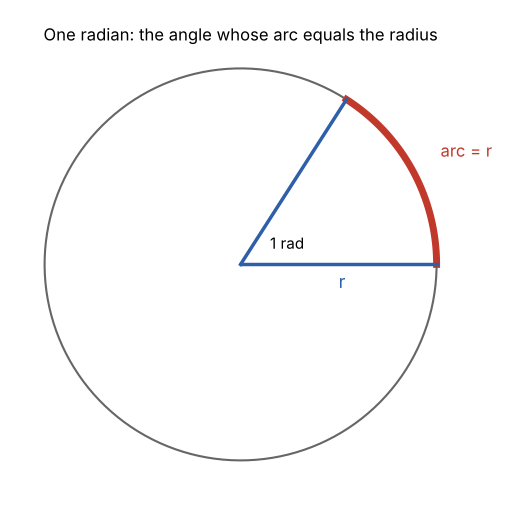
In radians, arc length becomes very simple: \(s=r\theta\). An angle of 2 radians in a circle of radius 5 cuts off an arc of length 10. This is why radians are the preferred angle unit in calculus and physics.
Why does this matter? Radians remove the \(\frac{\theta}{360}\) fraction entirely, because the angle already measures arc length in units of radius. To convert degrees to radians, multiply by \(\frac{\pi}{180}\). For example, \(120^{\circ}\) equals \(\frac{2\pi}{3}\) radians. Using worked example 1, the arc length is \(9\cdot\frac{2\pi}{3}=6\pi\), the same answer the degree formula gave. Checking a problem both ways is a quick way to catch errors.
Test-Taking Strategies
Mnemonic Devices and Memory Shortcuts
“Fraction times whole.” The fraction is always \(\frac{\theta}{360}\). Arc length uses circumference, which is “around,” and sector area uses area, which is “inside.”
Cross-Topic Connections
- Central angles and arc measures come from Topic 9.2: Arcs and Central Angles.
- Radius and diameter relationships come from Topic 9.1: Parts of a Circle.
- Fractions of a whole use Algebra 1 Topic 2.6: Ratios, Rates, and Proportions.
- Segment areas use triangle areas, including Topic 8.2: Special Right Triangles.
Common Question Formats
- Find an arc length or sector area, in terms of \(\pi\) or as a decimal.
- Find the radius from an arc length or sector area.
- Find the central angle from an arc length or sector area.
- Find the area of a segment of a circle.
Frequent Student Mistakes
- Using the diameter in place of the radius.
- Using circumference for sector area or area for arc length.
- Rounding \(\pi\) when the question asks for an answer in terms of \(\pi\).
Test-Day Shortcuts
Simplify the fraction \(\frac{\theta}{360}\) first. Common angles give clean fractions: \(30^{\circ}\) is \(\frac{1}{12}\), \(60^{\circ}\) is \(\frac{1}{6}\), \(90^{\circ}\) is \(\frac{1}{4}\), and \(120^{\circ}\) is \(\frac{1}{3}\).
Time Management Tips
Arc length and sector area items on Geometry unit tests and end-of-course exams take one to two minutes. Working-backward problems take slightly longer, so start with the part-to-whole ratio.