
A phone’s GPS can tell you that a store is exactly 2 miles away, but not which direction. Every point that is 2 miles from you forms a circle on the map. Coordinate geometry turns that idea into an equation. Once you know a circle’s center and radius, you can write one equation that every point on the circle satisfies, and you can read the center and radius straight back out of it.
This article covers Topic 9.6: Equations of Circles in Unit 9, Circles. The topic asks you to derive the equation of a circle from the distance formula, write equations from given information, and find the center and radius of a circle from its equation, including by completing the square.
By the end, you should be able to:
- Explain how the circle equation comes from the distance formula.
- Write the equation of a circle given its center and radius, or its center and a point on it.
- Identify the center and radius from an equation in standard form.
- Complete the square to rewrite a general equation in standard form.
Where the Equation Comes From
A circle is the set of all points a fixed distance \(r\) from a center \((h,k)\). Take any point \((x,y)\) on the circle. The distance formula says its distance from the center is \(\sqrt{(x-h)^{2}+(y-k)^{2}}\). Setting that distance equal to \(r\) and squaring both sides gives the standard form of a circle:
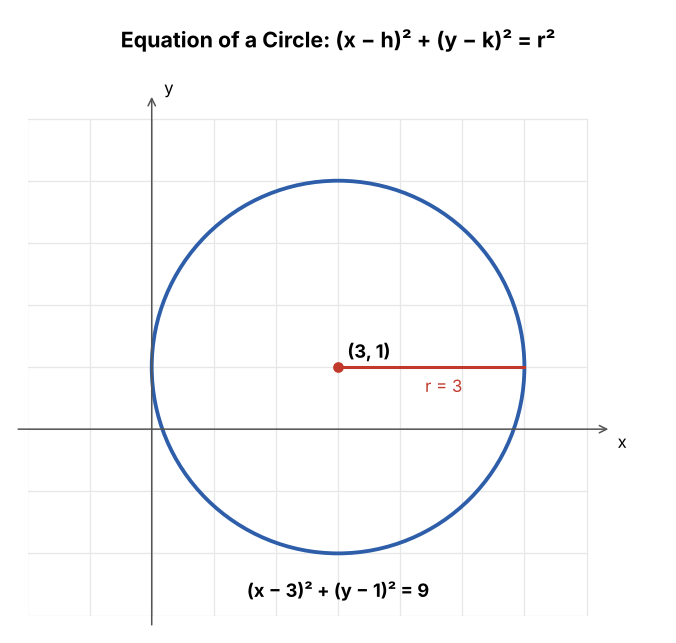
\((x-h)^{2}+(y-k)^{2}=r^{2}\)
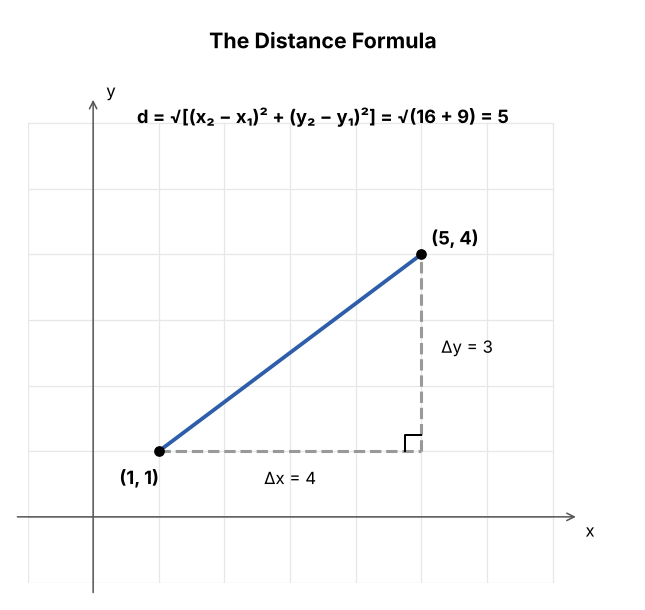
You can also see this with the Pythagorean Theorem. Draw a right triangle with the radius as the hypotenuse. Its legs are the horizontal change \(x-h\) and the vertical change \(y-k\). The sum of the squared legs equals the squared hypotenuse.
When the center is the origin, \(h\) and \(k\) are both 0, and the equation becomes \(x^{2}+y^{2}=r^{2}\).
Why does this matter? You never have to memorize the circle equation as a separate fact. If you forget it, rebuild it from the distance formula. That same reasoning lets you check whether any point is on, inside, or outside the circle.
Reading the Center and Radius
Standard form shows the center and radius directly, but watch the signs. The equation subtracts \(h\) and \(k\), so the center coordinates are the opposite of the numbers you see inside the parentheses.
| Equation | Center | Radius |
|---|---|---|
| \((x-4)^{2}+(y-1)^{2}=49\) | \((4,1)\) | 7 |
| \((x+5)^{2}+(y-2)^{2}=16\) | \((-5,2)\) | 4 |
| \(x^{2}+(y+3)^{2}=10\) | \((0,-3)\) | \(\sqrt{10}\) |
Remember that the right side is \(r^{2}\), not \(r\). Take its square root to find the radius.
Writing Equations
Worked example 1: Write the equation of a circle with center \((3,-2)\) and radius 5.
- Substitute \(h=3\), \(k=-2\), and \(r=5\).
- \((x-3)^{2}+(y-(-2))^{2}=5^{2}\).
- Simplify: \((x-3)^{2}+(y+2)^{2}=25\).
Worked example 2: A circle has center \((1,4)\) and passes through \((4,8)\). Write its equation.
- The radius is the distance from the center to the point: \(r^{2}=(4-1)^{2}+(8-4)^{2}=9+16=25\).
- You need \(r^{2}\), so there is no need to take the square root.
- The equation is \((x-1)^{2}+(y-4)^{2}=25\).
Worked example 3: The endpoints of a diameter are \((-2,1)\) and \((6,7)\). Write the equation.
- The center is the midpoint: \(\left(\frac{-2+6}{2},\frac{1+7}{2}\right)=(2,4)\).
- The radius is the distance from the center to an endpoint: \(r^{2}=(6-2)^{2}+(7-4)^{2}=16+9=25\).
- The equation is \((x-2)^{2}+(y-4)^{2}=25\).
Why does this matter? Example 2 shows a useful shortcut. The distance formula ends with a square root, and the circle equation needs the square of that distance. Stopping at \(r^{2}\) saves a step and avoids messy radicals.
Completing the Square
Sometimes a circle is given in general form, with the squares multiplied out. To find the center and radius, complete the square for \(x\) and for \(y\).
Worked example 4: Find the center and radius of \(x^{2}+y^{2}-6x+4y-12=0\).
- Group terms and move the constant: \((x^{2}-6x)+(y^{2}+4y)=12\).
- Half of \(-6\) is \(-3\), and its square is 9. Half of 4 is 2, and its square is 4.
- Add 9 and 4 to both sides: \((x^{2}-6x+9)+(y^{2}+4y+4)=12+9+4\).
- Factor: \((x-3)^{2}+(y+2)^{2}=25\).
- The center is \((3,-2)\) and the radius is 5.
Before completing the square, make sure the coefficients of \(x^{2}\) and \(y^{2}\) are both 1. If they are both 2, divide every term by 2 first. If the right side ends up as 0, the graph is a single point. If it ends up negative, there is no graph at all.
On, Inside, or Outside?
To test a point, substitute it into the left side and compare the result with \(r^{2}\). For the circle \((x-3)^{2}+(y+2)^{2}=25\), the point \((7,1)\) gives \(16+9=25\), so it is on the circle. The point \((6,1)\) gives \(9+9=18\), which is less than 25, so it is inside. A result greater than \(r^{2}\) means the point is outside.
Test-Taking Strategies
Mnemonic Devices and Memory Shortcuts
“Signs flip, radius squared.” The center coordinates are the opposites of the numbers in the parentheses, and the right side is the radius squared. For completing the square, “half it, square it, add it to both sides.”
Cross-Topic Connections
- The equation is built from Topic 1.2: Measuring Segments and the Distance Formula.
- Centers from diameter endpoints use Topic 1.3: The Midpoint Formula.
- Rewriting general form uses Algebra 1 Topic 10.4: Completing the Square.
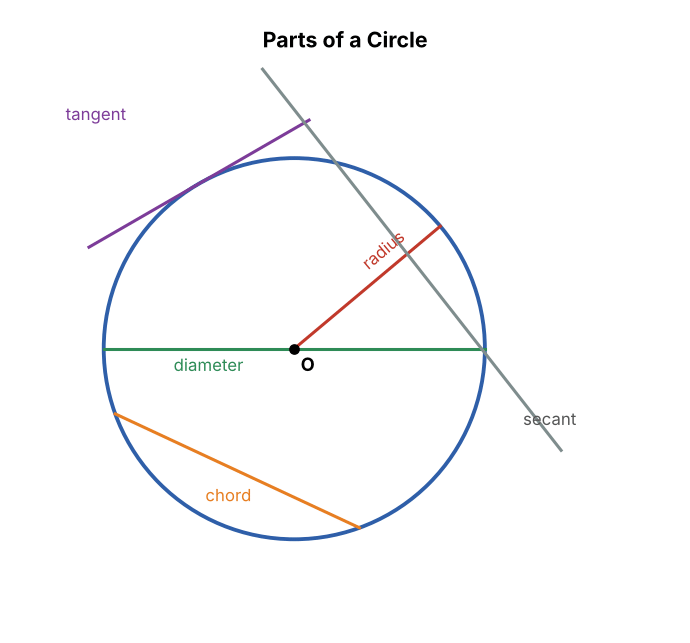
- Radius and diameter vocabulary comes from Topic 9.1: Parts of a Circle.
Common Question Formats
- Write an equation from a center and radius, or a center and a point.
- Identify the center and radius from standard form.
- Complete the square to find the center and radius.
- Decide whether a point lies on, inside, or outside a circle.
Frequent Student Mistakes
- Keeping the signs from the parentheses, so \((x+5)^{2}\) gets read as a center at 5.
- Reporting \(r^{2}\) as the radius.
- Adding the completing-the-square constants to only one side of the equation.
Test-Day Shortcuts
On multiple-choice items, check the center first. Usually only one or two choices have the right center, so you can rule out the rest before checking the radius. To check a choice quickly, substitute a known point from the problem.
Time Management Tips
Reading the center and radius takes under a minute on Geometry unit tests and end-of-course exams. Completing the square takes two to three minutes, so write each step on its own line.