
Measure the distance around any circle and divide it by the distance across. A coffee mug, a bicycle wheel, and a Ferris wheel all give the same answer, a little more than 3. That number is \(\pi\), and it connects every circle’s size to its circumference and its area. With two short formulas, you can find the fence needed around a round garden or the pizza in a 16 inch pie.
This article covers Topic 10.2: Circumference and Area of Circles in Unit 10, Area and Volume. The topic asks you to use the circumference and area formulas, work backward from one measurement to another, and find areas of regions that combine circles with other shapes.
By the end, you should be able to:
- Explain what \(\pi\) represents.
- Find the circumference and area of a circle from its radius or diameter.
- Find the radius from a given circumference or area.
- Find the area of shaded regions involving circles.
What Pi Means
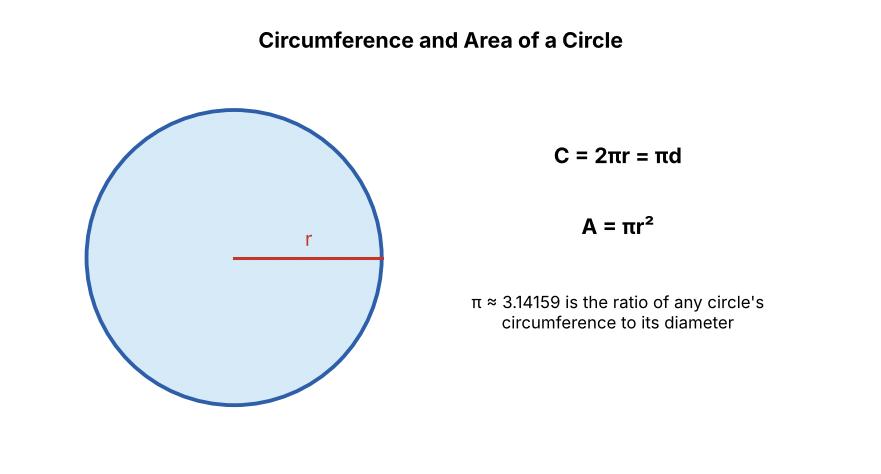
\(\pi\) is the ratio of a circle’s circumference to its diameter: \(\pi=\frac{C}{d}\). It is irrational, so its decimal form never ends or repeats. It is about 3.14159. Rearranging the ratio gives the circumference formulas.
| Measure | Using the Radius | Using the Diameter | Units |
|---|---|---|---|
| Circumference | \(C=2\pi r\) | \(C=\pi d\) | Length, such as cm |
| Area | \(A=\pi r^{2}\) | \(A=\pi\left(\frac{d}{2}\right)^{2}\) | Square units, such as cm² |
Why the Area Formula Works
Cut a circle into many thin sectors, like pizza slices. Arrange them in a row, alternating tips up and tips down. The result looks almost like a parallelogram. Its height is the radius \(r\), and its base is half the circumference, \(\pi r\). The area of that parallelogram is base times height: \(\pi r\cdot r=\pi r^{2}\). The more slices you use, the closer the shape gets to a true rectangle.
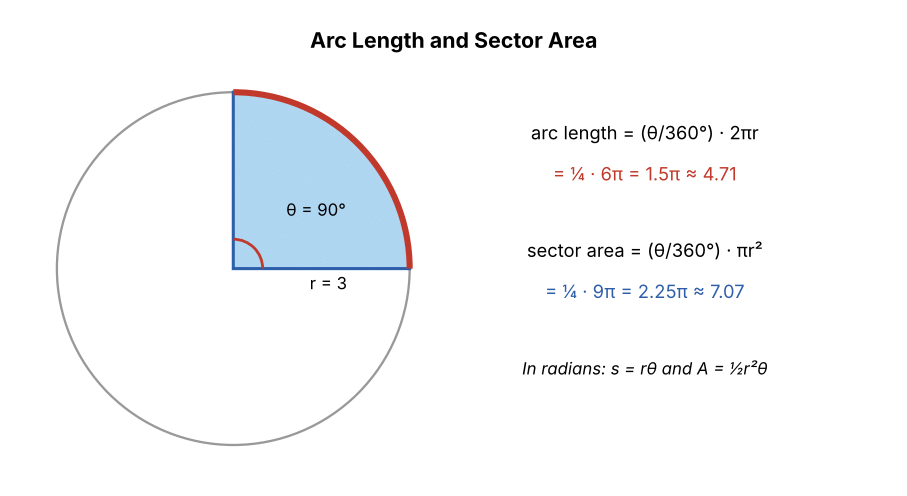
Why does this matter? This argument links the area of a circle back to the area of a parallelogram. It also shows why area uses \(r^{2}\). Area is two-dimensional, so it needs two lengths multiplied together.
Worked Examples
Worked example 1: Find the circumference and area of a circle with radius 7.
- Circumference: \(2\pi(7)=14\pi\approx 43.98\) units.
- Area: \(\pi(7)^{2}=49\pi\approx 153.94\) square units.
Worked example 2: A circle has a circumference of \(20\pi\). Find its area.
- Solve for the radius: \(2\pi r=20\pi\), so \(r=10\).
- Area: \(\pi(10)^{2}=100\pi\approx 314.16\) square units.
Worked example 3: A circle has an area of \(81\pi\) square meters. Find its circumference.
- Solve for the radius: \(\pi r^{2}=81\pi\), so \(r^{2}=81\) and \(r=9\).
- Circumference: \(2\pi(9)=18\pi\approx 56.55\) meters.
Worked example 4: A bicycle wheel has a diameter of 26 inches. How far does the bike travel in 100 full turns of the wheel?
- One turn covers one circumference: \(\pi(26)=26\pi\) inches.
- 100 turns: \(2600\pi\approx 8168\) inches, or about 681 feet.
Why does this matter? Working backward always goes through the radius. Whatever you are given, find \(r\) first. From the radius, every other measurement follows in one step.
Shaded Regions
Many problems ask for the area of a region between shapes. Find the area of the outer shape, then subtract the inner shape.
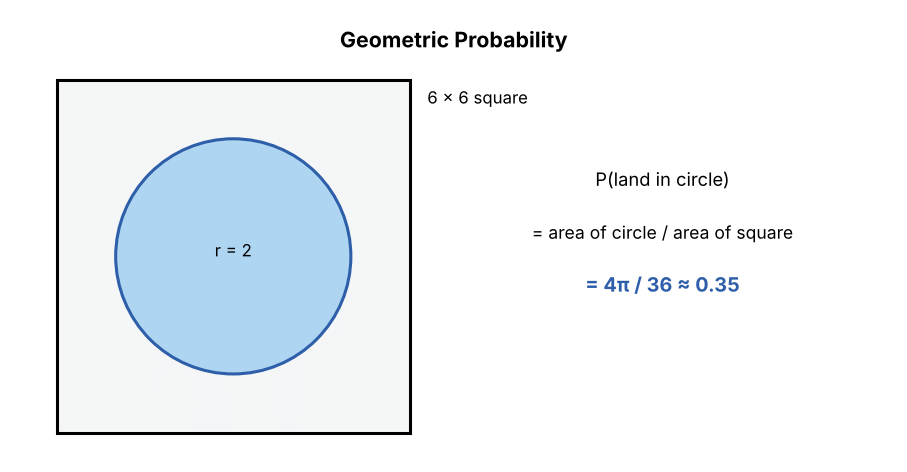
Worked example 5: A circular path has an outer radius of 10 feet and an inner radius of 6 feet. Find the area of the path.
- Outer circle: \(100\pi\).
- Inner circle: \(36\pi\).
- Path: \(100\pi-36\pi=64\pi\approx 201.06\) square feet.
Worked example 6: A square is inscribed in a circle of radius 5. Find the area inside the circle but outside the square.
- The square’s diagonal is a diameter, 10. A square with diagonal 10 has side \(5\sqrt{2}\), so its area is 50.
- Circle area: \(25\pi\).
- Shaded region: \(25\pi-50\approx 28.54\) square units.
Scaling a Circle
All circles are similar. If the radius is multiplied by \(k\), the circumference is multiplied by \(k\) and the area by \(k^{2}\). Doubling the radius of a pizza doubles the crust but gives four times as much pizza.
Test-Taking Strategies
Mnemonic Devices and Memory Shortcuts
“Cherry pie is delicious” for \(C=\pi d\), and “apple pies are too” for \(A=\pi r^{2}\), where “are too” sounds like “r squared.” Circumference is “around,” so it is a length. Area is “inside,” so it uses square units.
Cross-Topic Connections
- Radius and diameter relationships come from Topic 9.1: Parts of a Circle.
- Parts of the circumference and area are found in Topic 9.5: Arc Length and Sector Area.
- Solving a formula for \(r\) uses Algebra 1 Topic 2.5: Solving Literal Equations.
- The inscribed square uses Topic 8.2: Special Right Triangles.
Common Question Formats
- Find circumference or area from a radius or diameter.
- Find the radius or diameter from a circumference or area.
- Find a shaded area between circles and polygons.
- Solve a real-world problem with wheels, tracks, or gardens.
Frequent Student Mistakes
- Using the diameter in the area formula without halving it first.
- Squaring \(\pi\) along with the radius.
- Rounding \(\pi\) when the question asks for an exact answer in terms of \(\pi\).
Test-Day Shortcuts
If answer choices are written in terms of \(\pi\), keep \(\pi\) as a symbol and skip the calculator. If they are decimals, use the calculator’s \(\pi\) key rather than 3.14 to avoid rounding errors.
Time Management Tips
Direct circumference and area items on Geometry unit tests and end-of-course exams take under a minute. Shaded regions take two to three minutes, so sketch and label each shape first.