
How much cardboard does it take to make a cereal box? How much paper wraps around a soup can as its label? Both questions ask for surface area, the total area of all the faces that cover a solid. The good news is that you already know how to find these areas. A solid’s surface unfolds into flat rectangles, triangles, and circles, so surface area is really a sum of the area formulas you already have.
This article covers Topic 10.3: Surface Area of Prisms and Cylinders in Unit 10, Area and Volume. The topic asks you to use nets to visualize surfaces, find lateral and total surface area of prisms and cylinders, and work backward to find a missing dimension.
By the end, you should be able to:
- Identify the bases, lateral faces, and net of a prism or cylinder.
- Distinguish lateral area from total surface area.
- Find the surface area of right prisms and right cylinders.
- Solve for a missing height or radius from a given surface area.
Parts of Prisms and Cylinders
A prism has two congruent, parallel polygon bases joined by rectangular lateral faces. It is named by its base, such as a triangular prism or a rectangular prism. A cylinder has two congruent, parallel circular bases joined by one curved surface. In a right prism or cylinder, the lateral edges are perpendicular to the bases, so the height is the length of a lateral edge.
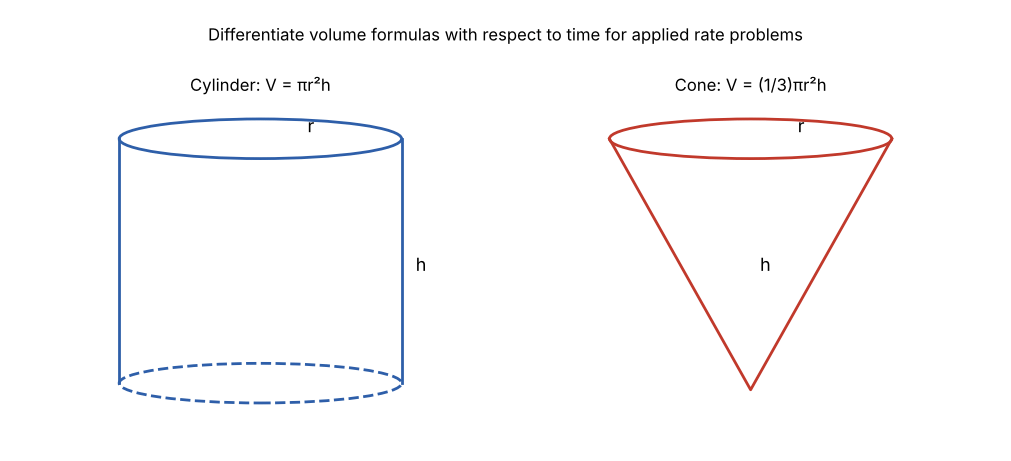
A net is a flat pattern that folds into the solid. Unfold a cereal box and you see six rectangles. Unroll a soup can label and you get one rectangle whose width is the can’s circumference.
Lateral Area and Total Surface Area
Lateral area covers only the sides. Total surface area adds both bases.
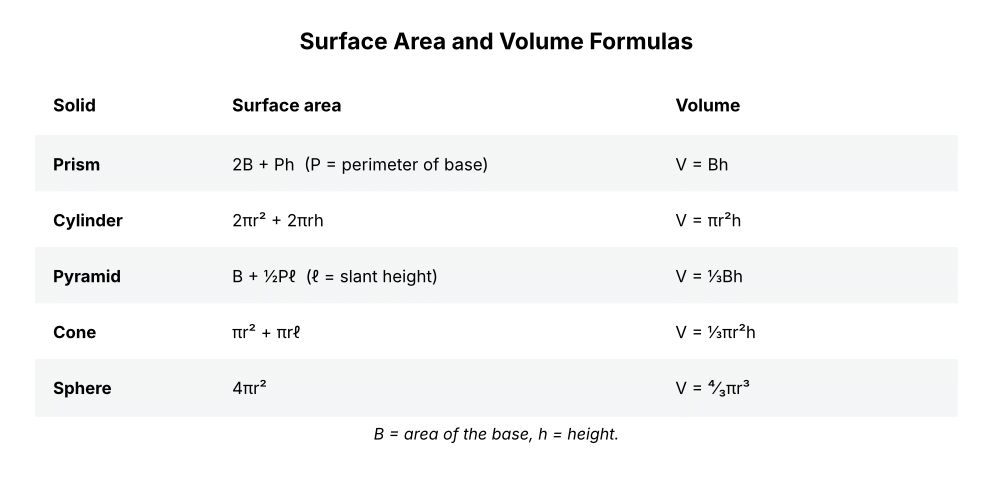
| Solid | Lateral Area | Total Surface Area |
|---|---|---|
| Right prism | \(L=Ph\) | \(S=Ph+2B\) |
| Right cylinder | \(L=2\pi rh\) | \(S=2\pi rh+2\pi r^{2}\) |
| Cube with edge \(s\) | \(L=4s^{2}\) | \(S=6s^{2}\) |
Here \(P\) is the perimeter of the base, \(B\) is the area of the base, and \(h\) is the height of the solid.
Why does this matter? The lateral faces unfold into one long rectangle. Its width is the distance around the base, and its height is the height of the solid. That is why lateral area is perimeter times height. A cylinder works the same way, with the circumference \(2\pi r\) as the perimeter.
Worked Examples
Worked example 1: Find the surface area of a rectangular prism that is 5 cm long, 3 cm wide, and 4 cm tall.
- Base perimeter: \(2(5)+2(3)=16\). Base area: \(5\cdot 3=15\).
- Lateral area: \(16\cdot 4=64\).
- Total: \(64+2(15)=94\) square centimeters.
You can check with the shortcut \(S=2(lw+lh+wh)=2(15+20+12)=94\).
Worked example 2: A triangular prism has a right triangle base with legs 6 and 8. The prism is 12 units long. Find its surface area.
- The hypotenuse is \(\sqrt{6^{2}+8^{2}}=10\), so the base perimeter is \(6+8+10=24\).
- Base area: \(\frac{1}{2}(6)(8)=24\).
- Lateral area: \(24\cdot 12=288\).
- Total: \(288+2(24)=336\) square units.
Worked example 3: Find the surface area of a cylinder with radius 3 and height 10.
- Lateral area: \(2\pi(3)(10)=60\pi\).
- Two bases: \(2\pi(3)^{2}=18\pi\).
- Total: \(78\pi\approx 245.04\) square units.
Worked example 4: A cylinder has radius 4 and a total surface area of \(88\pi\). Find its height.
- Set up: \(2\pi(4)h+2\pi(4)^{2}=88\pi\).
- Simplify: \(8\pi h+32\pi=88\pi\).
- Solve: \(8\pi h=56\pi\), so \(h=7\).
Why does this matter? Real situations often need only part of the surface. A can label is lateral area only. An open box without a lid uses the lateral area plus one base. Read the context carefully before adding both bases.
Scaling Surface Area
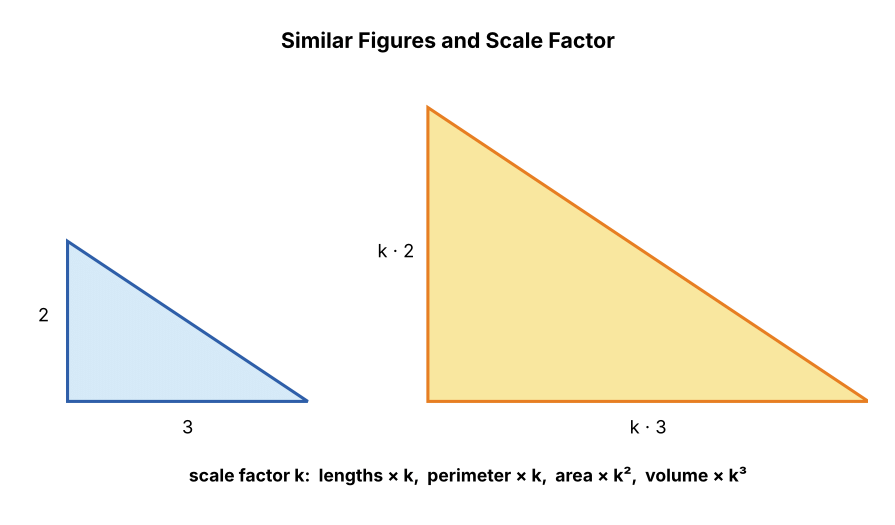
Surface area is still area, so it scales by the square of the scale factor. If every dimension of a box is tripled, the cardboard needed is multiplied by 9. This matters in packaging and biology, where surface area controls heat loss and material costs.
Test-Taking Strategies
Mnemonic Devices and Memory Shortcuts
“Wrap the sides, then cap the ends.” Lateral area wraps the sides as perimeter times height. Then add two bases to cap the ends. For a cylinder, “the label is a rectangle.”
Cross-Topic Connections
- Cylinder bases and the label width use Topic 10.2: Circumference and Area of Circles.
- Missing edges of triangular bases use Topic 8.1: The Pythagorean Theorem and Its Converse.
- Faces, edges, and parallel planes come from Topic 1.1: Points, Lines, and Planes.
- Scaling by \(k^{2}\) extends Topic 7.1: Ratios and Similar Polygons.
Common Question Formats
- Match a net to its solid.
- Find the lateral or total surface area of a prism or cylinder.
- Find a missing height or radius from a surface area.
- Solve a context problem, such as painting or wrapping.
Frequent Student Mistakes
- Adding only one base, or none, when total surface area is asked for.
- Using the diameter instead of the radius in cylinder formulas.
- Confusing the height of a triangular base with the height of the prism.
Test-Day Shortcuts
Sketch the net and write each face’s area on it. Adding labeled pieces is less error-prone than using a formula from memory, especially for unusual prisms.
Time Management Tips
Surface area items on Geometry unit tests and end-of-course exams take two to three minutes. Working backward to a missing dimension takes slightly longer, so set up the equation before simplifying.