
A waffle cone, the Great Pyramid, and a basketball all come to a point or curve smoothly, so their surfaces do not unfold into neat rectangles the way a box does. Still, the same plan works. Find the area of the sides, add the area of any base, and you have the surface area. The new ingredient for pyramids and cones is the slant height, and spheres get one elegant formula of their own.
This article covers Topic 10.4: Surface Area of Pyramids, Cones, and Spheres in Unit 10, Area and Volume. The topic asks you to find lateral and total surface areas of regular pyramids and right cones, use the slant height correctly, and find the surface area of spheres and hemispheres.
By the end, you should be able to:
- Distinguish the height of a pyramid or cone from its slant height.
- Find the surface area of a regular pyramid.
- Find the surface area of a right cone.
- Find the surface area of a sphere or hemisphere.
Height Versus Slant Height
The height \(h\) of a pyramid or cone runs straight down from the vertex to the center of the base. The slant height \(\ell\) runs down the side. For a regular pyramid, it is the height of each triangular face. For a cone, it runs from the vertex to the edge of the base.
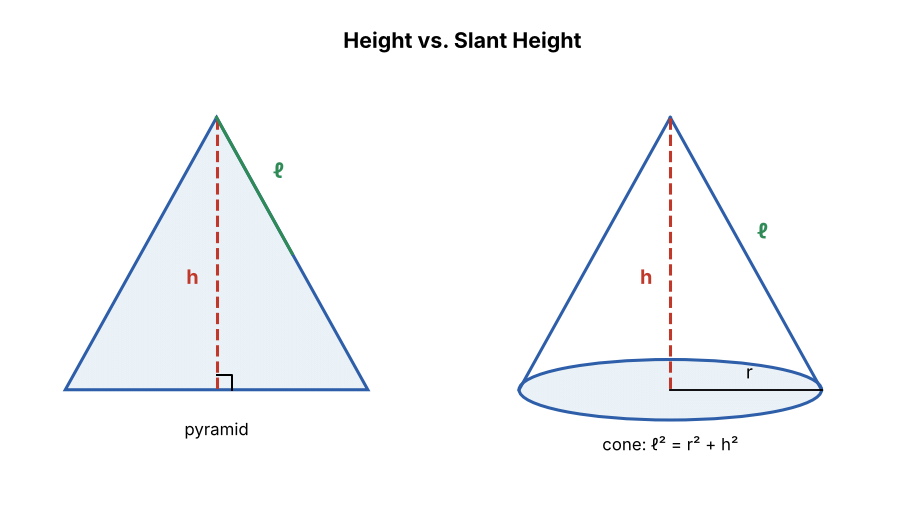
The height, the slant height, and a distance on the base form a right triangle. For a cone, the legs are \(h\) and \(r\), and the hypotenuse is \(\ell\). For a square pyramid, the legs are \(h\) and half the base edge.
Why does this matter? Surface area formulas use the slant height, while volume formulas use the height. Many problems give one and ask you to find the other with the Pythagorean Theorem. Labeling both on the diagram prevents the most common error in this topic.
The Formulas
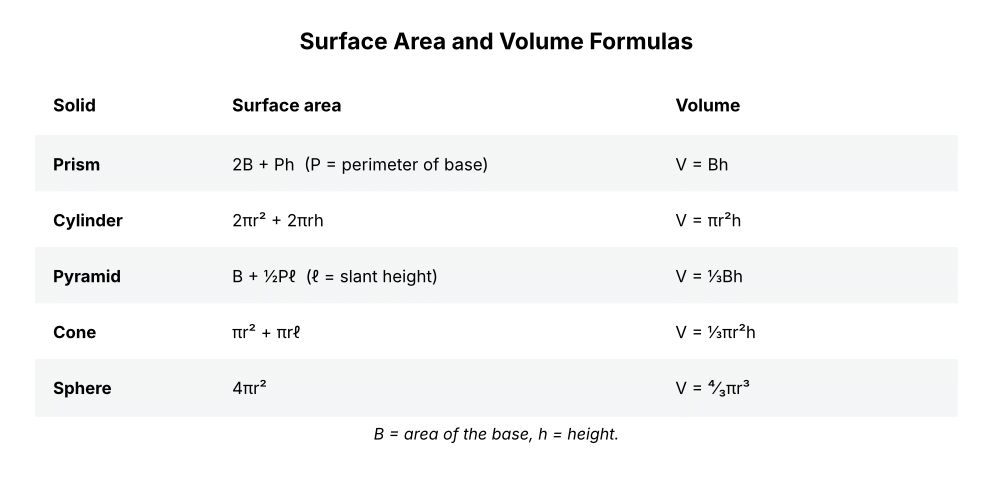
| Solid | Lateral Area | Total Surface Area |
|---|---|---|
| Regular pyramid | \(L=\frac{1}{2}P\ell\) | \(S=\frac{1}{2}P\ell+B\) |
| Right cone | \(L=\pi r\ell\) | \(S=\pi r\ell+\pi r^{2}\) |
| Sphere | None | \(S=4\pi r^{2}\) |
A pyramid’s lateral faces are triangles, each with area \(\frac{1}{2}s\ell\). Adding them gives half the perimeter times the slant height. A pyramid and a cone each have only one base, so you add \(B\) once.
Pyramids
Worked example 1: A square pyramid has a base edge of 10 and a slant height of 13. Find its surface area and its height.
- Perimeter: \(4(10)=40\). Base area: \(100\).
- Lateral area: \(\frac{1}{2}(40)(13)=260\).
- Total: \(260+100=360\) square units.
- Height: the legs are \(h\) and 5, with hypotenuse 13. So \(h=\sqrt{13^{2}-5^{2}}=12\).
Worked example 2: A square pyramid has a base edge of 8 and a height of 3. Find its surface area.
- Find the slant height: \(\ell=\sqrt{3^{2}+4^{2}}=5\).
- Lateral area: \(\frac{1}{2}(32)(5)=80\).
- Total: \(80+64=144\) square units.
Cones
Worked example 3: A cone has a radius of 6 and a height of 8. Find its surface area.
- Slant height: \(\ell=\sqrt{6^{2}+8^{2}}=10\).
- Lateral area: \(\pi(6)(10)=60\pi\).
- Base area: \(\pi(6)^{2}=36\pi\).
- Total: \(96\pi\approx 301.59\) square units.
The lateral surface of a cone unrolls into a sector of a circle whose radius is the slant height. A waffle cone has no base, so it uses only the lateral area.
Spheres
A sphere is the set of all points in space a fixed distance from a center. Its surface area is \(4\pi r^{2}\), exactly four times the area of a great circle through its center.
Worked example 4: Find the surface area of a sphere with radius 5. It is \(4\pi(5)^{2}=100\pi\approx 314.16\) square units.
Worked example 5: A sphere has a surface area of \(36\pi\). Find its radius. Set \(4\pi r^{2}=36\pi\), so \(r^{2}=9\) and \(r=3\).
Worked example 6: Find the total surface area of a solid hemisphere with radius 4. The curved part is half a sphere: \(2\pi(4)^{2}=32\pi\). The flat base is a circle: \(16\pi\). The total is \(48\pi\approx 150.80\) square units.
Why does this matter? Archimedes discovered that a sphere’s surface area equals the lateral area of the cylinder that fits snugly around it. That cylinder has radius \(r\) and height \(2r\), so its lateral area is \(2\pi r\cdot 2r=4\pi r^{2}\). This gives you a way to rebuild the formula if you forget it.
Test-Taking Strategies
Mnemonic Devices and Memory Shortcuts
“Slant for surface, height for volume.” For a sphere, “four circles cover a ball.” For pyramids and cones, “one base, not two.”
Cross-Topic Connections
- The same lateral plus base approach appears in Topic 10.3: Surface Area of Prisms and Cylinders.
- Slant heights come from Topic 8.1: The Pythagorean Theorem and Its Converse.
- Cone bases and great circles use Topic 10.2: Circumference and Area of Circles.
- An unrolled cone is a sector, as in Topic 9.5: Arc Length and Sector Area.
Common Question Formats
- Find the surface area of a pyramid or cone given the slant height.
- Find the slant height from the height, then the surface area.
- Find the surface area or radius of a sphere.
- Find the surface area of a hemisphere or a composite solid.
Frequent Student Mistakes
- Using the height instead of the slant height.
- Adding two bases to a pyramid or cone.
- Forgetting the flat circular base of a solid hemisphere.
Test-Day Shortcuts
Watch for Pythagorean triples. Many problems use slant heights from 3, 4, 5 or 5, 12, 13 triangles, so you can find the missing length without a calculator.
Time Management Tips
Pyramid, cone, and sphere items on Geometry unit tests and end-of-course exams take two to three minutes. Draw the right triangle inside the solid before computing.