
Surface area tells you how much material wraps a box. Volume tells you how much the box holds. When you buy a fish tank, a bag of potting soil, or a can of soup, the number that matters most is volume, measured in cubic units. For prisms and cylinders, every volume formula comes from one idea: stack copies of the base, layer by layer, up to the height.
This article covers Topic 10.5: Volume of Prisms and Cylinders in Unit 10, Area and Volume. The topic asks you to find the volumes of prisms and cylinders, apply Cavalieri’s Principle to oblique solids, solve for missing dimensions, and describe how volume changes with scale.
By the end, you should be able to:
- Explain why the volume of a prism or cylinder is base area times height.
- Find the volume of right and oblique prisms and cylinders.
- Solve for a missing height or radius from a given volume.
- Use the cube of the scale factor to compare volumes of similar solids.
The Stacking Idea
Picture a stack of identical sheets of paper. Each sheet is a thin copy of the base. The total amount of paper is the area of one sheet times the height of the stack. That gives the general formula for any prism or cylinder:
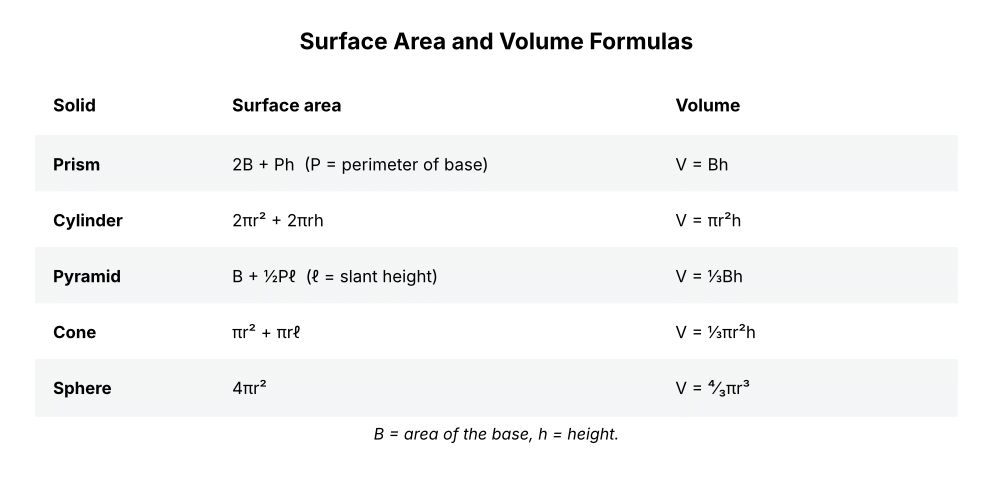
\(V=Bh\), where \(B\) is the area of the base.
| Solid | Base Area | Volume |
|---|---|---|
| Rectangular prism | \(B=lw\) | \(V=lwh\) |
| Cube with edge \(s\) | \(B=s^{2}\) | \(V=s^{3}\) |
| Triangular prism | \(B=\frac{1}{2}bh_{\text{base}}\) | \(V=Bh\) |
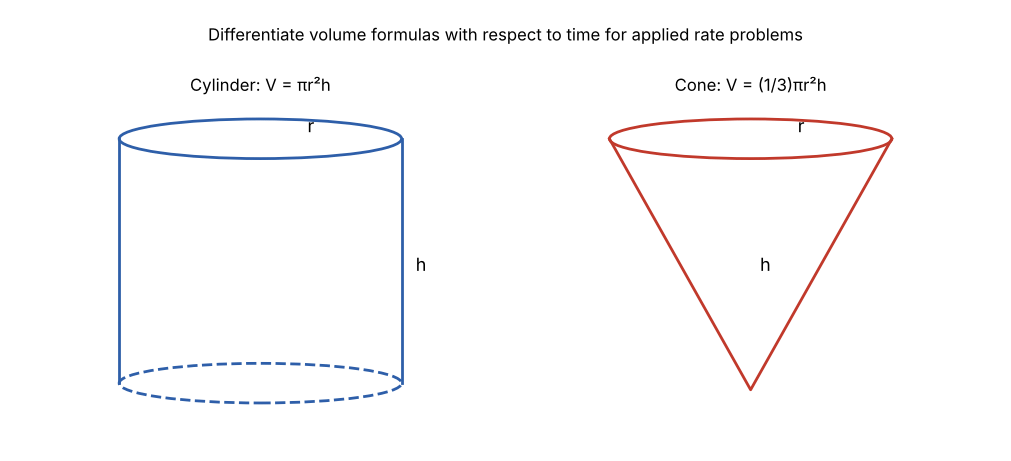
| Cylinder | \(B=\pi r^{2}\) | \(V=\pi r^{2}h\) |
Why does this matter? You only need one volume formula for this whole family. Find the area of the base with whatever area formula fits its shape, then multiply by the height. That works for hexagonal prisms, trapezoidal prisms, and any other base you meet.
Cavalieri’s Principle
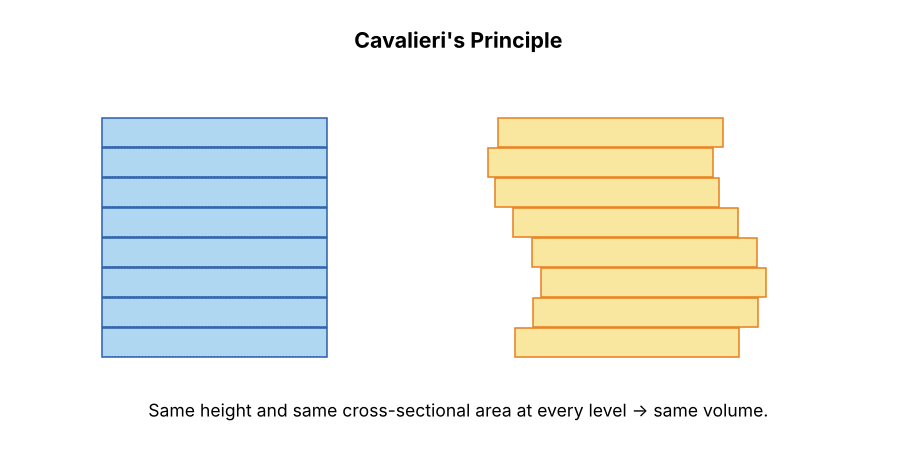
Push a stack of coins so it leans to one side. The stack still contains the same coins, so its volume has not changed. Cavalieri’s Principle states that if two solids have the same height and the same cross-sectional area at every level, they have the same volume. That means an oblique prism or cylinder, one that leans, still has volume \(Bh\). The height must be measured perpendicular to the base, not along the slanted side.
Worked Examples
Worked example 1: Find the volume of a rectangular prism that is 5 cm by 3 cm by 4 cm. The volume is \(5\cdot 3\cdot 4=60\) cubic centimeters.
Worked example 2: A triangular prism has a right triangle base with legs 6 and 8. The prism is 12 units long. Find its volume.
- Base area: \(\frac{1}{2}(6)(8)=24\).
- Volume: \(24\cdot 12=288\) cubic units.
Worked example 3: Find the volume of a cylinder with radius 3 and height 10.
- Base area: \(\pi(3)^{2}=9\pi\).
- Volume: \(9\pi\cdot 10=90\pi\approx 282.74\) cubic units.
Worked example 4: A cylinder has a volume of \(200\pi\) cubic inches and a radius of 5 inches. Find its height.
- Set up: \(\pi(5)^{2}h=200\pi\).
- Simplify: \(25\pi h=200\pi\).
- Solve: \(h=8\) inches.
Worked example 5: A fish tank is 3 feet long, 2 feet wide, and 1.5 feet tall. One cubic foot holds about 7.48 gallons. About how many gallons does the tank hold?
- Volume: \(3\cdot 2\cdot 1.5=9\) cubic feet.
- Capacity: \(9\cdot 7.48\approx 67.3\) gallons.
Why does this matter? Volume problems often mix units. A cubic foot is 12 inches on each side, so it equals \(12^{3}=1728\) cubic inches, not 12. Convert the lengths before you multiply, or use the cubed conversion factor afterward.
Scaling Volume
If two solids are similar with scale factor \(k\), their volumes compare by \(k^{3}\). Volume is three-dimensional, so the scale factor applies to length, width, and height. Doubling every dimension of a box multiplies its volume by 8, while its surface area grows only by 4.
This difference explains real patterns. A large animal has much more volume compared to its skin area than a small one, so it holds heat longer. Packaging designers use the same idea to fit more product into less material.
Test-Taking Strategies
Mnemonic Devices and Memory Shortcuts
“Base times height, every time.” Find \(B\) first, then multiply. For scaling, “length \(k\), area \(k^{2}\), volume \(k^{3}\).”
Cross-Topic Connections
- Compare wrapping and filling the same solids in Topic 10.3: Surface Area of Prisms and Cylinders.
- Cylinder bases use Topic 10.2: Circumference and Area of Circles.
- Volume ratios extend Topic 7.1: Ratios and Similar Polygons.
- Solving \(V=\pi r^{2}h\) for a dimension uses Algebra 1 Topic 2.5: Solving Literal Equations.
Common Question Formats
- Find the volume of a prism or cylinder.
- Find a missing height or radius from a volume.
- Compare an oblique solid with a right solid.
- Solve a capacity problem with unit conversions.
Frequent Student Mistakes
- Using the slanted edge as the height of an oblique solid.
- Confusing the height of a triangular base with the length of the prism.
- Converting cubic units with a linear factor, such as 12 instead of 1728.
Test-Day Shortcuts
When a problem gives the volume in terms of \(\pi\), divide \(\pi\) out of both sides right away. The remaining equation is simple arithmetic.
Time Management Tips
Direct volume items on Geometry unit tests and end-of-course exams take about a minute. Unit conversions and missing dimensions take two to three minutes.