
Slice a loaf of bread and every piece shows the same shape. Slice an orange and the circles grow, then shrink. Spin a door on its hinges and it sweeps out a cylinder of space. This topic connects flat shapes and solids in two directions. Cutting a solid with a plane creates a two-dimensional cross section, and rotating a flat shape around a line creates a three-dimensional solid.
This article covers Topic 10.7: Cross Sections and Solids of Revolution in Unit 10, Area and Volume. The topic asks you to identify the shapes of cross sections of common solids and to identify, describe, and measure the solids formed by rotating two-dimensional figures around an axis.
By the end, you should be able to:
- Identify cross sections of prisms, pyramids, cylinders, cones, and spheres.
- Find the area of a cross section using known lengths.
- Identify the solid formed when a figure rotates around a line.
- Find the volume of a solid of revolution.
Cross Sections
A cross section is the intersection of a solid and a plane. The shape depends on the solid and on the angle of the cut.
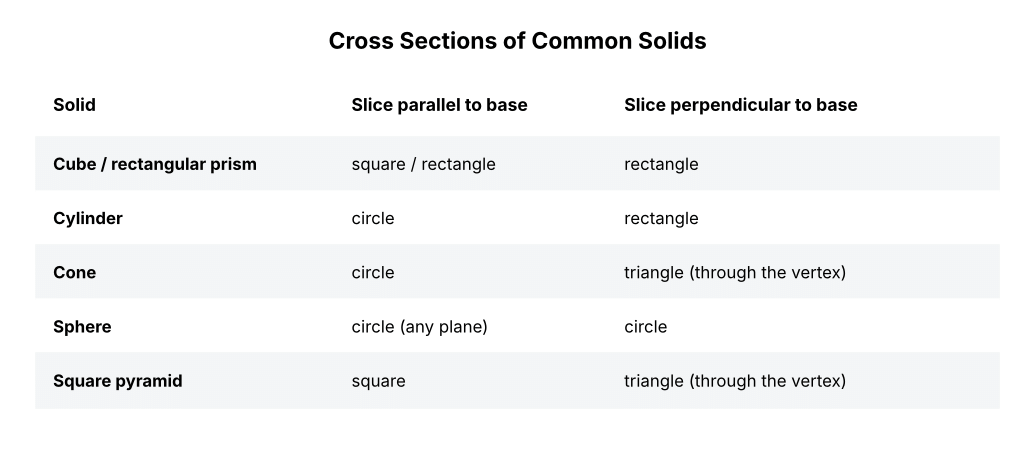
| Solid | Cut Parallel to Base | Cut Perpendicular to Base | Other Possible Cuts |
|---|---|---|---|
| Rectangular prism or cube | Rectangle congruent to the base | Rectangle | Triangle, pentagon, or hexagon at a slant |
| Square pyramid | Smaller square | Triangle or trapezoid | Other polygons at a slant |
| Cylinder | Circle congruent to the base | Rectangle | Ellipse at a slant |
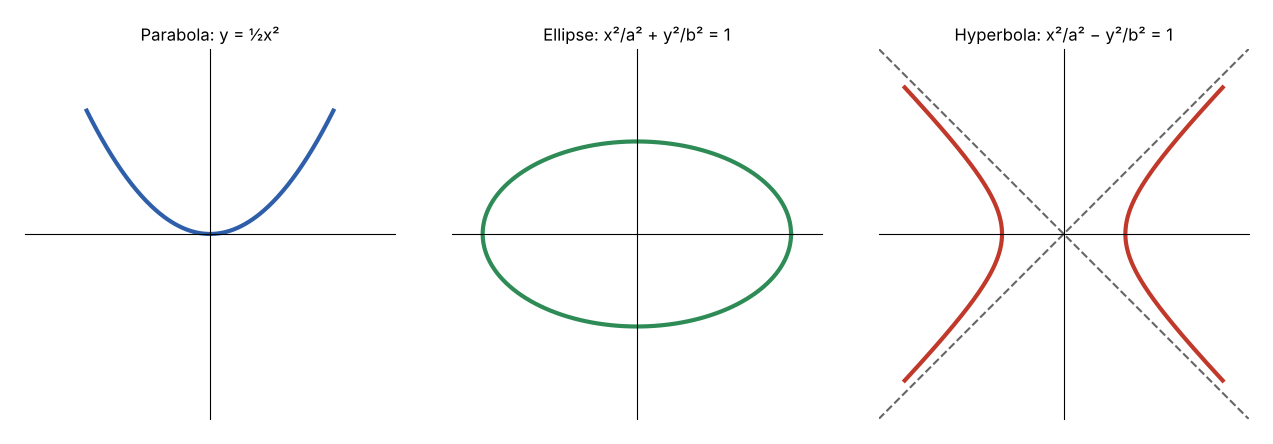
| Cone | Smaller circle | Triangle through the vertex | Ellipse, parabola, or hyperbola |
| Sphere | Always a circle | Largest through the center | |
A cube can have a hexagon as a cross section. Cut through the midpoints of six edges, tilted evenly, and the cut is a regular hexagon. This surprises many students and shows up often on tests.
Worked example 1: A sphere has radius 13. A plane cuts it 5 units from the center. Find the area of the cross section.
- The radius of the sphere, the distance to the plane, and the radius of the cross section form a right triangle.
- Cross section radius: \(\sqrt{13^{2}-5^{2}}=12\).
- Area: \(\pi(12)^{2}=144\pi\approx 452.39\) square units.
Worked example 2: A cube has edges of 4. A plane passes through two opposite edges, cutting the cube along a diagonal. Find the area of the cross section.
- The cross section is a rectangle. One side is an edge, 4.
- The other side is a face diagonal: \(4\sqrt{2}\).
- Area: \(4\cdot 4\sqrt{2}=16\sqrt{2}\approx 22.63\) square units.
Why does this matter? Cross sections explain why volume formulas work. Cavalieri’s Principle compares solids layer by layer, and medical scans like CT and MRI build a picture of the body from many cross sections.
Solids of Revolution
A solid of revolution forms when a two-dimensional figure rotates completely around a line, called the axis of rotation.
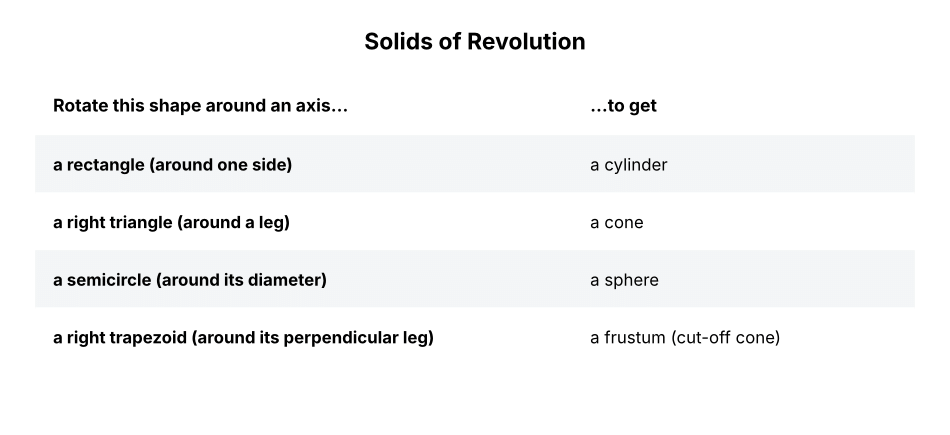
| Figure Rotated | Axis | Solid Formed |
|---|---|---|
| Rectangle | One of its sides | Cylinder |
| Right triangle | One of its legs | Cone |
| Semicircle | Its diameter | Sphere |
| Rectangle | A parallel line away from it | Cylinder with a cylindrical hole |
The side on the axis becomes the height. The side perpendicular to the axis sweeps out a circle and becomes the radius.
Worked example 3: A rectangle measures 2 by 5. It rotates around its 5 unit side. Find the volume of the solid.
- The solid is a cylinder with height 5 and radius 2.
- Volume: \(\pi(2)^{2}(5)=20\pi\approx 62.83\) cubic units.
Worked example 4: A right triangle has legs 3 and 4. Compare the volumes when it rotates around each leg.
- Around the leg of 3: a cone with \(h=3\) and \(r=4\). Volume: \(\frac{1}{3}\pi(16)(3)=16\pi\).
- Around the leg of 4: a cone with \(h=4\) and \(r=3\). Volume: \(\frac{1}{3}\pi(9)(4)=12\pi\).
- The volumes differ, even though the triangle is the same.
Why does this matter? The radius is squared in the volume formula, so the side that becomes the radius has a bigger effect. Always decide which side lies on the axis before computing.
Test-Taking Strategies
Mnemonic Devices and Memory Shortcuts
“On the axis is height, off the axis is radius.” For cross sections, “parallel to the base copies the base.” For spheres, “every slice is a circle.”
Cross-Topic Connections
- Cylinder volumes from rotations use Topic 10.5: Volume of Prisms and Cylinders.
- Cones and spheres are described in Topic 10.4: Surface Area of Pyramids, Cones, and Spheres.
- Sphere cross sections use Topic 8.1: The Pythagorean Theorem and Its Converse.
- Turning a figure around a point builds on Topic 4.3: Rotations.
Common Question Formats
- Identify the shape of a cross section from a description or picture.
- Find the area of a cross section.
- Identify the solid formed by rotating a figure.
- Find the volume of a solid of revolution.
Frequent Student Mistakes
- Assuming a cube’s cross section must be a square or rectangle.
- Swapping the radius and height in a solid of revolution.
- Using the diameter of the rotated semicircle as the radius of the sphere.
Test-Day Shortcuts
Sketch the rotation by drawing the figure, then its mirror image across the axis. Connect them with ovals at the top and bottom. The solid becomes clear in seconds.
Time Management Tips
Identification items on Geometry unit tests and end-of-course exams take under a minute. Area and volume calculations take two to three minutes, so sketch before computing.