
Two-column proofs rely on given facts and theorems. Coordinate proofs take a different route. You place a figure on the coordinate plane and let algebra do the work. Slopes reveal parallel and perpendicular sides, the distance formula reveals congruent sides, and the midpoint formula reveals bisected segments. With a smart placement, a single calculation can prove a fact about every triangle or quadrilateral of a given type.
This article covers Topic 11.1: Coordinate Proofs in Unit 11, Coordinate Geometry and Probability. The topic asks you to use slope, distance, and midpoint to classify figures and prove geometric theorems on the coordinate plane, including proofs with variable coordinates.
By the end, you should be able to:
- Choose the right formula for what you need to prove.
- Classify triangles and quadrilaterals from their vertex coordinates.
- Place a general figure on the coordinate plane with convenient coordinates.
- Write a coordinate proof of a general theorem.
The Three Tools
| To Prove | Use | What to Show |
|---|---|---|
| Sides are parallel | Slope formula | Equal slopes |
| Sides are perpendicular | Slope formula | Slopes with a product of \(-1\) |
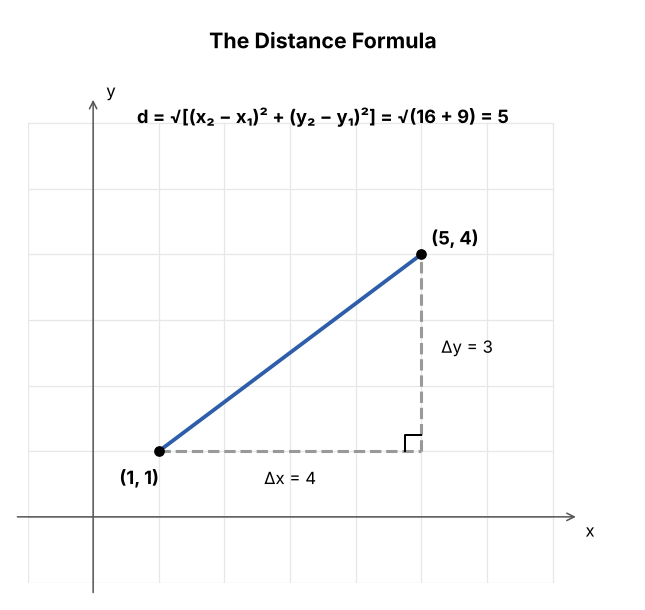
| Sides are congruent | Distance formula | Equal lengths |
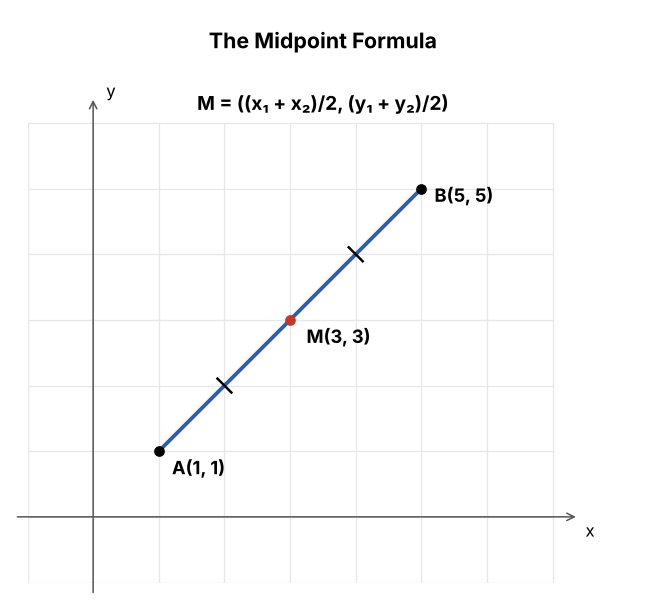
| A segment is bisected | Midpoint formula | The same midpoint |
Why does this matter? Every coordinate proof starts by matching the claim to one of these tools. If the claim mentions parallel or perpendicular, compute slopes. If it mentions congruent or equal lengths, compute distances. If it mentions bisecting, compute midpoints.
Classifying a Figure
Worked example 1: Classify quadrilateral \(ABCD\) with \(A(1,1)\), \(B(5,2)\), \(C(6,6)\), and \(D(2,5)\).
- Slopes: \(AB=\frac{1}{4}\), \(DC=\frac{1}{4}\), \(AD=4\), and \(BC=4\). Both pairs of opposite sides are parallel, so it is a parallelogram.
- Lengths: \(AB=\sqrt{4^{2}+1^{2}}=\sqrt{17}\) and \(AD=\sqrt{1^{2}+4^{2}}=\sqrt{17}\). Consecutive sides are congruent, so it is a rhombus.
- Check for right angles: \(\frac{1}{4}\cdot 4=1\), not \(-1\). The sides are not perpendicular, so it is not a square.
Conclusion: \(ABCD\) is a rhombus but not a square.
The order of checks matters. Start with the most general type, a parallelogram, and then test for the extra properties. A rectangle needs one right angle. A rhombus needs two consecutive congruent sides. A square needs both. You can also check the diagonals. For this figure, the slope of \(\overline{AC}\) is 1 and the slope of \(\overline{BD}\) is \(-1\), so the diagonals are perpendicular, which matches a rhombus.
Worked example 2: Show that the triangle with vertices \(P(0,0)\), \(Q(4,2)\), and \(R(2,6)\) is an isosceles right triangle.
- Slope of \(\overline{PQ}\): \(\frac{2}{4}=\frac{1}{2}\). Slope of \(\overline{QR}\): \(\frac{4}{-2}=-2\).
- The product is \(\frac{1}{2}\cdot(-2)=-1\), so \(\angle Q\) is a right angle.
- Lengths: \(PQ=\sqrt{16+4}=\sqrt{20}\) and \(QR=\sqrt{4+16}=\sqrt{20}\). The legs are congruent.
As a check, the hypotenuse \(PR=\sqrt{4+36}=\sqrt{40}\), and \(20+20=40\) confirms the Pythagorean relationship.
Proving General Theorems
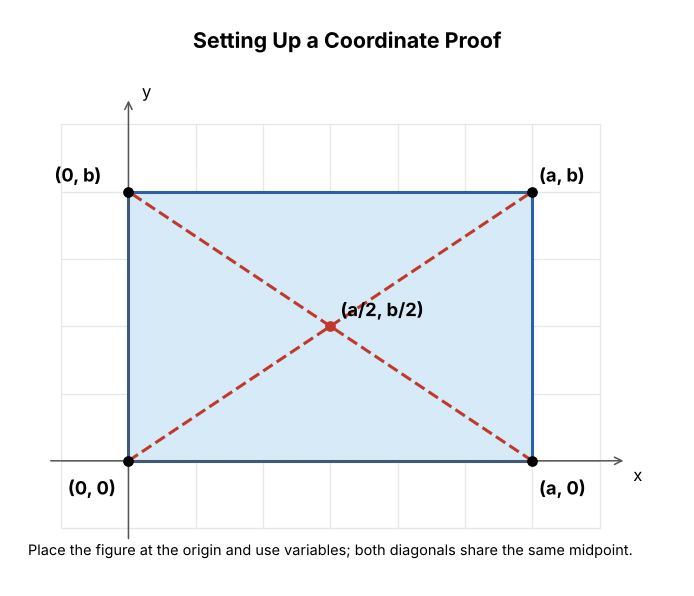
To prove a fact about every figure of a type, use variables for the coordinates. Place the figure so the algebra stays simple:
- Put a vertex at the origin.
- Put a side along the \(x\)-axis.
- Use coordinates like \(2a\) and \(2b\) when you will need midpoints, so you avoid fractions.
Worked example 3: Prove that the midpoint of the hypotenuse of a right triangle is the same distance from all three vertices.
- Place the right angle at the origin: \(O(0,0)\), \(A(2a,0)\), and \(B(0,2b)\).
- Midpoint of hypotenuse \(\overline{AB}\): \(M(a,b)\).
- Distances: \(MO=\sqrt{a^{2}+b^{2}}\), \(MA=\sqrt{(2a-a)^{2}+(0-b)^{2}}=\sqrt{a^{2}+b^{2}}\), and \(MB=\sqrt{(0-a)^{2}+(2b-b)^{2}}=\sqrt{a^{2}+b^{2}}\).
- All three distances are equal, which proves the claim for every right triangle.
Worked example 4: Prove the Triangle Midsegment Theorem.
- Place a triangle at \(O(0,0)\), \(A(2a,0)\), and \(C(2b,2c)\).
- Midpoint of \(\overline{OC}\): \(M(b,c)\). Midpoint of \(\overline{AC}\): \(N(a+b,c)\).
- Both midpoints have \(y\)-coordinate \(c\), so \(\overline{MN}\) is horizontal and parallel to \(\overline{OA}\).
- Length: \(MN=(a+b)-b=a\), which is half of \(OA=2a\).
Why does this matter? Using \(2a\), \(2b\), and \(2c\) is a deliberate choice. The midpoint formula divides by 2, so doubled coordinates produce clean midpoints like \((b,c)\). Placing a side on the \(x\)-axis makes its slope 0 and its length a simple difference.
Writing the Conclusion
A coordinate proof is not finished when the calculations end. Write a sentence that connects the results to the claim, such as “Since both pairs of opposite sides have equal slopes, the quadrilateral is a parallelogram.” Graders look for that sentence. It shows you know why the numbers prove the statement.
Test-Taking Strategies
Mnemonic Devices and Memory Shortcuts
“Slope for direction, distance for size, midpoint for halves.” For placement, “origin, axis, doubles.”
Cross-Topic Connections
- Congruent sides use Topic 1.2: Measuring Segments and the Distance Formula.
- Parallel and perpendicular tests come from Topic 3.3: Slopes of Parallel and Perpendicular Lines.
- The Midsegment Theorem is introduced in Topic 5.5: Midsegments, Bisectors, Medians, and Altitudes.
- Classifying quadrilaterals relies on Topic 6.3: Rectangles, Rhombuses, and Squares.
Common Question Formats
- Classify a quadrilateral or triangle from its vertices.
- Prove that a figure is a specific type, such as a rectangle.
- Find a missing vertex so a figure becomes a parallelogram.
- Complete a general proof with variable coordinates.
Frequent Student Mistakes
- Showing only one pair of parallel sides and calling the figure a parallelogram.
- Calling a rhombus a square without checking for a right angle.
- Ending with calculations and no concluding statement.
Test-Day Shortcuts
Sketch the points on a quick grid before computing. The sketch tells you which sides to compare and often suggests the figure’s type before any algebra.
Time Management Tips
Classification items on Geometry unit tests and end-of-course exams take two to three minutes. Written proofs can take five minutes or more, so organize slopes and lengths in a small table.