
Suppose a hiking trail runs straight from a parking lot to a lookout, and the park wants a rest stop one third of the way along. On a map with coordinates, where should it go? The midpoint formula only finds the halfway point. Partitioning a segment generalizes that idea, so you can find the point that splits a segment in any ratio, such as 1 to 2, 3 to 1, or 2 to 5.
This article covers Topic 11.2: Partitioning a Line Segment in Unit 11, Coordinate Geometry and Probability. The topic asks you to find the point that divides a directed line segment in a given ratio, on a number line and on the coordinate plane, and to connect partitioning to dilations.
By the end, you should be able to:
- Convert a part-to-part ratio into a fraction of the whole segment.
- Partition a segment on a number line.
- Partition a directed segment on the coordinate plane.
- Work backward to find a missing endpoint.
Ratios Versus Fractions
A ratio of \(m\) to \(n\) splits a segment into \(m+n\) equal parts. The partition point is \(m\) of those parts from the starting point. So the fraction of the way along the segment is:
\(\frac{m}{m+n}\)
| Ratio From A to B | Total Parts | Fraction of the Way From A |
|---|---|---|
| 1 to 1 | 2 | \(\frac{1}{2}\), the midpoint |
| 1 to 3 | 4 | \(\frac{1}{4}\) |
| 2 to 3 | 5 | \(\frac{2}{5}\) |
| 3 to 1 | 4 | \(\frac{3}{4}\) |
Why does this matter? This conversion is where most errors happen. A ratio of 1 to 3 does not mean one third of the way. It means one part out of four total parts, or one fourth of the way.
The Directed Segment
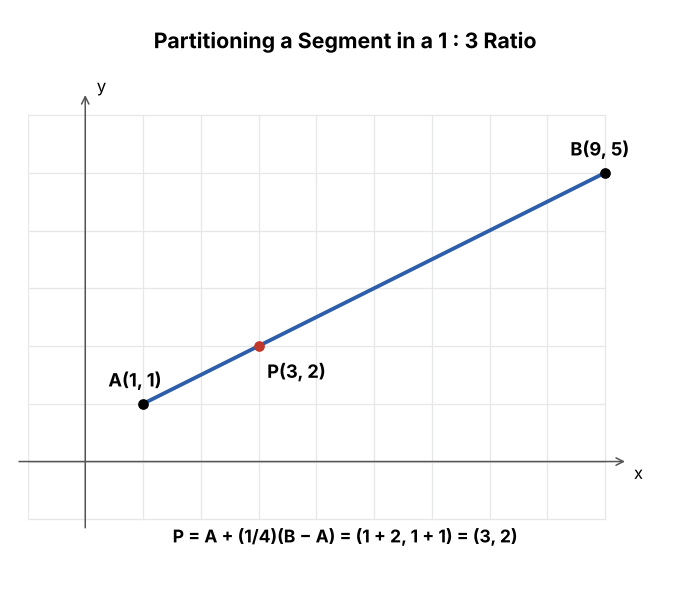
A directed segment \(\overline{AB}\) starts at \(A\) and ends at \(B\). Direction matters. A point that partitions \(\overline{AB}\) in a 1 to 3 ratio is close to \(A\). A point that partitions \(\overline{BA}\) in the same ratio is close to \(B\).
On a Number Line
Worked example 1: Point \(A\) is at \(-4\) and point \(B\) is at 11. Find the point that partitions \(\overline{AB}\) in a 3 to 2 ratio.
- Fraction: \(\frac{3}{5}\).
- Length of the segment: \(11-(-4)=15\).
- Distance from \(A\): \(\frac{3}{5}\cdot 15=9\).
- Partition point: \(-4+9=5\).
On the Coordinate Plane
Handle the \(x\) and \(y\) coordinates separately. Find the change from \(A\) to \(B\), take the fraction of that change, and add it to \(A\):
\(P=\left(x_{1}+\frac{m}{m+n}(x_{2}-x_{1}),\ y_{1}+\frac{m}{m+n}(y_{2}-y_{1})\right)\)
Worked example 2: Find the point that partitions the directed segment from \(A(1,2)\) to \(B(13,10)\) in a 1 to 3 ratio.
- Fraction: \(\frac{1}{4}\).
- Change: \(13-1=12\) in \(x\) and \(10-2=8\) in \(y\).
- One fourth of the change: 3 in \(x\) and 2 in \(y\).
- Partition point: \((1+3,2+2)=(4,4)\).
Worked example 3: Find the point that partitions the directed segment from \(A(-2,5)\) to \(B(8,0)\) in a 2 to 3 ratio.
- Fraction: \(\frac{2}{5}\).
- Change: 10 in \(x\) and \(-5\) in \(y\).
- Two fifths of the change: 4 in \(x\) and \(-2\) in \(y\).
- Partition point: \((-2+4,5-2)=(2,3)\).
Why does this matter? Partitioning is a dilation in disguise. The point that is \(\frac{m}{m+n}\) of the way from \(A\) to \(B\) is the image of \(B\) under a dilation centered at \(A\) with scale factor \(\frac{m}{m+n}\). That is why the same fraction multiplies both coordinate changes.
A Weighted Average Shortcut
The formula can also be written as a weighted average: \(P=\frac{nA+mB}{m+n}\), applied to each coordinate. Notice the weights cross over. The point is closer to the endpoint with the larger weight. For example 2, the \(x\)-coordinate is \(\frac{3(1)+1(13)}{4}=4\), which matches.
Working Backward
Worked example 4: Point \(P(4,5)\) is one third of the way from \(A(2,1)\) to \(B\). Find \(B\).
- The change from \(A\) to \(P\) is 2 in \(x\) and 4 in \(y\).
- That is one third of the full change, so the full change is 6 in \(x\) and 12 in \(y\).
- \(B=(2+6,1+12)=(8,13)\).
Why does this matter? Working backward tests whether you understand the fraction rather than just the formula. If the partial trip is one third of the whole, the whole trip is three times the partial one. The same reasoning helps you identify a ratio from three points: compare the distance from the start to the partition point with the distance from the partition point to the end.
Test-Taking Strategies
Mnemonic Devices and Memory Shortcuts
“Add the parts to get the whole.” Turn \(m\) to \(n\) into \(\frac{m}{m+n}\) before anything else. Then “start, plus a fraction of the trip.”
Cross-Topic Connections
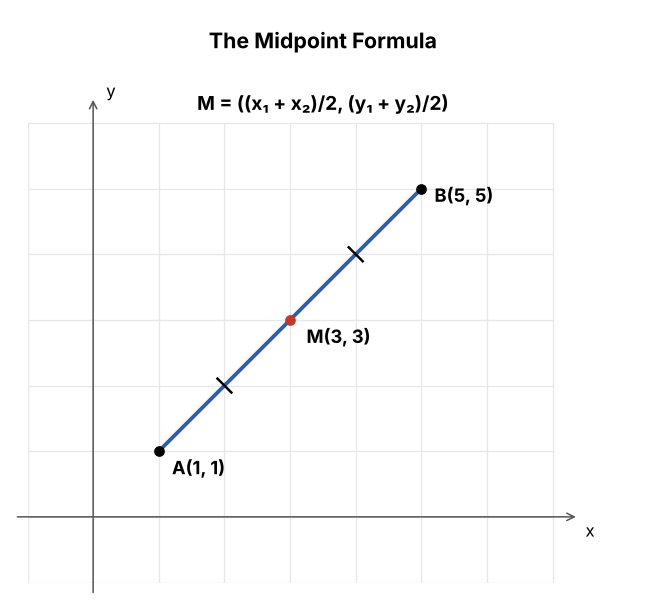
- The midpoint is the 1 to 1 case of Topic 1.3: The Midpoint Formula.
- Partitioning matches a dilation from the starting point, as in Topic 4.4: Dilations.
- Proportional segments connect to Topic 7.3: Proportionality Theorems.
- Part-to-part and part-to-whole ratios come from Algebra 1 Topic 2.6: Ratios, Rates, and Proportions.
Common Question Formats
- Find the point that partitions a segment on a number line.
- Find the point that partitions a directed segment on the coordinate plane.
- Find a missing endpoint from a partition point.
- Identify the ratio from three given points.
Frequent Student Mistakes
- Using \(\frac{m}{n}\) instead of \(\frac{m}{m+n}\).
- Measuring from \(B\) when the segment is directed from \(A\).
- Dropping the sign when a coordinate decreases.
Test-Day Shortcuts
Check that your answer lies between the endpoints and is closer to the correct one. A 1 to 3 partition should sit near the start. If it does not, recheck the fraction.
Time Management Tips
Partitioning items on Geometry unit tests and end-of-course exams take one to two minutes. Write the fraction and the coordinate changes on separate lines.