
Throw a dart at a board without aiming, and what are the chances it lands in the bullseye? You cannot list every possible landing spot, because there are infinitely many. Geometric probability solves this by comparing sizes instead of counting. If the bullseye covers 4 percent of the board’s area, a random dart has a 4 percent chance of landing there. Lengths, areas, and angles all become tools for finding probability.
This article covers Topic 11.3: Geometric Probability in Unit 11, Coordinate Geometry and Probability. The topic asks you to find probabilities by comparing lengths, areas, and angles, and to apply geometric probability to real situations such as waiting times, targets, and spinners.
By the end, you should be able to:
- Explain how geometric probability differs from counting outcomes.
- Find probabilities using lengths on a segment or timeline.
- Find probabilities using areas of regions.
- Find probabilities using central angles of sectors.
The Big Idea
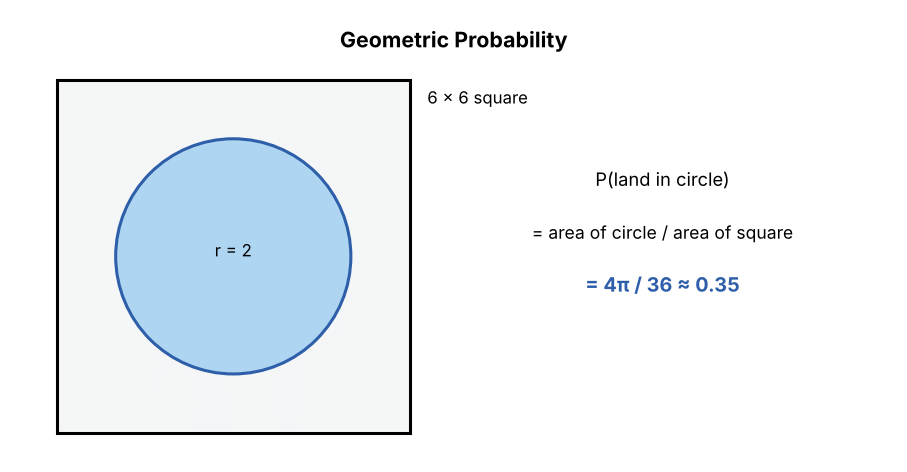
When every point in a region is equally likely, the probability of landing in a smaller part is the ratio of the part’s size to the whole.
| Type | Probability | Example |
|---|---|---|
| Length | \(\frac{\text{favorable length}}{\text{total length}}\) | A point on a segment, or a time on a schedule |
| Area | \(\frac{\text{favorable area}}{\text{total area}}\) | A dart on a board |
| Angle | \(\frac{\text{central angle}}{360}\) | A spinner |
Every probability is between 0 and 1. The probability of the complement, the event not happening, is 1 minus the probability of the event.
Probability With Length
Worked example 1: On a number line, \(A\) is at 0, \(B\) is at 3, \(C\) is at 8, and \(D\) is at 12. A point on \(\overline{AD}\) is chosen at random. Find the probability that it lies on \(\overline{BC}\).
- Favorable length: \(8-3=5\).
- Total length: \(12-0=12\).
- Probability: \(\frac{5}{12}\approx 0.42\).
Worked example 2: A bus arrives every 15 minutes. You arrive at the stop at a random time. Find the probability that you wait 4 minutes or less.
- Think of the 15 minutes between buses as a segment of length 15.
- You wait 4 minutes or less if you arrive in the last 4 minutes before a bus.
- Probability: \(\frac{4}{15}\approx 0.27\).
Why does this matter? Time behaves like length. Any situation with a random moment in an interval, such as a traffic light cycle, a bus schedule, or a song on repeat, can be modeled as a segment.
Probability With Area
Worked example 3: A circular dartboard has a radius of 10 inches. Its bullseye has a radius of 2 inches. A dart lands at a random point on the board. Find the probability it hits the bullseye.
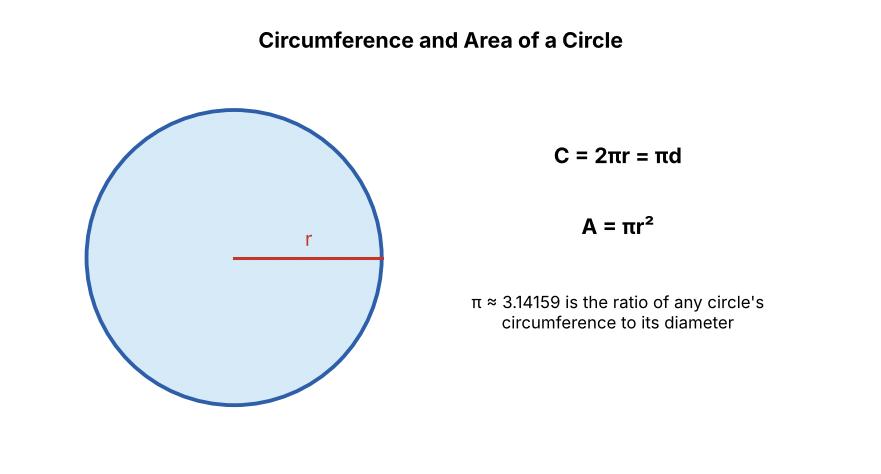
- Bullseye area: \(\pi(2)^{2}=4\pi\).
- Board area: \(\pi(10)^{2}=100\pi\).
- Probability: \(\frac{4\pi}{100\pi}=\frac{1}{25}=0.04\), or 4 percent.
Worked example 4: A target has three rings centered at the same point, with radii 2, 4, and 6. Find the probability that a random point on the target lands in the middle ring.
- Middle ring area: \(16\pi-4\pi=12\pi\).
- Total area: \(36\pi\).
- Probability: \(\frac{12\pi}{36\pi}=\frac{1}{3}\).
Worked example 5: A circle is inscribed in a square with side 10. A point in the square is chosen at random. Find the probability it is outside the circle.
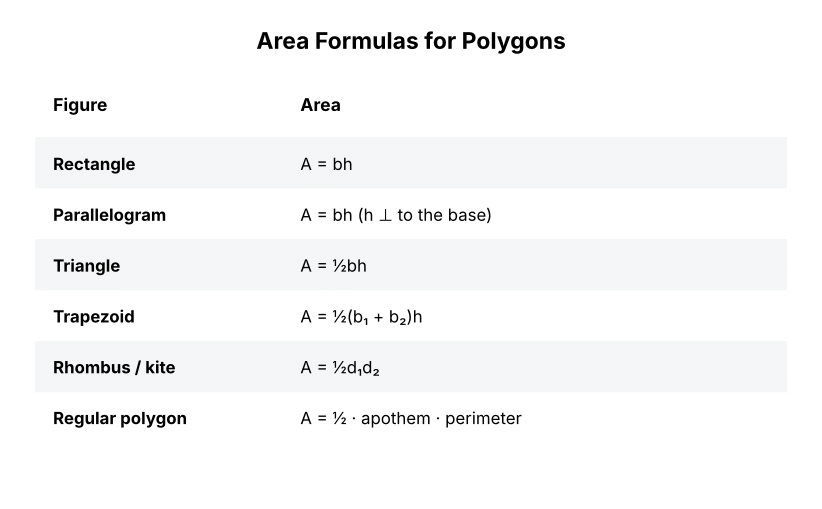
- Circle area: \(\pi(5)^{2}=25\pi\). Square area: 100.
- Probability inside the circle: \(\frac{25\pi}{100}=\frac{\pi}{4}\approx 0.785\).
- Probability outside: \(1-\frac{\pi}{4}\approx 0.215\).
Why does this matter? In example 3 and example 4, \(\pi\) cancels. When both regions are circles, the probability depends only on the squares of the radii. A bullseye with one fifth of the board’s radius has \(\left(\frac{1}{5}\right)^{2}=\frac{1}{25}\) of the area.
Probability With Angles
Worked example 6: A spinner has a red sector with a central angle of \(72^{\circ}\). Find the probability of landing on red. The probability is \(\frac{72}{360}=\frac{1}{5}\), or 20 percent.
For a spinner, the angle ratio and the sector area ratio give the same answer, since sector area is also proportional to the central angle.
Why does this matter? Probabilities like these let you check whether a game is fair. If a carnival spinner pays a prize on a \(30^{\circ}\) sector, you win only \(\frac{30}{360}=\frac{1}{12}\) of the time. Designers of games, sports scoring zones, and even weather forecasts that cover regions of a map use the same part over whole reasoning.
Test-Taking Strategies
Mnemonic Devices and Memory Shortcuts
“Part over whole, measured the same way.” Use length with length, area with area, and angle with angle. For complements, “one minus what you have.”
Cross-Topic Connections
- Segment lengths come from Topic 1.2: Measuring Segments and the Distance Formula.
- Spinner sectors use Topic 9.5: Arc Length and Sector Area.
- Targets and dartboards use Topic 10.2: Circumference and Area of Circles.
- Probability from data appears in Algebra 1 Topic 11.3: Two-Way Frequency Tables.
Common Question Formats
- Find the probability that a random point lies on part of a segment.
- Find a probability from waiting times or schedules.
- Find the probability of hitting a shaded region.
- Find the probability of a spinner landing on a sector.
Frequent Student Mistakes
- Using radii instead of areas, so a ring looks more or less likely than it is.
- Comparing the part with the rest instead of with the whole.
- Forgetting to subtract the inner circle when finding a ring’s area.
Test-Day Shortcuts
Cancel \(\pi\) whenever both regions are circular. Check that your answer is between 0 and 1 and that larger regions have larger probabilities.
Time Management Tips
Length and angle probability items on Geometry unit tests and end-of-course exams take about a minute. Area problems with rings or inscribed shapes take two to three minutes.