
SSS and SAS are not the only ways to prove triangles congruent. When you know two angles and a side, ASA or AAS often finishes the job, and right triangles have their own shortcut, HL. Knowing all five shortcuts, and the two combinations that do not work, lets you choose the fastest path in any congruence problem.
This article covers Topic 5.3: Triangle Congruence: ASA, AAS, and HL in Unit 5, Triangles. The topic asks you to apply the Angle-Side-Angle and Angle-Angle-Side criteria and the Hypotenuse-Leg Theorem, and to use CPCTC to draw conclusions after proving congruence.
By the end, you should be able to:
- Apply ASA when two angles and the included side are congruent.
- Apply AAS when two angles and a non-included side are congruent.
- Apply HL to right triangles.
- Use CPCTC to prove segments or angles congruent after proving triangles congruent.
Angle-Side-Angle (ASA)
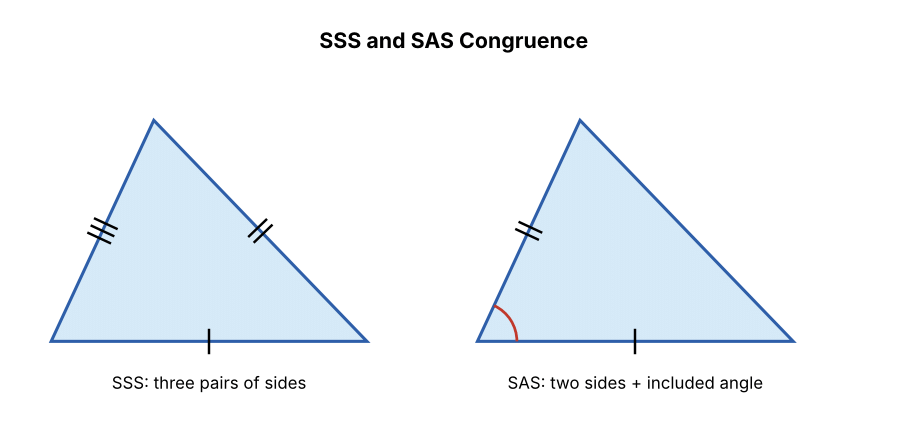
The ASA Congruence Postulate states that if two angles and the included side of one triangle are congruent to two angles and the included side of another, the triangles are congruent. The included side is the side between the two angles, connecting their vertices.
For \(\angle A\) and \(\angle B\) in \(\triangle ABC\), the included side is \(\overline{AB}\). If \(\angle A\cong\angle D\), \(\overline{AB}\cong\overline{DE}\), and \(\angle B\cong\angle E\), then \(\triangle ABC\cong\triangle DEF\) by ASA.
Angle-Angle-Side (AAS)
The AAS Congruence Theorem states that if two angles and a non-included side of one triangle are congruent to the corresponding parts of another, the triangles are congruent.
AAS follows from ASA. If two angles of one triangle match two angles of another, the third angles must also match, by the Triangle Sum Theorem. That turns any AAS situation into an ASA situation. The key is that the side must correspond: it must be opposite the same matching angle in both triangles.
Hypotenuse-Leg (HL)
The HL Congruence Theorem applies only to right triangles. If the hypotenuse and one leg of a right triangle are congruent to the hypotenuse and a leg of another right triangle, the triangles are congruent.
HL is a special case where side-side-angle actually works. Because the angle is \(90^{\circ}\) and the Pythagorean Theorem fixes the third side, the two triangles must match. You must state that both triangles are right triangles before citing HL.
Choosing a Shortcut
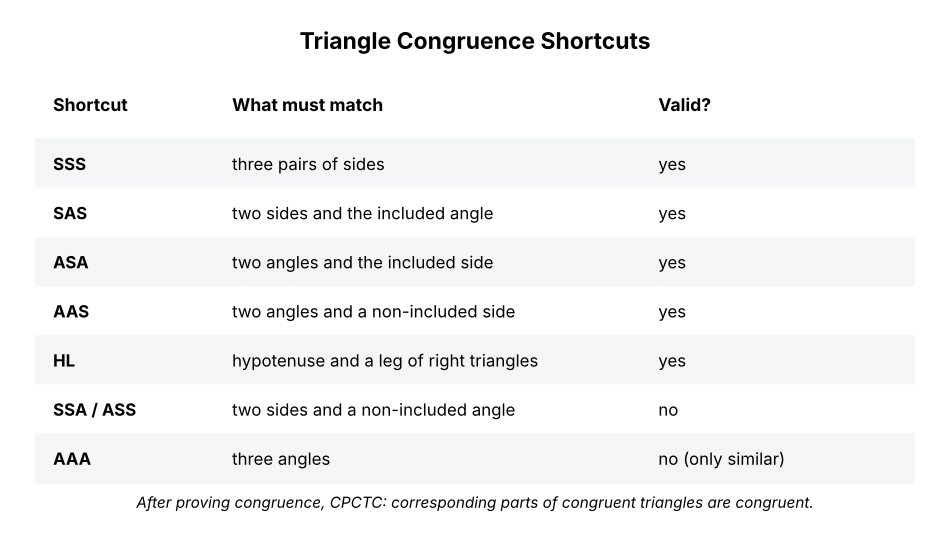
| Known Parts | Shortcut | Works? |
|---|---|---|
| Three sides | SSS | Yes |
| Two sides and the included angle | SAS | Yes |
| Two angles and the included side | ASA | Yes |
| Two angles and a non-included side | AAS | Yes |
| Hypotenuse and leg of right triangles | HL | Yes |
| Three angles | AAA | No, proves only similarity |
| Two sides and a non-included angle | SSA | No, except as HL |
Why does this matter? AAA fails because a small equilateral triangle and a large one have the same angles but different sizes. Test items often show three congruent angle pairs and ask whether the triangles must be congruent. The answer is no.
Using CPCTC
Once two triangles are proven congruent, all their corresponding parts are congruent. The reason is CPCTC: Corresponding Parts of Congruent Triangles are Congruent. CPCTC can only be used after the triangles are proven congruent.
Worked example: Given: \(\overline{AB}\parallel\overline{CD}\), and \(E\) is the midpoint of \(\overline{AD}\), where \(\overline{AD}\) and \(\overline{BC}\) intersect at \(E\). Prove: \(\overline{AB}\cong\overline{DC}\).
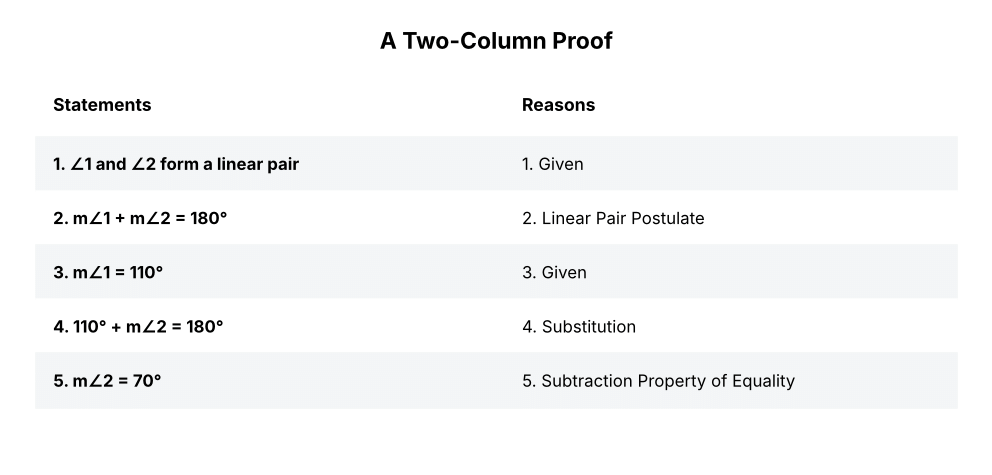
| Statements | Reasons |
|---|---|
| 1. \(\overline{AB}\parallel\overline{CD}\); \(E\) is the midpoint of \(\overline{AD}\) | 1. Given |
| 2. \(\angle A\cong\angle D\) | 2. Alternate Interior Angles Theorem |
| 3. \(\overline{AE}\cong\overline{DE}\) | 3. Definition of midpoint |
| 4. \(\angle AEB\cong\angle DEC\) | 4. Vertical Angles Theorem |
| 5. \(\triangle AEB\cong\triangle DEC\) | 5. ASA |
| 6. \(\overline{AB}\cong\overline{DC}\) | 6. CPCTC |
The side \(\overline{AE}\) lies between \(\angle A\) and \(\angle AEB\), so it is the included side, and ASA applies. If the given side had been opposite one of the angles, the proof would cite AAS instead.
Test-Taking Strategies
Mnemonic Devices and Memory Shortcuts
Five shortcuts work: SSS, SAS, ASA, AAS, HL. Two never work: AAA and SSA. A popular reminder is that the shortcut that spells a rude word backward is the one you should never use.
Cross-Topic Connections
- SSS and SAS are covered in Topic 5.2: Triangle Congruence: SSS and SAS.
- AAS relies on Topic 5.1: Classifying Triangles and the Triangle Sum Theorem.
- Parallel lines supply congruent angles, as in Topic 3.1: Angles Formed by Parallel Lines and Transversals.
- Midpoints supply congruent segments, as in Topic 1.3: The Midpoint Formula.
Common Question Formats
- Identify which shortcut proves two triangles congruent, or state that none applies.
- Decide what extra information is needed to use ASA, AAS, or HL.
- Complete a proof that ends with CPCTC.
- Distinguish ASA from AAS by locating the given side.
Frequent Student Mistakes
- Citing ASA when the side is not between the two angles.
- Using HL without first stating that both triangles are right triangles.
- Using CPCTC before proving the triangles congruent.
Test-Day Shortcuts
Mark the given parts on both triangles, then trace around one triangle in order. If the side falls between the two marked angles as you trace, it is ASA. If it falls after both angles, it is AAS.
Time Management Tips
Shortcut-identification items on Geometry unit tests and end-of-course exams take about a minute. Proofs ending in CPCTC take four to six minutes. Prove the triangles congruent first, then add the CPCTC step at the end.