
How much carpet covers a room, how much paint covers a wall, how much sod covers a yard? Each question asks for an area, the number of square units that fit inside a flat shape. Most area formulas grow from one simple idea, the area of a rectangle. Once you see how the other shapes rearrange into rectangles or halves of rectangles, the formulas stop feeling like a list to memorize.
This article covers Topic 10.1: Area of Polygons in Unit 10, Area and Volume. The topic asks you to find the areas of triangles, special quadrilaterals, regular polygons, and composite figures, and to describe how area changes when a figure is scaled.
By the end, you should be able to:
- Find the area of triangles, parallelograms, trapezoids, rhombuses, and kites.
- Find the area of a regular polygon using its apothem and perimeter.
- Find the area of a composite figure by adding or subtracting simpler shapes.
- Use the scale factor to compare areas of similar figures.
The Core Formulas
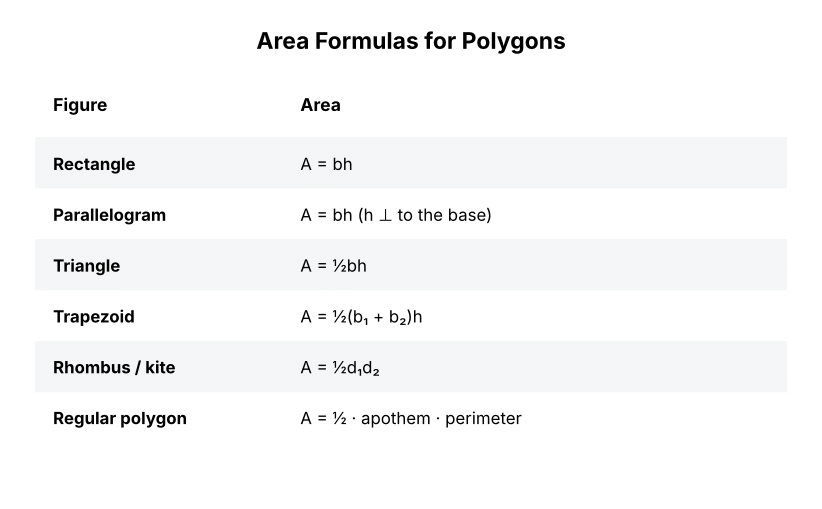
| Figure | Area Formula | Why It Works |
|---|---|---|
| Rectangle | \(A=bh\) | Rows times columns of unit squares. |
| Parallelogram | \(A=bh\) | Slide a triangle from one side to the other to form a rectangle. |
| Triangle | \(A=\frac{1}{2}bh\) | Two copies form a parallelogram. |
| Trapezoid | \(A=\frac{1}{2}(b_{1}+b_{2})h\) | Two copies, one flipped, form a parallelogram with base \(b_{1}+b_{2}\). |
| Rhombus or kite | \(A=\frac{1}{2}d_{1}d_{2}\) | The shape fills half the rectangle drawn around its diagonals. |
In every formula, the height is measured perpendicular to the base. For a parallelogram, the slanted side is not the height. Look for the dashed segment with a right angle mark.
Why does this matter? If you forget a formula, you can rebuild it by cutting and rearranging. A trapezoid is the average of its two bases times the height, which is the same as a rectangle whose width is that average.
Worked Examples
Worked example 1: A trapezoid has bases of 8 and 14 and a height of 5. Find its area.
- Add the bases: \(8+14=22\).
- Apply the formula: \(\frac{1}{2}(22)(5)=55\) square units.
Worked example 2: A rhombus has diagonals of 10 and 24. Find its area and side length.
- Area: \(\frac{1}{2}(10)(24)=120\) square units.
- The diagonals of a rhombus are perpendicular bisectors of each other, so they form four right triangles with legs 5 and 12.
- Side length: \(\sqrt{5^{2}+12^{2}}=13\).
Regular Polygons
A regular polygon has all sides and all angles congruent. Its apothem \(a\) is the perpendicular distance from the center to a side. Connecting the center to each vertex splits the polygon into congruent isosceles triangles, each with base \(s\) and height \(a\). Adding their areas gives:
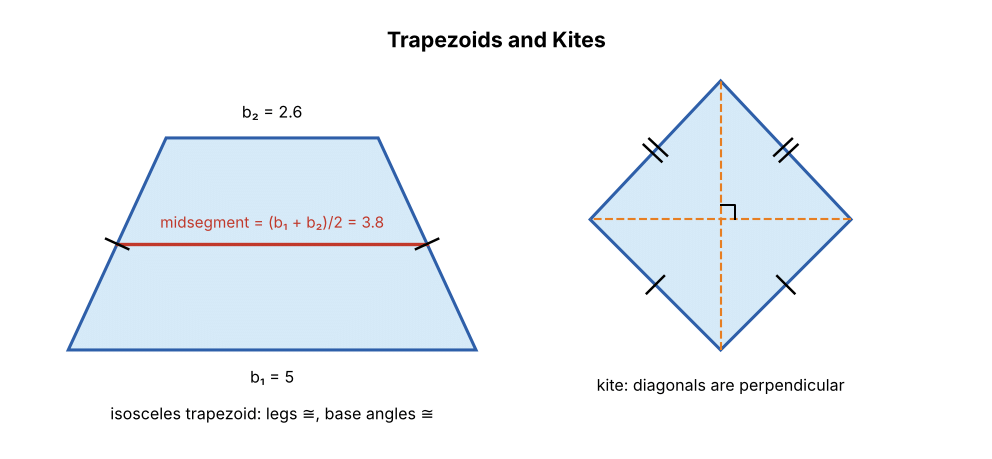
\(A=\frac{1}{2}aP\), where \(P\) is the perimeter.
Worked example 3: Find the area of a regular hexagon with side length 6.
- A regular hexagon splits into six equilateral triangles with side 6.
- The apothem is the height of one of those triangles. Using a 30-60-90 triangle, \(a=3\sqrt{3}\).
- Perimeter: \(6\cdot 6=36\).
- Area: \(\frac{1}{2}(3\sqrt{3})(36)=54\sqrt{3}\approx 93.53\) square units.
Why does this matter? Finding the apothem is usually the hard part. For hexagons, squares, and equilateral triangles, special right triangles give exact answers. For other polygons, such as pentagons, you need a trigonometric ratio with the central angle.
Composite Figures
A composite figure is made of simpler shapes. Break it into pieces, find each area, and then add. When a shape has a hole or a missing corner, subtract instead.
Worked example 4: A house outline is a 10 by 6 rectangle with a triangular roof on top. The roof has a base of 10 and a height of 4. Find the total area.
- Rectangle: \(10\cdot 6=60\).
- Triangle: \(\frac{1}{2}(10)(4)=20\).
- Total: \(60+20=80\) square units.
Area and Scale Factor
If two figures are similar with a scale factor of \(k\), their areas compare by \(k^{2}\). Area is two-dimensional, so the scale factor applies twice, once for length and once for width.
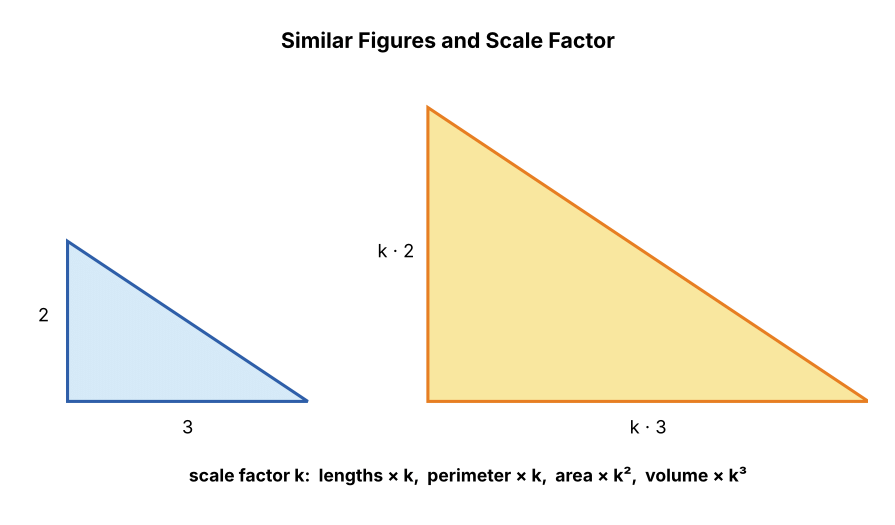
Worked example 5: A triangle has an area of 20 square inches. A similar triangle has sides 3 times as long. Its area is \(3^{2}\cdot 20=180\) square inches, not 60.
Why does this matter? Doubling every side of a garden does not double the soil you need. It multiplies the area by 4. This idea returns later in this unit for volume, where the factor becomes \(k^{3}\).
Test-Taking Strategies
Mnemonic Devices and Memory Shortcuts
“Triangles take half.” Triangles, trapezoids, rhombuses, kites, and regular polygons all have a one-half in their formulas. For scaling, “length times \(k\), area times \(k\) squared.”
Cross-Topic Connections
- Central angles of regular polygons come from Topic 6.1: Angles of Polygons.
- Diagonal facts for rhombuses come from Topic 6.3: Rectangles, Rhombuses, and Squares.
- Apothems often use Topic 8.2: Special Right Triangles.
- Area ratios extend Topic 7.1: Ratios and Similar Polygons.
Common Question Formats
- Find the area of a triangle or special quadrilateral.
- Find the area of a regular polygon from its side length.
- Find the area of a composite or shaded region.
- Find the area of a similar figure from a scale factor.
Frequent Student Mistakes
- Using a slanted side as the height.
- Forgetting the one-half in triangle and trapezoid formulas.
- Multiplying area by \(k\) instead of \(k^{2}\) for similar figures.
Test-Day Shortcuts
For shaded regions, find the area of the big shape and subtract the unshaded part. This is usually faster than adding many small pieces. Label the units as square units every time.
Time Management Tips
Basic area items on Geometry unit tests and end-of-course exams take about a minute. Regular polygons and composite figures take two to three minutes, so sketch the pieces before calculating.