
Fill a paper cone with water and pour it into a cylinder with the same base and height. It takes exactly three cones to fill the cylinder. That experiment captures the key fact of this topic: a pointed solid holds one third of the matching prism or cylinder. Spheres follow a related pattern that Archimedes considered his greatest discovery.
This article covers Topic 10.6: Volume of Pyramids, Cones, and Spheres in Unit 10, Area and Volume. The topic asks you to find volumes of pyramids, cones, spheres, and hemispheres, solve for missing dimensions, and find volumes of composite solids.
By the end, you should be able to:
- Explain why pyramid and cone volumes include a factor of one third.
- Find the volume of a pyramid or cone, using the height rather than the slant height.
- Find the volume of a sphere or hemisphere and solve for its radius.
- Find the volume of a composite solid.
The Formulas
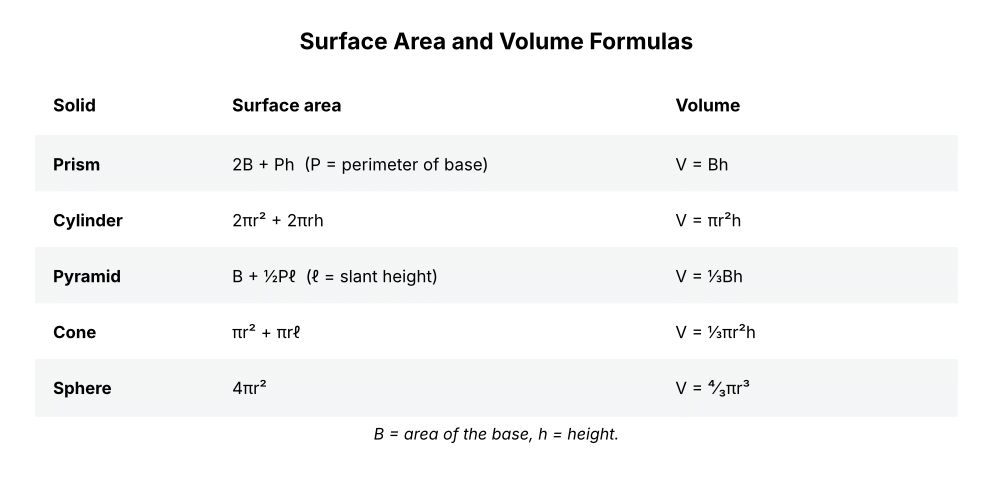
| Solid | Volume | Compare To |
|---|---|---|
| Pyramid | \(V=\frac{1}{3}Bh\) | One third of a prism with the same base and height |
| Cone | \(V=\frac{1}{3}\pi r^{2}h\) | One third of a cylinder with the same base and height |
| Sphere | \(V=\frac{4}{3}\pi r^{3}\) | Two thirds of the cylinder that fits around it |
| Hemisphere | \(V=\frac{2}{3}\pi r^{3}\) | Half a sphere |
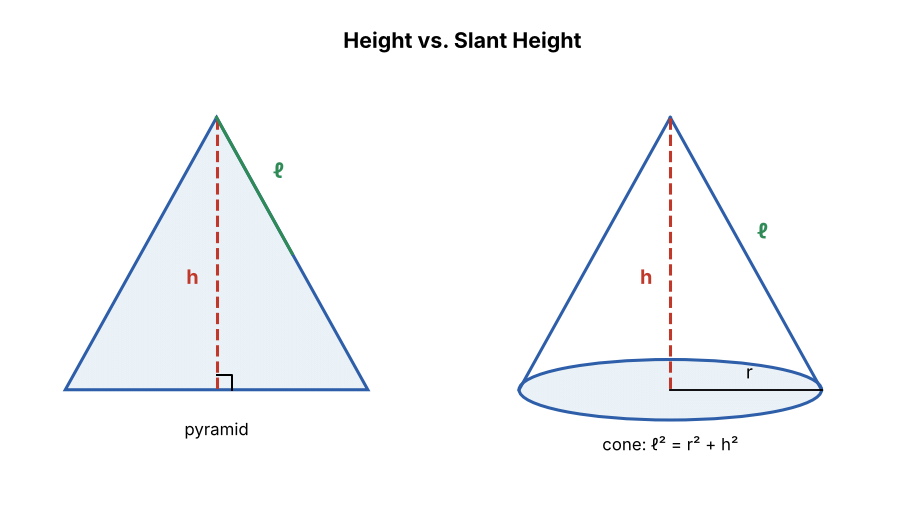
For pyramids and cones, \(h\) is the perpendicular height from the vertex to the base. It is not the slant height you used for surface area.
Why does this matter? The one third is not a guess. A cube can be cut into three congruent pyramids, each with the cube’s face as its base and the cube’s edge as its height. Each pyramid holds exactly one third of the cube.
Pyramids and Cones
Worked example 1: A square pyramid has a base edge of 10 and a height of 12. Find its volume. The volume is \(\frac{1}{3}(100)(12)=400\) cubic units.
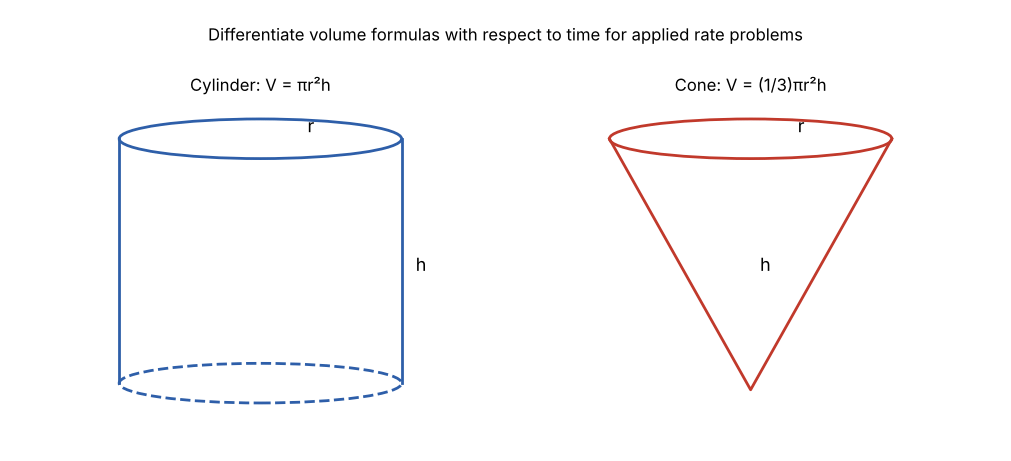
Worked example 2: A square pyramid has a base edge of 8 and a slant height of 5. Find its volume.
- Find the height. The right triangle has hypotenuse 5 and one leg 4, half the base edge. So \(h=\sqrt{5^{2}-4^{2}}=3\).
- Volume: \(\frac{1}{3}(64)(3)=64\) cubic units.
Worked example 3: A cone has a radius of 6 and a height of 8. Find its volume.
- Base area: \(\pi(6)^{2}=36\pi\).
- Volume: \(\frac{1}{3}(36\pi)(8)=96\pi\approx 301.59\) cubic units.
Spheres
Worked example 4: Find the volume of a sphere with radius 3. The volume is \(\frac{4}{3}\pi(3)^{3}=\frac{4}{3}\pi(27)=36\pi\approx 113.10\) cubic units.
Worked example 5: A sphere has a volume of \(288\pi\). Find its radius.
- Set up: \(\frac{4}{3}\pi r^{3}=288\pi\).
- Divide by \(\pi\) and multiply by \(\frac{3}{4}\): \(r^{3}=216\).
- Take the cube root: \(r=6\).
Why does this matter? Archimedes compared a cone, a sphere, and a cylinder that all have radius \(r\) and height \(2r\). Their volumes are \(\frac{2}{3}\pi r^{3}\), \(\frac{4}{3}\pi r^{3}\), and \(2\pi r^{3}\), a ratio of 1 to 2 to 3. If you remember the cylinder, you can rebuild the other two.
Composite Solids
Worked example 6: An ice cream cone is a cone with radius 3 and height 10, topped by a hemisphere of ice cream with the same radius. Find the total volume.
- Cone: \(\frac{1}{3}\pi(3)^{2}(10)=30\pi\).
- Hemisphere: \(\frac{2}{3}\pi(3)^{3}=18\pi\).
- Total: \(48\pi\approx 150.80\) cubic units.
Composite solids work like composite figures in area problems. Add pieces that are joined, and subtract pieces that are removed, such as a cone drilled out of a cylinder.
Scaling Volume
Similar solids compare by the cube of the scale factor. If one sphere has a radius 2 times as large as another, its volume is \(2^{3}=8\) times as large. A beach ball with a radius of 30 cm holds 1,000 times the air of a marble with a radius of 3 cm, since the scale factor is 10.
Why does this matter? Volume grows much faster than length. That is why doubling a meatball’s width takes eight times the meat, and why a slightly larger orange gives noticeably more juice. On tests, use the cube of the scale factor rather than recomputing each volume from scratch.
Test-Taking Strategies
Mnemonic Devices and Memory Shortcuts
“Points take a third.” Any solid that comes to a point gets \(\frac{1}{3}\). For spheres, “four thirds pi r cubed” has a rhythm worth repeating. Remember “1, 2, 3” for cone, sphere, and cylinder.
Cross-Topic Connections
- The matching prisms and cylinders are in Topic 10.5: Volume of Prisms and Cylinders.
- Slant height and height appear together in Topic 10.4: Surface Area of Pyramids, Cones, and Spheres.
- Finding the height uses Topic 8.1: The Pythagorean Theorem and Its Converse.
- Similar solids scale by \(k^{3}\), extending Topic 7.1: Ratios and Similar Polygons.
Common Question Formats
- Find the volume of a pyramid, cone, or sphere.
- Find the height from a slant height, then the volume.
- Find a radius from a sphere’s volume.
- Find the volume of a composite solid.
Frequent Student Mistakes
- Using the slant height in a volume formula.
- Forgetting the one third for pyramids and cones.
- Squaring the radius in the sphere formula instead of cubing it.
Test-Day Shortcuts
When a cone and a cylinder share a base and height, the cone is one third of the cylinder. Use that ratio directly instead of computing both volumes.
Time Management Tips
Single solid volume items on Geometry unit tests and end-of-course exams take one to two minutes. Composite solids take two to three minutes, so list each piece before computing.