
When President Abraham Lincoln was assassinated in April 1865, Walt Whitman responded with poems. In “O Captain! My Captain!” he imagined Lincoln as a ship’s captain who brings his vessel safely home, only to fall dead on the deck as the crowds cheer. Whitman did not name Lincoln, but readers understood. The poem is an elegy, a poem of mourning, and it shows how poets have long used verse to process grief.
This article covers Topic 2.9: The Elegy in Unit 2, Structure and Form. The topic asks you to define the elegy, trace its traditional stages, and analyze how elegies move from grief toward consolation.
By the end, you should be able to:
- Define the elegy and distinguish it from related forms.
- Identify the three traditional stages of an elegy.
- Recognize the pastoral elegy and its conventions.
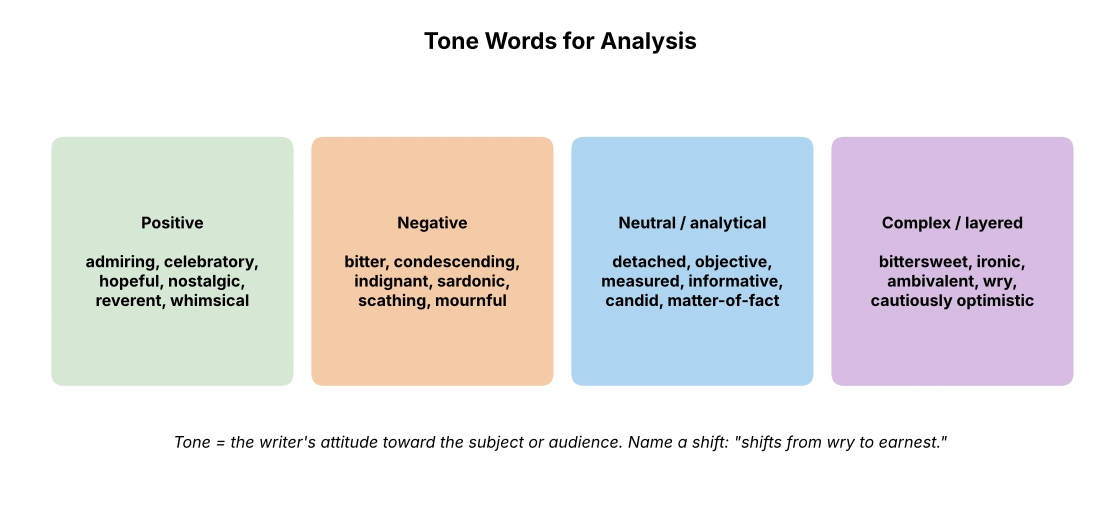
- Analyze how an elegy’s tone shifts over the course of the poem.
What Is an Elegy?
An elegy is a poem of serious reflection, usually a lament for someone who has died. Elegies can also mourn the loss of a place, a time, or a way of life, or they can reflect more generally on mortality.
In ancient Greek and Latin poetry, “elegy” meant poems written in a particular meter, the elegiac couplet, and they covered many subjects, including love. Over time, the English elegy came to mean a poem of mourning.
| Form | Purpose | Tone |
|---|---|---|
| Elegy | Mourns and reflects on loss | Solemn, sorrowful, reflective |
| Ode | Praises and celebrates | Elevated, admiring |
| Epitaph | A brief inscription honoring the dead, often for a tombstone | Concise, memorial |
| Dirge | A short song of mourning, often for a funeral | Mournful, musical |
The Three Stages
Many traditional elegies move through three stages:
- Lament: the speaker expresses grief, sometimes with anger or disbelief.
- Praise: the speaker honors and remembers the dead person’s qualities.
- Consolation: the speaker finds comfort, acceptance, or a new understanding, often through faith, nature, memory, or art.
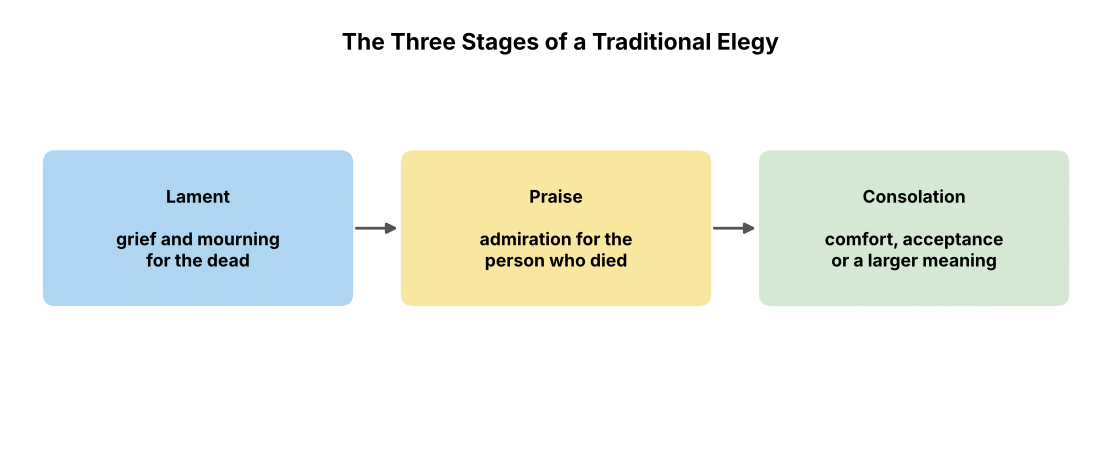
Not every elegy reaches consolation. Some modern elegies deliberately refuse comfort, which can make the grief feel more honest and raw.
Why does this matter? Recognizing the stages helps you track tone. Tests often ask how a speaker’s attitude toward loss changes. In a traditional elegy, the answer is usually a movement from despair toward acceptance.
Worked Example: Gray’s Elegy
Thomas Gray’s “Elegy Written in a Country Churchyard” (1751) begins:
The curfew tolls the knell of parting day,
- Setting: evening in a rural graveyard. The tolling bell and the “parting day” signal endings.
- Subject: not one person, but the ordinary villagers buried there, whose lives were never famous.
- Reflection: the speaker suggests that some of these humble people might have been great poets or leaders if they had been given the chance.
- Theme: death comes to everyone, rich and poor alike, and humble lives have their own dignity.
Gray’s poem shows that an elegy can mourn a whole community and reflect on mortality itself.
The Pastoral Elegy
A pastoral elegy presents the poet and the dead person as shepherds in an idealized countryside. Nature itself seems to mourn. Common conventions include:
- An invocation of the muses.
- Nature grieving, with flowers wilting and streams falling silent.
- A procession of mourners.
- Questions about why the death happened.
- A final consolation, often that the dead person lives on in a higher realm.
John Milton’s “Lycidas” (1637), written for a drowned classmate, and Percy Bysshe Shelley’s “Adonais” (1821), written for John Keats, are famous examples.
Elegies of Consolation
Alfred, Lord Tennyson spent about seventeen years writing In Memoriam A.H.H. (1850) after the sudden death of his friend Arthur Hallam. The long poem moves through doubt and despair toward faith. It contains the famous lines “‘Tis better to have loved and lost / Than never to have loved at all,” a statement of consolation that has become a common saying.
Why does this matter? Elegies show how literature helps people cope with grief. Analyzing them asks you to notice not only sadness but how a speaker searches for meaning after loss.
Test-Taking Strategies
Mnemonic Devices and Memory Shortcuts
“Lament, Praise, Console”: think “LPC” or “Loss, Praise, Comfort.” An ode says “O, how wonderful”; an elegy says “Alas, how we miss you.”
Cross-Topic Connections
- Compare praise poems in Topic 2.8: The Ode.
- Tone shifts in elegies are explained in Topic 1.3: Tone and Mood in Poetry.
- Stating what an elegy says about loss uses Topic 1.4: Theme in Poetry.
- The speaker’s grief is examined through Topic 1.2: Speaker and Voice.
Common Question Formats
- Identify a poem as an elegy and explain why.
- Locate the shift from lament to consolation.
- Explain how nature imagery reflects grief.
- Compare an elegy with an ode.
Frequent Student Mistakes
- Confusing elegies with odes.
- Assuming every elegy must end in comfort.
- Focusing only on sadness and missing the praise and reflection.
Test-Day Shortcuts
Compare the first and last stanzas. The difference in tone usually shows the speaker’s journey from grief to acceptance or continued sorrow.
Time Management Tips
Elegy questions on English unit tests and standardized reading tests such as the SAT and ACT take 30 to 60 seconds. Mark the tone of each stanza in the margin as you read.