
“Peter Piper picked a peck of pickled peppers.” Tongue twisters are fun because they pile up the same sounds until your mouth trips over them. Poets use the same principle, more subtly, to create music in language. Repeated consonants and vowels can make a line sound soft or harsh, slow or quick, soothing or tense. The three main tools for this effect are alliteration, assonance, and consonance.
This article covers Topic 3.6: Alliteration, Assonance, and Consonance in Unit 3, Figurative Language and Sound. The topic asks you to identify these sound devices and explain how they create rhythm, emphasis, and mood.
By the end, you should be able to:
- Define alliteration, assonance, and consonance.
- Identify each device in a line of poetry.
- Distinguish sound from spelling when identifying devices.
- Explain the effect of a sound device on mood and meaning.
The Three Devices
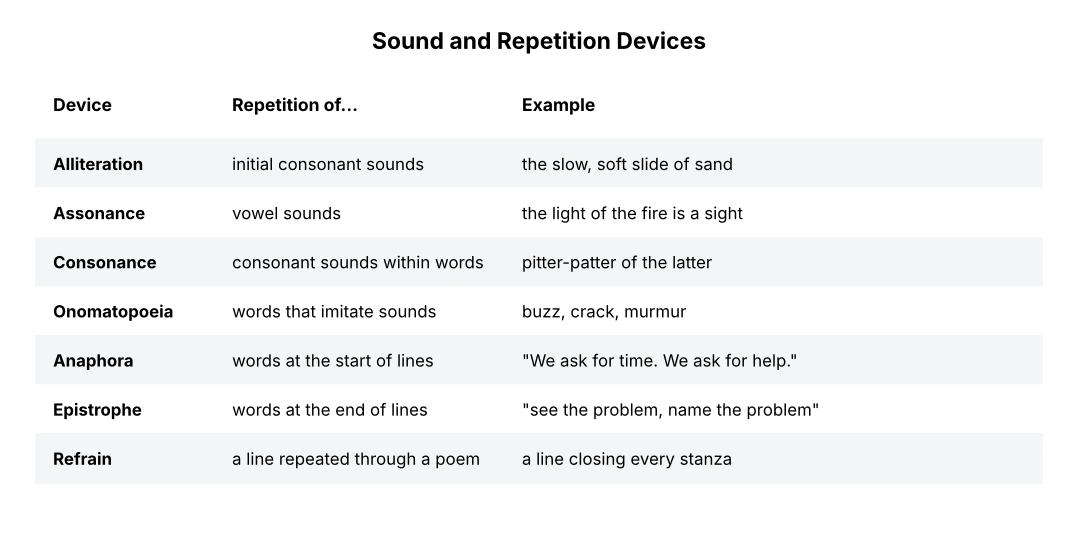
| Device | What Repeats | Where | Example |
|---|---|---|---|
| Alliteration | Consonant sounds | At the beginning of nearby words | big blue balloon |
| Assonance | Vowel sounds | Inside nearby words | “the gray rain faded away“ |
| Consonance | Consonant sounds | Inside or at the end of nearby words | “pitter-patter,” “blank and think“ |
Many teachers treat alliteration as a special kind of consonance, focused on the first sounds of words.
Sound, Not Spelling
These devices depend on what you hear, not what you see. “City” and “silver” alliterate because both begin with an s sound. “City” and “cat” do not, because one begins with an s sound and the other with a k sound. Likewise, “know” and “boat” show assonance through a shared long o sound, even though the spellings differ.
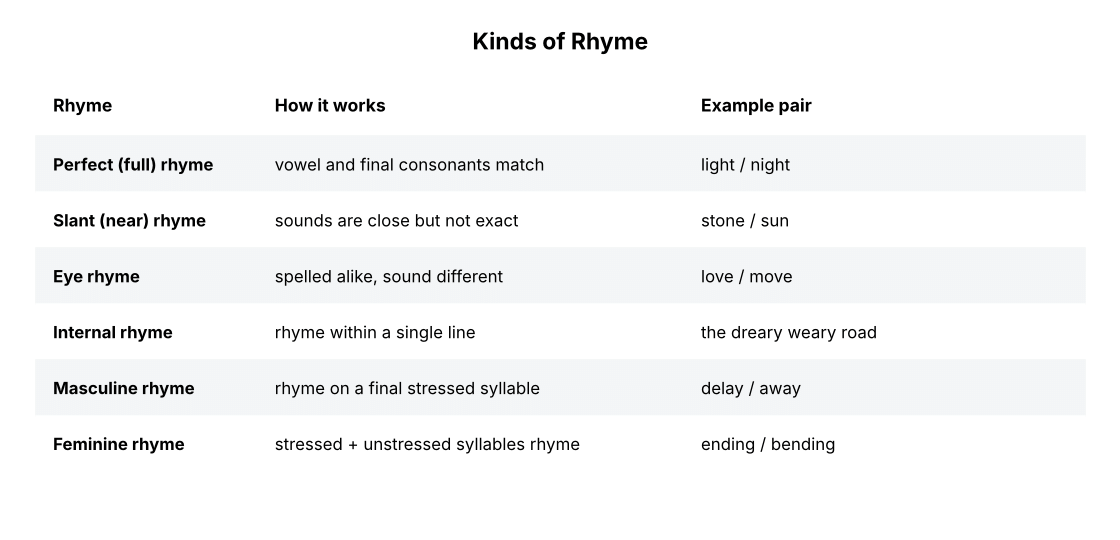
Always read the line aloud before deciding.
Worked Example: Coleridge
In “The Rime of the Ancient Mariner” (1798), Coleridge describes a ship speeding across the sea:
The fair breeze blew, the white foam flew,
The furrow followed free;
- Alliteration: fair, foam, flew, furrow, followed, free. Some readers also hear it in breeze and blew.
- Assonance: the long oo sound in “blew” and “flew.”
- Effect: the soft, breathy f sounds imitate wind rushing past, and the quick rhythm suggests the ship’s speed.
Why does this matter? Sound devices are not decoration. They help a poem enact what it describes. When the sound of a line matches its meaning, readers feel the experience instead of just understanding it.
Worked Example: Tennyson
In The Princess (1847), Alfred, Lord Tennyson writes:
The moan of doves in immemorial elms,
And murmuring of innumerable bees.
- Consonance: repeated m and n sounds in “moan,” “immemorial,” “elms,” “murmuring,” and “innumerable.”
- Effect: the humming nasal sounds imitate the low drone of doves and bees, creating a drowsy, peaceful summer mood.
What Sounds Suggest
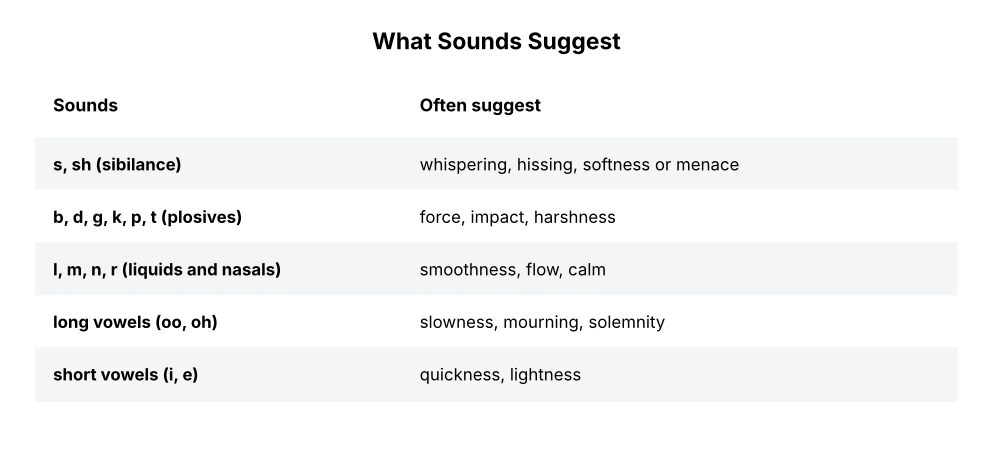
| Sound Type | Examples | Common Effect |
|---|---|---|
| Soft consonants | l, m, n, s, f, w | Calm, smooth, gentle, flowing |
| Hard consonants | k, g, t, d, b, p | Harsh, abrupt, forceful, tense |
| Long vowels | oo, oh, ay | Slow, mournful, drawn out |
| Short vowels | i as in “bit,” e as in “bet” | Quick, light, sharp |
These are tendencies, not rules. Always connect the sound to the specific meaning of the line.
Sound Devices in Everyday Life
Sound devices are not limited to poetry. Brand names such as Coca-Cola and Dunkin’ Donuts use alliteration to be memorable. Headlines, slogans, and speeches use repeated sounds to stick in listeners’ minds. Recognizing these patterns in advertising and rhetoric shows that poets use the same tools that make everyday language catchy and persuasive.
Sibilance
Repeated s, sh, and z sounds are called sibilance, a type of consonance. Sibilance can sound like whispering, hissing, or the sea, depending on context. A line full of s sounds about a snake may feel menacing, while the same sounds in a line about waves may feel soothing.
Why does this matter? Test questions often ask about the “effect” of a sound device. A strong answer names the device, identifies the repeated sound, and explains how that sound supports the line’s mood or meaning.
Test-Taking Strategies
Mnemonic Devices and Memory Shortcuts
“Alliteration is at the Arrival (start); Assonance is A vowel; Consonance is Consonants anywhere.”
Cross-Topic Connections
- Rhyme is another sound pattern, explained in Topic 2.2: Rhyme and Rhyme Scheme.
- Sound works with beat in Topic 2.3: Meter and Rhythm.
- Sound devices shape Topic 1.3: Tone and Mood in Poetry.
- The Coleridge example comes from a poem discussed in Topic 2.10: Ballads.
Common Question Formats
- Identify the sound device in a line.
- Distinguish alliteration from assonance and consonance.
- Explain how a sound device contributes to mood.
- Find the line that contains a specific device.
Frequent Student Mistakes
- Identifying devices by spelling instead of sound.
- Confusing assonance (vowels) with consonance (consonants).
- Naming a device without explaining its effect.
Test-Day Shortcuts
Whisper the line under your breath and listen for the sound that keeps returning. Then decide whether it is a vowel or consonant, and where in the words it appears.
Time Management Tips
Sound device questions on English unit tests and standardized reading tests such as the SAT and ACT take 20 to 40 seconds. Effect questions take a little longer.