
Buzz. Sizzle. Crash. Hiss. Say these words aloud and you almost hear the bee, the frying pan, the falling dishes, and the snake. Words that imitate the sounds they name are called onomatopoeia. Comic books use them for punches and explosions, but poets use them too, often with great subtlety, to let readers hear a poem as well as understand it.
This article covers Topic 3.7: Onomatopoeia in Unit 3, Figurative Language and Sound. The topic asks you to identify onomatopoeia, distinguish its direct and indirect forms, and explain how it contributes to imagery and mood.
By the end, you should be able to:
- Define onomatopoeia and give examples.
- Distinguish single-word onomatopoeia from lines that imitate sound.
- Explain how onomatopoeia creates auditory imagery.
- Analyze the effect of onomatopoeia on mood and meaning.
What Onomatopoeia Is
Onomatopoeia (pronounced on-uh-mat-uh-PEE-uh) is the use of words whose sounds imitate or suggest their meanings. The term comes from Greek words meaning “name” and “to make,” literally “making a name” from a sound.
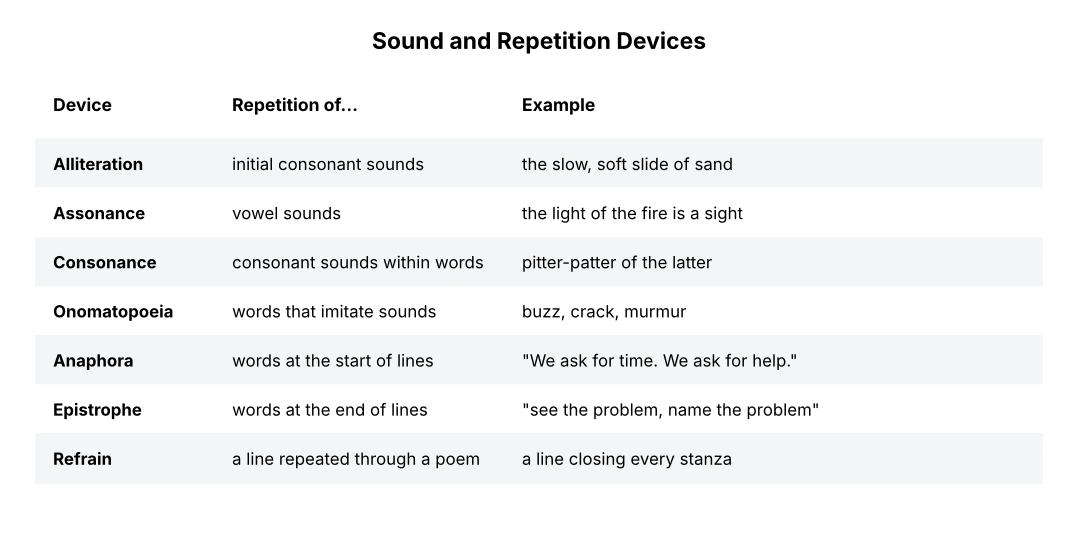
| Category | Examples |
|---|---|
| Animal sounds | moo, meow, quack, chirp, hiss, buzz, howl |
| Water sounds | splash, drip, gurgle, trickle, plop |
| Collisions | bang, crash, thud, smash, clang |
| Air and movement | whoosh, swish, rustle, whisper, flutter |
| Human sounds | giggle, mumble, sniff, hiccup, groan |
| Machines and objects | tick, click, beep, hum, sizzle |
Direct and Indirect Onomatopoeia
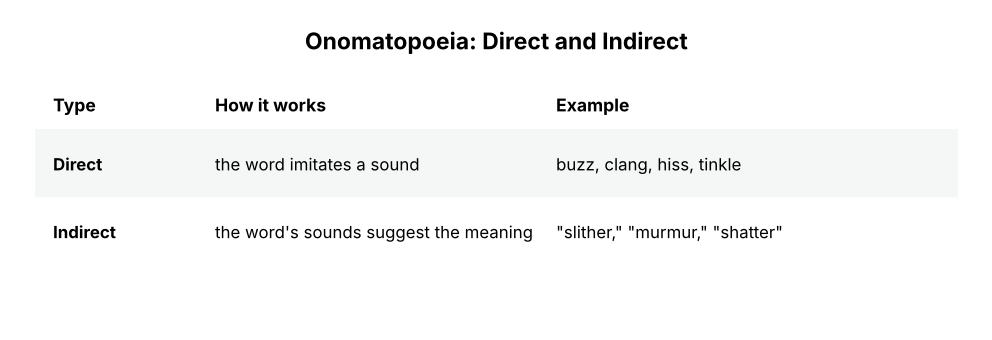
- Direct (or simple) onomatopoeia: a single word that sounds like what it names, such as “buzz” or “splash.”
- Indirect (or associative) onomatopoeia: a group of words whose combined sounds suggest the sound being described, even if no single word is a sound effect.
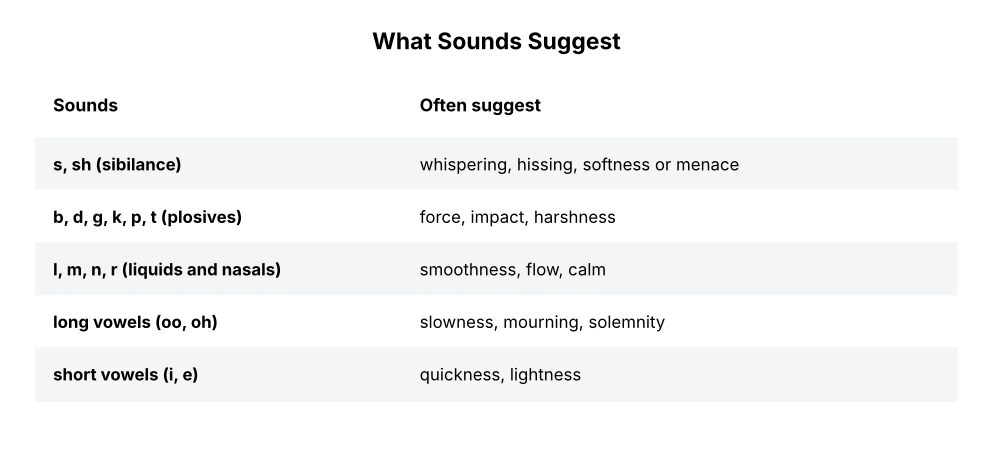
Indirect onomatopoeia overlaps with alliteration, assonance, and consonance. When a poet repeats soft s and sh sounds to describe waves, the whole line imitates the sea.
Worked Example: Poe’s “The Bells”
Edgar Allan Poe’s “The Bells” (1849) is famous for its use of sound. Each section describes a different kind of bell: silver sleigh bells, golden wedding bells, brass alarm bells, and iron funeral bells. In the first section, Poe describes the “tintinnabulation” of the bells, a long, jingling word that seems to ring as you say it. Throughout the poem, the word “bells” repeats again and again, imitating the ringing itself.
- Direct onomatopoeia: words such as “tinkle,” “jingling,” “clang,” “clash,” and “roar” appear across the sections.
- Indirect onomatopoeia: the repetition of “bells, bells, bells” mimics continuous ringing.
- Shift in mood: the light, tinkling sounds of the sleigh bells give way to harsh clanging alarm bells and finally to slow, heavy tolling funeral bells.
- Effect: the changing sounds trace a journey from youthful joy to fear to death.
Why does this matter? In “The Bells,” sound carries the meaning. Readers do not just learn that the mood darkens; they hear it darken. Onomatopoeia turns a poem into an experience.
Onomatopoeia and Imagery
Onomatopoeia creates auditory imagery, language that appeals to the sense of hearing. Combined with visual and other sensory details, it makes a scene feel complete. Compare:
- “The rain fell on the roof.”
- “The rain pattered and drummed on the tin roof.”
The second sentence lets you hear the rain, and the words “pattered” and “drummed” suggest its rhythm and force.
Choosing Sounds for Mood
Different sound words create different moods:
- “Whisper,” “murmur,” and “rustle” feel quiet and gentle.
- “Crash,” “bang,” and “shriek” feel sudden and alarming.
- “Drone,” “hum,” and “toll” feel slow and steady.
When analyzing onomatopoeia, connect the sound to the poem’s mood and to what is happening at that moment.
Why does this matter? Questions about sound devices usually ask about effect. Saying “the poet uses onomatopoeia” is only the first step; explaining what the sound makes the reader feel or notice is what earns credit.
Onomatopoeia Across Languages
Onomatopoeia differs from language to language. A rooster says “cock-a-doodle-doo” in English, “kikeriki” in German, and “kokekokko” in Japanese. Because each language imitates sounds through its own system of sounds, onomatopoeia shows how human ears and languages shape what we hear.
Test-Taking Strategies
Mnemonic Devices and Memory Shortcuts
“If you can hear it in the word, it is onomatopoeia.” For spelling, break it into parts: ono, mato, poeia.
Cross-Topic Connections
- Sound words are a kind of sensory language from Topic 3.1: Imagery.
- Repeated sounds are explained in Topic 3.6: Alliteration, Assonance, and Consonance.
- Sound shapes atmosphere, as in Topic 1.3: Tone and Mood in Poetry.
- Reading aloud is part of Topic 1.1: How to Read a Poem.
Common Question Formats
- Identify the example of onomatopoeia in a passage.
- Explain how a sound word contributes to imagery.
- Describe how sounds change the mood across a poem.
- Distinguish onomatopoeia from alliteration.
Frequent Student Mistakes
- Calling any action verb onomatopoeia, even if it does not imitate a sound.
- Overlooking indirect onomatopoeia created by groups of words.
- Labeling the device without explaining the effect.
Test-Day Shortcuts
Say the word aloud. If its sound resembles the noise it describes, it is onomatopoeia; if it only names an action, it is not.
Time Management Tips
Onomatopoeia questions on English unit tests and standardized reading tests such as the SAT and ACT take 15 to 30 seconds. Spend extra time only on effect questions.