
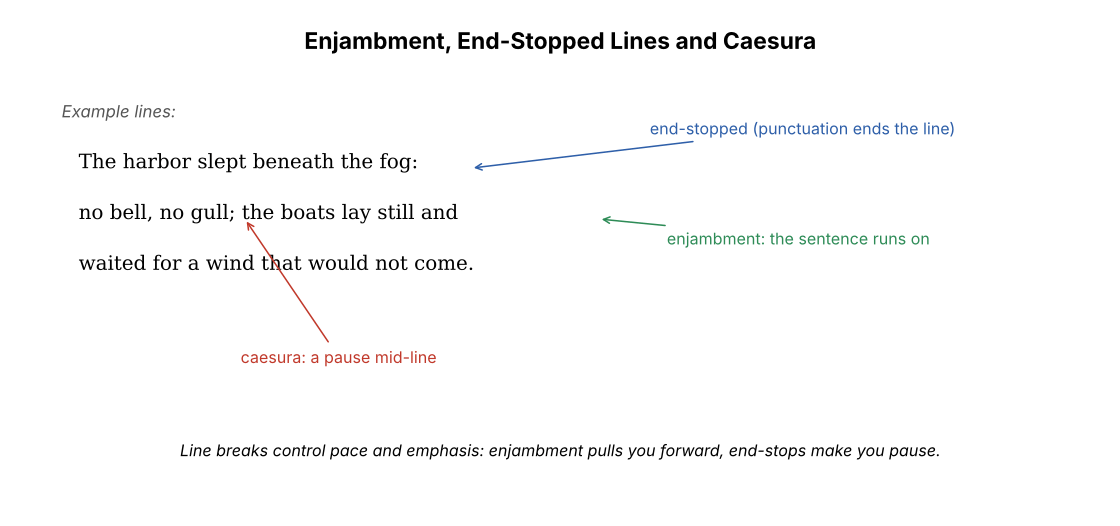
Where a line of poetry ends is never an accident. Sometimes a sentence stops neatly at the end of a line. Sometimes it spills over into the next line, pulling the reader forward. And sometimes a sharp pause lands right in the middle of a line, forcing the reader to stop and think. These choices, called end-stopped lines, enjambment, and caesura, control the pace of a poem and decide which words get emphasis.
This article covers Topic 3.8: Enjambment and Caesura in Unit 3, Figurative Language and Sound. The topic asks you to identify end-stopped lines, enjambment, and caesura and explain how each affects rhythm, pacing, and meaning.
By the end, you should be able to:
- Distinguish end-stopped lines from enjambed lines.
- Identify a caesura and explain its effect.
- Explain how line breaks create emphasis and surprise.
- Read enjambed lines aloud correctly.
End-Stopped Lines
An end-stopped line ends with a natural pause, usually marked by punctuation such as a period, comma, semicolon, or colon. The grammar and the line end together.
Alexander Pope’s An Essay on Criticism (1711) is full of end-stopped lines, such as:
A little learning is a dang’rous thing;
The semicolon closes the thought at the line’s end, creating a firm, balanced, confident effect. End-stopped lines often sound orderly and controlled, which suits Pope’s witty, rule-giving style.
Enjambment
Enjambment (from the French word for “straddling”) occurs when a sentence or phrase runs past the end of a line without a pause and continues into the next line.
John Keats’s Endymion (1818) begins:
A thing of beauty is a joy for ever:
Its loveliness increases; it will never
Pass into nothingness;
- Line 1 is end-stopped with a colon.
- Line 2 ends with “never,” but the thought is not finished. It is enjambed.
- The reader must move to line 3 to learn what will “never” happen.
- Effect: “never” hangs at the end of the line for a moment, gaining emphasis before the meaning resolves. The flowing movement also mirrors the idea of beauty continuing on and on.
Why does this matter? The last word of a line naturally receives attention. Enjambment lets poets place a key word in that spot, create suspense, and even give a phrase a double meaning, one when the line is read alone and another when the sentence is completed.
Effects of Enjambment
- Momentum: pulls the reader quickly from line to line.
- Emphasis: highlights the last word of a line and the first word of the next.
- Surprise: a line can seem to mean one thing until the next line changes it.
- Natural speech: sentences flow as they do in conversation.
- Tension: the mismatch between line and sentence can create unease or excitement.
Caesura
A caesura (pronounced si-ZHOOR-uh) is a strong pause within a line, usually created by punctuation such as a period, comma, semicolon, question mark, or dash.
Pope’s line from the same poem shows a caesura clearly:
To err is human; to forgive, divine.
- The semicolon in the middle creates a strong pause.
- The two halves balance each other: a human weakness, then a divine virtue.
- A smaller pause at the comma adds a beat before “divine.”
- Effect: the pause highlights the contrast and gives the line the feel of a memorable saying.
Caesuras can come early, in the middle, or late in a line. A caesura near the end can create a dramatic stop, while several caesuras in one line can make the speaker sound hesitant or overwhelmed.
Comparing the Three Techniques
| Technique | Where the Pause Is | Typical Effect |
|---|---|---|
| End-stopped line | At the end of the line | Order, finality, balance |
| Enjambment | No pause at the line’s end | Flow, momentum, suspense |
| Caesura | Inside the line | Emphasis, hesitation, contrast |
Reading Enjambed Lines Aloud
A common mistake is pausing at the end of every line. Instead, follow the punctuation. If a line has no punctuation at the end, carry your voice into the next line, perhaps with only the slightest hesitation. Reading this way makes the poem sound natural and reveals how the poet intended it to flow.
Why does this matter? Line breaks are one of the few tools that belong only to poetry. Questions about structure often focus on why a line breaks where it does, and enjambment and caesura are the vocabulary for explaining those choices.
Test-Taking Strategies
Mnemonic Devices and Memory Shortcuts
“Enjambment runs on; caesura cuts in.” Think of enjambment as a sentence jumping a fence (the line break) and caesura as a stop sign in the middle of the road.
Cross-Topic Connections
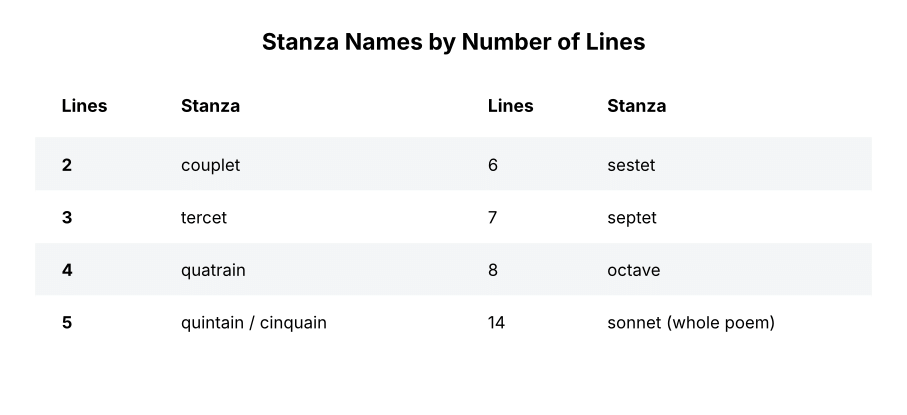
- Line breaks are introduced in Topic 2.1: Lines and Stanzas.
- Pauses interrupt the beat in Topic 2.4: Iambic Pentameter.
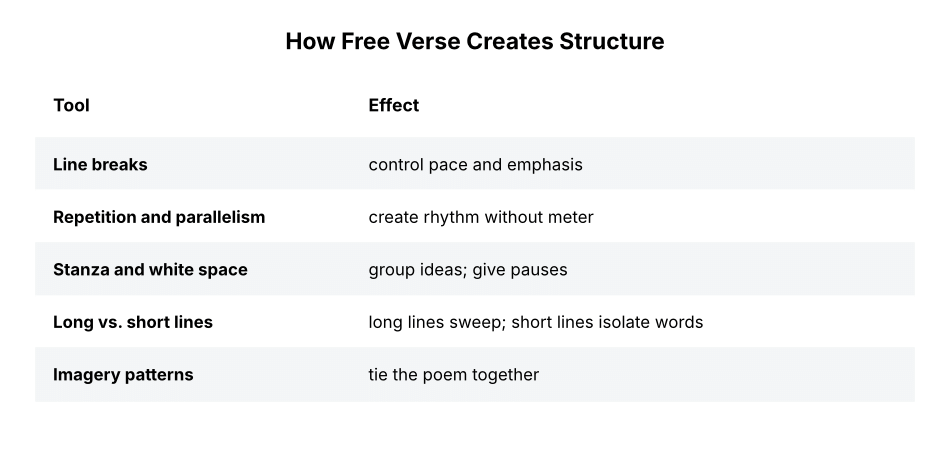
- Line breaks are central to Topic 2.5: Free Verse.
- Reading by punctuation is practiced in Topic 1.1: How to Read a Poem.
Common Question Formats
- Identify whether a line is end-stopped or enjambed.
- Locate the caesura in a line.
- Explain the effect of a line break on meaning.
- Explain how pacing reflects the speaker’s emotion.
Frequent Student Mistakes
- Pausing at every line break when reading.
- Calling any comma within a line a caesura, even a minor pause.
- Identifying the technique without explaining its effect.
Test-Day Shortcuts
Check the last character of each line. Punctuation usually means end-stopped; no punctuation usually means enjambment.
Time Management Tips
Line-structure questions on English unit tests and standardized reading tests such as the SAT and ACT take 20 to 40 seconds. Focus your time on explaining effects.