
Maximize your score with these resources:
- Albert.io Digital SAT® Reading and Writing question banks
- Free Digital SAT® Reading and Writing cheat sheets
“By the time the rescue team arrived, the hikers waited for six hours.” Something sounds off. The waiting began before the team arrived and continued up to that moment, so the sentence needs “had waited.” Verb tense and form questions on the Digital SAT test whether the verb fits the time frame of the passage and whether it uses the correct form, such as a proper past participle. They reward students who read the surrounding sentences, not just the underlined words.
This article covers Topic 4.5: Verb Tense and Form in Unit 4, Standard English Conventions. The topic asks you to choose verb tenses that are consistent with a passage’s time frame and to use correct verb forms, including participles, infinitives, and gerunds.
By the end, you should be able to:
- Use context clues to determine the correct verb tense.
- Distinguish simple, progressive, and perfect tenses.
- Use correct past participle forms of irregular verbs.
- Decide whether a sentence needs a finite verb or a nonfinite form such as an infinitive or participle.
Tense Follows the Passage
The most important rule: match the time frame of the surrounding text. If a passage describes a historical event in the past tense, the underlined verb should usually be past tense too. If the passage states general facts or scientific truths, it usually uses present tense.
Worked example 1:
In 1928, Alexander Fleming noticed that mold had killed bacteria in one of his culture dishes. He investigates / investigated the mold further and identified the substance that became penicillin.
- Surrounding verbs: “noticed,” “had killed,” “identified.” The passage is in the past.
- Correct verb: “investigated.”
The Main Tenses
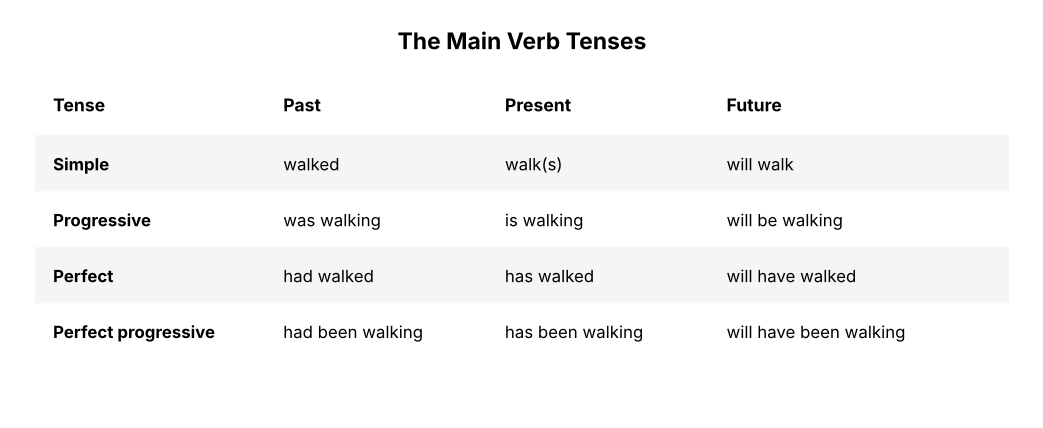
| Tense | Form | Use |
|---|---|---|
| Simple past | walked | A completed action at a past time |
| Present perfect | has walked / have walked | An action that began in the past and continues, or past action relevant now |
| Past perfect | had walked | An action completed before another past action |
| Future | will walk | An action that has not yet happened |
| Progressive forms | is walking, was walking | An ongoing action |
Signal words help: “since” and “for the past decade” often call for present perfect (“has grown since 2010”). “By the time,” “before,” and “already” with another past event often call for past perfect (“had left before the storm hit”). “Currently” and “now” call for present tense.
Why does this matter? Most tense errors on the SAT are not about grammar knowledge; they are about reading context. The answer is usually determined by a verb or time phrase in a nearby sentence.
Irregular Past Participles
Perfect tenses and passive voice require the past participle. Irregular verbs have special forms that are often misused.
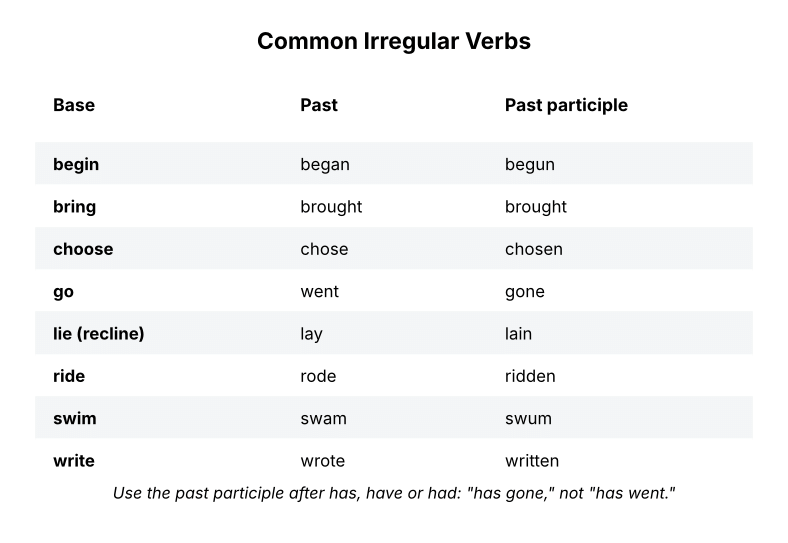
| Base | Simple Past | Past Participle |
|---|---|---|
| begin | began | begun |
| choose | chose | chosen |
| rise | rose | risen |
| write | wrote | written |
| swim | swam | swum |
Incorrect: Prices have rose sharply. Correct: Prices have risen sharply.
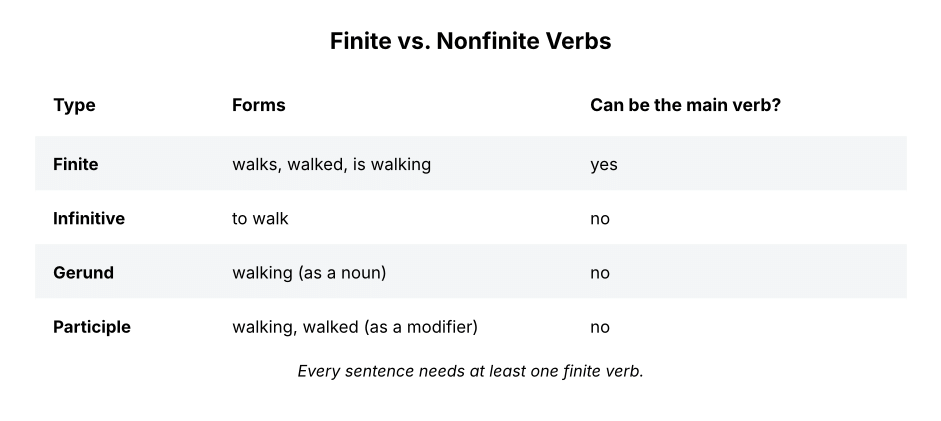
Finite and Nonfinite Verbs
Every complete sentence needs a finite verb, one that shows tense and agrees with a subject. Infinitives (to discover), present participles (discovering), and past participles used alone (discovered as a modifier) cannot be a sentence’s main verb.
Worked example 2:
The archaeologists working at the site in southern Peru uncovering / to uncover / uncovered a tomb filled with ceramic vessels.
- The subject is “archaeologists.” “Working at the site in southern Peru” is a modifier, not the main verb.
- The sentence still needs a finite main verb.
- “Uncovering” and “to uncover” are nonfinite and would leave a fragment.
- Correct: “uncovered.”
This is one of the most common verb form questions on the Digital SAT. Long subjects with modifiers make it easy to forget that the main verb is still missing.
Infinitives and Gerunds After Certain Verbs
Some verbs are followed by infinitives (decide to go, hope to win), while others are followed by gerunds (enjoy reading, avoid wasting). The SAT occasionally tests these patterns, especially in phrases like “capable of producing” (not “capable to produce”).
Consistency Within a Sentence
Verbs joined in a series or compound predicate should share a tense: “The team collected samples, analyzed them, and published the results,” not “collected, analyzes, and published.”
Why does this matter? Clear, consistent verbs help readers follow the order of events. A careless shift between past and present can make a reader think events happened at different times than they did.
Test-Taking Strategies
Mnemonic Devices and Memory Shortcuts
“The passage sets the clock.” For past perfect, “had plus participle means earlier past.”
Cross-Topic Connections
- All tested rules are summarized in Topic 4.8: Grammar Rules Overview.
- Missing main verbs create errors covered in Topic 4.1: Sentence Boundaries.
- Perfect tenses are explained in Grammar Topic 2.5: Perfect Verb Tenses.
- Ongoing actions are covered in Grammar Topic 2.6: Progressive Verb Tenses.
Common Question Formats
- Choose the verb tense that fits the passage’s time frame.
- Choose the correct past participle of an irregular verb.
- Choose a finite main verb to complete a sentence.
- Keep verbs in a series consistent.
Frequent Student Mistakes
- Choosing a tense based only on the underlined sentence.
- Using simple past forms after “has” or “had.”
- Choosing an “-ing” form when the sentence lacks a main verb.
Test-Day Shortcuts
Before choosing, underline the nearest verb outside the blank. Its tense is usually the tense you need, unless a time phrase signals a change.
Time Management Tips
The Digital SAT Reading and Writing section gives about 71 seconds per question. Verb questions usually take 30 seconds; finite-verb questions may need a full reread of a long sentence.