
Maximize your score with these resources:
- Albert.io AP® US History question banks
- Free AP® US History study guides
- Free AP® US History score calculator
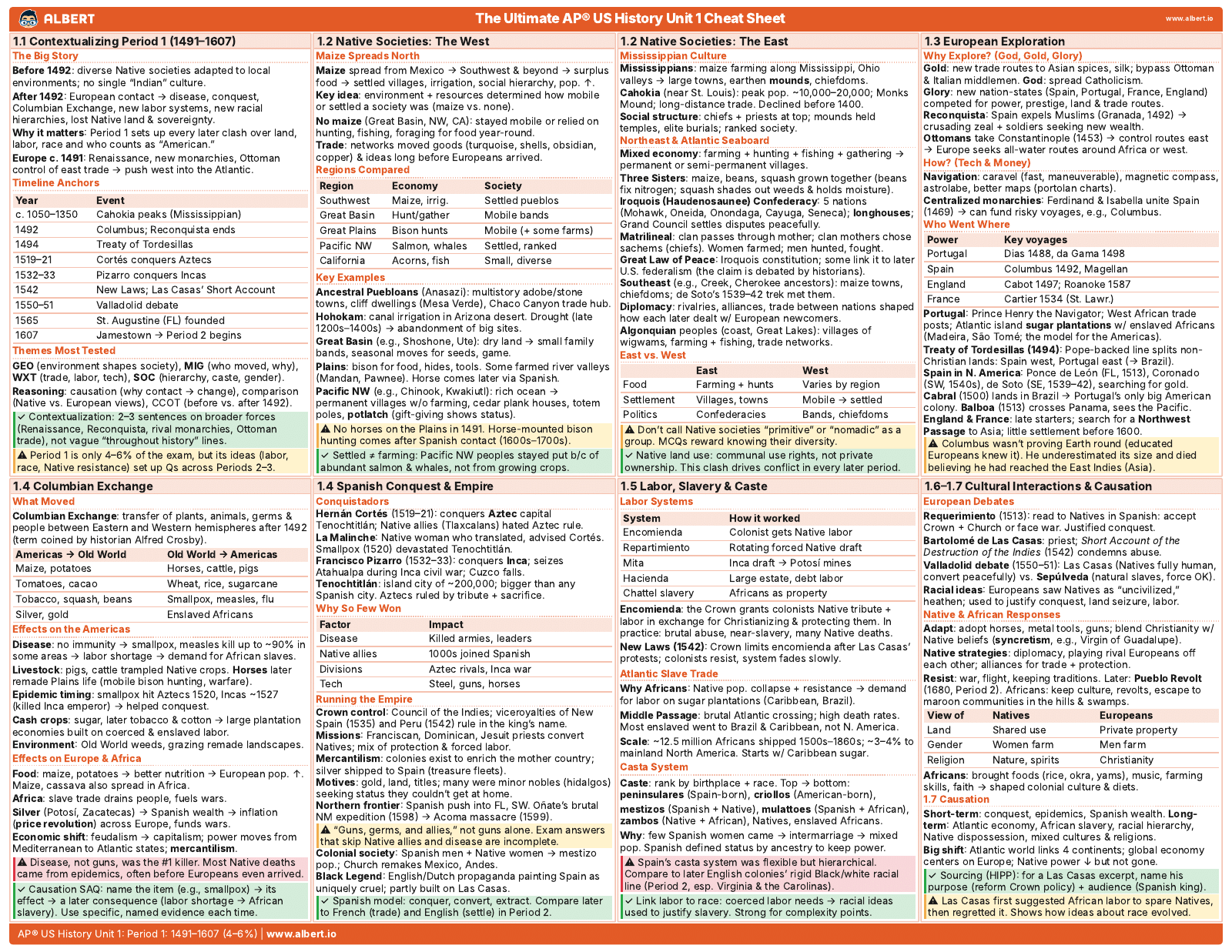
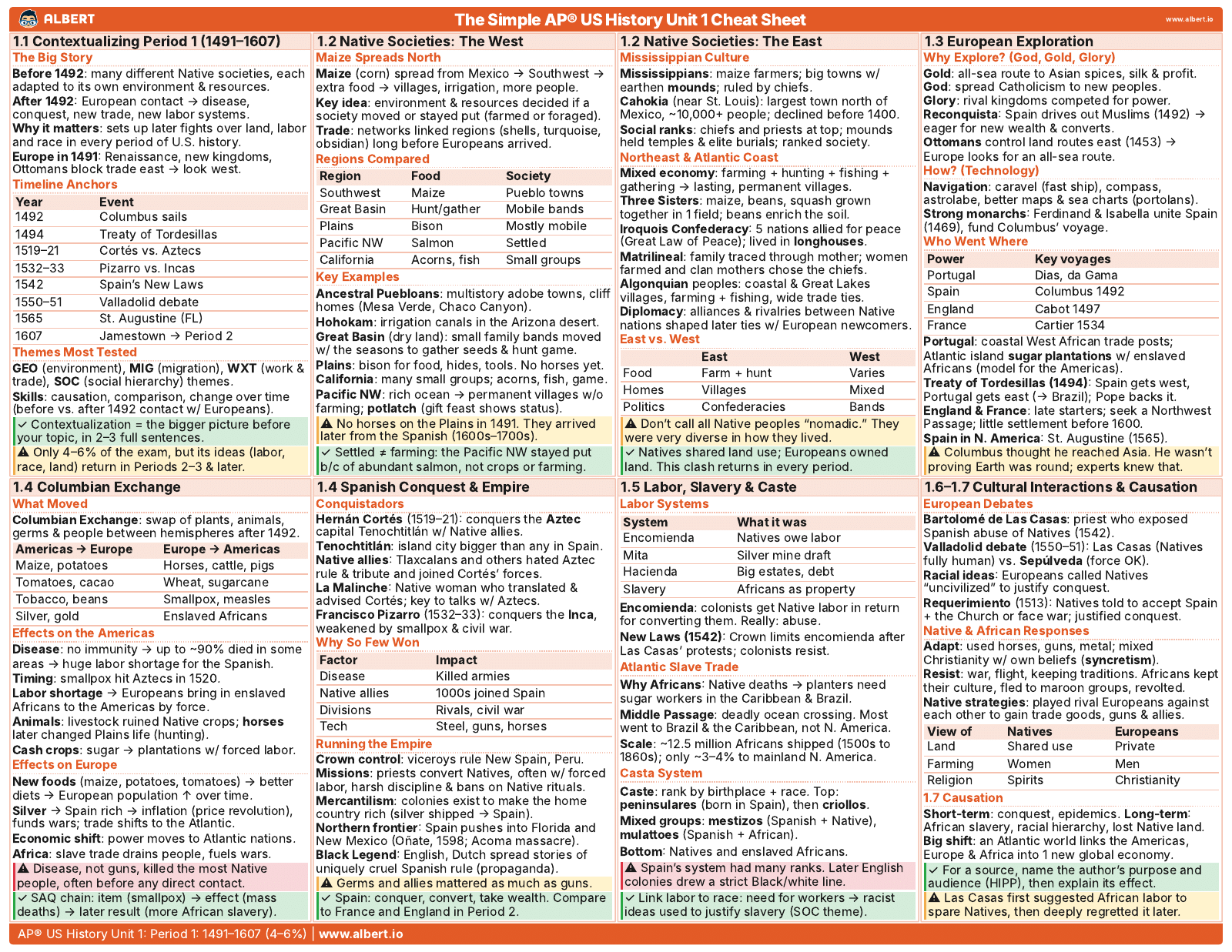
Our APUSH Unit 1 cheat sheet packs Period 1 (1491–1607) onto one printable page: Native societies before contact, European exploration, the Columbian Exchange, Spanish conquest, and the labor and caste systems that followed. This unit is worth 4–6% of the AP® US History exam. Download the Simple version for a first pass or the Ultimate version for full-detail review.
Practice AP® US History Unit 1 questions on Albert
What’s on the APUSH Unit 1 Cheat Sheet?
Both versions follow the same eight cards, built from the College Board’s AP® US History Course and Exam Description: context for the period, Native societies in the West, Native societies in the East, European exploration, the Columbian Exchange, Spanish conquest, labor and caste, and cultural interactions with causation.
The Simple version is for students meeting Period 1 for the first time or reviewing it quickly. It keeps the core facts, a timeline, and one tip and one warning per card, with a few words of context the first time a term appears.
The Ultimate version is for students aiming for a 4 or 5. It adds the details that separate a vague answer from a precise one: Cahokia’s dates, the Requerimiento, the mita, the New Laws of 1542, the Valladolid debate, the scale of the Atlantic slave trade, and specific exam traps. Start with Simple, then move to Ultimate once the big story feels familiar.
AP® US History Unit 1 at a Glance
Period 1 is the shortest unit in the course, about eight class periods, and it carries 4–6% of the exam score. Here are its seven topics.
| Topic | Name | Focus |
|---|---|---|
| 1.1 | Contextualizing Period 1 | The world of 1491 and why contact mattered |
| 1.2 | Native American Societies Before European Contact | How environment shaped economies and societies |
| 1.3 | European Exploration in the Americas | Motives and tools behind the voyages |
| 1.4 | Columbian Exchange, Spanish Exploration, and Conquest | What moved across the Atlantic and how Spain conquered |
| 1.5 | Labor, Slavery, and Caste in the Spanish Colonial System | Encomienda, African slavery, and the casta system |
| 1.6 | Cultural Interactions Between Europeans, Native Americans, and Africans | Debates over treatment and how people adapted or resisted |
| 1.7 | Causation in Period 1 | Short- and long-term effects of contact |
The weight is small, but the ideas are not. Land, coerced labor, race, and Native resistance all start here and come back in every later period.
Key Concepts in Unit 1: Period 1, 1491–1607
Native Societies Shaped by Their Environments (1.2)
The first big idea is diversity. Native peoples in 1491 did not share one culture or one way of life. What decided how a society lived was mostly its environment. Maize cultivation spread north from present-day Mexico into the Southwest, and where maize grew, surplus food supported permanent villages, irrigation, and more complex social structures. The Ancestral Puebloans built multistory adobe towns, and the Hohokam dug canal systems across the Arizona desert.
Where farming was hard, societies stayed mobile. Great Basin peoples moved in small family bands, and Plains peoples hunted bison on foot (horses arrived only after Spanish contact). The Pacific Northwest breaks the pattern: abundant salmon let peoples like the Chinook live in permanent villages without farming. In the East, Mississippian peoples built mound towns such as Cahokia, and Northeastern nations combined farming of maize, beans, and squash with hunting, fishing, and gathering. The Iroquois Confederacy united five nations, and its clans were matrilineal.
Worked example: An SAQ asks you to explain one way environment shaped a Native society before 1492. A strong answer: “In the Pacific Northwest, abundant salmon and ocean resources allowed peoples such as the Chinook to build permanent villages and ranked societies without relying on agriculture.” That names a place, a resource, and a result.
Exam tip: Avoid calling Native peoples “nomadic” or “primitive” as a group. Multiple-choice options built on that idea are usually wrong.
Why Europeans Sailed West (1.3)
Historians often sum up European motives as “God, gold, and glory.” Merchants and monarchs wanted a sea route to Asian spices and silk that avoided Ottoman and Italian middlemen. Rulers wanted to spread Catholicism. New, centralized monarchies in Spain, Portugal, France, and England competed for wealth and prestige. Spain had just completed the Reconquista in 1492, leaving a class of soldiers eager for new conquests.
Technology made the voyages possible: the caravel, the magnetic compass, the astrolabe, and better maps. Portugal led the way down the African coast and built sugar plantations on Atlantic islands worked by enslaved Africans, a model later copied in the Americas. The Treaty of Tordesillas (1494) divided newly claimed lands between Spain and Portugal, which is why Brazil speaks Portuguese.
Worked example: A stimulus shows a 15th-century map with Portuguese trading posts along West Africa. A question asks what development it reflects. The answer: European states searching for new trade routes and sources of wealth, which set the stage for the Atlantic slave trade.
Exam tip: When asked about causes of exploration, give at least two categories (economic, religious, political). Ranking them shows analysis.
The Columbian Exchange (1.4)
The Columbian Exchange was the transfer of plants, animals, diseases, and people between the Eastern and Western Hemispheres after 1492. From the Americas came maize, potatoes, tomatoes, cacao, and tobacco. From Europe and Africa came horses, cattle, pigs, wheat, sugarcane, and diseases like smallpox and measles.
Disease had the biggest effect. With no immunity, Native populations fell by as much as 90% in some areas, which created labor shortages that Europeans filled with enslaved Africans. American foods improved diets in Europe and Africa and helped populations grow. American silver from mines like Potosí made Spain rich for a time, drove up prices across Europe, and helped shift economic power toward Atlantic nations.
Worked example: “Explain one effect of the Columbian Exchange on the Americas.” Chain it: smallpox killed huge numbers of Native people, which reduced the available labor force, which led Spanish and Portuguese colonists to import enslaved Africans to work plantations and mines.
Exam tip: Readers reward causal chains. Name the item, its immediate effect, and a longer-term consequence.
Spanish Conquest and Colonial Labor (1.4–1.5)
Hernán Cortés conquered the Aztec capital of Tenochtitlán in 1521 and Francisco Pizarro toppled the Inca in the early 1530s. Small Spanish forces won because of disease, thousands of Native allies who resented Aztec rule, divisions within Native empires, and steel weapons and horses. Spain then built an empire run by viceroys and organized around mercantilism: colonies existed to enrich Spain.
Labor systems followed. The encomienda gave colonists the right to Native labor and tribute in exchange for Christianizing them, and in practice it was brutal. The mita, borrowed from the Inca, drafted Andean workers for the silver mines. As Native populations collapsed, the Atlantic slave trade grew, sending most enslaved Africans to Brazil and the Caribbean. Few Spanish women migrated, so intermarriage produced a mixed population, and the Spanish casta system ranked people by birthplace and ancestry: peninsulares, then criollos, then mestizos and mulattoes, with Native people and enslaved Africans at the bottom.
Worked example: A source excerpt from a Spanish colonial official complains about labor shortages in the mines. Contextualize it: Native population decline from disease and overwork led Spain to rely on the mita and, increasingly, on enslaved Africans.
Exam tip: Connect labor to race. The need for coerced labor helped produce ideas about racial hierarchy, a link that earns credit for sophisticated analysis.
Cultural Interactions and Causation (1.6–1.7)
Europeans argued about how to treat Native peoples. The Requerimiento of 1513 told Native peoples to accept Spanish rule and Christianity or face war. The priest Bartolomé de Las Casas condemned Spanish abuses, and in the Valladolid debate (1550–51) he argued that Native peoples were fully human, while Juan Ginés de Sepúlveda argued that force was justified. Native peoples and Africans responded by adapting, through new tools, horses, and blending Christianity with their own beliefs, and by resisting through war, flight, and keeping their traditions.
Worked example: For a Las Casas excerpt, sourcing means identifying his purpose (persuading the Spanish Crown to reform colonial policy) and his audience (the king and Spanish officials). That explains why he describes abuses so vividly.
Exam tip: For causation, separate short-term effects (conquest, epidemics) from long-term ones (African slavery, racial hierarchy, Native dispossession).
How Unit 1 Shows Up on the Exam
Expect Period 1 mostly in multiple-choice sets, where you read a primary or secondary source and answer two to four questions about context, causation, or comparison. Maps, images, and excerpts from figures like Las Casas are common stimuli.
Starting with the May 2027 exam, all three short-answer questions include a source and each covers a different period, so a Period 1 source can appear in an SAQ. Answer each part directly, in one to three sentences, with specific evidence. The document-based question covers 1754 to 1980, so Period 1 will not be the DBQ, though it can serve as context for a later topic. The long essay is now a single broad prompt, and Period 1 evidence can support essays about labor, Native-European relations, or colonization. Scorers reward a clear claim, accurate specific evidence, and reasoning that explains why, not just what.
For AP® US History Unit 1 review, pair the green tips on the APUSH Unit 1 cheat sheet with timed practice questions so you get used to reading a source and answering fast.
Common Mistakes in Unit 1
- Treating Native peoples as one group. Fix: name the region and how its environment shaped it.
- Crediting conquest to guns alone. Fix: include disease, Native allies, and divisions within Native empires.
- Putting horses on the Plains in 1491. Fix: horses arrived with the Spanish and changed Plains life later.
- Confusing encomienda with slavery. Fix: encomienda was a grant of Native labor and tribute; chattel slavery made Africans property for life.
- Writing vague contextualization. Fix: describe specific broader forces, like the Reconquista or competition among European monarchies.
Frequently Asked Questions
Can I use this cheat sheet on the exam?
No. The AP® US History exam does not allow notes or reference sheets. The APUSH Unit 1 cheat sheet is a study tool for review before test day, like a one-page Period 1 study guide.
Should I start with the Simple or Ultimate version?
Start with Simple if you are new to Period 1 or short on time. Move to Ultimate when you can explain the big story without notes and want the specific evidence that strengthens essays.
How much of the exam is Unit 1?
About 4–6% of your score. It is small, but its themes of land, labor, and race appear throughout the course.
What dates does Unit 1 cover?
1491 to 1607, from Native societies before Columbus to the founding of Jamestown, which begins Period 2.