
Maximize your score with these resources:
- Albert.io AP® World History question banks
- Free AP® World History study guides
- Free AP® World History score calculator
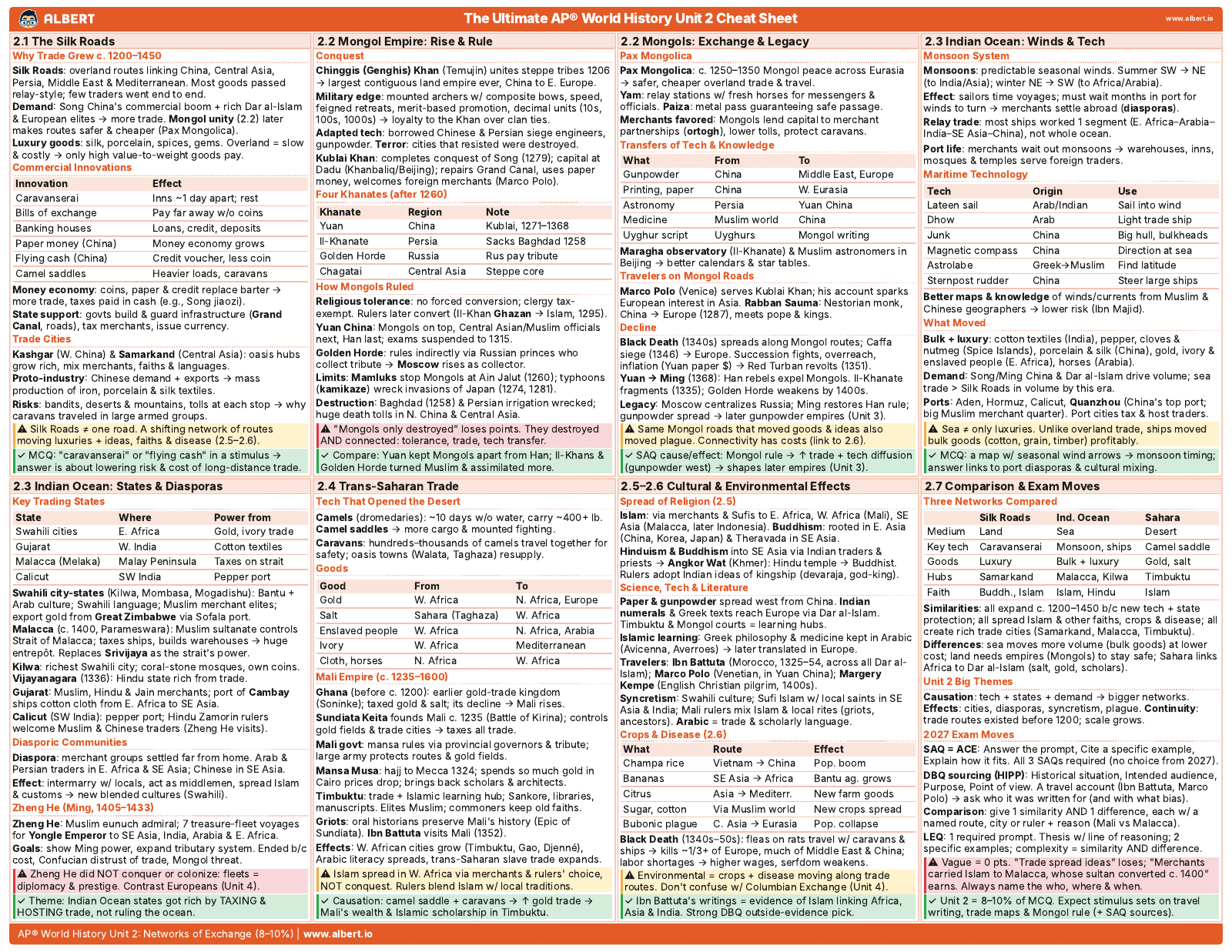
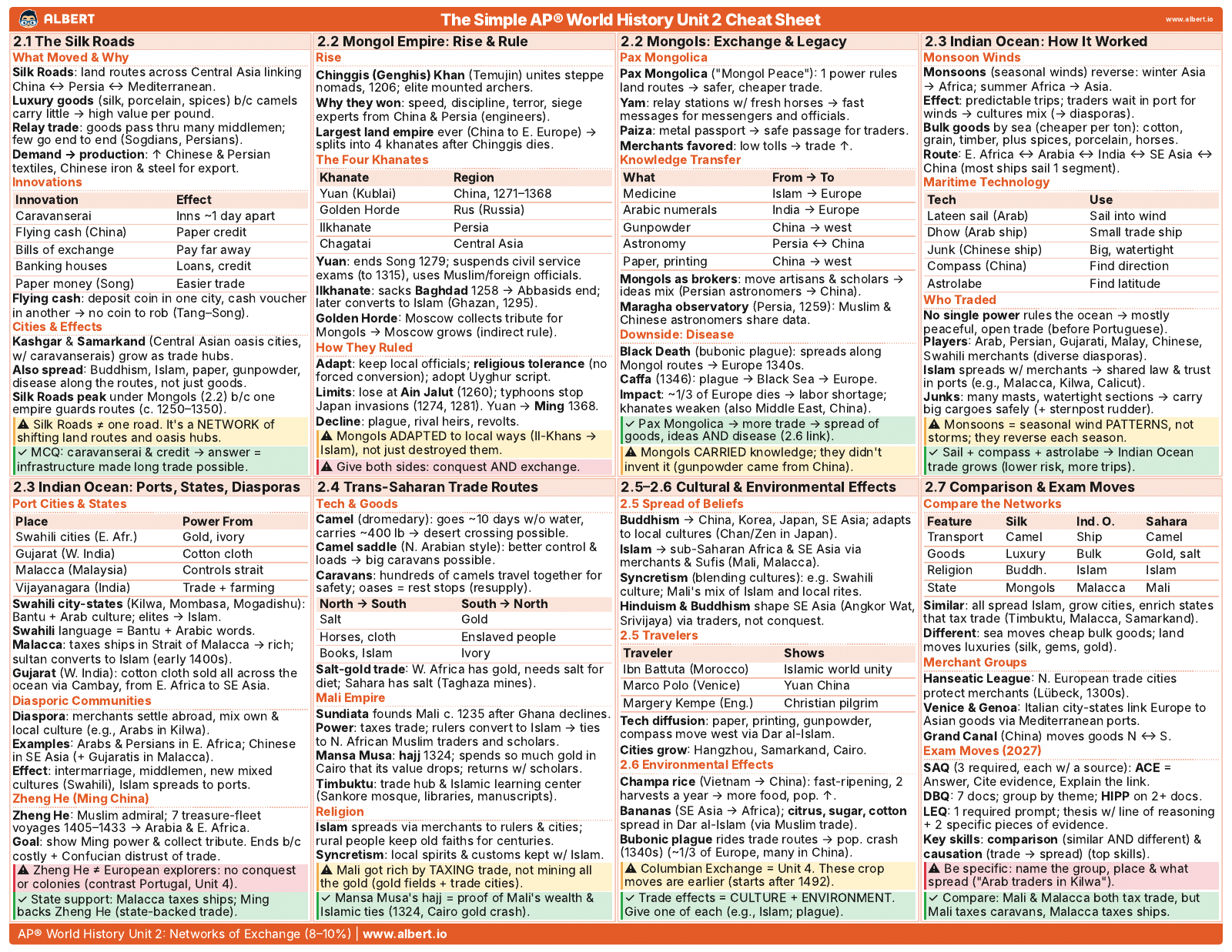
Our AP® World History Unit 2 cheat sheet packs Networks of Exchange (c. 1200 to 1450) onto one page: the Silk Roads, the Mongol Empire, Indian Ocean and trans-Saharan trade, and what all that contact did to cultures and environments. Unit 2 is worth 8 to 10% of the exam. Download the Simple version for a first pass or the Ultimate version for full detail.
Practice AP® World History Unit 2 questions on Albert
What’s on the AP® World History Unit 2 Cheat Sheet?
Both versions cover the same seven College Board topics (2.1 through 2.7) across eight cards, so you can switch between them without losing your place. The difference is depth.
The Simple version is for students meeting this unit for the first time or reviewing after a break. It keeps the core of each topic: what moved on each network, the technology that made it possible, the big states and people, and the one trap per topic most likely to cost you points. Key ideas get a few words of context the first time they appear.
The Ultimate version is for students who already know the basics and want everything in one place for test prep. It adds the four Mongol khanates with a key fact for each, a full maritime technology table, the salt and gold goods on the trans-Saharan routes, Ibn Battuta, Marco Polo and Margery Kempe side by side, and a three-network comparison table. Its last card turns the content into exam moves for the new SAQ, DBQ and LEQ formats.
Use either one as your AP® World History Unit 2 review sheet alongside your notes, class readings and practice questions.
AP® World History Unit 2 at a Glance
The AP® World History: Modern course places Unit 2 right after the state-building of Unit 1. Where Unit 1 asks how societies were organized around 1200, Unit 2 asks how they were connected, and what those connections changed.
| Topic | Name | Focus |
|---|---|---|
| 2.1 | The Silk Roads | Caravanserai, flying cash, bills of exchange, and the cities that grew from overland trade |
| 2.2 | The Mongol Empire and the Making of the Modern World | Conquest, the khanates, Pax Mongolica, and the transfer of technology and ideas |
| 2.3 | Exchange in the Indian Ocean | Monsoon winds, maritime technology, port states, diasporic communities, Zheng He |
| 2.4 | Trans-Saharan Trade Routes | Camels and saddles, the salt and gold trade, the Mali Empire |
| 2.5 | Cultural Consequences of Connectivity | Spread of religions, travelers, and technology |
| 2.6 | Environmental Consequences of Connectivity | Crop transfers and the bubonic plague |
| 2.7 | Comparison of Economic Exchange | How the three networks were alike and different |
Unit 2 accounts for 8 to 10% of the multiple-choice section, but its ideas show up far more often than that number suggests. Trade, diffusion and the Mongols are favorite context for DBQs and LEQs that start in 1200.
Key Concepts in Unit 2: Networks of Exchange
The Silk Roads and the Tools of Long-Distance Trade (2.1)
The Silk Roads were a shifting web of land routes linking China, Central Asia, Persia and the Mediterranean. Camels carry limited loads and the trips took months, so merchants focused on luxury goods with high value per pound: silk, porcelain, spices and precious stones. Very few traders traveled the whole distance. Goods moved in a relay, passing through many hands and gaining value at each stop.
What made the system work was commercial infrastructure. Caravanserai gave caravans safe places to rest roughly a day’s travel apart. Flying cash in China and bills of exchange in the Islamic world let merchants move value without carrying heavy coins. Banking houses extended credit. Demand for luxury goods also pushed production upward, especially Chinese and Persian textiles and Chinese iron and steel.
Worked example: A source describes a merchant depositing coins in one city and collecting a paper note to cash in another. Identify the practice (flying cash or a bill of exchange) and explain its effect: lower risk of theft, so more merchants could trade over long distances.
Exam tip: When an answer choice mentions caravanserai or credit, the question is almost always about infrastructure that made trade possible, not about a specific good.
The Mongol Empire: Conquest and Connection (2.2)
Temujin united the steppe nomads and took the title Chinggis Khan in 1206. Mobile horse archers, strict discipline, terror tactics and siege engineers recruited from China and Persia built the largest land empire in history. After his death it split into four khanates: the Yuan in China, the Golden Horde in Rus, the Ilkhanate in Persia, and the Chagatai Khanate in Central Asia.
The Mongols did not rule by replacing local systems. They kept local officials and tax collectors, tolerated many religions, and adopted the Uyghur script. The Ilkhanate sacked Baghdad in 1258 and ended the Abbasid Caliphate, then later converted to Islam. In Rus, Moscow’s princes grew stronger by collecting tribute for the Golden Horde.
Mongol control of Eurasia created the Pax Mongolica. The Yam relay system and paiza passports made travel safer, and Silk Road trade peaked. Greek and Islamic medicine, Arabic numerals, gunpowder, paper and printing all moved more freely. So did the bubonic plague, which reached Europe through the Black Sea port of Caffa in the 1340s.
Worked example: An LEQ asks how the Mongols affected Eurasia. A strong thesis covers both sides: violent conquest that destroyed cities like Baghdad, and the trade and knowledge transfer made possible by Pax Mongolica.
Exam tip: The Mongols carried knowledge across Eurasia; they did not invent it. If a choice credits them with inventing gunpowder, it is wrong.
The Indian Ocean: Winds, Ships and Port States (2.3)
The Indian Ocean was the largest trade network of the period. The key was the monsoon, seasonal winds that blow from Asia toward Africa in winter and reverse in summer. That pattern made sailing predictable. Merchants often waited months in port for the winds to turn, which turned port cities into meeting places for many cultures.
Technology mattered too. The lateen sail, the Arab dhow, the large Chinese junk, the magnetic compass and the astrolabe all made longer voyages possible. Because ships could carry far more than camels, the Indian Ocean moved bulk goods such as cotton cloth, grain and timber alongside spices.
States grew by controlling or serving this trade. The Swahili city-states of East Africa, Gujarat in western India, the Sultanate of Malacca and Vijayanagara in southern India all prospered. Merchants who settled abroad formed diasporic communities, such as Arab and Persian traders in East Africa and Chinese merchants in Southeast Asia. Swahili culture and language, a Bantu base with Arabic influence, is the classic example of the blending this produced.
Ming China briefly entered the ocean on its own terms. Admiral Zheng He led seven voyages between 1405 and 1433 to display Ming power and collect tribute. They ended because they were expensive and the court turned toward defending its northern border.
Exam tip: Zheng He is not Columbus. His voyages had no colonies and no conquest.
Trans-Saharan Trade and the Mali Empire (2.4)
Camels can travel days without water, and the camel saddle let riders control them and carry heavier loads. Together they made large caravans across the Sahara possible. The core exchange was simple: West Africa had gold but needed salt, and the Sahara had salt.
The Mali Empire, founded by Sundiata around 1235, grew rich by controlling and taxing this trade. Its rulers converted to Islam, which strengthened ties with North African merchants. Mansa Musa‘s hajj in 1324 became famous because he spent so much gold in Cairo that its value dropped. Timbuktu grew into both a trade hub and a center of Islamic learning.
Worked example: A SAQ shows a map of Mansa Musa’s route to Mecca. Use it as evidence of two things at once: Mali’s wealth from the gold trade, and its connection to the wider Islamic world.
Exam tip: Mali’s power came from taxing trade, not from mining all of the gold itself.
Cultural and Environmental Consequences (2.5 to 2.6)
Trade carried beliefs. Buddhism spread into East and Southeast Asia, Hinduism and Buddhism shaped states like the Khmer Empire, and Islam reached sub-Saharan Africa and Southeast Asia with merchants and Sufi missionaries. Rulers and city elites often converted first, while rural people blended new faiths with older practices. That blending is syncretism.
Travelers left records you can use as evidence. Ibn Battuta’s journeys across Dar al-Islam show how shared Islamic law let him work as a judge far from home. Marco Polo described Yuan China to Europeans. Margery Kempe recorded Christian pilgrimage.
Trade also changed environments. Champa rice from Vietnam boosted China’s food supply and population. Bananas spread from Southeast Asia to Africa, and citrus, sugar and cotton spread across the Islamic world and the Mediterranean. The same routes carried the bubonic plague across Afro-Eurasia in the 1340s.
Exam tip: These crop transfers happen inside Afro-Eurasia, long before 1492. The Columbian Exchange belongs to Unit 4.
How Unit 2 Shows Up on the Exam
Starting in May 2027, the updated AP history exam format has 55 multiple-choice questions (40%), three required short-answer questions that are all sourced (20%), one DBQ with seven documents (25%), and one required LEQ (15%). The College Board says scoring rubrics stay the same.
Multiple-choice sets on Unit 2 usually pair a primary source, such as a traveler’s account or a merchant’s letter, with questions on causation and comparison. You might be asked what made a trade route possible, what effect trade had on a region, or which development was a similarity across networks.
Because the SAQs are now all sourced, expect to read a short secondary source on, for example, the Mongols, then identify and explain a development using specific evidence. The DBQ and LEQ now cover a wide time span, so Unit 2 often supplies the starting point for change-over-time arguments that run to 1450 and beyond.
Scorers reward specific evidence tied clearly to the claim. “Trade spread ideas” earns nothing. “Muslim merchants spread Islam to the Swahili city-states of East Africa” can earn the point.
Common Mistakes in Unit 2
- Treating the Silk Roads as one road. It was a network of routes, and few people traveled all of it. Describe it as a relay system.
- Calling the Mongols only destroyers. Prompts expect both conquest and exchange. Pair Baghdad in 1258 with Pax Mongolica.
- Comparing Zheng He to European explorers. His voyages sought prestige and tribute, not colonies. Say so directly when you compare.
- Mixing up time periods. Champa rice and bananas spread within Afro-Eurasia in this unit. Crops crossing the Atlantic belong in Unit 4.
- Giving a similarity without a difference. On comparison questions, name both, with a specific example for each.
Frequently Asked Questions
Can I use this cheat sheet on the AP® World History exam?
No. No notes are allowed on the exam. The cheat sheet is a study tool for review in the weeks before test day.
Should I start with the Simple or the Ultimate version?
Start with the Simple AP® World History Unit 2 cheat sheet if the unit is new or fuzzy. Move to Ultimate once you can explain each topic without looking, since its extra detail is what turns a general answer into one that earns evidence points.
How much of the exam is Unit 2?
The College Board weights Unit 2 at 8 to 10% of the multiple-choice section. Its themes also appear in free-response questions that span several periods.
What should I memorize for Unit 2?
Know one or two specific examples for each network: the technology that made it work, a state that grew from it, and something that spread along it. Then test yourself with AP® World History Unit 2 practice questions. For a deeper Networks of Exchange study guide on Topic 2.7, read our Comparison of Economic Exchange review.