
Maximize your score with these resources:
- Albert.io AP® US History question banks
- Free AP® US History study guides
- Free AP® US History score calculator
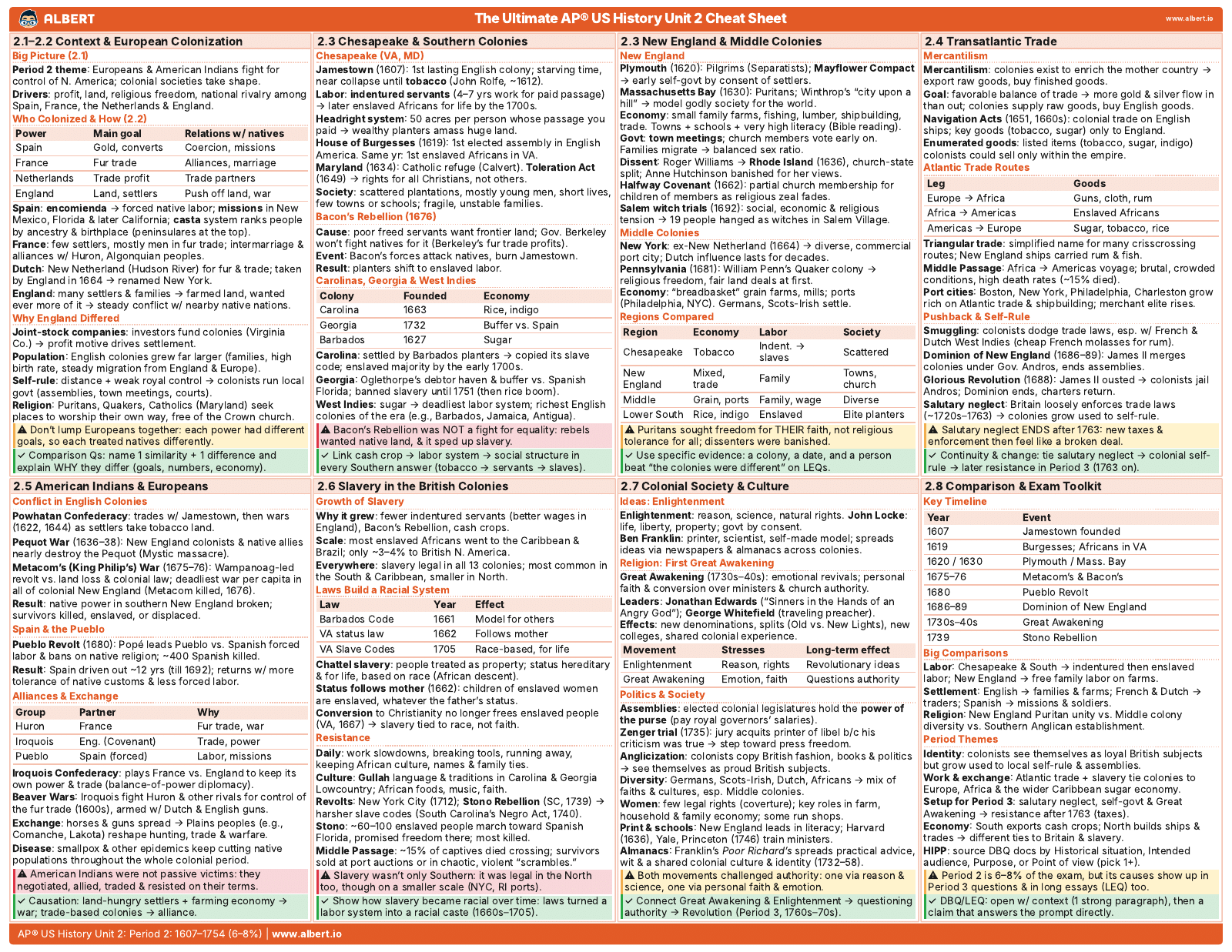
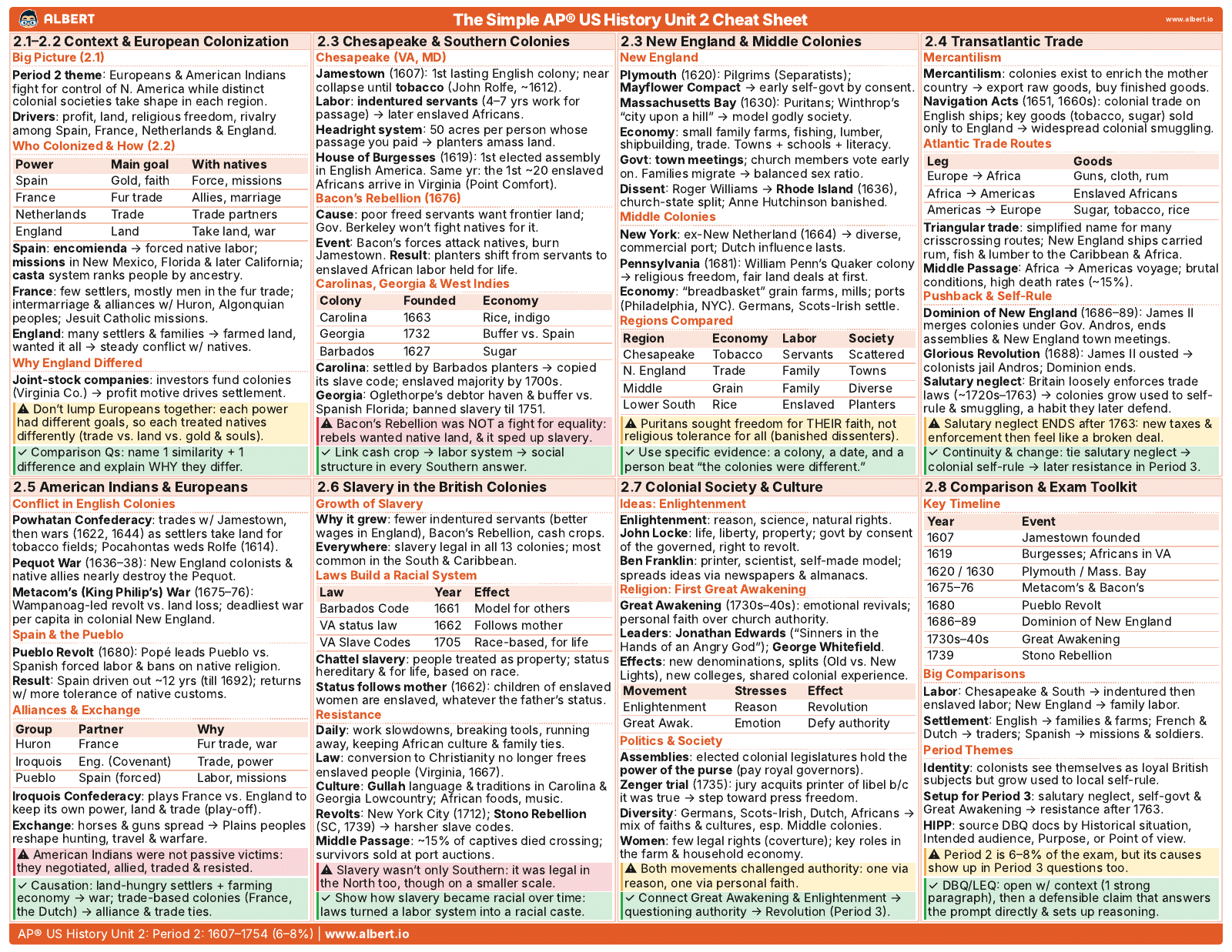
This APUSH Unit 2 cheat sheet covers Period 2, 1607–1754, from Jamestown to the eve of the French and Indian War. The period makes up 6–8% of the exam, but its ideas about labor, self-rule, and religion drive the Revolution that follows. Pick the Simple version for the essentials or the Ultimate version for every key date, law, and exam trap.
Practice AP® US History Unit 2 questions on Albert
What’s on the APUSH Unit 2 Cheat Sheet?
Both versions follow the same eight cards, mapped to the AP® United States History Course and Exam Description: European colonization, the Chesapeake and Southern colonies, New England and the Middle colonies, transatlantic trade, American Indian and European interactions, slavery, colonial society and culture, and a comparison and exam toolkit card.
The Simple version is for students who want the core story: who settled where, why, and what each region looked like. It keeps the main dates, the big laws, and the single most common mistake for each topic.
The Ultimate version is for students aiming at a 4 or 5. It adds the specific evidence that wins essay points: the headright system, the Halfway Covenant, the Dominion of New England, the 1662 Virginia law that made slavery follow the mother’s status, the Zenger trial, and the Stono Rebellion. If you can use every line on the Ultimate APUSH Unit 2 cheat sheet as evidence, your essays will not run short on specifics.
APUSH Unit 2 at a Glance
Period 2 covers how Europeans, American Indians, and Africans shaped colonial North America, and how British colonies grew into distinct regions with a growing habit of self-government. It accounts for 6–8% of the AP® U.S. History exam.
| Topic | Name | Focus |
|---|---|---|
| 2.1 | Contextualizing Period 2 | Competition for North America; why colonies formed |
| 2.2 | European Colonization | Spanish, French, Dutch, and British goals and methods |
| 2.3 | The Regions of British Colonies | Chesapeake, New England, Middle, and Southern colonies |
| 2.4 | Transatlantic Trade | Mercantilism, Navigation Acts, Atlantic trade routes |
| 2.5 | Interactions Between American Indians and Europeans | War, trade, alliances, and resistance |
| 2.6 | Slavery in the British Colonies | Growth of race-based slavery and resistance to it |
| 2.7 | Colonial Society and Culture | Enlightenment, Great Awakening, self-government |
| 2.8 | Comparison in Period 2 | Comparing regions and colonizing powers |
Key Concepts in Unit 2: Period 2, 1607–1754
European Colonization (Topics 2.1–2.2)
Spain, France, the Netherlands, and England all colonized North America, but they did it for different reasons and in different ways. Spain sought gold and converts and used the encomienda system and missions, which forced native labor and pressed Catholicism. France sent few settlers, built its colony on the fur trade, and relied on alliances and intermarriage with American Indian nations. The Dutch focused on trade along the Hudson River until England took New Netherland in 1664.
England stood apart because it sent large numbers of settlers, including whole families. Those settlers wanted land to farm, which led to steady conflict with American Indians. Joint-stock companies, like the Virginia Company, funded early colonies in search of profit.
Worked example: compare French and English relations with American Indians. Both traded with native nations. But the French needed native partners to run the fur trade, so they built alliances, while the English wanted farmland, so they pushed native peoples off it. The difference in goals explains the difference in relations.
Exam tip: comparison questions reward a similarity, a difference, and an explanation of why the difference exists. Listing traits side by side is not enough.
The Regions of British Colonies (Topic 2.3)
The Chesapeake colonies of Virginia and Maryland grew around tobacco. Planters relied first on indentured servants and later on enslaved Africans, and the headright system let them build large landholdings. Settlements were scattered, and the population skewed young and male in the early decades.
New England was settled by Puritan families seeking to build a godly society. Its economy mixed small farms, fishing, shipbuilding, and trade, and its towns supported schools, churches, and town meetings. Dissenters like Roger Williams and Anne Hutchinson were pushed out, and Williams founded Rhode Island.
The Middle colonies, especially Pennsylvania and New York, were the most diverse. Pennsylvania, founded by William Penn as a Quaker colony, offered religious freedom. Grain farms earned the region the name “breadbasket.” The Lower South, including Carolina, grew rice and indigo with an enslaved majority, following a model borrowed from Barbados.
Worked example: Bacon’s Rebellion (1676) shows how labor and land shaped the Chesapeake. Poor freed servants wanted frontier land, and Governor Berkeley refused to wage war on American Indians to get it. After the rebellion, planters turned more to enslaved labor, which they saw as more controllable than a growing class of poor freed servants.
Exam tip: for any regional question, connect the economy to the labor system and then to the social structure. That chain is what readers look for.
Transatlantic Trade (Topic 2.4)
Under mercantilism, colonies existed to enrich the mother country by supplying raw materials and buying finished goods. The Navigation Acts required colonial trade to use English ships and sent key goods like tobacco and sugar only to England. The Atlantic economy linked Europe, Africa, and the Americas, often simplified as “triangular trade.”
Colonists did not always follow the rules. Smuggling was common. When James II merged the northern colonies into the Dominion of New England (1686–1689) and suspended their assemblies, colonists in Boston overthrew Governor Andros after the Glorious Revolution. For much of the 1700s, Britain practiced salutary neglect, loosely enforcing trade laws.
Worked example: trace continuity and change. Salutary neglect let colonial assemblies grow strong and used to self-rule. When Britain began enforcing laws and passing new taxes after 1763, colonists saw a sharp break from the past, which fed resistance in Period 3.
Exam tip: salutary neglect is one of the most useful links between Periods 2 and 3. Use it to explain why later British policies felt like a betrayal.
American Indians and Europeans (Topic 2.5)
Relations ranged from trade and alliance to open war. In Virginia, the Powhatan Confederacy traded with Jamestown, then fought wars in 1622 and 1644 as settlers took land for tobacco. In New England, the Pequot War (1636–1638) and Metacom’s War (1675–1676) broke native power in the region. In New Mexico, the Pueblo Revolt (1680), led by Popé, drove the Spanish out for about 12 years; when Spain returned, it allowed more native religious practice.
American Indian nations also used European rivalries to their advantage. The Iroquois Confederacy balanced France against England to protect its trade and power. Horses and guns spread across the continent and changed life on the Plains.
Worked example: explain the Pueblo Revolt’s causes and effects. Spanish forced labor and bans on native religion caused the revolt. The effect was a Spanish return marked by greater tolerance of Pueblo customs, a clear example of resistance changing colonial policy.
Exam tip: treat American Indians as actors, not only victims. Essays that show native nations negotiating, allying, and resisting earn more credit for complexity.
Slavery and Colonial Society (Topics 2.6–2.7)
Slavery existed in all 13 colonies but grew fastest in the South and the Caribbean. Colonial laws turned it into a hereditary, race-based system: a 1662 Virginia law made a child’s status follow the mother’s, and the 1705 Virginia Slave Codes defined enslaved people as property for life. Enslaved people resisted through work slowdowns, running away, preserving African culture, and revolts such as the Stono Rebellion (1739) in South Carolina.
Two movements reshaped colonial culture. The Enlightenment stressed reason and natural rights, with John Locke’s ideas about government by consent. The First Great Awakening (1730s–1740s), led by preachers like Jonathan Edwards and George Whitefield, stressed personal faith over church authority. Both encouraged colonists to question established authority.
Worked example: the Zenger trial (1735) shows growing colonial confidence. A New York jury acquitted printer John Peter Zenger of libel for criticizing the royal governor, a step toward freedom of the press.
Exam tip: when you write about the Great Awakening or the Enlightenment, connect them forward. Questioning religious or political authority in the 1740s helps explain the Revolution in the 1770s.
How Unit 2 Shows Up on the Exam
The AP® U.S. History exam has 55 multiple-choice questions, 3 short-answer questions, 1 document-based question (DBQ), and 1 long essay question (LEQ). Multiple-choice questions come in sets tied to a stimulus, such as a primary source, map, or chart.
Period 2 often appears in multiple-choice sets built on colonial sources: a Puritan sermon, a colonial law, a description of Atlantic trade, or a native leader’s speech. Short-answer questions often ask you to compare regions or colonizing powers. On the LEQ, Period 2 can be the focus of a comparison or causation prompt. Readers reward a clear, defensible claim, specific evidence, and reasoning that explains how the evidence supports the claim.
Common Mistakes in Unit 2
- Mistake: describing all colonizers as acting the same way. Fix: explain how Spain, France, the Netherlands, and England each had different goals and so treated American Indians differently.
- Mistake: saying the Puritans believed in religious freedom for everyone. Fix: they sought freedom for their own faith and banished dissenters like Roger Williams and Anne Hutchinson.
- Mistake: treating Bacon’s Rebellion as a fight for equality. Fix: rebels wanted American Indian land, and the rebellion pushed planters toward enslaved labor.
- Mistake: describing slavery as only a Southern institution. Fix: slavery was legal in every colony, though far more common in the South and the Caribbean.
- Mistake: using vague evidence like “the colonies were different.” Fix: name a colony, a date, a law, or a person.
Frequently Asked Questions
Can I use this cheat sheet on the exam?
No. Notes are not allowed on the AP® U.S. History exam. Use the APUSH Unit 2 cheat sheet as a study tool in the weeks before the test.
Should I start with the Simple or the Ultimate version?
Start with Simple to learn the regions and the main events. Once you can explain each one, move to Ultimate to build the specific evidence you need for essays.
Why does Period 2 matter if it is only 6–8% of the exam?
Many causes of the American Revolution start here: salutary neglect, strong colonial assemblies, the Great Awakening, and Enlightenment ideas. Period 3 questions often expect you to know this background.
How should I practice with this sheet?
Pick a card, write a short comparison or causation paragraph from memory, then check it against the sheet. Follow up with timed APUSH Unit 2 practice questions built on primary sources.