
Maximize your score with these resources:
- Albert.io AP® US History question banks
- Free AP® US History study guides
- Free AP® US History score calculator
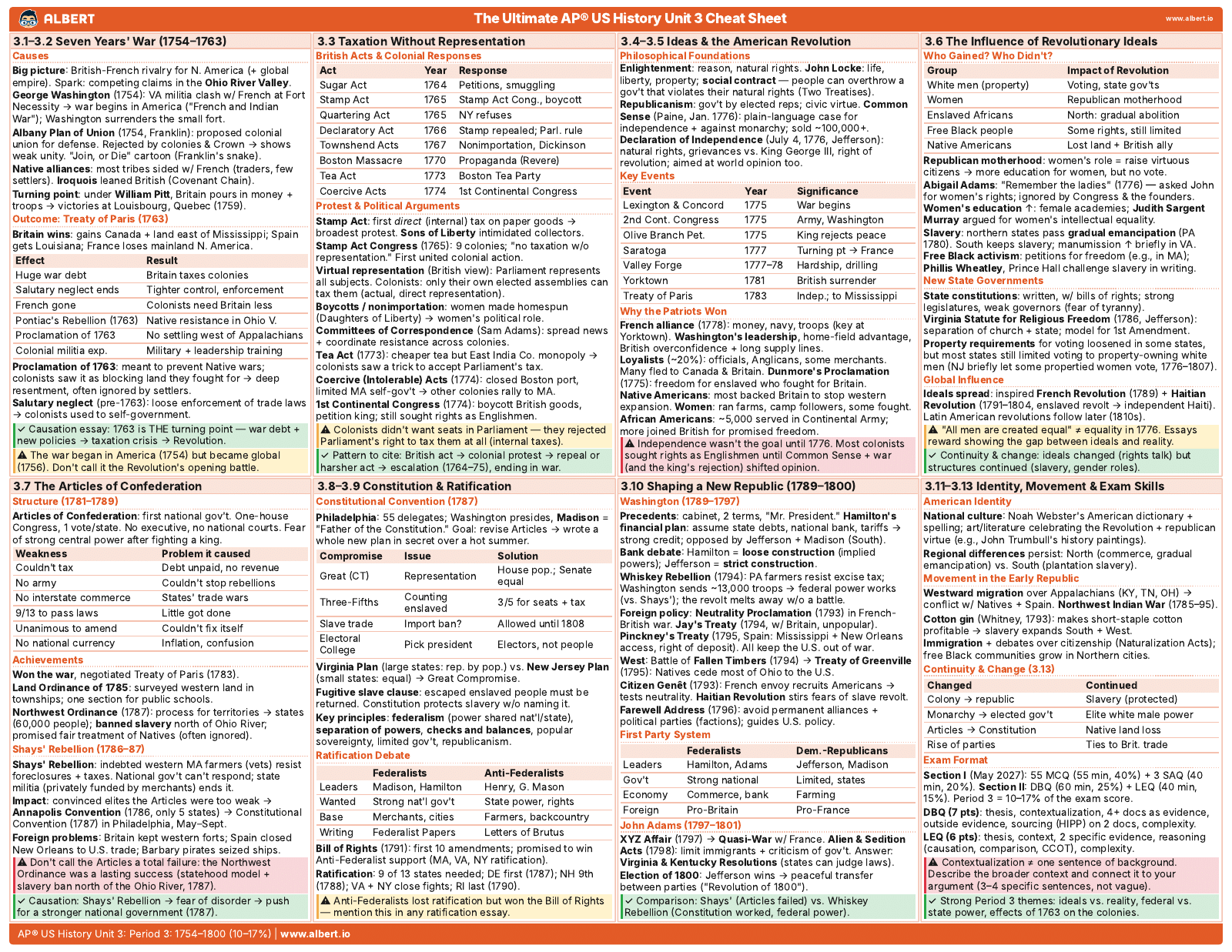
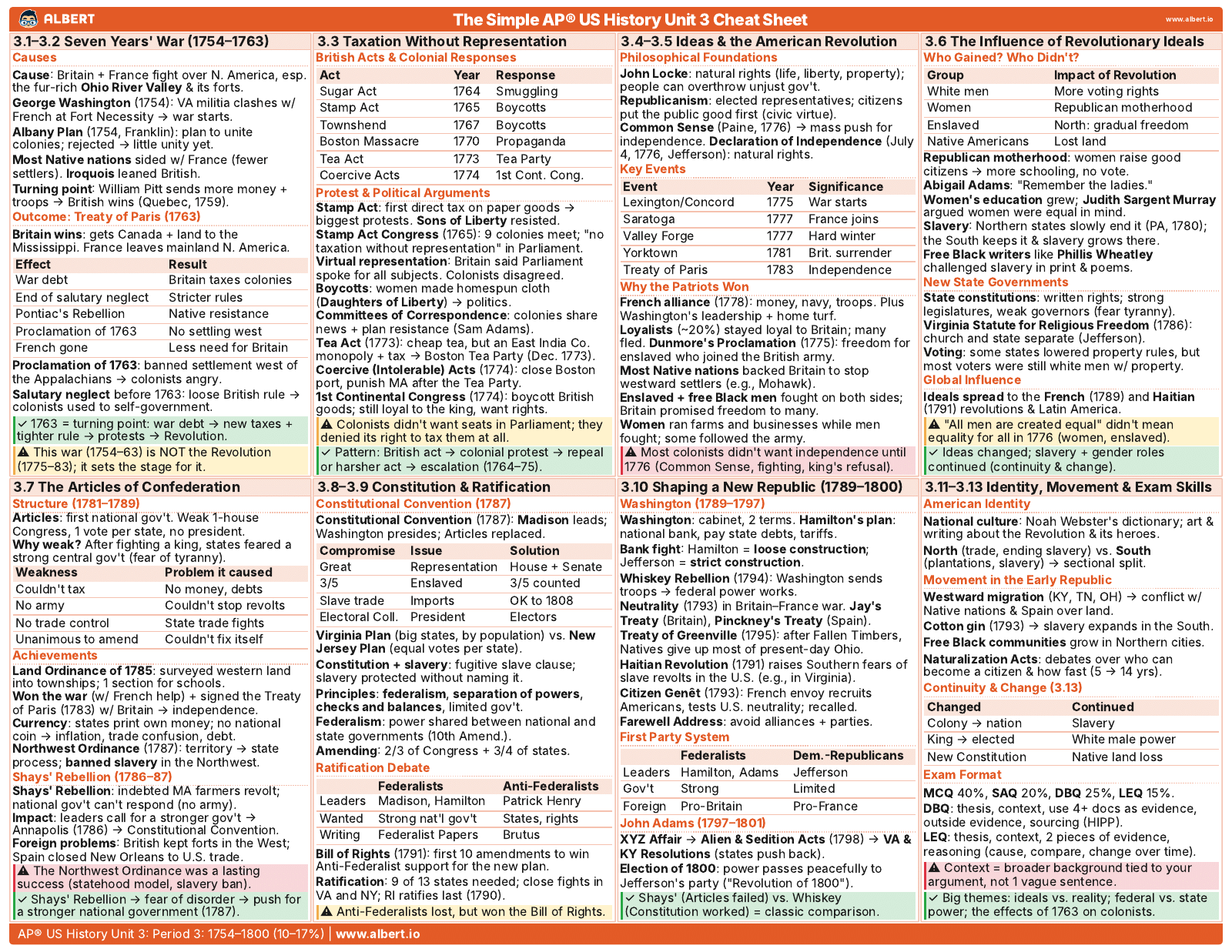
This APUSH Unit 3 cheat sheet takes you from the Seven Years’ War to the election of 1800 on a single page: the taxation crisis, the Revolution, the Articles of Confederation, the Constitution, and the first party system. Period 3 makes up 10–17% of the AP® United States History exam. Start with the Simple version for the core story, or use the Ultimate version for full detail.
Practice AP® US History Unit 3 questions on Albert
What’s on the APUSH Unit 3 Cheat Sheet?
Both versions follow the same eight cards: the Seven Years’ War, taxation without representation, the ideas and events of the Revolution, the influence of revolutionary ideals, the Articles of Confederation, the Constitution and ratification, the 1790s, and a final card on American identity, migration, continuity and change, and exam skills.
The Simple version gives you the essential chain of events, the key tables (British acts and colonial responses, the major battles, the weaknesses of the Articles, the compromises of 1787, the first two parties), and one key warning per card. Start there if Period 3 is new or fuzzy.
The Ultimate version adds the detail that strong essays use: salutary neglect, virtual representation, the Tea Act’s monopoly, Dunmore’s Proclamation, republican motherhood, the Virginia Statute for Religious Freedom, the Land Ordinance, Citizen Genêt, the XYZ Affair, and the DBQ and LEQ rubrics.
APUSH Unit 3 at a Glance
The College Board’s AP® US History Course and Exam Description divides Period 3 into 13 topics.
| Topic | Name | Focus |
|---|---|---|
| 3.1 | Contextualizing Period 3 | British-French rivalry, colonial society by 1754 |
| 3.2 | The Seven Years’ War (The French and Indian War) | Causes, Treaty of Paris (1763), Proclamation of 1763 |
| 3.3 | Taxation Without Representation | British acts and colonial resistance |
| 3.4 | Philosophical Foundations of the American Revolution | Enlightenment, Locke, Common Sense, the Declaration |
| 3.5 | The American Revolution | Key battles, French alliance, Loyalists |
| 3.6 | The Influence of Revolutionary Ideals | Women, enslaved people, state constitutions, global impact |
| 3.7 | The Articles of Confederation | Weaknesses, Northwest Ordinance, Shays’ Rebellion |
| 3.8 | The Constitutional Convention and Debates over Ratification | Compromises, Federalists vs. Anti-Federalists |
| 3.9 | The Constitution | Federalism, separation of powers, Bill of Rights |
| 3.10 | Shaping a New Republic | Washington and Adams, Hamilton’s plan, first parties |
| 3.11 | Developing an American Identity | National culture, regional differences |
| 3.12 | Movement in the Early Republic | Westward migration, cotton gin, conflict with Native nations |
| 3.13 | Continuity and Change in Period 3 | What the Revolution changed and what it didn’t |
At 10–17% of the exam, Period 3 accounts for roughly 6 to 9 of the 55 multiple-choice questions, and it’s a frequent setting for DBQ and LEQ prompts about the causes of the Revolution and the debate over federal power.
Key Concepts in Unit 3: Period 3, 1754–1800
The Seven Years’ War and the Turning Point of 1763
The war began in 1754 over competing British and French claims in the Ohio River Valley. A young George Washington’s clash with the French at Fort Necessity opened the fighting in North America. Britain won, and the Treaty of Paris (1763) pushed France off the mainland.
Victory created the problems that led to revolution. Britain was deep in debt and decided the colonies should help pay for their own defense. It also ended its long policy of salutary neglect, the loose enforcement of trade laws that had let the colonies govern themselves. After Pontiac’s Rebellion, the Proclamation of 1763 barred settlement west of the Appalachians, angering colonists who felt they had fought for that land.
Worked example: An LEQ asks you to evaluate the extent to which the Seven Years’ War changed the relationship between Britain and its colonies. A strong thesis argues that the war was a major turning point because the war debt and the end of salutary neglect led directly to new taxes and tighter control. For complexity, add a qualification: colonial habits of self-government had been building for decades before 1754.
Exam tip: Don’t confuse the Seven Years’ War (1754–1763) with the Revolution (1775–1783). The first one set up the second.
Taxation Without Representation
Between 1764 and 1774, a cycle repeated: Parliament passed a new act, colonists protested, and Britain either repealed it or pushed harder. The Stamp Act (1765) was the turning point because it was a direct tax on everyday paper goods and hit almost everyone. Colonists organized the Stamp Act Congress, boycotted British goods, and formed groups like the Sons of Liberty.
The core dispute was about authority, not just money. Britain argued that Parliament virtually represented every subject of the empire. Colonists answered that only their own elected assemblies could tax them. By 1774, the Coercive (Intolerable) Acts had punished Boston, and the First Continental Congress met to coordinate a colony-wide boycott.
Worked example: A document shows Paul Revere’s engraving of the Boston Massacre. To source it, note the purpose: Revere was a Patriot creating propaganda to turn colonists against British troops. That explains why the image shows soldiers firing on a peaceful crowd.
Exam tip: Colonists weren’t asking for seats in Parliament. They rejected Parliament’s right to tax them at all.
Revolutionary Ideas and the War for Independence
Enlightenment ideas gave the revolution its language. John Locke argued that people have natural rights to life, liberty, and property, and that they can overthrow a government that violates them. Thomas Paine’s Common Sense (1776) made the case for independence in plain language. The Declaration of Independence applied these ideas to the colonists’ grievances against King George III.
The war turned at Saratoga (1777), which convinced France to join the Patriots in 1778. French money, troops, and especially the French navy made the decisive victory at Yorktown (1781) possible. The Treaty of Paris (1783) recognized American independence and set the western border at the Mississippi River.
Exam tip: Independence was not the goal from the start. Most colonists wanted their rights as Englishmen restored until fighting began in 1775 and Common Sense shifted opinion in early 1776.
Revolutionary Ideals in Practice
The Revolution’s ideals reached further than its framers intended, but unevenly. White men with property gained new political rights under state constitutions. Women gained a new civic role through republican motherhood, the idea that mothers should raise virtuous citizens, but they didn’t gain the vote. Northern states began gradual emancipation, while slavery grew stronger in the South. Native Americans, most of whom had sided with Britain, lost their main ally and faced rapid western expansion.
Worked example: A continuity-and-change question asks how the Revolution affected enslaved people. A balanced answer notes the change (Northern gradual emancipation and the Northwest Ordinance’s ban on slavery) and the continuity (slavery’s protection in the Constitution and its expansion after the cotton gin).
Exam tip: APUSH rewards showing the gap between “all men are created equal” and who actually gained equality.
From the Articles to the Constitution to the 1790s
The Articles of Confederation created a deliberately weak national government. Congress couldn’t tax, raise an army, or regulate trade between states, and amendments required every state’s approval. It did pass the Northwest Ordinance (1787), which set the path to statehood and banned slavery north of the Ohio River. Shays’ Rebellion (1786–87), an uprising of indebted Massachusetts farmers, convinced many leaders that the national government needed more power.
At the Constitutional Convention, the Great Compromise created a House based on population and a Senate with equal representation. The Three-Fifths Compromise counted enslaved people for representation and taxes. Federalists defended the new plan in the Federalist Papers; Anti-Federalists feared it would threaten states and individual rights. The Bill of Rights (1791) answered their concerns.
Under Washington, Hamilton’s financial plan (assuming state debts, creating a national bank, and adding tariffs) split the country. Jefferson and Madison argued for strict construction of the Constitution, and the first two parties formed: Federalists and Democratic-Republicans. John Adams’s Alien and Sedition Acts drew the Virginia and Kentucky Resolutions in response, and the election of 1800 brought the first peaceful transfer of power between parties.
Worked example: Compare Shays’ Rebellion with the Whiskey Rebellion (1794). Under the Articles, the national government couldn’t respond to Shays, and a privately funded state militia ended it. Under the Constitution, Washington sent about 13,000 militiamen to end the Whiskey Rebellion. The comparison shows how much the new government had strengthened federal authority.
How Unit 3 Shows Up on the Exam
The exam has 55 multiple-choice questions (55 minutes, 40%) and three short-answer questions (40 minutes, 20%) in Section I. Section II has the DBQ (60 minutes, 25%) and one LEQ (40 minutes, 15%). Multiple-choice and short-answer questions come in sets tied to a source: a political cartoon, a pamphlet excerpt, or a historian’s argument.
Period 3, and every card on the APUSH Unit 3 cheat sheet, lines up with three common essay skills: causation (what led to the Revolution), comparison (the Articles vs. the Constitution, Federalists vs. Anti-Federalists), and continuity and change (how much the Revolution changed American society). On the DBQ, the 7-point rubric rewards a thesis, contextualization, evidence from at least four documents, outside evidence, sourcing for two documents, and complexity. The LEQ has a similar 6-point rubric without documents.
Common Mistakes in Unit 3
- Mixing up the two Treaties of Paris. 1763 ended the Seven Years’ War; 1783 ended the Revolution.
- Treating the Articles as a total failure. The Northwest Ordinance was a lasting success.
- Calling the Revolution a revolution for everyone. Show who gained rights and who didn’t.
- Ignoring the Anti-Federalists’ win. They lost ratification but secured the Bill of Rights.
- Thin contextualization. One sentence of background won’t earn the point. Describe the broader situation and connect it to your argument.
Frequently Asked Questions
Can I use this cheat sheet on the APUSH exam?
No. Notes aren’t allowed on the exam. Use the sheet to review before class tests and practice exams, and to plan your DBQ and LEQ evidence.
Should I start with the Simple or the Ultimate version?
Start with the Simple APUSH Unit 3 cheat sheet to lock in the chain of causes from 1763 to 1800. Switch to Ultimate when you’re ready to add the specific evidence that wins essay points.
How much of the APUSH exam is Period 3?
Period 3 is 10–17% of the exam. Its themes, especially federal vs. state power and the gap between ideals and reality, come back in later periods.
What are the most important dates in Period 3?
1754 (war begins), 1763 (Treaty of Paris and the Proclamation), 1765 (Stamp Act), 1776 (Declaration of Independence), 1781 (Yorktown and the Articles take effect), 1787 (Constitutional Convention and Northwest Ordinance), 1791 (Bill of Rights), and 1800 (Jefferson’s election).