
Maximize your score with these resources:
- Albert.io AP® Chemistry question banks
- Free AP® Chemistry study guides
- Free AP® Chemistry score calculator
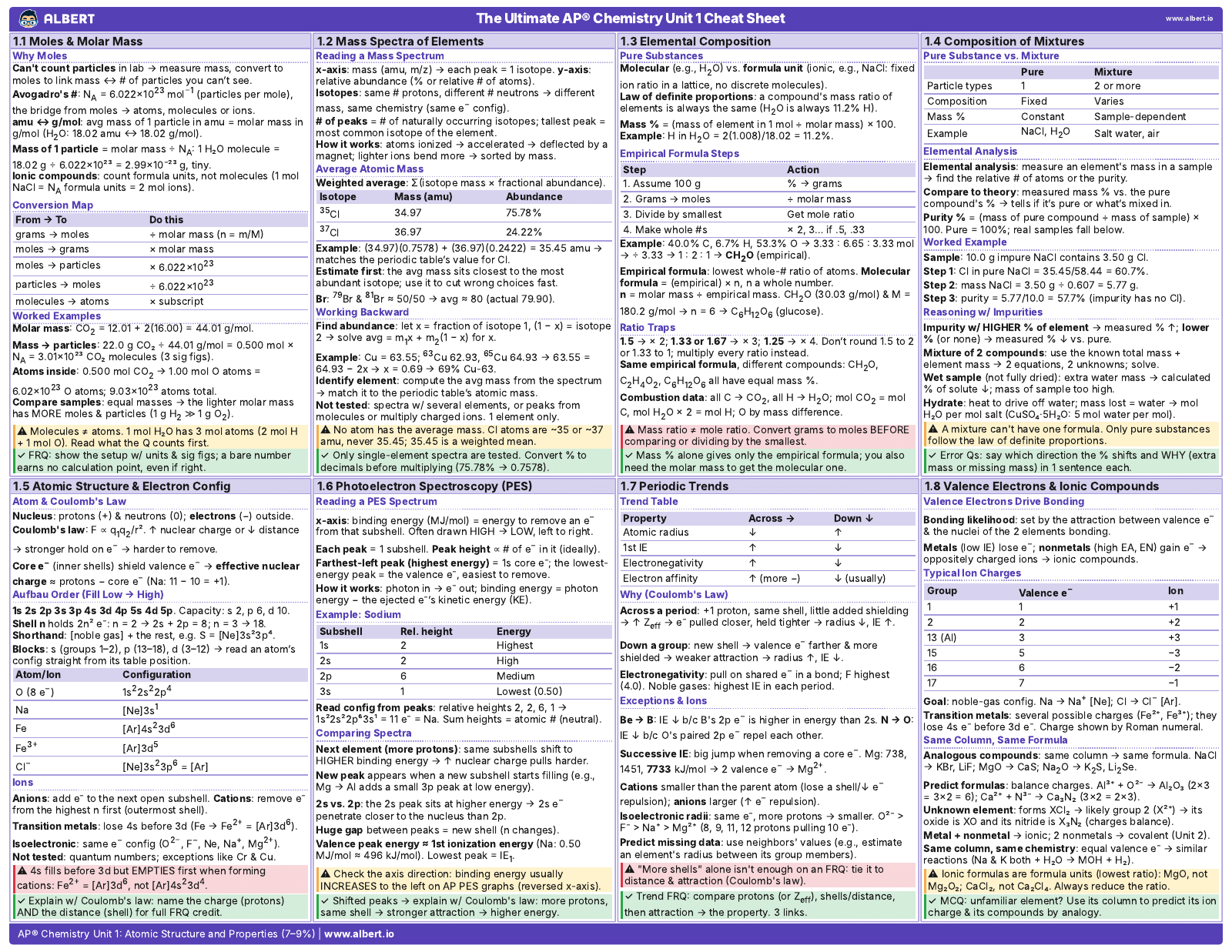
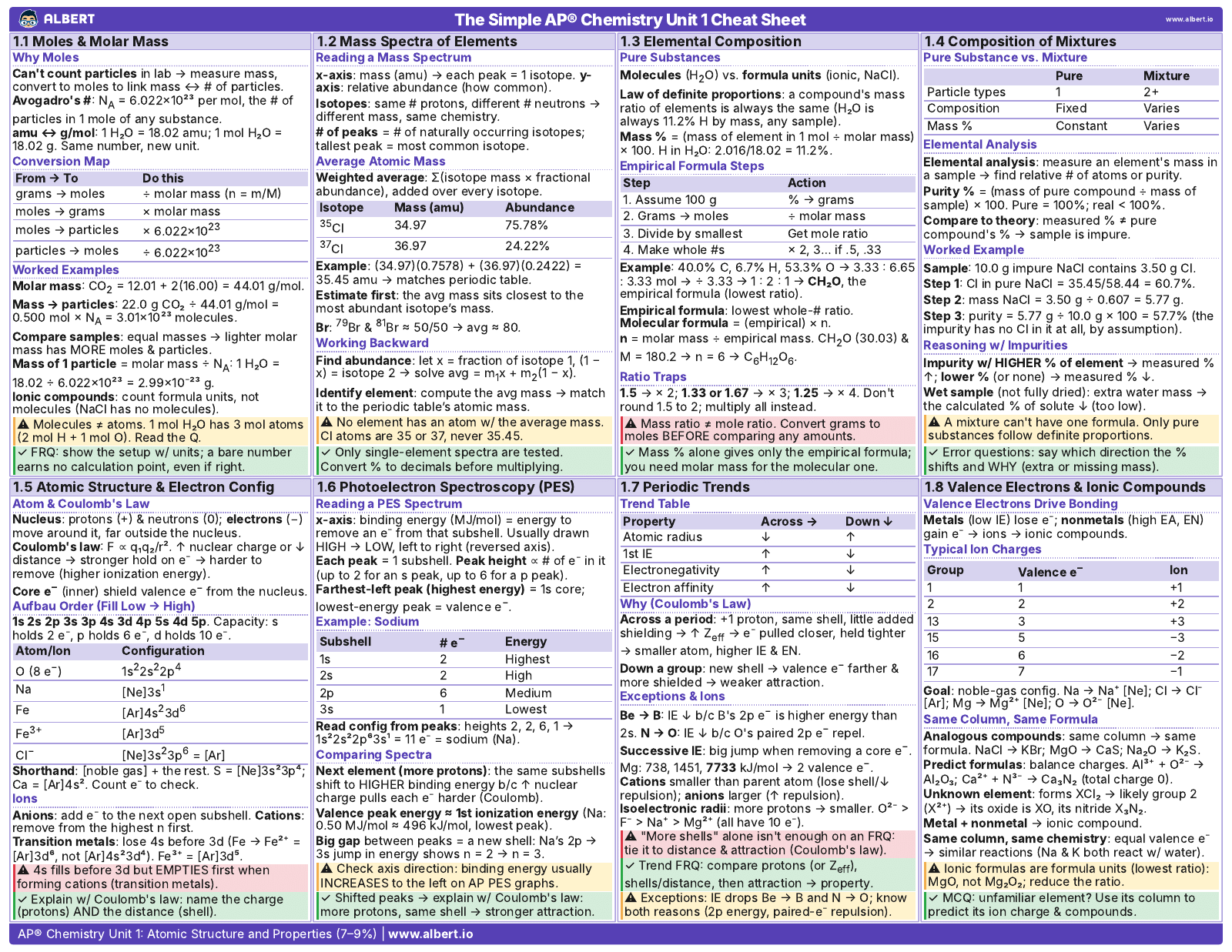
This AP Chem Unit 1 cheat sheet covers Atomic Structure and Properties: moles, mass spectra, electron configuration, photoelectron spectroscopy and periodic trends. Unit 1 is 7–9% of the AP® Chemistry exam and sets up the Coulomb’s-law reasoning you’ll use all year. Download it in Simple to learn the unit or Ultimate for full exam review.
Practice AP® Chemistry Unit 1 questions on Albert
What’s on the AP Chem Unit 1 Cheat Sheet?
Both versions cover the eight Unit 1 topics on eight cards, one card per topic: moles, mass spectra, elemental composition, mixtures, electron configuration, photoelectron spectroscopy, periodic trends and ionic compounds. The exam gives you a periodic table and a formula sheet, so the cheat sheet doesn’t stop at listing equations. It shows how to set up the problems and how to explain trends the way AP scorers expect.
The Simple version is for learning the unit. It keeps the mole conversion map, the empirical-formula steps, the electron configurations for atoms and ions, a labeled PES example, the trend table and the typical ion charges, each with a short worked example.
The Ultimate version is for test prep. It adds working backward from average atomic mass to isotope abundance, combustion data, hydrate and impurity reasoning, blocks of the periodic table, how PES spectra shift between elements, successive ionization energies, the Be→B and N→O exceptions, and isoelectronic radius rankings.
AP Chem Unit 1 at a Glance
Unit 1 makes up 7–9% of the AP® Chemistry exam. It sets up the two ideas you’ll use all year: the mole as the bridge between mass and particles, and Coulomb’s law as the explanation for how atoms behave.
| Topic | Name | Focus |
|---|---|---|
| 1.1 | Moles and Molar Mass | Converting between mass, moles and particles |
| 1.2 | Mass Spectra of Elements | Isotopes, abundance and average atomic mass |
| 1.3 | Elemental Composition of Pure Substances | Definite proportions, mass percent, empirical formulas |
| 1.4 | Composition of Mixtures | Elemental analysis and purity |
| 1.5 | Atomic Structure and Electron Configuration | Aufbau principle, ions, Coulomb’s law |
| 1.6 | Photoelectron Spectroscopy | Reading PES peaks as subshells and energies |
| 1.7 | Periodic Trends | Radius, ionization energy, electronegativity, electron affinity |
| 1.8 | Valence Electrons and Ionic Compounds | Typical charges and analogous compounds |
Key Concepts in Unit 1: Atomic Structure and Properties
Moles and Mass Spectra (1.1–1.2)
You can’t count atoms in a lab, so chemists weigh them and convert. The mole links the two: one mole is 6.022 × 10²³ particles, and the mass of one particle in amu equals the molar mass in grams per mole. To go from grams to moles, divide by molar mass (n = m/M). To go from moles to particles, multiply by Avogadro’s number.
Worked example: how many molecules are in 22.0 g of CO2? The molar mass is 12.01 + 2(16.00) = 44.01 g/mol, so 22.0 g ÷ 44.01 g/mol = 0.500 mol. Multiply by 6.022 × 10²³ to get 3.01 × 10²³ molecules. Each molecule has two oxygen atoms, so the sample holds 6.02 × 10²³ O atoms.
A mass spectrum shows an element’s isotopes as peaks: the x-axis is mass and the y-axis is relative abundance. The average atomic mass is a weighted average. For chlorine, (34.97)(0.7578) + (36.97)(0.2422) = 35.45 amu, which matches the periodic table. No chlorine atom actually has a mass of 35.45. The average just sits closest to the most common isotope.
Exam tip: estimate before you calculate. If one isotope is about 75% of the sample, the answer must land much closer to that isotope’s mass.
Formulas, Composition and Purity (1.3–1.4)
A pure compound always has the same mass ratio of elements (the law of definite proportions), so its mass percent composition is fixed. To find an empirical formula, assume a 100 g sample, convert each element’s grams to moles, divide by the smallest number of moles, and multiply to get whole numbers if needed.
Worked example: a compound is 40.0% C, 6.7% H and 53.3% O. That’s 3.33 mol C, 6.65 mol H and 3.33 mol O, a 1 : 2 : 1 ratio, so the empirical formula is CH2O. If the molar mass is 180.2 g/mol, divide by the empirical mass (30.03) to get 6, so the molecular formula is C6H12O6.
Mixtures don’t follow definite proportions, and elemental analysis can show how pure a sample is. Suppose 10.0 g of impure NaCl contains 3.50 g of Cl. Pure NaCl is 60.7% Cl, so the sample holds 3.50 ÷ 0.607 = 5.77 g of NaCl, making it 57.7% pure.
Exam tip: in error questions, say which way the result moves and why. A sample that wasn’t fully dried has extra water mass, so the calculated percent of the other component comes out too low.
Electron Configuration and PES (1.5–1.6)
Electrons fill subshells from lowest to highest energy (the Aufbau principle): 1s, 2s, 2p, 3s, 3p, 4s, 3d, 4p. Iron is [Ar]4s23d6. When transition metals form cations, they lose 4s electrons first, so Fe3+ is [Ar]3d5. Anions add electrons to the next open subshell, so Cl− has the same configuration as argon.
Coulomb’s law (F ∝ q1q2/r²) explains why some electrons are harder to remove: more nuclear charge or a shorter distance means a stronger attraction. Core electrons shield valence electrons, which lowers the effective nuclear charge those electrons feel.
Photoelectron spectroscopy (PES) makes this visible. Each peak is one subshell, its position shows the energy needed to remove those electrons, and its height is proportional to how many electrons are in it. Worked example: peaks with relative heights 2, 2, 6 and 1, from highest to lowest energy, mean 1s22s22p63s1, which is sodium. Its lowest-energy peak, about 0.50 MJ/mol, matches sodium’s first ionization energy.
Exam tip: moving one element to the right adds a proton, so every existing peak shifts to a higher binding energy. Explain that shift with Coulomb’s law: more protons, same shell, stronger attraction.
Periodic Trends and Ionic Compounds (1.7–1.8)
Across a period, atomic radius decreases while ionization energy and electronegativity increase. Down a group, the opposite happens. The reason is the same every time: across a period, protons are added to the same shell with little extra shielding, so electrons are pulled closer and held tighter. Down a group, a new shell puts valence electrons farther from the nucleus.
Two exceptions show up often. Boron’s first ionization energy is lower than beryllium’s because boron’s outer electron is in a higher-energy 2p subshell. Oxygen’s is lower than nitrogen’s because oxygen’s paired 2p electrons repel each other. Successive ionization energies show where the core begins: magnesium’s jump from 1,451 to 7,733 kJ/mol after its second electron tells you it has two valence electrons.
Valence electrons also predict ion charges: group 1 forms +1 ions, group 2 forms +2, group 16 forms −2 and group 17 forms −1. Elements in the same column form analogous compounds, so if NaCl exists, so do KBr and LiF. To write a formula, balance the charges: Al3+ and O2− give Al2O3.
Exam tip: “it has more shells” alone won’t earn the point. Tie the structure to distance and attraction, and name both the charge and the distance.
How Unit 1 Shows Up on the Exam
The AP® Chemistry exam has 60 multiple-choice questions in 90 minutes (50% of the score) and seven free-response questions in 105 minutes: three long questions worth 10 points each and four short questions worth 4 points each (the other 50%). You get a periodic table and a formula sheet, and a calculator is recommended for both sections.
Unit 1 multiple-choice questions often show a mass spectrum or PES graph and ask you to identify the element, compare two spectra, or explain why a peak sits where it does. Others ask you to rank atoms or ions by radius or ionization energy, or to predict the formula of a compound from an unfamiliar element’s position.
On the free-response section, Unit 1 shows up inside larger questions. Expect a mole or empirical-formula calculation as one part of a long question, and a short explanation that compares two atoms’ properties. Scorers want calculations with units and a clear setup, and explanations that use Coulomb’s law: the number of protons or effective nuclear charge, the distance or shell, and how those change the attraction.
Common Mistakes in Unit 1
- Mistake: comparing masses instead of moles when finding an empirical formula. Fix: convert grams to moles before you take any ratio.
- Mistake: rounding a 1.5 ratio to 2. Fix: multiply every subscript by 2 (and by 3 for ratios near 1.33 or 1.67).
- Mistake: removing 3d electrons first when forming a transition-metal cation. Fix: 4s fills first and also empties first.
- Mistake: explaining a trend with “more shells” or “more protons” alone. Fix: connect the structure to distance and nuclear charge, then to the strength of attraction.
- Mistake: reading a PES graph as if energy increases to the right. Fix: check the axis; on AP graphs, binding energy usually increases to the left.
Frequently Asked Questions
Can I use this cheat sheet on the exam?
No. You can’t bring notes into the AP exam room; the only references you get are the periodic table and the formula sheet College Board provides. The AP Chem Unit 1 cheat sheet is a study tool for learning how to use those references before test day.
Should I start with the Simple or the Ultimate version?
Start with Simple while you learn the unit. Switch to Ultimate when you can work every Simple example without looking, since it adds the edge cases and explanations that free-response questions reward.
Do I need to know quantum numbers or exceptions like chromium and copper?
No. The course framework says assigning quantum numbers and writing configurations for exceptions to the Aufbau principle won’t be assessed. Focus on standard configurations, ions and the reasoning behind PES and periodic trends.
What’s the best way to practice Unit 1?
Pair each card with a set of AP Chem Unit 1 practice questions on that topic. When you miss one, find the line on the card that would have answered it, then try a similar question without the sheet.
For the full list of topics and learning objectives, see College Board’s AP® Chemistry course page.