
Maximize your score with these resources:
- Albert.io AP® US History question banks
- Free AP® US History study guides
- Free AP® US History score calculator
This APUSH Unit 4 cheat sheet covers Period 4, 1800 to 1848: Jefferson and the first party system, the War of 1812, the Market Revolution, Jacksonian democracy, the Second Great Awakening and the reform movements it sparked, and the growth of slavery in the South. Period 4 makes up 10–17% of the AP® U.S. History exam. Download it below in Simple for a first pass or Ultimate for full detail.
Practice AP® US History Unit 4 questions on Albert
What’s on the APUSH Unit 4 Cheat Sheet?
Both versions use the same eight cards, following the College Board’s topics: Jefferson and the rise of parties, regional interests and foreign policy, the Market Revolution’s economy, its effects on society, Jacksonian democracy, culture and reform, African Americans and the South, and causation with essay strategy.
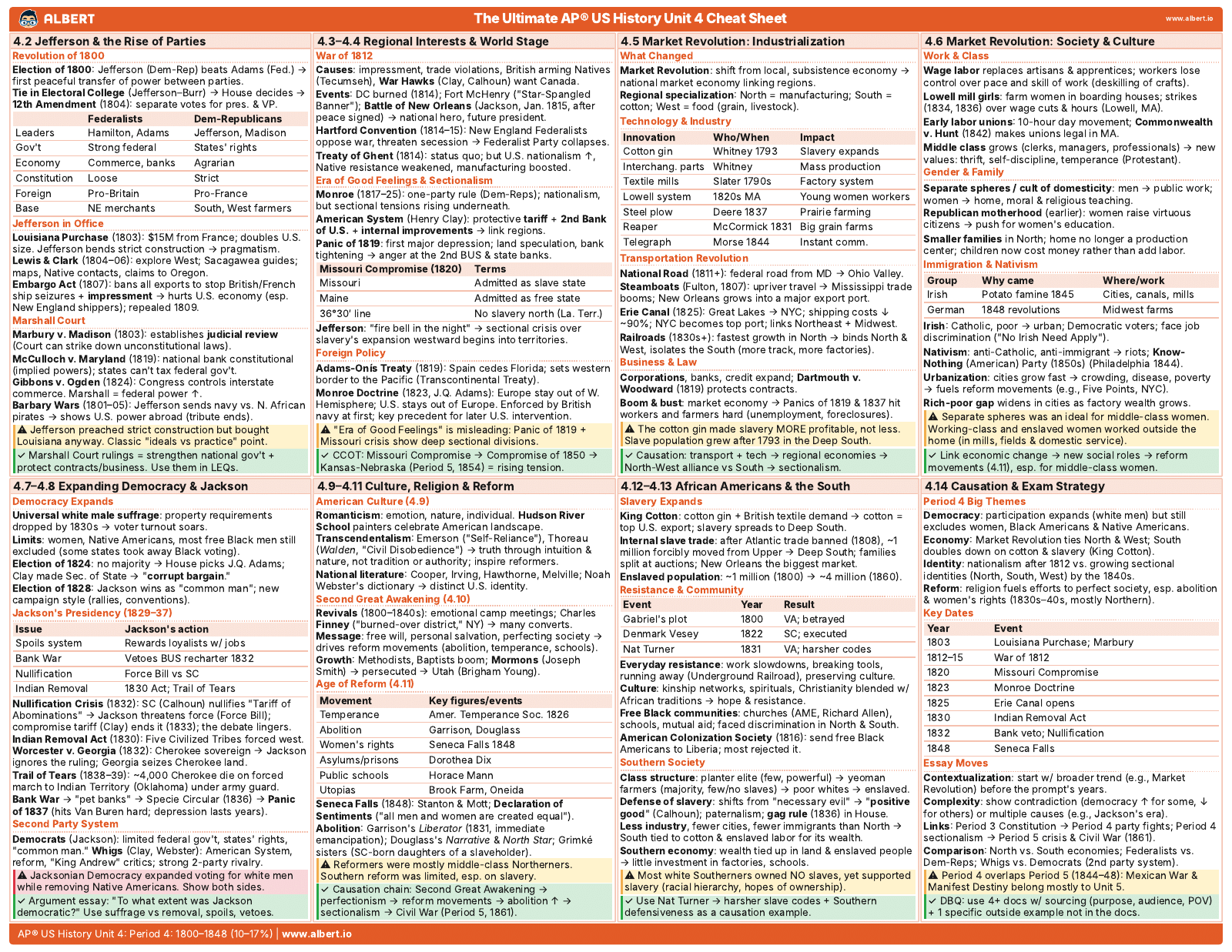
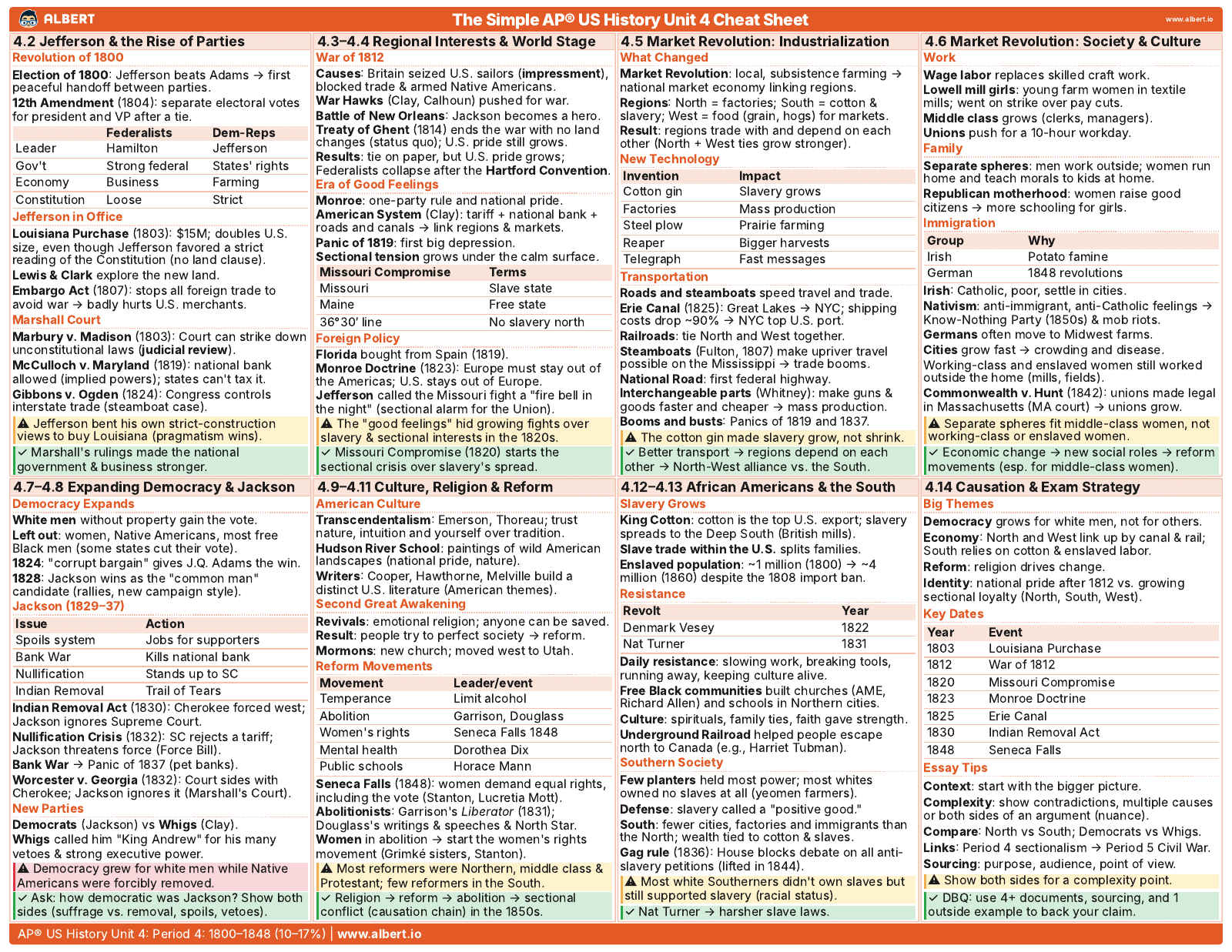
- Simple is for students learning the period or reviewing for a class test. It gives the main events, people and turning points with short notes on why each matters.
- Ultimate is for students aiming for a 4 or 5. It adds Supreme Court cases, the terms of the Missouri Compromise, a full table of Market Revolution inventions, immigration and nativism, every major Jackson policy, reform movement leaders, slave rebellions, and a key dates timeline.
Start with Simple until you can explain each card’s causes and effects from memory, then move to Ultimate for the specific evidence essays reward.
APUSH Unit 4 at a Glance
Period 4 picks up after the Constitution and the first presidencies (Period 3) and ends just as Manifest Destiny and the Mexican-American War push the nation toward the Civil War (Period 5). The AP® U.S. History Course and Exam Description organizes it into these topics.
| Topics | Name | Focus |
|---|---|---|
| 4.1 | Contextualizing Period 4 | The big picture, 1800–1848 |
| 4.2 | The Rise of Political Parties and the Era of Jefferson | Federalists vs Democratic-Republicans; Marshall Court |
| 4.3 | Politics and Regional Interests | American System, Missouri Compromise |
| 4.4 | America on the World Stage | War of 1812, Monroe Doctrine |
| 4.5–4.6 | Market Revolution: Industrialization; Society and Culture | Factories, transportation, immigration, gender roles |
| 4.7–4.8 | Expanding Democracy; Jackson and Federal Power | Suffrage, Indian Removal, Bank War, nullification |
| 4.9–4.11 | American Culture; Second Great Awakening; An Age of Reform | Romanticism, revivals, abolition, women’s rights |
| 4.12–4.13 | African Americans in the Early Republic; Society of the South | Slavery’s expansion, resistance, Southern class structure |
| 4.14 | Causation in Period 4 | How these changes connect |
Key Concepts in Unit 4: Period 4, 1800–1848
Jefferson, Parties and the Marshall Court (4.2)
The election of 1800 was the first time power passed peacefully from one party to another, from Adams’s Federalists to Jefferson’s Democratic-Republicans. Jefferson favored a small federal government and a strict reading of the Constitution, yet he bought the Louisiana Territory in 1803 without clear constitutional authority. Meanwhile, Chief Justice John Marshall’s Supreme Court strengthened federal power through cases like Marbury v. Madison (judicial review) and McCulloch v. Maryland (implied powers).
Reading a source: In a letter, Jefferson admits the Louisiana Purchase goes beyond the Constitution but argues the chance is too good to lose. A strong answer notes the tension between his principles and his actions, and explains that national expansion and security won out over strict construction.
Exam tip: Marshall Court cases are excellent evidence for any essay about the growth of federal power.
The War of 1812 and Rising Sectionalism (4.3–4.4)
British impressment of American sailors and support for Native resistance led to the War of 1812. The war ended in a draw with the Treaty of Ghent, but it boosted nationalism, made Andrew Jackson a hero, and destroyed the Federalist Party after the Hartford Convention. The so-called Era of Good Feelings that followed hid real divisions: the Panic of 1819 and the fight over Missouri statehood exposed tensions over banking and slavery. The Missouri Compromise of 1820 admitted Missouri as a slave state and Maine as a free state, and banned slavery north of 36°30′ in the rest of the Louisiana Territory. The Monroe Doctrine of 1823 warned Europe against new colonization in the Americas.
Exam tip: The Missouri Compromise is the first link in a chain of slavery compromises that runs through 1850 and 1854. Use it in continuity and change essays.
The Market Revolution (4.5–4.6)
Between 1800 and 1848, the U.S. economy shifted from local, mostly self-sufficient farming to a national market. New technology (the cotton gin, interchangeable parts, textile mills, the steel plow, the reaper, the telegraph) and new transportation (roads, steamboats, the Erie Canal and railroads) tied regions together. The North industrialized, the West grew food, and the South grew cotton. Wage labor replaced skilled crafts, the middle class grew, and the ideal of separate spheres cast middle-class women as guardians of the home. Irish and German immigration surged in the 1840s, prompting anti-Catholic nativism.
Reading a source: Suppose a document is a letter from a Lowell mill worker in the 1840s describing long days and wage cuts. Use it to show how factory work changed women’s lives, created new opportunities, and also produced early labor protest.
Exam tip: Connect transportation to sectionalism: canals and railroads bound the North and West together and left the South increasingly isolated.
Jacksonian Democracy (4.7–4.8)
By the 1830s most states had dropped property requirements, so nearly all white men could vote. Andrew Jackson rode this wave to the presidency in 1828 after losing the disputed 1824 election to John Quincy Adams. As president, Jackson rewarded supporters with government jobs, vetoed the recharter of the Second Bank of the United States, faced down South Carolina in the Nullification Crisis, and signed the Indian Removal Act of 1830. Even after the Supreme Court ruled for the Cherokee in Worcester v. Georgia, the federal government forced them west on the Trail of Tears. Opponents formed the Whig Party, creating the Second Party System.
Reading a source: Jackson’s 1832 bank veto message attacks the bank as a tool of the rich against “the humble members of society.” Its intended audience was ordinary voters, and its purpose was to cast Jackson as the champion of the common man. Pair it with evidence on Indian Removal to show the limits of that democracy.
Exam tip: For a complexity point, show that democracy expanded for white men while it shrank for Native Americans, free Black Americans and women.
Culture, the Second Great Awakening and Reform (4.9–4.11)
A distinct American culture emerged in Hudson River School painting, Transcendentalist writing by Emerson and Thoreau, and a new national literature. The Second Great Awakening spread an emotional, democratic religion that stressed free will and the possibility of perfecting society. That belief fueled reform: temperance, public schools (Horace Mann), better treatment of the mentally ill (Dorothea Dix), utopian communities, abolition (William Lloyd Garrison, Frederick Douglass) and women’s rights. The 1848 Seneca Falls Convention’s Declaration of Sentiments rewrote the Declaration of Independence to include women.
Exam tip: Women’s work in the abolition movement, and their exclusion from its leadership, helped launch the women’s rights movement.
African Americans and the South (4.12–4.13)
The cotton gin and British demand made cotton the nation’s leading export and pushed slavery into the Deep South. After the 1808 ban on importing enslaved people, a huge internal slave trade tore families apart. Enslaved people resisted through work slowdowns, escape, preserving culture and family, and revolts led by Denmark Vesey (1822) and Nat Turner (1831). Free Black communities built churches and schools. A small planter elite dominated Southern society, though most white Southerners owned no enslaved people. Defenders began calling slavery a “positive good.”
Exam tip: Nat Turner’s revolt is a strong causation example: it led to harsher slave codes and a more defensive South.
How Unit 4 Shows Up on the Exam
Multiple-choice sets give you a primary or secondary source, like a speech, letter, cartoon or map, and ask about its context, causes or effects. Short-answer questions often ask you to explain one cause or effect of a development like the Market Revolution or Indian Removal.
Period 4 is a common setting for the long essay and the document-based question. Popular prompts include how the Market Revolution changed American society, how democratic the Jacksonian era really was, and how reform movements reflected religious change. See the AP® U.S. History exam page for the current format and rubrics.
Common Mistakes in Unit 4
- Mistake: Treating the Era of Good Feelings as a time of unity. Fix: Point to the Panic of 1819 and the Missouri crisis.
- Mistake: Saying the cotton gin reduced slavery. Fix: It made cotton far more profitable, so slavery expanded.
- Mistake: Calling Jacksonian democracy simply democratic. Fix: Show who gained the vote and who was excluded or removed.
- Mistake: Describing reform as a national movement. Fix: Most reformers were Northern and middle class; the South resisted abolition.
- Mistake: Listing events without connecting them. Fix: Use cause-and-effect language: “which led to,” “as a result.”
Frequently Asked Questions
Can I use this cheat sheet on the exam?
No. Notes aren’t allowed on the AP® U.S. History exam. The APUSH Unit 4 cheat sheet is a study tool for reviewing evidence and connections before exam day.
Should I start with the Simple or Ultimate version?
Start with Simple if Period 4 is new or you have a unit test. Move to Ultimate when you’re preparing essays and need specific evidence.
Why does Period 4 overlap with Period 5?
Period 4 ends in 1848 and Period 5 starts in 1844. The overlap covers Manifest Destiny and the Mexican-American War, which the College Board places mainly in Period 5.
Which Supreme Court cases should I know for Period 4?
Marbury v. Madison, McCulloch v. Maryland, Gibbons v. Ogden and Worcester v. Georgia are the most useful. Each shows something about federal power or its limits.
How does Period 4 connect to the Civil War?
The Market Revolution tied the North and West together, cotton deepened the South’s reliance on slavery, and abolitionism grew out of the reform era. All three set up the sectional conflict of Period 5.