
Maximize your score with these resources:
- Albert.io AP® Physics C: E & M question banks
- Free AP® Physics C: E & M study guides
- Free AP® Physics C: E & M score calculator
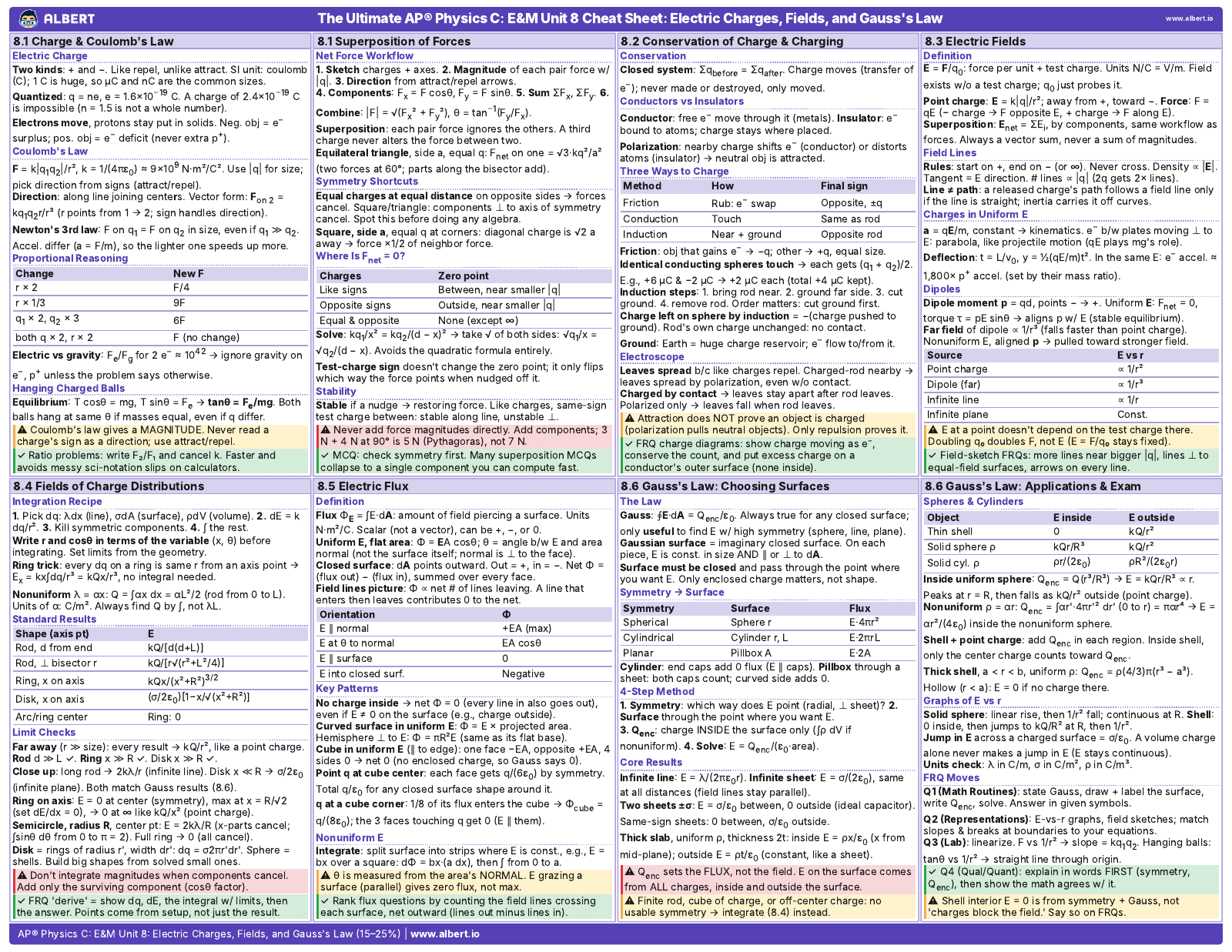
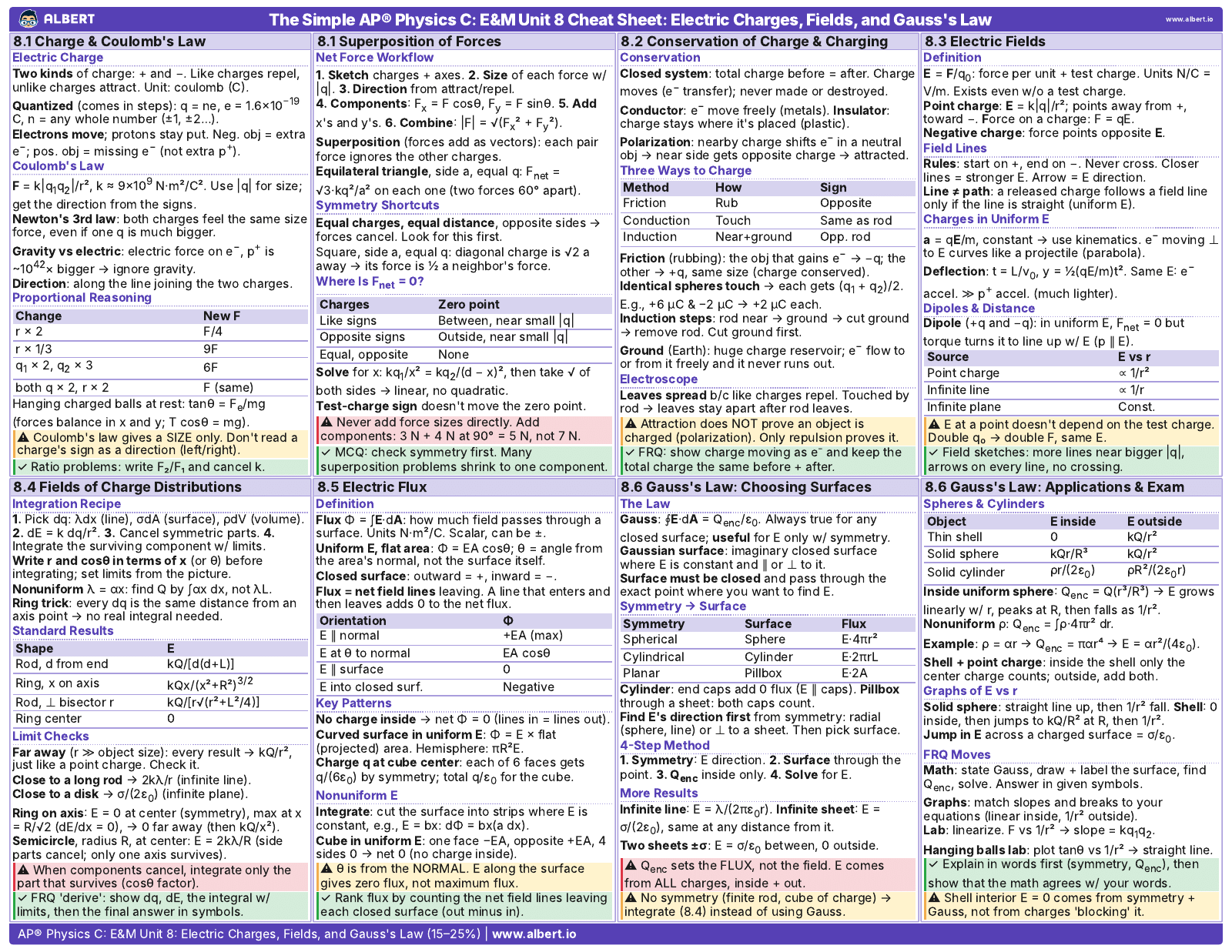
Our AP® Physics C: E&M Unit 8 cheat sheet packs Coulomb’s law, electric fields, flux, and Gauss’s law onto one landscape page. Unit 8 carries 15–25% of the AP® Physics C: Electricity and Magnetism exam, tied with Unit 11 for the biggest share of any unit. Download it in two versions: Simple for a first pass, Ultimate when you want every shortcut and trap.
Practice AP® Physics C: E&M Unit 8 questions on Albert
What’s on the AP® Physics C: E&M Unit 8 Cheat Sheet?
Both versions use the same eight cards, so you can start with one and move to the other without relearning the layout. Two cards cover Topic 8.1 (charge, Coulomb’s law, and superposition of forces), one covers 8.2 (conservation of charge and charging), one covers 8.3 (electric fields), one covers 8.4 (fields of charge distributions), one covers 8.5 (electric flux), and two cover 8.6 (choosing Gaussian surfaces, then applying Gauss’s law on the exam).
Simple is for students meeting the unit for the first time or reviewing after a long break. It keeps the core workflows, the standard results, and the single most important trap on each card, with a few words of context the first time a term shows up.
Ultimate is for students who already know the basics and want the edge cases: proportional-reasoning tables, zero-field points for any pair of charges, the integration recipe with limit checks, flux through a cube with a charge at the corner, nonuniform charge densities, and FRQ moves for all four free-response types. Neither version repeats the official equation sheet line by line; both focus on how to use it.
AP® Physics C: E&M Unit 8 at a Glance
The College Board’s course framework splits Unit 8 into six topics and weights the unit at 15–25% of the exam. It is also the foundation for every unit after it: potential (Unit 9), capacitors (Unit 10), and even circuits build on the field ideas here.
| Topic | Name | Focus |
|---|---|---|
| 8.1 | Electric Charge and Electric Force | Coulomb’s law and vector addition of forces |
| 8.2 | Conservation of Electric Charge and the Process of Charging | Friction, conduction, induction, polarization |
| 8.3 | Electric Fields | E = F/q, field lines, charges moving in uniform fields |
| 8.4 | Electric Fields of Charge Distributions | Integrating dq over rods, rings, disks, and arcs |
| 8.5 | Electric Flux | Φ = ∫E·dA through open and closed surfaces |
| 8.6 | Gauss’s Law | Using symmetry to find E for spheres, lines, and planes |
Expect this unit to show up in both multiple-choice sets and at least one free-response question. Students who are fast with symmetry arguments save minutes on every section.
Key Concepts in Unit 8: Electric Charges, Fields, and Gauss’s Law
Coulomb’s Law and Superposition (8.1)
Coulomb’s law, F = k|q1q2|/r², gives the size of the force between two point charges. The direction comes from a separate step: like charges repel and unlike charges attract, along the line joining them. Keeping size and direction apart is the habit that prevents most sign errors.
With three or more charges, find each pair force on its own, break each into x- and y-components, add the components, and only then combine them. A third charge never alters the force between the other two.
Worked example: Two charges, +4 μC at x = 0 and +1 μC at x = 3 m. Where is the net force on a test charge zero? Like signs put the point between them, closer to the smaller charge. Set 4/x² = 1/(3 − x)² and take the square root of both sides: 2/x = 1/(3 − x), so x = 2 m. Taking the square root first skips the quadratic.
Exam tip: On ratio questions, write F2/F1 and cancel k. Doubling both charges and doubling the distance leaves the force unchanged, a favorite multiple-choice setup.
Conservation of Charge and Charging (8.2)
Charge is never created or destroyed; electrons move from one object to another. Rubbing (friction) leaves the two objects with equal and opposite charges. Touching a charged conductor (conduction) leaves the object with the same sign as the source. Induction uses a nearby charged rod plus a ground connection to leave the object with the opposite sign, and the rod never touches it.
Worked example: Two identical metal spheres carry +6 μC and −2 μC. After they touch and separate, each has (6 − 2)/2 = +2 μC. The total, +4 μC, is the same before and after.
Exam tip: In an induction sequence, the ground connection must be broken before the rod is removed. If the rod leaves first, the charge flows back and the object ends neutral. Questions often swap these two steps.
Electric Fields and Field Lines (8.3)
The electric field is force per unit positive test charge, E = F/q0. A point charge creates a field of size kq/r² pointing away from positive charge and toward negative charge. A charge placed in the field feels F = qE, so a negative charge is pushed opposite the field direction.
In a uniform field, the acceleration a = qE/m is constant, so all of your kinematics carries over. An electron entering parallel plates at right angles to the field follows a parabola, just like a projectile.
Worked example: An electron enters a uniform field E between plates of length L with speed v0. The time between the plates is t = L/v0, and the sideways deflection is y = ½(eE/m)t². A proton in the same field deflects about 1,800 times less because its mass is about 1,800 times greater.
Exam tip: On field-line sketches, draw more lines near the larger charge, never let lines cross, and put an arrow on every line.
Fields of Continuous Charge Distributions (8.4)
This topic is where the calculus in Physics C pays off. The recipe is the same every time: pick a small piece of charge dq (λdx for a line, σdA for a surface, ρdV for a volume), write its field dE = k dq/r², use symmetry to cancel components, and integrate the component that survives.
Worked example: A ring of radius R carries charge Q. Find E at a distance x along its axis. Every dq on the ring sits the same distance r = √(x² + R²) from the point, and the components perpendicular to the axis cancel in pairs. The axial component of each piece is k dq·x/r³, so E = kQx/(x² + R²)3/2. Check the limits: at x = 0 the field is zero, and when x is much larger than R it becomes kQ/x², a point charge.
Exam tip: If the charge density is nonuniform, such as λ = αx, find the total charge by integrating. Writing Q = λL is a common way to lose a point.
Electric Flux (8.5)
Flux measures how much field passes through a surface: Φ = ∫E·dA. For a flat surface in a uniform field, Φ = EA cos θ, where θ is measured from the surface’s normal, not from the surface itself. On a closed surface, outward flux is positive and inward flux is negative.
Worked example: A cube sits in a uniform field parallel to one of its edges. One face has flux −EA, the opposite face has +EA, and the four side faces have zero. The net flux is zero, which matches the fact that the cube encloses no charge.
Exam tip: For a charge q at the center of a cube, symmetry gives each face q/(6ε0) without any integration.
Gauss’s Law (8.6)
Gauss’s law says the net flux through any closed surface equals the enclosed charge divided by ε0. It is always true, but it only finds E when the charge has strong symmetry: spherical, cylindrical, or planar. Pick a Gaussian surface where E is constant in size and either parallel or perpendicular to the surface everywhere.
Worked example: A solid insulating sphere of radius R has uniform charge Q. Inside, at radius r, a spherical Gaussian surface encloses Q(r³/R³). Then E(4πr²) = Q(r³/R³)/ε0, so E = kQr/R³. The field grows linearly to the surface and then falls as kQ/r² outside. Compare a thin shell, where the field is zero inside and jumps to kQ/R² at the surface.
Exam tip: The enclosed charge determines the flux, not the field. The field on a Gaussian surface comes from every charge, inside and outside.
How Unit 8 Shows Up on the Exam
The exam has 42 multiple-choice questions in 85 minutes and four free-response questions in 95 minutes, each section worth 50% of the score, according to the College Board’s AP® Physics C: E&M course page. Multiple-choice items on Unit 8 lean on symmetry, proportional reasoning, and ranking (flux through surfaces, field at several points).
Each free-response type can test this unit. Mathematical Routines often asks you to derive E for a charge distribution, by integration or Gauss’s law. Translation Between Representations asks you to draw or match graphs of E versus r and field-line diagrams. Experimental Design and Analysis can use a hanging charged ball or force sensor, where you linearize the results (plot F against 1/r²) and read k or a charge from the slope. Qualitative/Quantitative Translation asks you to explain a result in words, such as why the field inside a charged shell is zero, and then back it up with equations.
Scorers reward a clear setup: a labeled Gaussian surface, an expression for the enclosed charge, the integral with limits, and an answer in the symbols the question gives.
Common Mistakes in Unit 8
- Adding force magnitudes. A 3 N and a 4 N force at right angles add to 5 N, not 7 N. Fix: always add components.
- Reading a sign as a direction. Plugging signed charges into Coulomb’s law and treating the minus sign as “left” causes errors. Fix: use magnitudes, then set the direction from attraction or repulsion.
- Measuring θ from the surface. In Φ = EA cos θ, the angle is from the normal. Fix: a field running along a surface gives zero flux.
- Using Gauss’s law without symmetry. A finite rod or a cube of charge has no Gaussian surface with constant E. Fix: integrate instead.
- Treating attraction as proof of charge. A charged rod attracts a neutral object through polarization. Fix: only repulsion proves an object is charged.
Frequently Asked Questions
Can I use this cheat sheet on the exam?
No. You get the official equation sheet on exam day, and nothing else. This AP® Physics C: E&M Unit 8 cheat sheet is a study tool for review and practice before the exam.
Should I start with the Simple or the Ultimate version?
Start with Simple if Unit 8 is new to you or you are still shaky on superposition. Move to Ultimate once you can do the core problems without notes and want the edge cases and FRQ moves.
Do I need calculus for Unit 8?
Yes. Topic 8.4 asks you to integrate over charge distributions, and nonuniform densities in Gauss’s law problems need an integral for the enclosed charge.
How does Unit 8 connect to the rest of the course?
Electric potential in Unit 9 is built from the field you learn here, and capacitors in Unit 10 use Gauss’s law results for parallel plates directly.