
Maximize your score with these resources:
- Albert.io AP® Chemistry question banks
- Free AP® Chemistry study guides
- Free AP® Chemistry score calculator
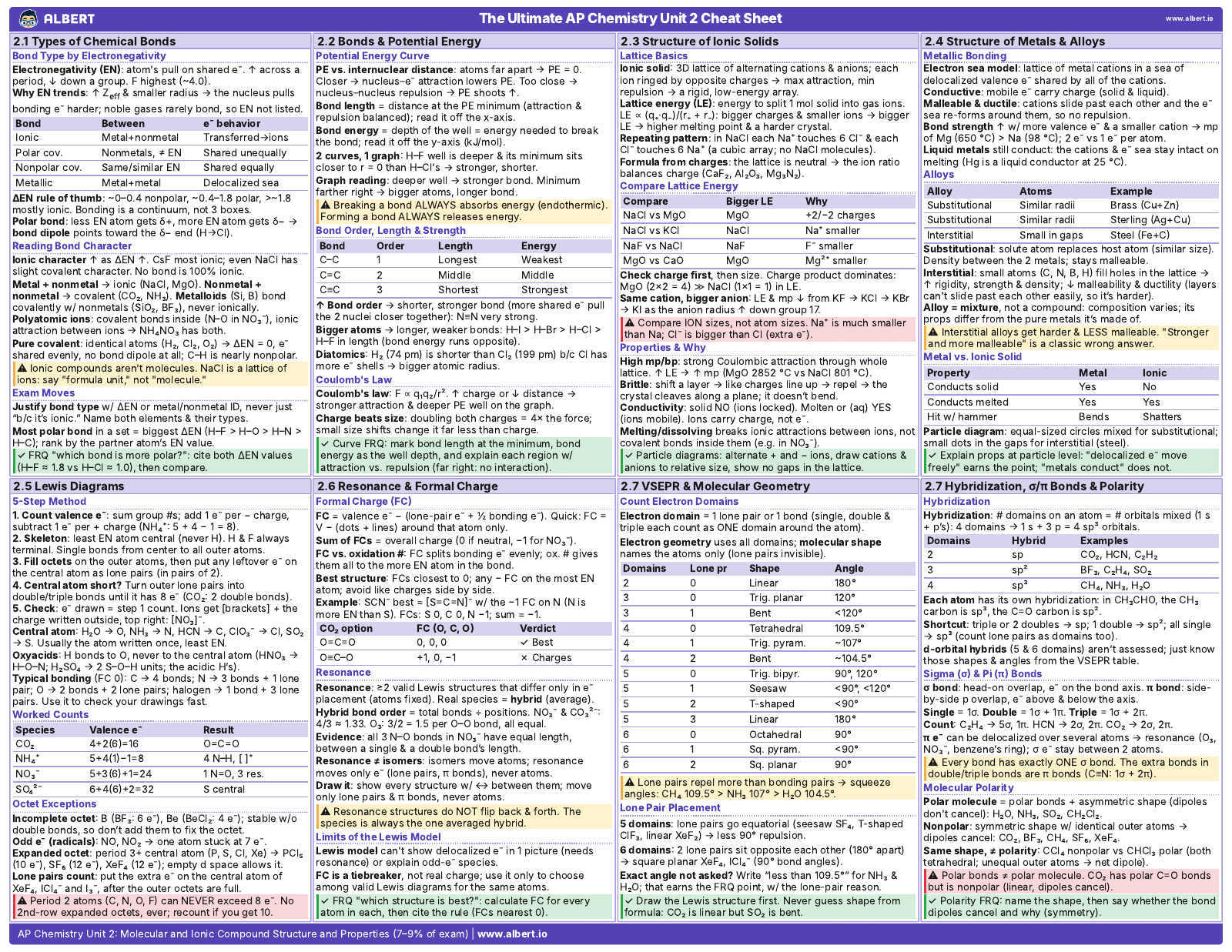
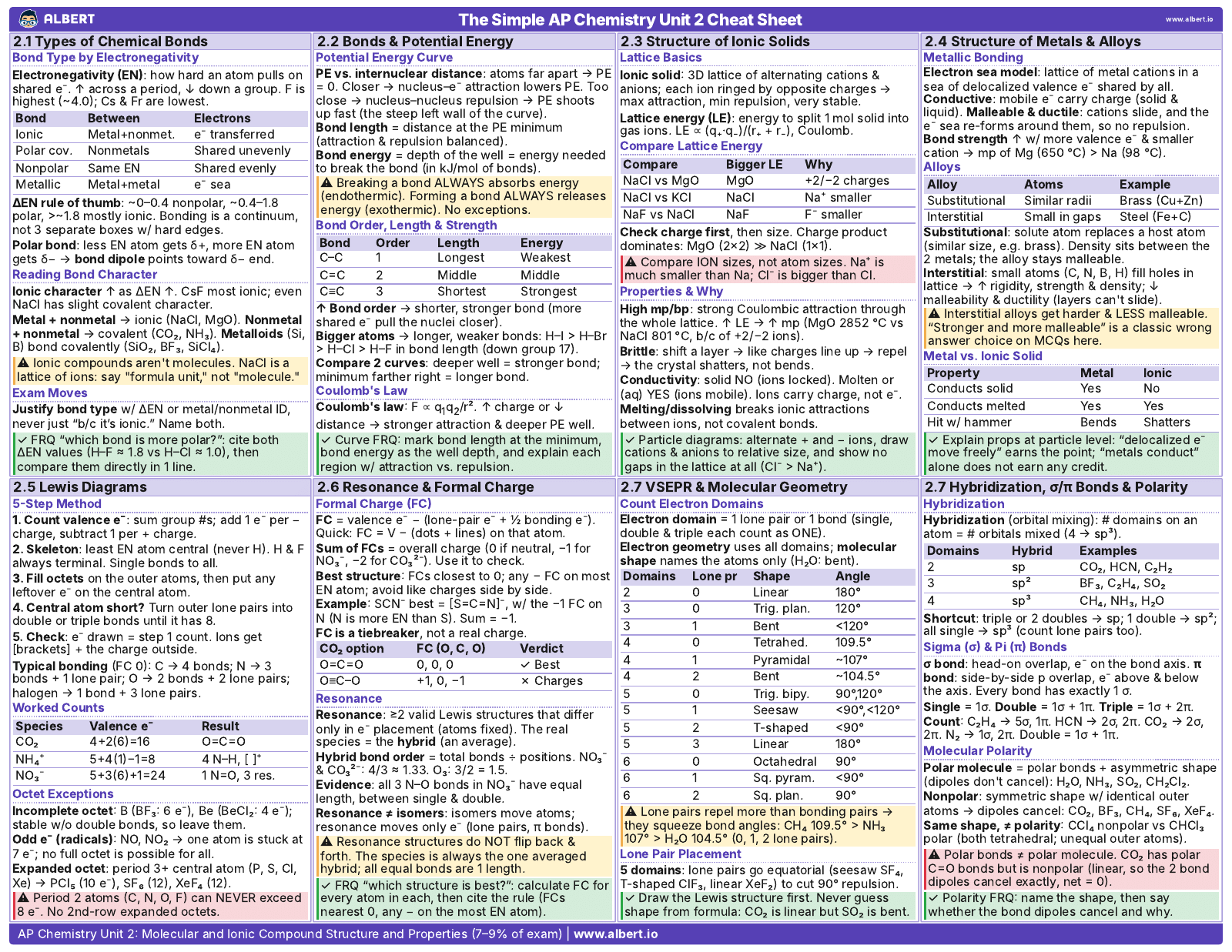
This AP Chem Unit 2 cheat sheet packs everything about how atoms bond onto one page: bond types, potential energy curves, ionic and metallic solids, Lewis diagrams, formal charge, VSEPR shapes and hybridization. Unit 2 is 7–9% of the AP® Chemistry exam, and it feeds almost every unit after it. Pick the Simple version for a first pass or the Ultimate version for full detail.
Practice AP® Chemistry Unit 2 questions on Albert
What’s on the AP Chem Unit 2 Cheat Sheet?
Both versions follow the College Board’s seven Unit 2 topics across eight cards, so you can study one topic at a time and still see how they connect. The last topic, VSEPR and hybridization, gets two cards because it carries the most exam questions.
The Simple version is for students meeting this material for the first time or reviewing it after a long break. It keeps the core rules, one worked example per idea, and the single most common trap for each topic. The text is larger and the cards are less crowded.
The Ultimate version is for students aiming for a 4 or 5. It adds the second and third traps, more comparison examples (lattice energy rankings, bond length trends, formal charge tiebreakers), the full VSEPR table with lone pair placement rules, and short FRQ moves that earn specific points. If you already know what a Lewis diagram is and want to stop losing points on the details, start here.
Both versions are study tools. Use them while you practice, then test yourself without them.
AP® Chemistry Unit 2 at a Glance
Unit 2 builds on the atomic structure ideas from Unit 1 (electron configuration, Coulomb’s law, periodic trends) and turns them into a model of bonding. Unit 3 then uses that model to explain intermolecular forces and physical properties, so weak spots here cause trouble later.
| Topic | Name | Focus |
|---|---|---|
| 2.1 | Types of Chemical Bonds | Ionic, covalent and metallic bonds; electronegativity and bond polarity |
| 2.2 | Intramolecular Force and Potential Energy | Potential energy curves, bond length, bond energy, bond order |
| 2.3 | Structure of Ionic Solids | Lattices, lattice energy, properties of ionic solids |
| 2.4 | Structure of Metals and Alloys | Electron sea model, substitutional and interstitial alloys |
| 2.5 | Lewis Diagrams | Counting valence electrons, octet exceptions |
| 2.6 | Resonance and Formal Charge | Resonance hybrids, choosing the best Lewis diagram |
| 2.7 | VSEPR and Hybridization | Molecular geometry, bond angles, sp/sp²/sp³, sigma and pi bonds, polarity |
Unit 2 is weighted at 7–9% of the exam score, according to the College Board’s AP® Chemistry course page. That sounds small, but Lewis diagrams and molecular shapes show up inside questions from Units 3, 4 and 8 as well.
Key Concepts in Unit 2: Molecular and Ionic Compound Structure and Properties
Bond Types and Electronegativity (2.1)
Electronegativity is how strongly an atom pulls on shared electrons. It rises across a period and falls down a group, so fluorine is the most electronegative element. The difference in electronegativity between two bonded atoms tells you how evenly they share electrons. A difference near zero gives a nonpolar covalent bond, a moderate difference gives a polar covalent bond, and a large difference gives a bond with mostly ionic character.
Treat this as a continuum, not three separate boxes. On the exam, the quick test is usually enough: a metal bonded to a nonmetal is ionic, two nonmetals are covalent, and metal atoms together form a metallic bond.
Worked example: Which bond is more polar, H–F or H–Cl? Fluorine’s electronegativity is about 4.0 and chlorine’s is about 3.2, while hydrogen’s is about 2.2. The differences are about 1.8 and 1.0, so H–F is more polar, and the partial negative charge sits on F.
Exam tip: When you justify a bond type, cite the electronegativity difference or identify the elements as metals and nonmetals. “Because it is ionic” is a restatement, not a reason.
Potential Energy Curves and Coulomb’s Law (2.2)
A potential energy curve plots the energy of two atoms against the distance between their nuclei. Far apart, the energy is zero. As they approach, each nucleus attracts the other atom’s electrons and the energy drops. Push them too close and the two nuclei repel, so the energy climbs steeply. The bottom of the well is where attraction and repulsion balance. Its x-value is the bond length and its depth is the bond energy.
Bond order changes both. A triple bond holds atoms closer and more tightly than a double bond, which beats a single bond. Larger atoms make longer, weaker bonds, so bond length increases from H–F to H–Cl to H–Br to H–I.
Worked example: A graph shows two curves, one for H₂ and one for Cl₂. The H₂ curve’s minimum sits at a smaller distance (74 pm versus 199 pm) because hydrogen has only one electron shell. If the H₂ well is also deeper, H₂ has the stronger bond.
Exam tip: Breaking a bond always absorbs energy. Students who write that a bond “releases energy when it breaks” lose the point every time.
Ionic Solids and Lattice Energy (2.3)
An ionic solid is a three-dimensional lattice of alternating cations and anions. Each ion is surrounded by ions of the opposite charge, which maximizes attraction. Lattice energy measures how strongly the lattice holds together, and it follows Coulomb’s law: it grows with the product of the ion charges and shrinks as the ions get larger.
The same attraction explains the properties. Ionic solids have high melting points, they are brittle because shifting a layer lines up like charges, and they conduct electricity only when molten or dissolved, because only then can the ions move.
Worked example: Rank NaCl, MgO and KCl by lattice energy. Check charge first: MgO has +2 and −2 ions, so it is highest by far. NaCl and KCl both have +1 and −1 ions, so compare size next. Na⁺ is smaller than K⁺, so NaCl beats KCl. Order: MgO > NaCl > KCl. That matches their melting points.
Exam tip: Compare ion sizes, not atom sizes. Na⁺ is much smaller than a neutral Na atom, and Cl⁻ is larger than a neutral Cl atom.
Metals and Alloys (2.4)
The electron sea model pictures metal cations in a sea of delocalized valence electrons. Those mobile electrons explain conductivity in solid metals, and the fact that the sea re-forms around cations that slide past each other explains malleability and ductility.
Alloys come in two types. In a substitutional alloy, atoms of similar size replace each other in the lattice, as in brass (copper and zinc). In an interstitial alloy, much smaller atoms fill the holes between the host atoms, as with carbon in steel. Those small atoms make it harder for layers to slide, so interstitial alloys are stronger and more rigid but less malleable and ductile.
Worked example: A particle diagram shows large gray circles in a regular pattern with small black dots in the gaps. That is an interstitial alloy. Compared with the pure metal, expect higher density, higher strength and lower malleability.
Exam tip: Explain properties at the particle level. “Delocalized electrons can move through the lattice” earns credit; “metals conduct electricity” does not.
Lewis Diagrams, Resonance and Formal Charge (2.5–2.6)
Draw a Lewis diagram in five steps: count the valence electrons (adjusting for charge), place the least electronegative atom in the center, connect every atom with single bonds, complete the outer atoms’ octets, then move lone pairs into double or triple bonds if the central atom is short. Know the exceptions. Boron and beryllium are stable with fewer than eight electrons, odd-electron species like NO leave one atom short, and atoms in period 3 or below, such as S, P and Xe, can hold more than eight. Period 2 atoms never can.
When more than one valid diagram exists, formal charge picks the best one: FC = valence electrons − (lone pair electrons + half the bonding electrons). The best structure has formal charges closest to zero and puts any negative charge on the most electronegative atom.
Worked example: For CO₂, compare O=C=O with O≡C–O. In O=C=O every atom has a formal charge of 0. In O≡C–O the triple-bonded oxygen is +1 and the single-bonded oxygen is −1. The first structure wins.
Resonance applies when diagrams differ only in where the electrons sit. Nitrate has three equivalent structures, and the real ion is their average, so each N–O bond has a bond order of 4/3 and all three bonds have the same length.
Exam tip: Resonance structures do not switch back and forth. The ion is always the averaged hybrid.
VSEPR, Hybridization and Polarity (2.7)
VSEPR theory says electron domains around a central atom spread out as far as possible. Count every lone pair and every bond as one domain, whether the bond is single, double or triple. Two domains give a linear shape, three give trigonal planar, four give tetrahedral, five give trigonal bipyramidal and six give octahedral. Lone pairs change the molecular shape and squeeze the bond angles because they repel more strongly than bonding pairs.
Hybridization matches the domain count: two domains are sp, three are sp² and four are sp³. Every single bond is one sigma bond. A double bond adds one pi bond and a triple bond adds two.
Worked example: NH₃ has three bonds and one lone pair on nitrogen. Four domains make it sp³ hybridized with a tetrahedral electron geometry, but the molecule is trigonal pyramidal with angles of about 107°. Because the N–H bond dipoles do not cancel, NH₃ is polar.
Exam tip: Polar bonds do not guarantee a polar molecule. CO₂ has two polar C=O bonds but is linear, so the dipoles cancel and the molecule is nonpolar.
How Unit 2 Shows Up on the Exam
The AP® Chemistry exam has 60 multiple-choice questions in 90 minutes and seven free-response questions (three long, four short) in 105 minutes, each section worth half the score. Unit 2 appears in both.
In the multiple-choice section, expect questions that ask you to rank lattice energies or melting points, read a potential energy curve, choose the correct Lewis diagram or formal charge, or identify a molecular geometry, bond angle or hybridization. Many come as sets built around a particle diagram or a table of data.
In the free-response section, Unit 2 skills usually appear inside larger questions. You might draw a complete Lewis diagram for a molecule from a reaction, predict its shape, state the hybridization of a particular atom, or explain a property difference using Coulomb’s law. Scorers reward a specific comparison (“Mg²⁺ has a greater charge than Na⁺, so the attraction is stronger”) over a general statement. Show all lone pairs in Lewis diagrams, because a missing pair on an outer atom costs the point.
Common Mistakes in Unit 2
- Mistake: Saying a bond releases energy when it breaks. Fix: Bond breaking always absorbs energy; bond forming releases it.
- Mistake: Comparing atom sizes when ranking lattice energy. Fix: Use ion charges first, then ionic radii.
- Mistake: Counting a double bond as two electron domains. Fix: Any bond between two atoms, single, double or triple, is one domain.
- Mistake: Giving carbon, nitrogen or oxygen an expanded octet. Fix: Only atoms in period 3 or below can hold more than eight electrons.
- Mistake: Calling any molecule with polar bonds polar. Fix: Check the shape. Symmetric molecules with identical outer atoms are nonpolar.
Frequently Asked Questions
Can I use this cheat sheet on the exam?
No. The AP Chem Unit 2 cheat sheet is a study tool for practice and review. On test day you get the official periodic table and equation sheet, and nothing else.
Should I start with the Simple or the Ultimate version?
Start with the Simple AP Chem Unit 2 cheat sheet if bonding still feels new or you want a quick review of the core rules. Move to Ultimate once you can draw Lewis diagrams and predict shapes without notes, and you want the traps and edge cases that separate a 4 from a 5.
Is hybridization involving d orbitals on the AP® Chemistry exam?
No. You need sp, sp² and sp³. For molecules with five or six electron domains, know the shapes and bond angles, not the hybridization.
How much of the exam is Unit 2?
About 7–9% of the score directly. The skills also support Unit 3 (intermolecular forces) and Unit 8 (acids and bases), so it is worth mastering early.