
Maximize your score with these resources:
- Albert.io AP® US History question banks
- Free AP® US History study guides
- Free AP® US History score calculator
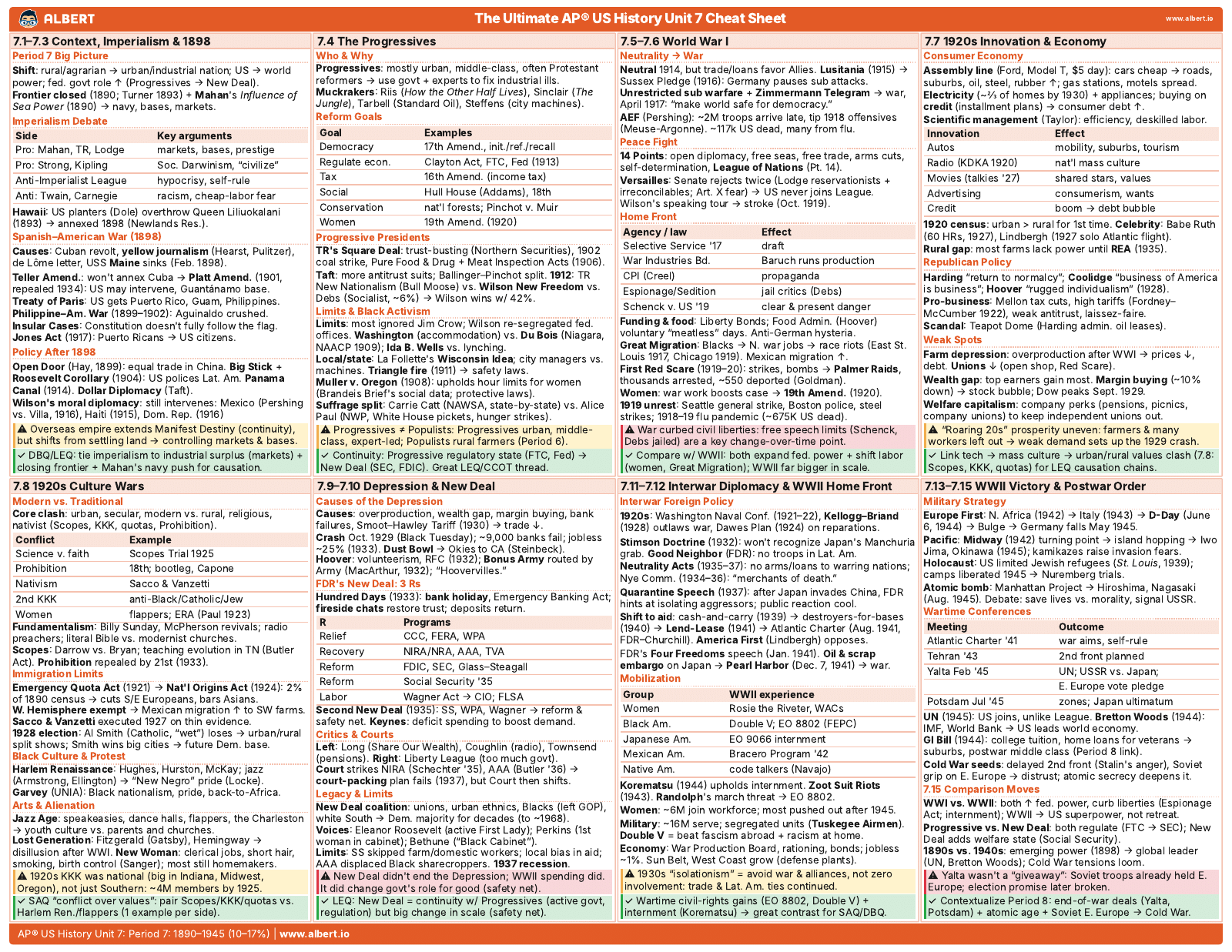
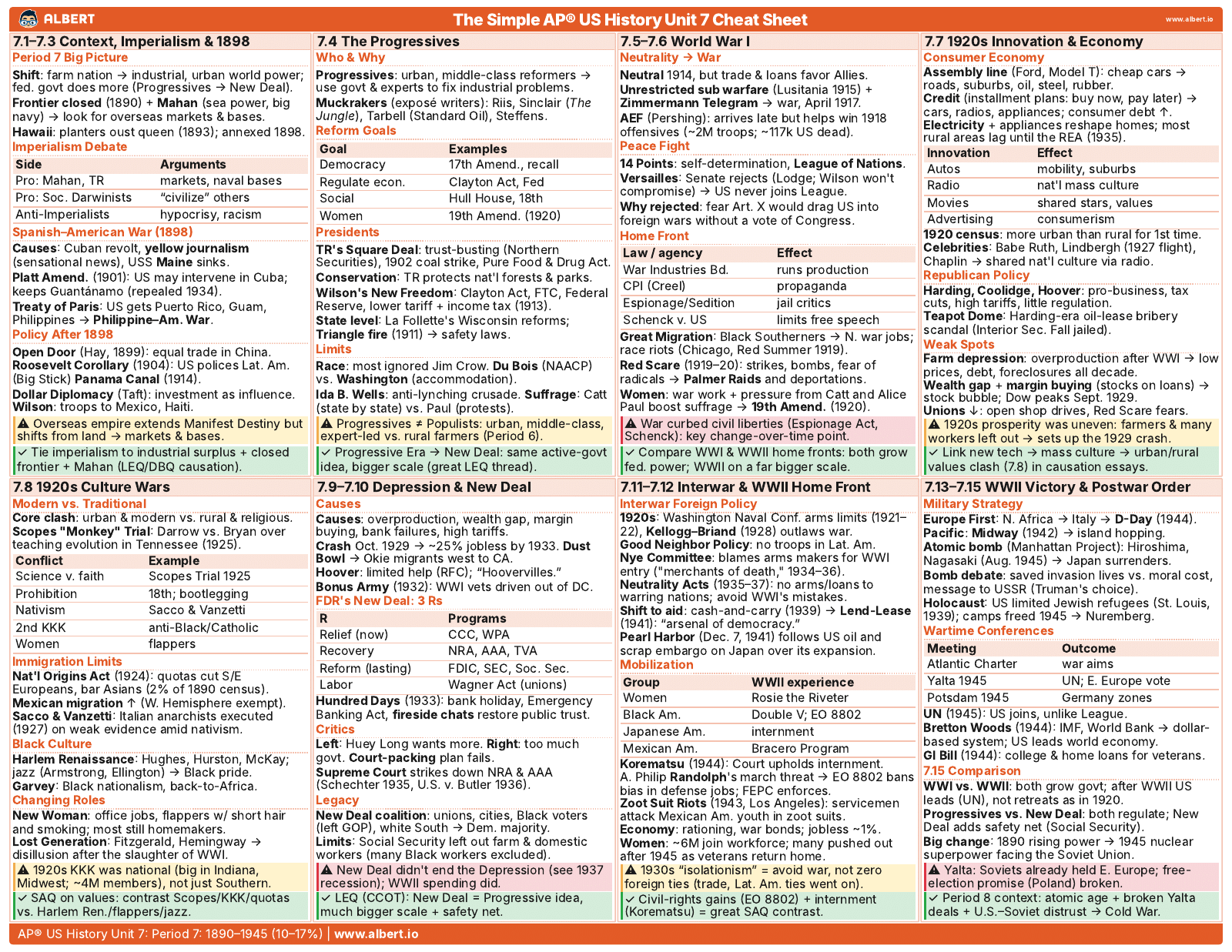
This APUSH Unit 7 cheat sheet covers 1890 to 1945, the stretch where the United States became an overseas empire, reformed its industrial economy, fought two world wars and rebuilt the federal government during the Great Depression. Period 7 makes up 10–17% of the AP® U.S. History Exam. Download the Simple version for a fast first pass or the Ultimate version when you want every term in one place.
Practice AP® US History Unit 7 questions on Albert
What’s on the APUSH Unit 7 Cheat Sheet?
Both versions follow the same eight cards, so you can switch between them without losing your place. The cards follow the College Board’s Unit 7 topics in order: imperialism and the Spanish–American War, the Progressives, World War I, 1920s technology and the economy, 1920s culture wars, the Great Depression and New Deal, interwar diplomacy and the WWII home front, and WWII victory with the postwar order.
The Simple version is for your first review or the night before a unit test. It keeps the big causes, the core laws and programs, and one warning and one exam tip per card, with a few words of explanation the first time a term appears.
The Ultimate version is for students aiming at a 4 or 5. It adds the court cases, executive orders, conferences and named reformers that turn a vague essay into a specific one, plus comparison moves for Topic 7.15. If you can explain every bold term on the Ultimate sheet, you are ready for Period 7 multiple-choice sets.
AP® US History Unit 7 at a Glance
The AP® U.S. History Course and Exam Description splits Period 7 into 15 topics. Unit 7 shares the top weighting band with Units 3 through 8, and the DBQ draws from 1754 to 1980, so this period is a frequent DBQ source.
| Topic | Name | Focus |
|---|---|---|
| 7.1 | Contextualizing Period 7 | Industrial nation becomes a world power |
| 7.2 | Imperialism: Debates | Arguments for and against overseas expansion |
| 7.3 | The Spanish–American War | Causes, new territories, the Philippine–American War |
| 7.4 | The Progressives | Reform at the city, state and federal levels |
| 7.5 | World War I: Military and Diplomacy | Entry into the war, the Fourteen Points, Versailles |
| 7.6 | World War I: Home Front | Mobilization, civil liberties, the Great Migration |
| 7.7 | 1920s: Innovations in Communication and Technology | Cars, radio, film and a consumer economy |
| 7.8 | 1920s: Cultural and Political Controversies | Modern versus traditional values, immigration quotas |
| 7.9 | The Great Depression | Causes and Hoover’s response |
| 7.10 | The New Deal | Relief, recovery, reform and their limits |
| 7.11 | Interwar Foreign Policy | Treaties, neutrality and the road to war |
| 7.12 | World War II: Mobilization | Women, minorities and the wartime economy |
| 7.13 | World War II: Military | Strategy in Europe and the Pacific, the atomic bomb |
| 7.14 | Postwar Diplomacy | Wartime conferences and the United Nations |
| 7.15 | Comparison in Period 7 | Comparing reform eras, wars and foreign policy |
Key Concepts in Unit 7: Period 7, 1890–1945
Imperialism and the Spanish–American War (7.1–7.3)
Start with the reasons. The 1890 census declared the frontier closed, factories were producing more than Americans could buy, and Alfred Thayer Mahan argued that great powers needed navies, coaling stations and overseas markets. Social Darwinists added a racial claim that Americans had a duty to “civilize” other peoples. The Anti-Imperialist League, which included Mark Twain and Andrew Carnegie, answered that ruling colonies betrayed the Declaration of Independence. Some anti-imperialists also opposed expansion for racist reasons, which is a nuance readers reward.
The war with Spain in 1898 grew out of the Cuban revolt, yellow journalism and the sinking of the USS Maine. The Teller Amendment promised not to annex Cuba, but the Platt Amendment later let the United States intervene there. The Treaty of Paris gave the United States Puerto Rico, Guam and the Philippines, and Filipino nationalists under Emilio Aguinaldo then fought a long war against American rule.
Worked example: A source shows a cartoon of Uncle Sam carrying a Filipino child labeled “the white man’s burden.” Read it as evidence of the “civilizing” argument for empire, then point out that it ignores the Filipinos’ own fight for independence. That move, naming the argument and its blind spot, is how you earn sourcing credit.
Exam tip: Treat overseas empire as both a continuation of Manifest Destiny and a change from it. Earlier expansion took land for settlers; this expansion sought markets and naval bases.
The Progressive Era (7.4)
Progressives were mostly urban, middle-class reformers who trusted experts and government to fix the problems of industrial life. Muckrakers such as Jacob Riis, Upton Sinclair and Ida Tarbell exposed slums, unsafe meatpacking and monopoly power. Reform came at every level: city managers replaced political machines, Robert La Follette’s Wisconsin pioneered state reforms, and the federal government added the 16th, 17th, 18th and 19th Amendments.
Theodore Roosevelt’s Square Deal broke up trusts, protected forests and passed the Pure Food and Drug Act. Woodrow Wilson’s New Freedom added the Clayton Antitrust Act, the Federal Trade Commission and the Federal Reserve. The movement had clear limits on race. Most Progressives ignored Jim Crow, and Wilson segregated federal offices. W.E.B. Du Bois and the NAACP pushed for full civil rights, while Booker T. Washington urged economic progress first.
Worked example: A prompt asks how far the Progressive Era expanded democracy. A strong thesis says it widened voting through the 17th and 19th Amendments and the initiative, referendum and recall, but that it left Black Southerners shut out by poll taxes and literacy tests.
Exam tip: Never mix up Progressives and Populists. Populists were Period 6 farmers; Progressives were urban professionals.
World War I at Home and Abroad (7.5–7.6)
The United States declared neutrality in 1914, but its trade and loans tied it to Britain and France. German submarine attacks, including the sinking of the Lusitania, and the Zimmermann Telegram brought the country into the war in April 1917. Wilson’s Fourteen Points called for self-determination and a League of Nations, but the Senate rejected the Treaty of Versailles because many senators feared Article X would commit the country to future wars.
At home, the War Industries Board ran production and the Committee on Public Information sold the war. The Espionage and Sedition Acts sent critics such as Eugene Debs to prison, and Schenck v. United States upheld those limits with the “clear and present danger” test. Black Southerners moved north for war jobs in the Great Migration, and the 1919 strikes and bombings set off the First Red Scare.
Worked example: For a question on how WWI changed the federal government, cite the War Industries Board and the Sedition Act as evidence of more power over the economy and over speech.
Exam tip: Wartime limits on civil liberties are a strong continuity thread. Pair WWI’s Sedition Act with WWII’s Japanese American internment.
The 1920s: New Technology and Culture Wars (7.7–7.8)
Henry Ford’s assembly line made cars affordable, and with them came roads, suburbs and a consumer economy built on credit. Radio, movies and advertising created a national mass culture. Republican presidents Harding, Coolidge and Hoover cut taxes, raised tariffs and left business mostly alone. Not everyone gained: farmers faced falling prices all decade, and the wealth gap grew.
The decade also split along cultural lines. The Scopes Trial set religion against science, Prohibition divided “wets” from “drys,” and a revived Ku Klux Klan targeted Black Americans, Catholics, Jews and immigrants. The National Origins Act of 1924 cut immigration from Southern and Eastern Europe and barred most Asian immigrants. In response, the Harlem Renaissance and Marcus Garvey’s movement promoted Black pride.
Worked example: A short-answer question gives a 1925 newspaper quote mocking William Jennings Bryan. Explain that the writer is a modern, urban voice, and use the Scopes Trial as evidence of a wider clash between city and countryside.
Exam tip: The 1920s Klan was strong in the Midwest, especially Indiana. Pointing that out shows the conflict was national, not regional.
The Great Depression and the New Deal (7.9–7.10)
The crash of 1929 exposed deeper problems: overproduction, an uneven distribution of wealth, stock buying on margin, bank failures and high tariffs. By 1933 about a quarter of the workforce had no job. Hoover relied mostly on voluntary efforts, though he created the Reconstruction Finance Corporation. Franklin Roosevelt’s New Deal moved faster with relief (CCC, WPA), recovery (NRA, AAA) and reform (FDIC, SEC, Social Security, the Wagner Act).
Critics attacked from both sides. Huey Long and Father Coughlin wanted more redistribution, while the Liberty League called the New Deal a threat to liberty. The Supreme Court struck down the NRA and the first AAA, and Roosevelt’s 1937 court-packing plan failed. The New Deal built a lasting Democratic coalition of unions, city voters, white Southerners and Black voters, though programs such as Social Security first left out farm and domestic workers.
Worked example: To argue continuity, link the Progressive regulatory state to New Deal agencies such as the SEC. To argue change, point to Social Security, which made the federal government responsible for people’s economic security for the first time.
Exam tip: Don’t write that the New Deal ended the Depression. Unemployment stayed high until wartime spending took over.
Interwar Diplomacy and World War II (7.11–7.14)
After WWI, the United States limited naval arms, signed the Kellogg–Briand Pact and adopted the Good Neighbor Policy toward Latin America. In the 1930s, the Neutrality Acts tried to keep the country out of another European war. Cash-and-carry, destroyers-for-bases and Lend-Lease moved it step by step toward aiding Britain until Pearl Harbor ended the debate.
Mobilization changed American society. Millions of women took factory jobs, A. Philip Randolph’s threatened march won Executive Order 8802 against job discrimination in defense work, and the Bracero Program brought Mexican workers north. Executive Order 9066 forced about 120,000 Japanese Americans into camps, and the Supreme Court upheld it in Korematsu v. United States. Abroad, the Allies followed a Europe First strategy, the Pacific war turned at Midway, and atomic bombs ended the war with Japan. Conferences at Yalta and Potsdam and the founding of the United Nations set up the postwar world.
Worked example: A DBQ document is a 1942 poster calling for a “Double Victory.” Use it to show that Black Americans tied the fight against fascism abroad to the fight against racism at home.
Exam tip: When you explain why the United States joined the UN but not the League, contrast the end of each war: isolationism in 1919, global leadership in 1945.
How Unit 7 Shows Up on the Exam
Multiple-choice sets often pair a Period 7 source with questions about its context or causes: a muckraker excerpt, a New Deal poster, an immigration quota table or a WWII propaganda image. Expect at least one question asking what development a source reflects and one asking which later event built on it.
Starting with the May 2027 exam, all three short-answer questions are required and each comes with a source. One uses secondary text, one a primary text and one a non-text source such as a cartoon or chart, and each covers a different period. Period 7 is a natural fit for any of them.
The DBQ draws from 1754 to 1980, so a Period 7 prompt is likely in any given year. The long essay is now a single required broad prompt, so Period 7 evidence can support arguments that stretch into Periods 6 or 8. Scorers reward a defensible thesis, specific evidence, contextualization and a complex argument that weighs change against continuity or causes against effects.
Common Mistakes in Unit 7
- Mistake: Calling the 1930s United States fully isolationist. Fix: Say it avoided alliances and war while staying active in trade and Latin America.
- Mistake: Saying Wilson’s Fourteen Points failed because Europe ignored them. Fix: Explain that the U.S. Senate rejected the treaty and the League.
- Mistake: Treating the 1920s as prosperous for everyone. Fix: Use farmers and the wealth gap to show uneven growth that set up 1929.
- Mistake: Listing New Deal agencies without saying what they changed. Fix: Tie each program to relief, recovery or reform and name its lasting effect.
- Mistake: Writing about WWII only as battles. Fix: Most Period 7 WWII questions focus on the home front, civil rights and postwar diplomacy.
Frequently Asked Questions
Can I use this cheat sheet on the AP® US History exam?
No. The AP® U.S. History Exam doesn’t allow notes or reference sheets. This APUSH Unit 7 cheat sheet is a study tool for review, practice and self-quizzing before the exam.
Should I start with the Simple or the Ultimate version?
Start with Simple if Period 7 is new or you need a fast review. Move to Ultimate once you can explain everything on Simple from memory. The added cases, executive orders and conferences are what make essay evidence specific.
How much of the exam is Unit 7?
Period 7 accounts for 10–17% of the multiple-choice section, and it is in range for the DBQ, which covers 1754 to 1980.
What’s the best way to study with the APUSH Unit 7 cheat sheet?
Cover the right side of each table and try to recall it, then explain each bold term out loud in one sentence. Finish with timed practice questions on the same topics so you get used to source-based questions.