
Maximize your score with these resources:
- Albert.io AP® US History question banks
- Free AP® US History study guides
- Free AP® US History score calculator
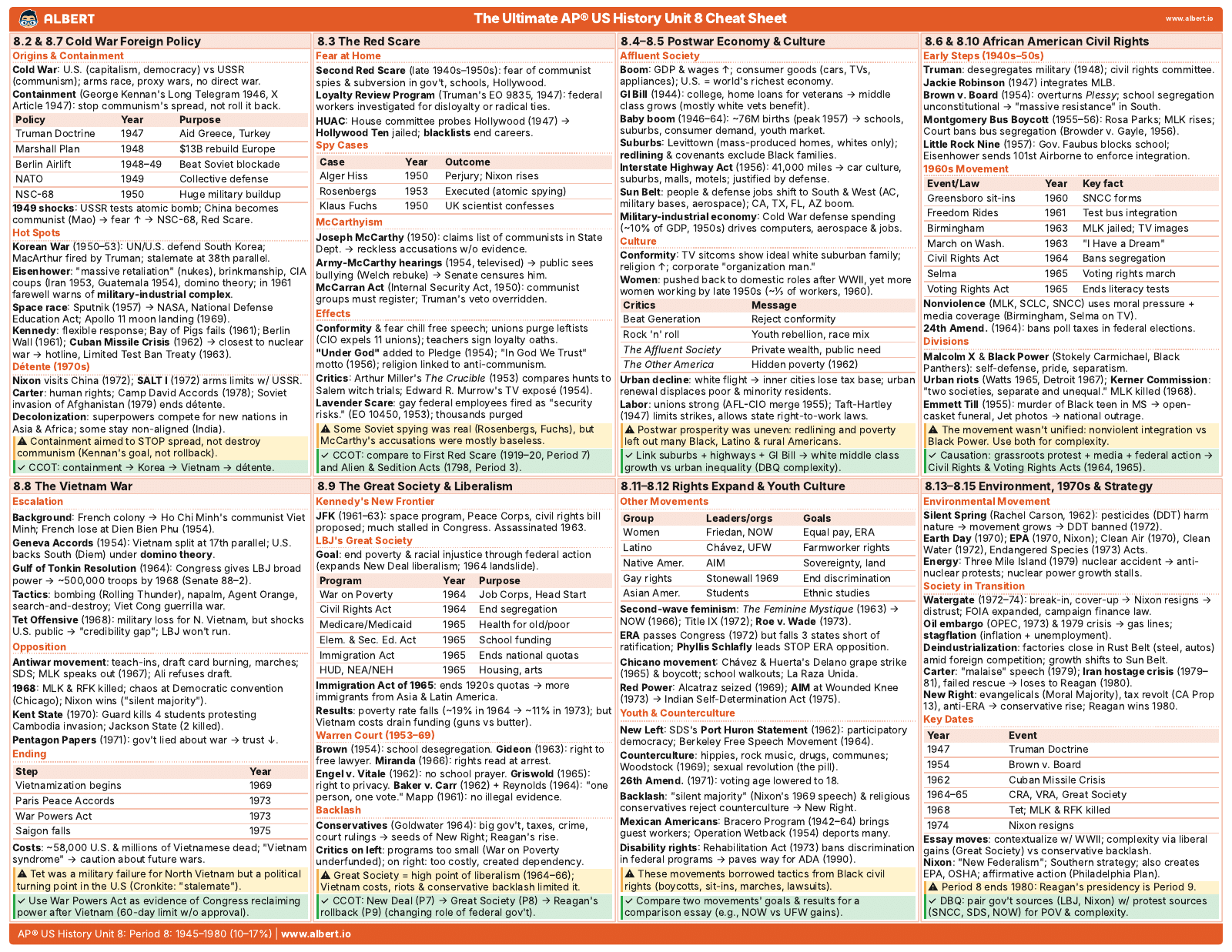
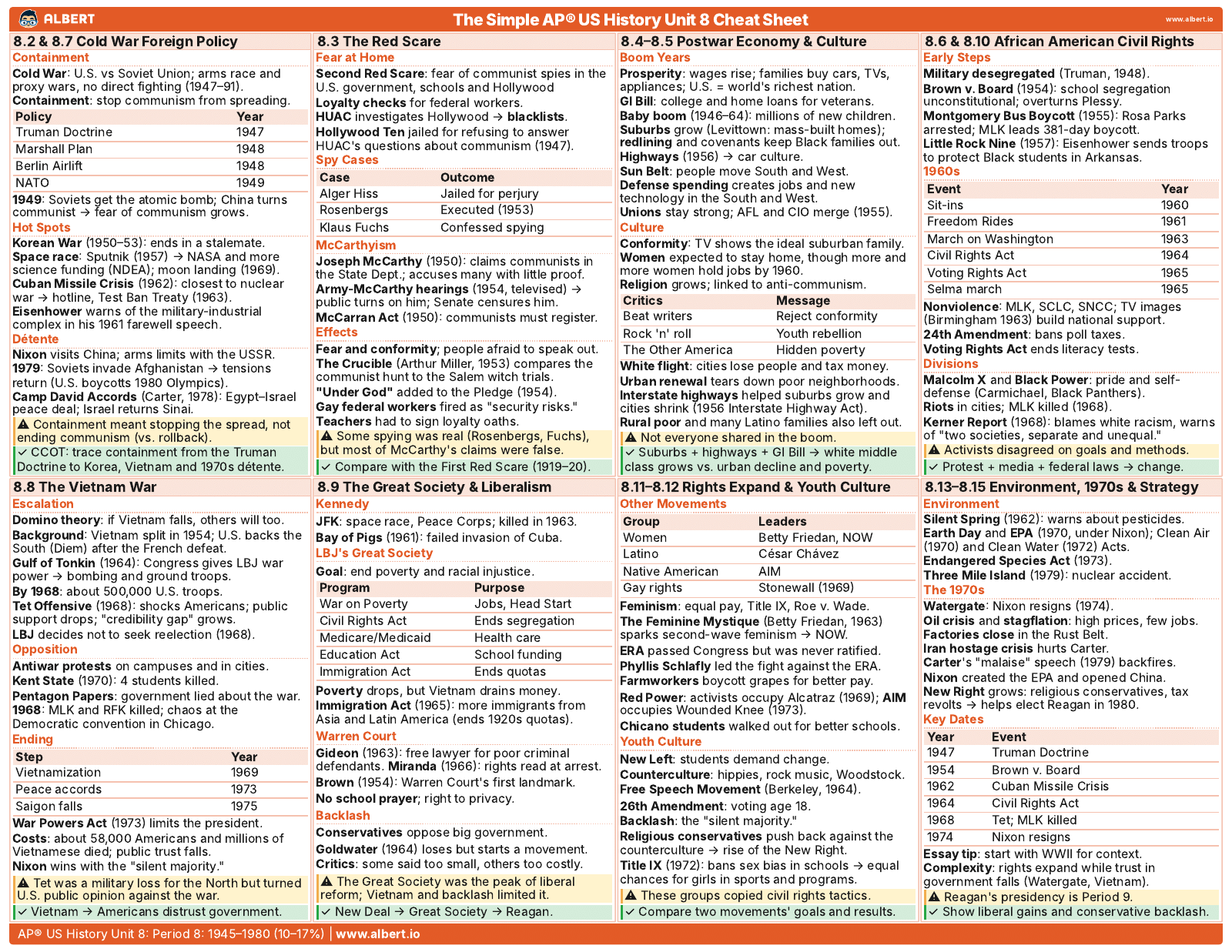
This APUSH Unit 8 cheat sheet covers Period 8, 1945 to 1980: the Cold War and containment, the Red Scare, postwar prosperity, the civil rights movement, Vietnam, the Great Society, the movements for women’s, Latino and Native American rights, and the turbulent 1970s. Period 8 makes up 10–17% of the AP® U.S. History exam. Download it below in Simple for a first pass or Ultimate for full detail.
Practice AP® US History Unit 8 questions on Albert
What’s on the APUSH Unit 8 Cheat Sheet?
Both versions share eight cards: Cold War foreign policy, the Red Scare, the postwar economy and culture, African American civil rights, the Vietnam War, the Great Society and the Warren Court, expanding rights and youth culture, and the environment and 1970s with essay strategy.
- Simple is for students learning the period or reviewing for a class test. It covers the main policies, events, laws and leaders with short notes on why each one matters.
- Ultimate is for students aiming for a 4 or 5. It adds a containment policy timeline, Red Scare spy cases, critics of 1950s conformity, a civil rights timeline with laws, Vietnam’s escalation and exit, Great Society programs, major Warren Court cases, a comparison of rights movements, and the economic and political crises of the 1970s.
Use Simple to learn how the pieces fit together, then Ultimate for the specific evidence essays need.
APUSH Unit 8 at a Glance
Period 8 runs from the end of World War II to the eve of the Reagan era. The AP® U.S. History Course and Exam Description organizes it into these topics.
| Topics | Name | Focus |
|---|---|---|
| 8.1 | Contextualizing Period 8 | The big picture, 1945–1980 |
| 8.2, 8.7 | The Cold War from 1945 to 1980 | Containment, Korea, nuclear arms, détente |
| 8.3 | The Red Scare | HUAC, McCarthyism, loyalty programs |
| 8.4–8.5 | Economy after 1945; Culture after 1945 | Suburbs, baby boom, conformity and its critics |
| 8.6, 8.10 | Early Steps in the Civil Rights Movement; The African American Civil Rights Movement (1960s) | Brown, boycotts, sit-ins, landmark laws |
| 8.8 | The Vietnam War | Escalation, protest, withdrawal |
| 8.9 | The Great Society | LBJ’s programs, Warren Court |
| 8.11–8.12 | The Civil Rights Movement Expands; Youth Culture of the 1960s | Feminism, Chicano and Native activism, counterculture |
| 8.13–8.14 | The Environment and Natural Resources; Society in Transition | EPA, Watergate, oil crisis, New Right |
| 8.15 | Continuity and Change in Period 8 | What changed and what stayed the same |
Key Concepts in Unit 8: Period 8, 1945–1980
The Cold War (8.2, 8.7)
After World War II, the U.S. and Soviet Union became rivals in a global struggle between capitalism and communism. The U.S. adopted containment: stop communism from spreading. The Truman Doctrine aided Greece and Turkey, the Marshall Plan rebuilt Western Europe, the Berlin Airlift beat a Soviet blockade, and NATO bound the U.S. to defend its allies. The Soviet atomic bomb and China’s communist revolution in 1949 raised fears, and the Korean War (1950–53) ended in stalemate. Eisenhower relied on nuclear deterrence and covert action; Kennedy faced the Bay of Pigs and the Cuban Missile Crisis. In the 1970s, Nixon pursued détente, opening relations with China and signing arms limits with the USSR, until the Soviet invasion of Afghanistan in 1979.
Reading a source: George Kennan’s 1946 “Long Telegram” argued Soviet expansion could be held back by steady pressure. Its audience was U.S. policymakers, and its argument became the basis for containment.
Exam tip: Containment aimed to stop communism’s spread, not destroy it. Use that to explain decisions in Korea and Vietnam.
The Red Scare (8.3)
Cold War fears produced a second Red Scare. Truman’s loyalty program screened federal workers, the House Un-American Activities Committee investigated Hollywood, and spy cases like Alger Hiss and the Rosenbergs suggested real threats. Senator Joseph McCarthy made sweeping accusations with little evidence until televised hearings in 1954 turned the public against him. The scare chilled free speech and encouraged conformity.
Exam tip: Some Soviet spying was real, but most McCarthy accusations were not. Compare this period with the First Red Scare after World War I.
Postwar Economy and Culture (8.4–8.5)
The postwar years brought rapid growth. The GI Bill helped veterans buy homes and attend college, the baby boom fueled demand, and the Interstate Highway Act of 1956 helped suburbs spread. People and defense jobs moved to the Sun Belt. Television promoted an ideal of white suburban family life, while critics, including the Beat writers and Michael Harrington’s The Other America, pointed to conformity and hidden poverty. Redlining kept many Black families out of the suburbs, and cities lost residents and tax revenue.
Exam tip: Prosperity was uneven. Discuss who gained from suburbanization and who was excluded.
The Civil Rights Movement (8.6, 8.10)
Brown v. Board of Education (1954) ruled school segregation unconstitutional, overturning Plessy. The Montgomery Bus Boycott made Martin Luther King Jr. a national leader, and Eisenhower sent troops to protect the Little Rock Nine. In the 1960s, sit-ins, Freedom Rides, the Birmingham campaign, the March on Washington and the Selma march put pressure on the federal government, which passed the Civil Rights Act of 1964 and the Voting Rights Act of 1965. Frustration with slow progress led to Black Power, urban unrest and the Kerner Commission’s warning of “two societies, separate and unequal.”
Reading a source: King’s “Letter from Birmingham Jail” (1963) answers ministers who urged patience. Use it to explain the strategy of nonviolent direct action and why activists refused to wait.
The Vietnam War (8.8)
Driven by the domino theory, the U.S. backed South Vietnam after 1954. The Gulf of Tonkin Resolution (1964) gave President Johnson broad authority, and troop levels reached about 500,000 by 1968. The Tet Offensive was a military defeat for North Vietnam but convinced many Americans the war could not be won quickly. Protests grew, from campuses to Kent State, and the Pentagon Papers showed the government had misled the public. Nixon’s Vietnamization and the 1973 Paris Peace Accords ended U.S. combat, and Saigon fell in 1975. Congress passed the War Powers Act to limit presidential war-making.
Exam tip: Tet is a strong turning point example: it changed public opinion more than it changed the battlefield.
The Great Society and Expanding Rights (8.9, 8.11–8.12)
Lyndon Johnson’s Great Society expanded the federal role through the War on Poverty, Medicare and Medicaid, school funding and the Immigration Act of 1965, which ended national-origin quotas. The Warren Court expanded rights in cases like Gideon v. Wainwright and Miranda v. Arizona. Other groups adopted civil rights tactics: second-wave feminists formed NOW and won Title IX, César Chávez organized farmworkers, the American Indian Movement demanded sovereignty, and the Stonewall uprising sparked the gay rights movement. Young people built a New Left and a counterculture, and the 26th Amendment lowered the voting age to 18.
Exam tip: Compare two movements’ goals, tactics and results to build a comparison essay quickly.
The Environment and the 1970s (8.13–8.14)
Rachel Carson’s Silent Spring sparked the environmental movement, leading to Earth Day, the EPA and new clean air, clean water and endangered species laws. The 1970s also brought Watergate and Nixon’s resignation, oil embargoes, stagflation and the closing of factories in the Rust Belt. The Iran hostage crisis damaged Jimmy Carter, and a New Right of evangelical Christians, tax protesters and opponents of the ERA prepared the ground for Ronald Reagan.
How Unit 8 Shows Up on the Exam
Multiple-choice sets often use speeches, Supreme Court excerpts, protest photographs or political cartoons about the Cold War. Short-answer questions frequently ask about causes and effects of containment, the civil rights movement or the Great Society.
Period 8 is common in long essays and DBQs on the civil rights movement, Cold War policy at home and abroad, the growth of federal power, and the rise of conservatism. See the AP® U.S. History exam page for the current format and rubrics.
Common Mistakes in Unit 8
- Mistake: Saying containment aimed to defeat communism everywhere. Fix: It aimed to stop its spread.
- Mistake: Treating the civil rights movement as one unified group. Fix: Contrast nonviolent integration with Black Power.
- Mistake: Calling Tet a U.S. military defeat. Fix: It was a political turning point, not a battlefield loss.
- Mistake: Describing the 1950s as prosperous for everyone. Fix: Redlining and poverty excluded many.
- Mistake: Placing Reagan in Period 8. Fix: Period 9 starts in 1980.
Frequently Asked Questions
Can I use this cheat sheet on the exam?
No. Notes aren’t allowed on the AP® U.S. History exam. The APUSH Unit 8 cheat sheet is a study tool for reviewing evidence and connections before exam day.
Should I start with the Simple or Ultimate version?
Start with Simple if Period 8 is new or you have a unit test. Move to Ultimate when you’re preparing for essays.
Which laws from Period 8 are most important?
The Civil Rights Act of 1964, the Voting Rights Act of 1965, the Immigration Act of 1965 and the War Powers Act of 1973 appear often on the exam.
How should I connect the civil rights movement to other movements?
Show how women, Latino Americans, Native Americans and gay Americans borrowed civil rights tactics like boycotts, marches and lawsuits, then compare their goals and results.
How does Period 8 connect to Period 9?
The economic troubles of the 1970s and backlash against 1960s liberalism fueled the conservative movement that elected Ronald Reagan in 1980.