
Maximize your score with these resources:
- Albert.io AP® Calculus question banks
- Free AP® Calculus study guides
- Free AP® Calculus score calculator
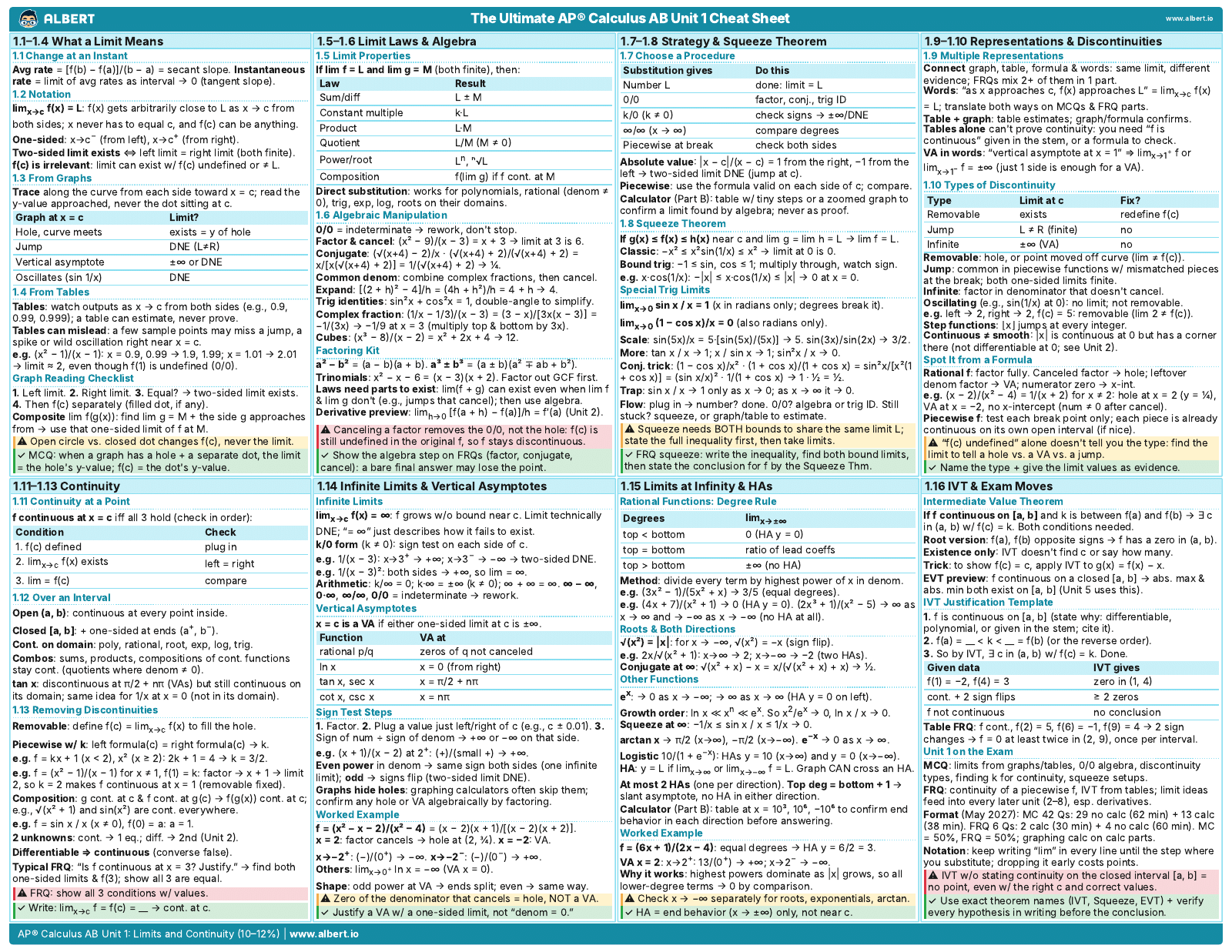
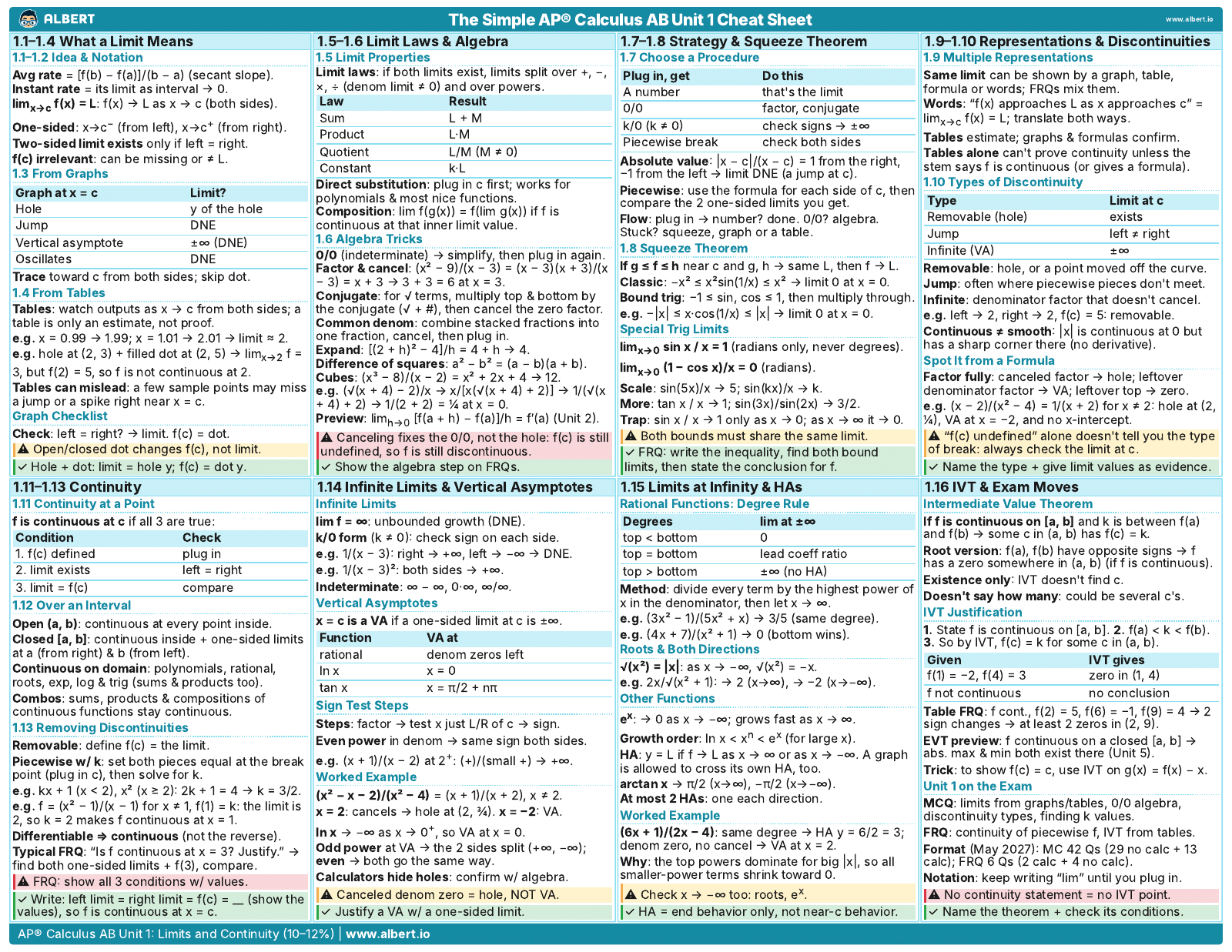
This AP Calc AB Unit 1 cheat sheet covers limits and continuity, the foundation every later unit builds on. Unit 1 makes up 10–12% of the AP® Calculus AB Exam’s multiple-choice section, and its ideas show up again in derivatives, integrals and nearly every free-response question. Start with the Simple version for a clean first pass, then move to the Ultimate version for every technique, trap and justification template.
Practice AP® Calculus AB Unit 1 questions on Albert
What’s on the AP Calc AB Unit 1 Cheat Sheet?
Both versions use the same eight cards, following the College Board’s Unit 1 topics in order: what a limit means, limit laws and algebra, choosing a procedure and the Squeeze Theorem, representations and types of discontinuity, continuity, infinite limits and vertical asymptotes, limits at infinity and horizontal asymptotes, and the Intermediate Value Theorem.
The Simple version is built for your first review. It keeps the definitions, the core algebra moves and one warning and one exam tip per card, with short explanations the first time a term appears.
The Ultimate version is for students aiming at a 4 or 5. It adds factoring formulas, extra trig limits, the sign test for vertical asymptotes, end behavior for roots and exponentials, and fill-in templates for continuity and IVT justifications. If you can work every example on the Ultimate sheet without looking, you are ready for Unit 1 questions on the exam.
AP® Calculus AB Unit 1 at a Glance
The AP® Calculus AB and BC Course and Exam Description splits Unit 1 into 16 topics. The unit counts for 10–12% of the multiple-choice score on the AB exam.
| Topic | Name | Focus |
|---|---|---|
| 1.1 | Introducing Calculus: Can Change Occur at an Instant? | Average vs. instantaneous rate of change |
| 1.2 | Defining Limits and Using Limit Notation | Reading and writing limit statements |
| 1.3 | Estimating Limit Values from Graphs | One-sided and two-sided limits from a graph |
| 1.4 | Estimating Limit Values from Tables | Estimating limits from numerical data |
| 1.5 | Determining Limits Using Algebraic Properties of Limits | Limit laws and direct substitution |
| 1.6 | Determining Limits Using Algebraic Manipulation | Factoring, conjugates and simplifying 0/0 forms |
| 1.7 | Selecting Procedures for Determining Limits | Choosing the right method |
| 1.8 | Determining Limits Using the Squeeze Theorem | Bounding a function between two others |
| 1.9 | Connecting Multiple Representations of Limits | Graphs, tables, formulas and words |
| 1.10 | Exploring Types of Discontinuities | Removable, jump and infinite discontinuities |
| 1.11 | Defining Continuity at a Point | The three-part continuity test |
| 1.12 | Confirming Continuity over an Interval | Continuity on open and closed intervals |
| 1.13 | Removing Discontinuities | Redefining points and solving for constants |
| 1.14 | Connecting Infinite Limits and Vertical Asymptotes | Unbounded behavior near a point |
| 1.15 | Connecting Limits at Infinity and Horizontal Asymptotes | End behavior |
| 1.16 | Working with the Intermediate Value Theorem (IVT) | Proving a value exists |
Key Concepts in Unit 1: Limits and Continuity
What a Limit Means (1.1–1.4)
Calculus starts with a question: how can something change at a single instant? The average rate of change over [a, b] is the slope of a secant line. Shrink the interval toward zero and the limit of those slopes is the instantaneous rate, which becomes the derivative in Unit 2.
The statement lim f(x) = L as x → c says f(x) gets as close as you like to L when x is close enough to c. The value f(c) plays no role. A two-sided limit exists only when the left-hand and right-hand limits are equal and finite.
Worked example: A graph has an open circle at (2, 3) and a closed dot at (2, 5). Tracing from both sides, the curve heads toward y = 3, so the limit as x → 2 is 3. The dot tells you f(2) = 5. These are two different questions, and the exam asks both.
Exam tip: Tables give estimates, not proof. If a table shows f(1.99) = 3.98 and f(2.01) = 4.02, say the limit appears to be 4.
Limit Laws and Algebraic Manipulation (1.5–1.6)
When both limits exist, limits split across sums, differences, products, constant multiples and quotients (as long as the denominator’s limit isn’t zero). For polynomials and most familiar functions, direct substitution works: plug in c and you’re done.
The interesting cases come when substitution gives 0/0. That result is indeterminate, so it says “do more work,” not “the limit is 0” or “the limit doesn’t exist.” The standard moves are factoring and canceling, multiplying by a conjugate, combining fractions over a common denominator and expanding.
Worked example: Find the limit of (√(x + 4) − 2)/x as x → 0. Substitution gives 0/0. Multiply the top and bottom by √(x + 4) + 2. The numerator becomes (x + 4) − 4 = x, which cancels with the denominator, leaving 1/(√(x + 4) + 2). Now substitute: 1/(2 + 2) = 1/4.
Exam tip: After you cancel a factor, the simplified expression has the same limit, but the original function is still undefined at that point. A canceled factor means a hole, not a fixed function.
Choosing a Procedure and the Squeeze Theorem (1.7–1.8)
Topic 1.7 is about deciding what to do. Plug in first. A number means you’re finished. 0/0 means algebra. A nonzero number over 0 means the function is unbounded, so check signs on each side. At a piecewise break or an absolute value, find each one-sided limit separately.
The Squeeze Theorem handles functions you can’t simplify. If g(x) ≤ f(x) ≤ h(x) near c, and g and h both approach L, then f must approach L too. It also gives the two special trig limits you need to know: sin x / x → 1 and (1 − cos x)/x → 0 as x → 0, with x in radians.
Worked example: Find the limit of x² sin(1/x) as x → 0. Since −1 ≤ sin(1/x) ≤ 1, multiply through by x² (which is never negative) to get −x² ≤ x² sin(1/x) ≤ x². Both bounds approach 0, so by the Squeeze Theorem the limit is 0.
Exam tip: Rescale trig limits to match the special form. sin(5x)/x equals 5 · sin(5x)/(5x), which approaches 5.
Discontinuities and Continuity (1.9–1.13)
There are three types of discontinuity to name. A removable discontinuity has a limit, but the function is undefined there or has a different value. A jump has different left and right limits. An infinite discontinuity has a vertical asymptote.
A function is continuous at x = c when three things are true: f(c) is defined, the limit as x → c exists, and the two are equal. On a closed interval [a, b], you also need the one-sided limits at the endpoints to match f(a) and f(b).
Worked example: Let f(x) = kx + 1 for x < 2 and f(x) = x² for x ≥ 2. For continuity at x = 2, the left limit 2k + 1 must equal the right limit and f(2), both 4. Solving 2k + 1 = 4 gives k = 3/2.
Exam tip: On a free-response question, write the full chain: the left limit equals the right limit equals f(c) equals a specific number, so f is continuous at c. “There’s no hole” earns nothing.
Infinite Limits and Limits at Infinity (1.14–1.15)
Infinite limits describe behavior near a vertical asymptote. When substitution gives a nonzero number over 0, test a value just left and just right of c to find the sign. For 1/(x − 3), the function goes to +∞ from the right and −∞ from the left, so the two-sided limit doesn’t exist.
Limits at infinity describe end behavior. For rational functions, compare degrees: a smaller numerator degree gives 0, equal degrees give the ratio of leading coefficients, and a larger numerator degree gives no horizontal asymptote. To prove it, divide every term by the highest power of x in the denominator.
Worked example: For f(x) = 2x/√(x² + 1), divide by |x| = √(x²). As x → ∞, |x| = x and the limit is 2. As x → −∞, |x| = −x and the limit is −2. This function has two different horizontal asymptotes.
Exam tip: A denominator zero that cancels is a hole, not an asymptote. Factor completely before you name any vertical asymptotes.
The Intermediate Value Theorem (1.16)
If f is continuous on [a, b] and k is any value between f(a) and f(b), then f(c) = k for at least one c in (a, b). The theorem guarantees a value exists. It doesn’t find c or tell you how many there are.
Worked example: A continuous function has f(1) = −2 and f(4) = 3. Because 0 is between −2 and 3, the IVT guarantees a zero somewhere in (1, 4).
Exam tip: IVT questions often give a table of values for a function described as differentiable. Differentiable implies continuous, so say that, then apply the theorem. Leave out the continuity statement and you lose the point.
How Unit 1 Shows Up on the Exam
Starting in May 2027, the multiple-choice section has 42 questions in 1 hour 40 minutes: 29 without a calculator and 13 with a graphing calculator. Unit 1 questions usually ask you to read a limit from a graph or table, simplify a 0/0 form, classify a discontinuity or find a constant that makes a piecewise function continuous.
The free-response section has 6 questions in 90 minutes. Unit 1 rarely gets its own question, but limits and continuity appear inside many of them. Typical tasks include justifying continuity at a point, applying the IVT to a table and evaluating a limit as one part of a longer problem. Readers look for correct notation, named theorems and every hypothesis checked.
Common Mistakes in Unit 1
- Mistake: Treating 0/0 as an answer. Fix: It’s a signal to simplify. Factor, rationalize or use a trig limit, then substitute again.
- Mistake: Confusing f(c) with the limit as x → c. Fix: Find the limit by tracing the curve and f(c) from the dot. Answer each separately.
- Mistake: Calling every denominator zero a vertical asymptote. Fix: Factor first. A canceled factor gives a hole.
- Mistake: Dropping “lim” in the middle of your work. Fix: Keep writing the limit symbol on every line until you substitute.
- Mistake: Applying the IVT without stating continuity. Fix: Start every IVT justification with “f is continuous on [a, b]” and give the reason.
Frequently Asked Questions
Can I use this cheat sheet on the AP® Calculus AB exam?
No. The exam doesn’t provide or allow a formula sheet or notes. This AP Calc AB Unit 1 cheat sheet is a study tool for review, practice and memorizing the key rules.
Should I start with the Simple or the Ultimate version?
Start with Simple if limits are new to you or you’re reviewing quickly before a test. Switch to Ultimate once you can work the Simple examples from memory. Its extra examples and justification templates are what earn free-response points.
How much of the exam is Unit 1?
Unit 1 counts for 10–12% of the AB multiple-choice section. Because derivatives and integrals are defined with limits, the skills also matter in every later unit.
Do I need the formal epsilon-delta definition of a limit?
No. The AB exam tests limits through graphs, tables and algebra, not epsilon-delta proofs. Focus on reading, computing and justifying limits.