
Maximize your score with these resources:
- Albert.io AP® European History question banks
- Free AP® European History study guides
- Free AP® European History score calculator
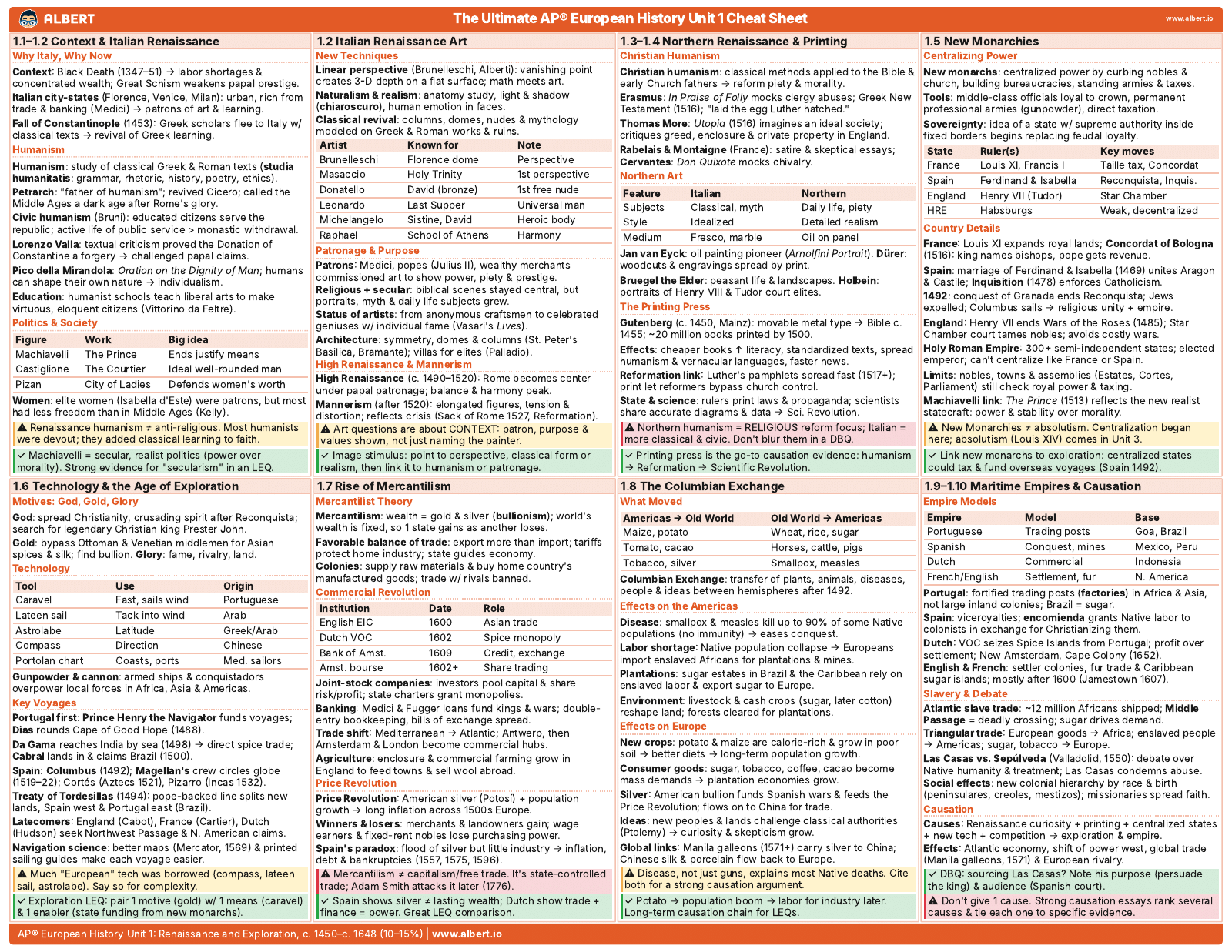
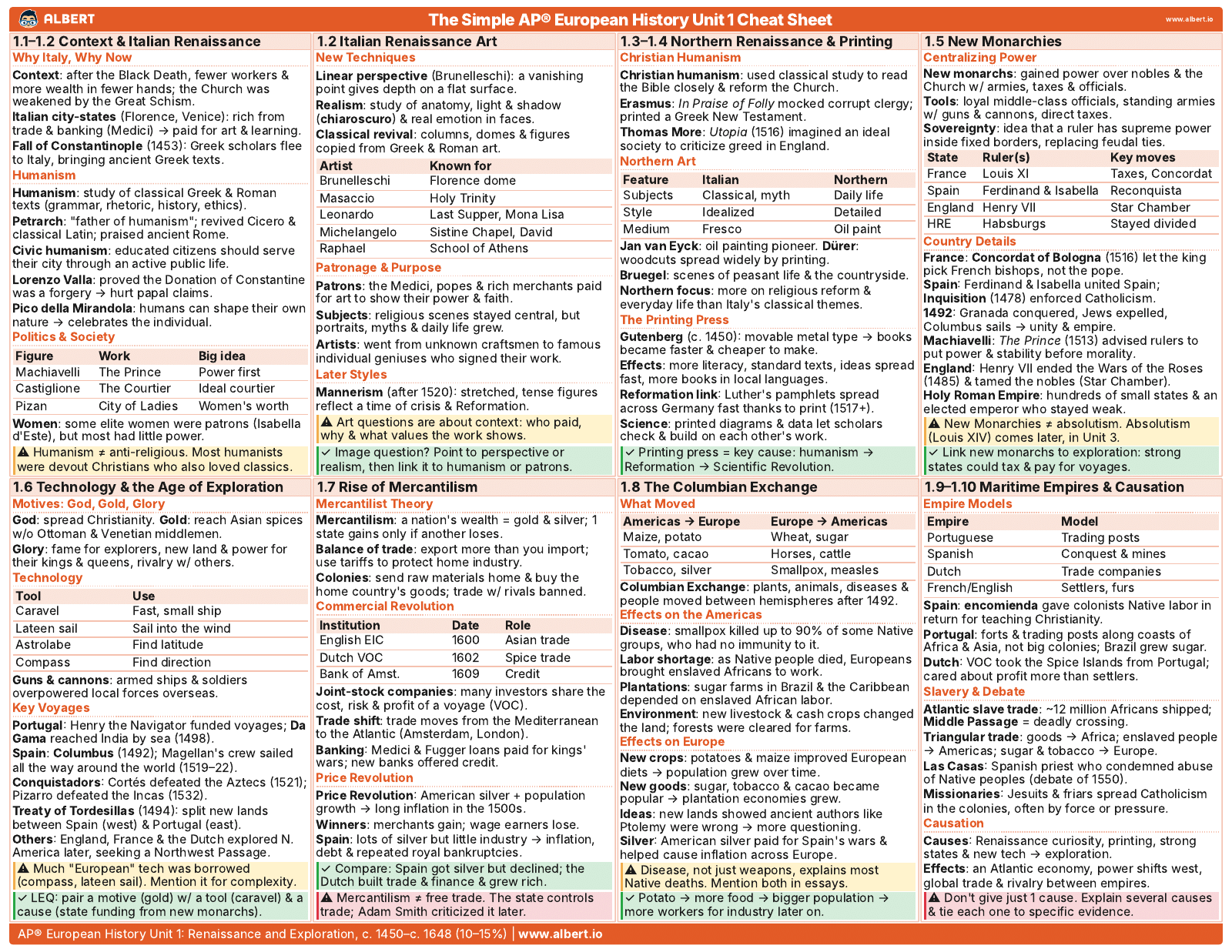
This AP Euro Unit 1 cheat sheet covers the Renaissance and the Age of Exploration, from about 1450 to 1648: humanism, Renaissance art, the printing press, the new monarchies, and Europe’s first overseas empires. Unit 1 makes up 10–15% of the AP® European History exam. Choose the Simple version for a quick review or the Ultimate version for every name, date, and causation link.
Practice AP® European History Unit 1 questions on Albert
What’s on the AP Euro Unit 1 Cheat Sheet?
Both versions follow the topics in the College Board’s AP® European History Course and Exam Description, from the context of the Renaissance through the causes and effects of exploration. Related topics share cards so the whole unit fits on one page.
The Simple version is for your first pass or a refresher before a quiz. It keeps the essential people and ideas (Petrarch, Machiavelli, Erasmus, Gutenberg, Ferdinand and Isabella, Columbus) with a few words on why each matters.
The Ultimate version is for students aiming at the DBQ and LEQ. It adds the details that earn evidence points: Lorenzo Valla and the Donation of Constantine, the Concordat of Bologna, the Treaty of Tordesillas, the Dutch East India Company, the Price Revolution, the Valladolid debate, and causation chains you can use in essays. Every card ends with a tip or a warning about a common mistake.
AP Euro Unit 1 at a Glance
Unit 1 is worth 10–15% of the exam, which usually means roughly 6 to 8 of the 55 multiple-choice questions. Because it sets up the Reformation, absolutism, and the Scientific Revolution, its ideas show up again in later units and in long essays that span periods.
| Topic | Name | Focus |
|---|---|---|
| 1.1 | Contextualizing Renaissance and Discovery | Black Death, the Great Schism, and the fall of Constantinople as background. |
| 1.2 | Italian Renaissance | Humanism, civic humanism, secular politics, and new artistic techniques. |
| 1.3 | Northern Renaissance | Christian humanism, Erasmus and More, Northern art. |
| 1.4 | Printing | Gutenberg’s press and how it spread ideas. |
| 1.5 | New Monarchies | How rulers in France, Spain, and England centralized power. |
| 1.6 | Technological Advances and the Age of Exploration | Motives, ships and navigation tools, key voyages. |
| 1.7 | Rise of Mercantilism | Bullion, trade balances, joint-stock companies, the Price Revolution. |
| 1.8 | The Columbian Exchange | Crops, animals, and diseases moving between hemispheres. |
| 1.9 | Maritime Empires Developed | Portuguese, Spanish, Dutch, and other empires; the Atlantic slave trade. |
| 1.10 | Causation in the Renaissance and Age of Discovery | Explaining why these changes happened and what they led to. |
Key Concepts in Unit 1: Renaissance and Exploration
The Italian Renaissance and Humanism
The Renaissance began in the wealthy city-states of northern Italy, where trade and banking families like the Medici had money to spend on art and learning. Humanism was the movement at its center: the study of classical Greek and Roman texts in grammar, rhetoric, history, poetry, and ethics. Petrarch revived Cicero and is often called the father of humanism. Civic humanists such as Leonardo Bruni argued that educated citizens should serve their republic. Lorenzo Valla used textual analysis to prove the Donation of Constantine a forgery, weakening a key papal claim. Machiavelli’s The Prince separated politics from traditional morality.
Worked example: A DBQ document quotes Pico della Mirandola saying humans can choose to rise toward the divine or sink toward the beasts. That is evidence for Renaissance individualism, and it also shows humanism working inside a Christian framework rather than against it.
Exam tip: Humanism was not anti-religious. Showing that humanists blended classical learning with Christian faith is an easy way to add complexity.
Renaissance Art in Italy and the North
Italian artists developed linear perspective (Brunelleschi, Masaccio), realistic anatomy, and chiaroscuro, and they revived classical forms. Patrons such as the Medici and Pope Julius II paid for art to display power and piety. Leonardo, Michelangelo, and Raphael defined the High Renaissance. North of the Alps, artists such as Jan van Eyck, Albrecht Dürer, and Pieter Bruegel used oil paint and detailed realism to show everyday life and personal faith.
Worked example: Raphael’s School of Athens places Plato and Aristotle in a grand classical hall drawn in perfect perspective, painted for the pope’s private library. It shows classical revival, new technique, and papal patronage all at once, which makes it strong evidence for several kinds of argument.
Exam tip: When you use a painting as evidence, name the patron or purpose and the value it shows. Naming the artist alone is not analysis.
The Northern Renaissance and the Printing Press
Northern humanists, called Christian humanists, used classical scholarship to study the Bible and reform the Church. Erasmus mocked clerical abuses in In Praise of Folly and published a Greek New Testament in 1516. Thomas More criticized English society in Utopia. Around 1450, Johannes Gutenberg introduced movable metal type in Mainz. Printing made books cheaper, raised literacy, standardized texts, and spread new ideas far faster than hand copying.
Worked example: Martin Luther’s Ninety-Five Theses (1517) were printed and spread across Germany within weeks. Without the press, a local academic dispute might have stayed local. This makes printing a classic link between Unit 1 and the Reformation in Unit 2.
Exam tip: The printing press works as causation evidence for humanism, the Reformation, and the Scientific Revolution. One example can support three different essays.
The New Monarchies
In the late 1400s, rulers in France, Spain, and England strengthened central power at the expense of nobles and the Church. They built bureaucracies staffed by middle-class officials, created standing armies, and raised taxes directly. In France, the Concordat of Bologna (1516) gave the king the right to name bishops. In Spain, Ferdinand and Isabella united Aragon and Castile, used the Inquisition to enforce religious unity, and completed the Reconquista in 1492. In England, Henry VII ended the Wars of the Roses and used the Court of Star Chamber to control powerful nobles. The Holy Roman Empire stayed divided into hundreds of states.
Worked example: The year 1492 ties together three Spanish developments: the conquest of Granada, the expulsion of Jews, and Columbus’s first voyage. A centralized, religiously unified state was able to fund and claim an overseas empire.
Exam tip: Don’t call the new monarchs absolutists. Centralization starts here; absolutism under Louis XIV belongs to Unit 3.
Exploration, Mercantilism, and Maritime Empires
Europeans explored for “God, gold, and glory”: spreading Christianity, reaching Asian spices without Ottoman and Venetian middlemen, and winning fame and power. The caravel, lateen sail, astrolabe, and magnetic compass (several borrowed from Arab and Chinese sources) made long voyages possible. Portugal led the way, with Dias rounding the Cape of Good Hope (1488) and da Gama reaching India (1498). Spain followed with Columbus (1492), and the Treaty of Tordesillas (1494) divided new lands between the two. Governments followed mercantilism, which held that wealth meant gold and silver and that colonies existed to enrich the home country. Joint-stock companies like the Dutch East India Company (1602) spread risk among investors.
Worked example: Spain received enormous amounts of silver from mines like Potosí, yet suffered inflation and repeated royal bankruptcies. The Dutch, with few mines, grew rich through trade, shipping, and finance. The comparison shows that bullion alone did not create lasting wealth.
Exam tip: Mercantilism is state-controlled trade, not free-market capitalism. Adam Smith attacked it later, in 1776.
The Columbian Exchange and Its Consequences
After 1492, plants, animals, diseases, and people crossed the Atlantic. Maize and potatoes eventually improved European diets and supported population growth. Horses, cattle, and wheat reshaped the Americas. Smallpox and measles killed a large share of Native populations, and the resulting labor shortage drove the Atlantic slave trade, which carried roughly 12 million Africans across the Middle Passage. In the Spanish colonies, the encomienda system forced Native labor, and Bartolomé de las Casas condemned the abuse in the Valladolid debate of 1550.
Worked example: To explain the growth of the Atlantic slave trade, connect three steps: disease collapses Native populations, sugar plantations need large numbers of workers, and European traders turn to West Africa. Each step is a cause, and together they form a strong causation argument.
Exam tip: Name disease as well as weapons when you explain the conquest of the Americas. Most Native deaths came from epidemics.
How Unit 1 Shows Up on the Exam
The AP® European History exam has four parts: 55 multiple-choice questions in 55 minutes (40%), 3 short-answer questions in 40 minutes (20%), one document-based question in 60 minutes including a 15-minute reading period (25%), and one long essay question in 40 minutes (15%).
Unit 1 multiple-choice sets often start with a primary source, such as an excerpt from Machiavelli or Erasmus or a Renaissance painting, and ask about context or causation. Short-answer questions may ask you to explain one cause of exploration or one effect of the printing press. In DBQs and LEQs, scorers reward a defensible thesis, specific evidence beyond the documents, and complexity, such as explaining both continuity and change, or several causes ranked by importance. Sourcing a document by its author’s purpose or audience (Las Casas writing to persuade the Spanish crown, for example) earns a separate point.
Common Mistakes in Unit 1
- Treating humanism as anti-religious. Most humanists were devout; Northern humanists aimed to reform the Church, not reject it.
- Blurring Italian and Northern humanism. Italian humanism leaned classical and civic; Northern humanism focused on religious reform.
- Calling the new monarchs absolute rulers. They centralized power but still faced nobles, towns, and assemblies.
- Equating mercantilism with free trade. Mercantilism meant tight state control of trade.
- Giving one cause for exploration. Strong answers combine motives, technology, and state funding.
Frequently Asked Questions
Can I use this cheat sheet on the AP® European History exam?
No. Notes and reference sheets aren’t allowed on the AP® European History exam. Use the cheat sheet for studying, homework, and review before your unit test or the exam.
Should I start with the Simple or the Ultimate version?
Start with Simple if the Renaissance and exploration are new to you or you want a fast refresher. Move to Ultimate once the main names feel familiar; it adds the specific evidence that helps on the DBQ and LEQ.
How much of the AP Euro exam is Unit 1?
Unit 1 is weighted at 10–15% of the exam. Its themes, such as the spread of ideas, state power, and European expansion, carry into later units, so the payoff goes beyond the questions labeled Unit 1.
What dates should I memorize for Unit 1?
Focus on a short list that anchors the period: about 1450 (printing press), 1453 (fall of Constantinople), 1492 (Granada and Columbus), 1494 (Treaty of Tordesillas), 1498 (da Gama reaches India), and 1517 (Luther, the bridge to Unit 2). Knowing the order of events matters more than exact dates on most questions.