
Maximize your score with these resources:
- Albert.io AP® English Language question banks
- Free AP® English Language study guides
- Free AP® English Language score calculator
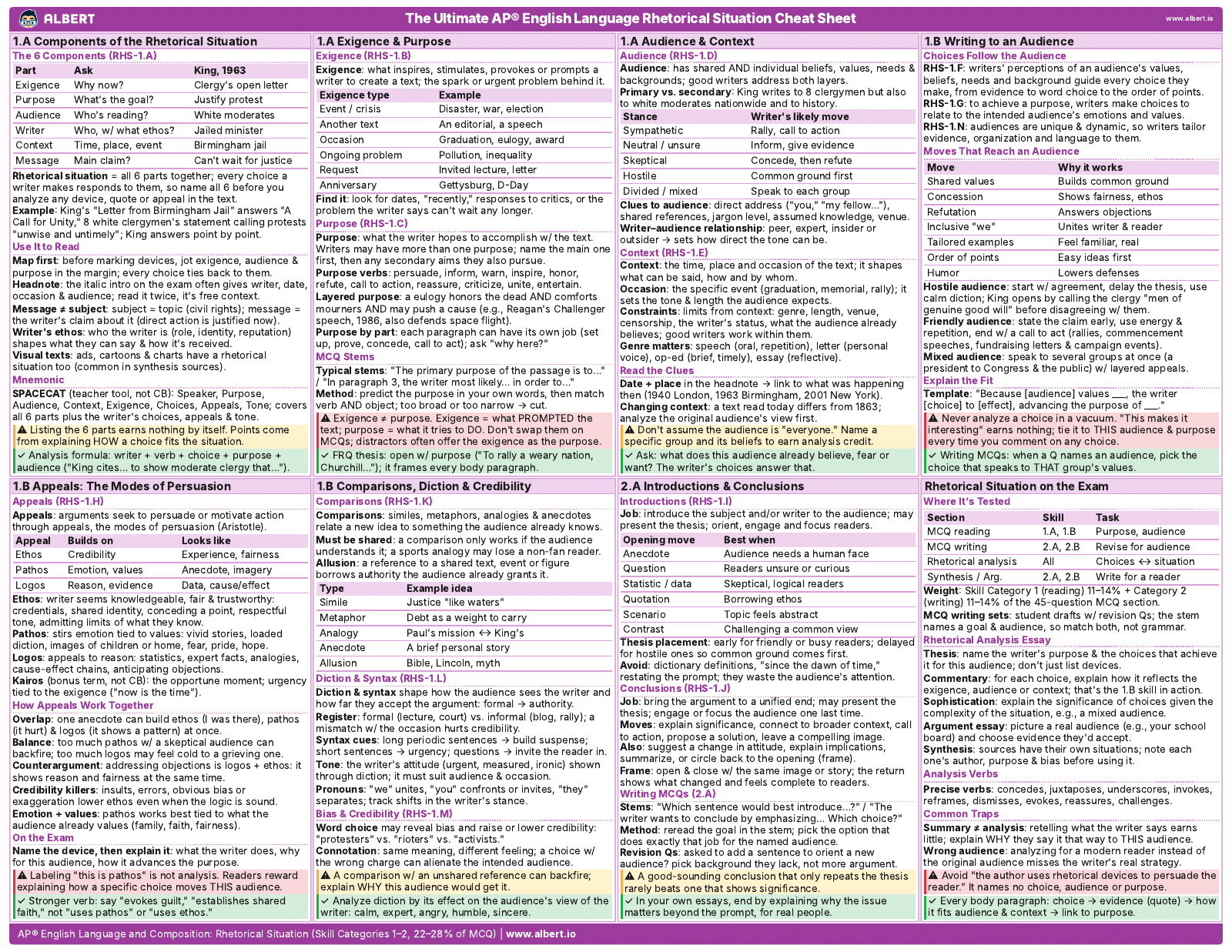
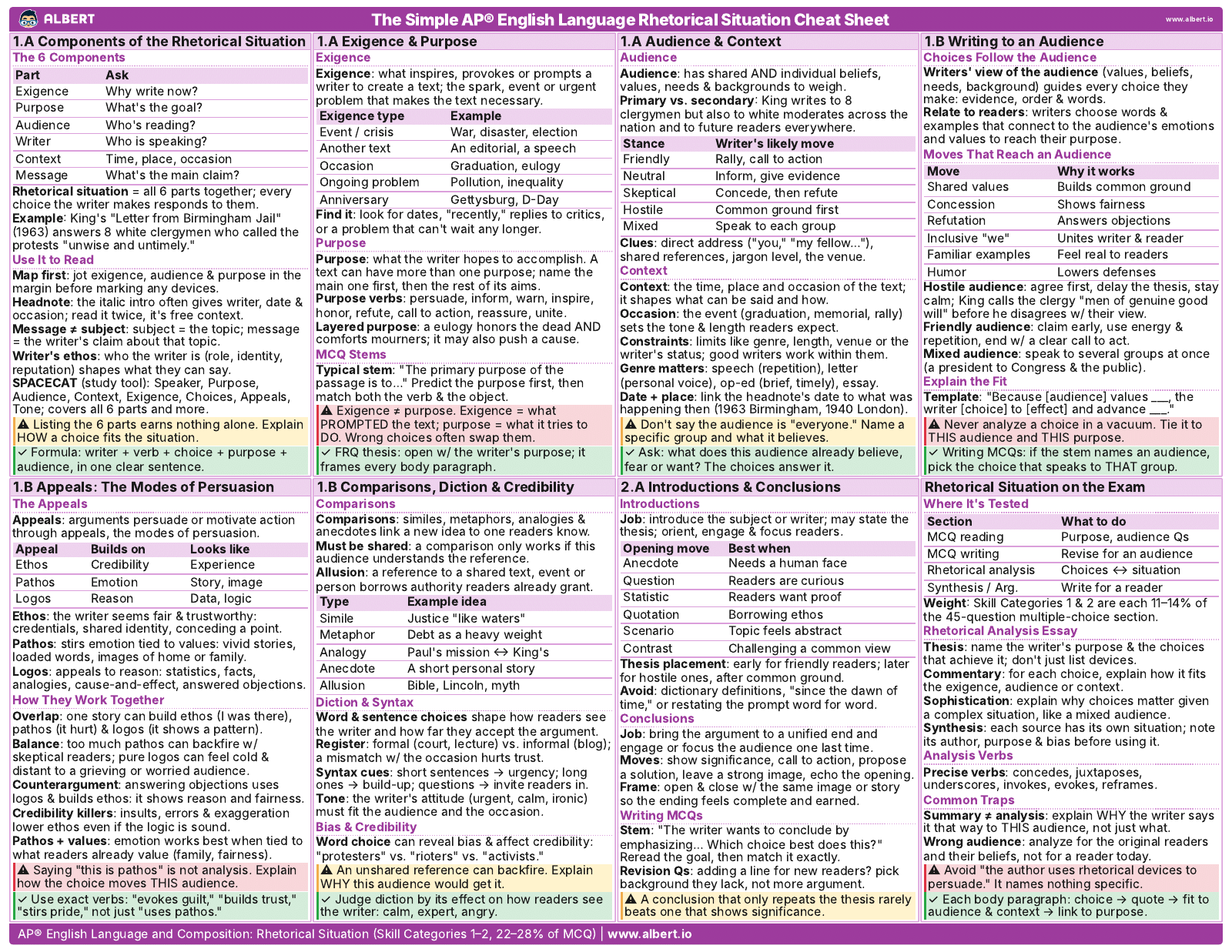
This AP Lang rhetorical situation cheat sheet covers the ideas behind every reading question and essay on the exam: exigence, purpose, audience, context, and the choices writers make in response. Rhetorical Situation skills make up roughly a quarter of the multiple-choice section. Pick the Simple version for the essentials or the Ultimate version for every move and trap.
Practice AP® English Language & Composite questions on Albert
What’s on the AP Lang Rhetorical Situation Cheat Sheet?
Both versions follow the Rhetorical Situation big idea in the College Board’s AP® English Language and Composition Course and Exam Description. The eight cards are labeled by the course skills they support: three cards on skill 1.A (identifying the components of the rhetorical situation), three on skill 1.B (explaining how an argument reflects its audience), one on skill 2.A (writing introductions and conclusions), and a final card on how all of it shows up on the exam.
The Simple version gives you the six components with the question to ask about each, a table of audience types and the moves that reach them, the three appeals, opening and closing moves, and one key warning per card.
The Ultimate version adds a worked example of King’s “Letter from Birmingham Jail” mapped onto every component, layered purposes, constraints and genre, mixed and hostile audiences, kairos, allusion and register, revision-question strategy, and essay templates. Start with Simple, then move to Ultimate once you can name all six components without looking.
AP Lang Rhetorical Situation at a Glance
| Skill | What you do | Essential knowledge |
|---|---|---|
| 1.A | Identify and describe the exigence, audience, writer, purpose, context and message | RHS-1.A to RHS-1.E |
| 1.B | Explain how an argument shows an understanding of an audience’s beliefs, values or needs | RHS-1.F to RHS-1.H, RHS-1.K to RHS-1.N |
| 2.A | Write introductions and conclusions that fit the purpose and context | RHS-1.I, RHS-1.J |
| 2.B | Show an understanding of an audience’s beliefs, values or needs in your own writing | RHS-1.F to RHS-1.N |
Exam weight: on the 45-question multiple-choice section, Skill Category 1 (Rhetorical Situation, Reading) and Skill Category 2 (Rhetorical Situation, Writing) are each worth 11–14%. The same thinking drives all three essays.
Key Concepts in Rhetorical Situation
The Six Components
The course framework defines the rhetorical situation as the exigence, purpose, audience, writer, context and message of a text taken together. None of them works alone. A writer’s purpose only makes sense in light of the audience, and the right word or example depends on the context.
Worked example: Frederick Douglass delivered “What to the Slave Is the Fourth of July?” on July 5, 1852, to the Rochester Ladies’ Anti-Slavery Society. The writer is a formerly enslaved abolitionist. The audience is a mostly white, sympathetic Northern crowd celebrating independence. The context is a national holiday about liberty, which is also the exigence. His message is that the celebration is hollow while slavery continues, and his purpose is to move his listeners from comfortable approval to action.
Notice how each component points to the others: because the audience already sees itself as pro-freedom, Douglass can turn their own values against slavery instead of arguing from scratch.
Exam tip: read the headnote twice. It usually tells you the writer, date, occasion and audience before you read a word of the passage.
Exigence and Purpose
Exigence is what inspires, provokes or prompts a writer to create a text: an event, another text, an occasion or an ongoing problem. Purpose is what the writer hopes to accomplish, and a text can have more than one. Keep them separate. Exigence is what caused the text; purpose is what the text is trying to do.
Worked example: In Lincoln’s Gettysburg Address (1863), the exigence is the dedication of a cemetery for soldiers killed at Gettysburg. The purpose goes beyond honoring the dead: Lincoln asks listeners to commit themselves to “the unfinished work” so that the nation survives.
Exam tip: on purpose questions, predict the answer in your own words, then check both the verb (“to warn,” “to honor”) and the object. A choice with the right verb and the wrong object is still wrong.
Audience and Context
An audience has shared and individual beliefs, values, needs and backgrounds. Strong writers figure out where their readers stand. A sympathetic audience can be rallied, a neutral one needs evidence, a skeptical one needs concessions, and a hostile one needs common ground first. Context, meaning the time, place and occasion, limits what a writer can say and how.
Worked example: King opens his letter by calling the clergymen “men of genuine good will” before disagreeing with them. Addressing a skeptical audience of fellow clergy, he builds common ground first so they keep reading.
Exam tip: never call the audience “everyone.” Name the group and what it believes, and your commentary will have something to connect to.
Appeals, Comparisons and Word Choice
Arguments persuade through appeals: ethos (credibility), pathos (emotion tied to values) and logos (reason and evidence). Writers also use comparisons such as similes, metaphors, analogies and anecdotes to relate new ideas to something the audience already knows. A comparison only works if the audience shares the reference. Diction and syntax shape how readers see the writer, and word choice can reveal bias and raise or lower credibility.
Worked example: Compare “protesters,” “rioters” and “activists” for the same group. Each word signals a different stance, and a writer who picks the wrong one can lose the readers they most need to persuade.
Exam tip: don’t stop at labeling an appeal. Readers reward explaining how a specific choice affects this audience and moves the writer toward the purpose.
Introductions and Conclusions
An introduction presents the subject and may state the thesis; it orients, engages and focuses the audience through an anecdote, question, statistic, quotation or scenario. A conclusion brings the argument to a unified end, often by explaining significance, calling for action, proposing a solution or returning to an opening image.
Worked example: For a hostile audience, a writer might open with a shared value and hold the thesis until later. For a friendly crowd, stating the claim right away and closing with a call to act works better.
Exam tip: on writing questions, reread the goal in the stem (“The writer wants to emphasize…”) and pick the option that does exactly that job.
How Rhetorical Situation Shows Up on the Exam
The multiple-choice section has two reading sets and three writing sets. Reading questions ask about purpose, audience and how a choice fits the situation. Writing questions present a student draft and ask you to revise it for a stated goal and audience, such as choosing the best introduction or the sentence that would most help a particular reader.
On the free-response section, the rhetorical analysis essay depends directly on these skills. The strongest essays name the writer’s purpose and audience in the thesis, then explain how each choice responds to the exigence, audience or context. The sophistication point often comes from explaining the significance of choices in a complex situation, such as a speech aimed at more than one audience. The synthesis and argument essays test the same ideas in your own writing: choose evidence and an opening that suit a real reader.
Common Mistakes in Rhetorical Situation
- Mixing up exigence and purpose. Fix: exigence is what prompted the text; purpose is what the text tries to do.
- Labeling devices without explaining them. Fix: connect every choice to the audience and the purpose.
- Analyzing for the wrong audience. Fix: think about the original listeners or readers, not a reader today.
- Summarizing instead of analyzing. Fix: explain why the writer says something a certain way, not just what they say.
- Ignoring the headnote. Fix: use it to identify the writer, date, occasion and audience before you start.
Frequently Asked Questions
Can I use this cheat sheet on the exam?
No. You can’t bring notes into the AP® English Language exam. The cheat sheet is a study tool to use while you practice reading passages and writing essays.
Should I start with the Simple or Ultimate version?
Start with the Simple AP Lang rhetorical situation cheat sheet if the vocabulary is new to you. Switch to Ultimate when you want more examples, moves and essay templates.
How is the rhetorical situation different from rhetorical analysis?
The rhetorical situation is the set of circumstances around a text: who wrote it, for whom, when, why and in response to what. Rhetorical analysis is the essay task of explaining how the writer’s choices work within those circumstances. You need the first to do the second well. A device such as repetition means one thing in a eulogy for a grieving family and something different in a campaign speech to supporters, so identify the situation before you judge any choice.
Is SPACECAT on the AP exam?
No. SPACECAT is a teaching mnemonic, not a College Board term. It is a handy way to remember the components, but your essay should explain choices, not list acronym parts.
How should I practice?
For every passage you read, write one sentence naming the writer, audience, exigence and purpose before you analyze anything. Then use the AP Lang rhetorical situation cheat sheet to check which moves the writer made for that audience.