
Maximize your score with these resources:
- Albert.io AP® English Language question banks
- Free AP® English Language study guides
- Free AP® English Language score calculator
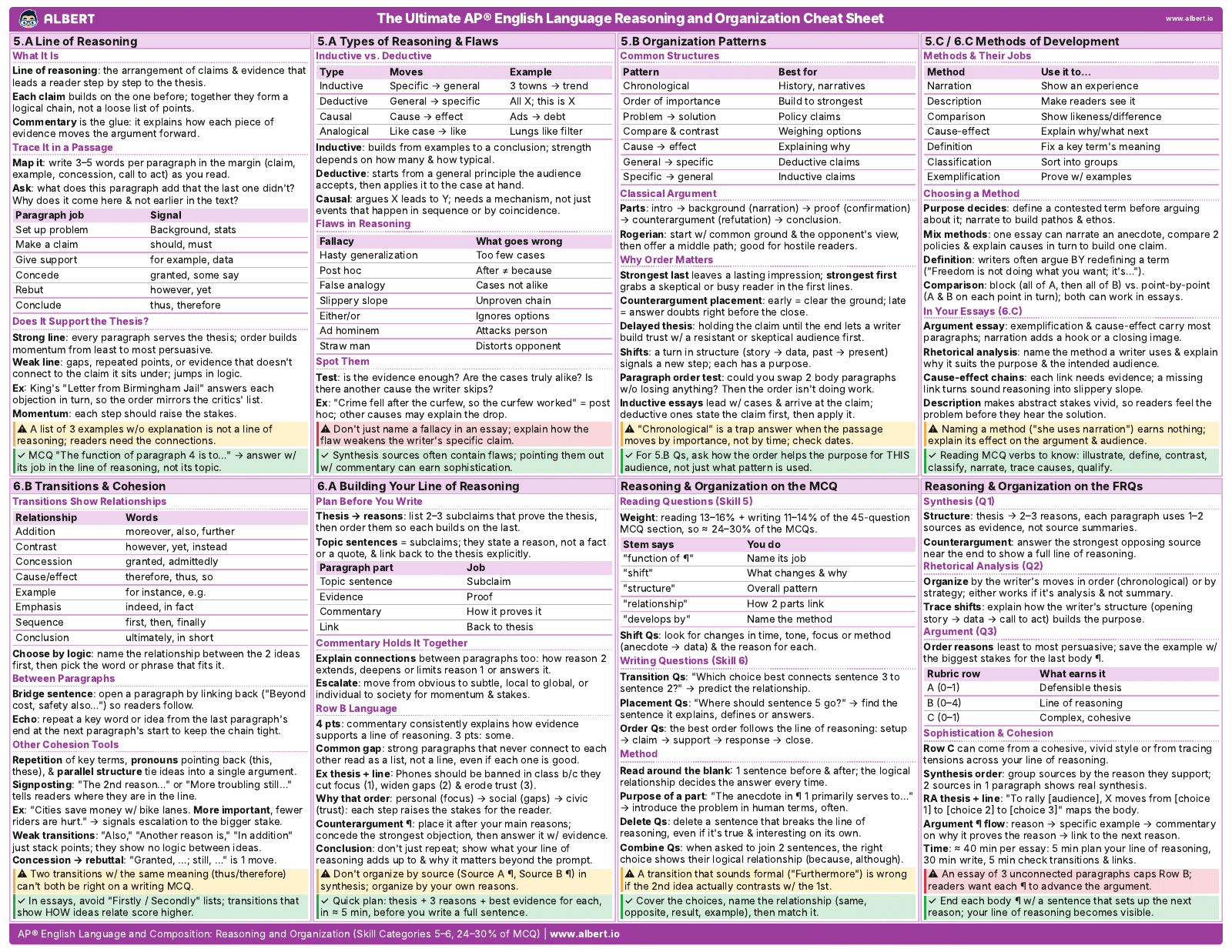
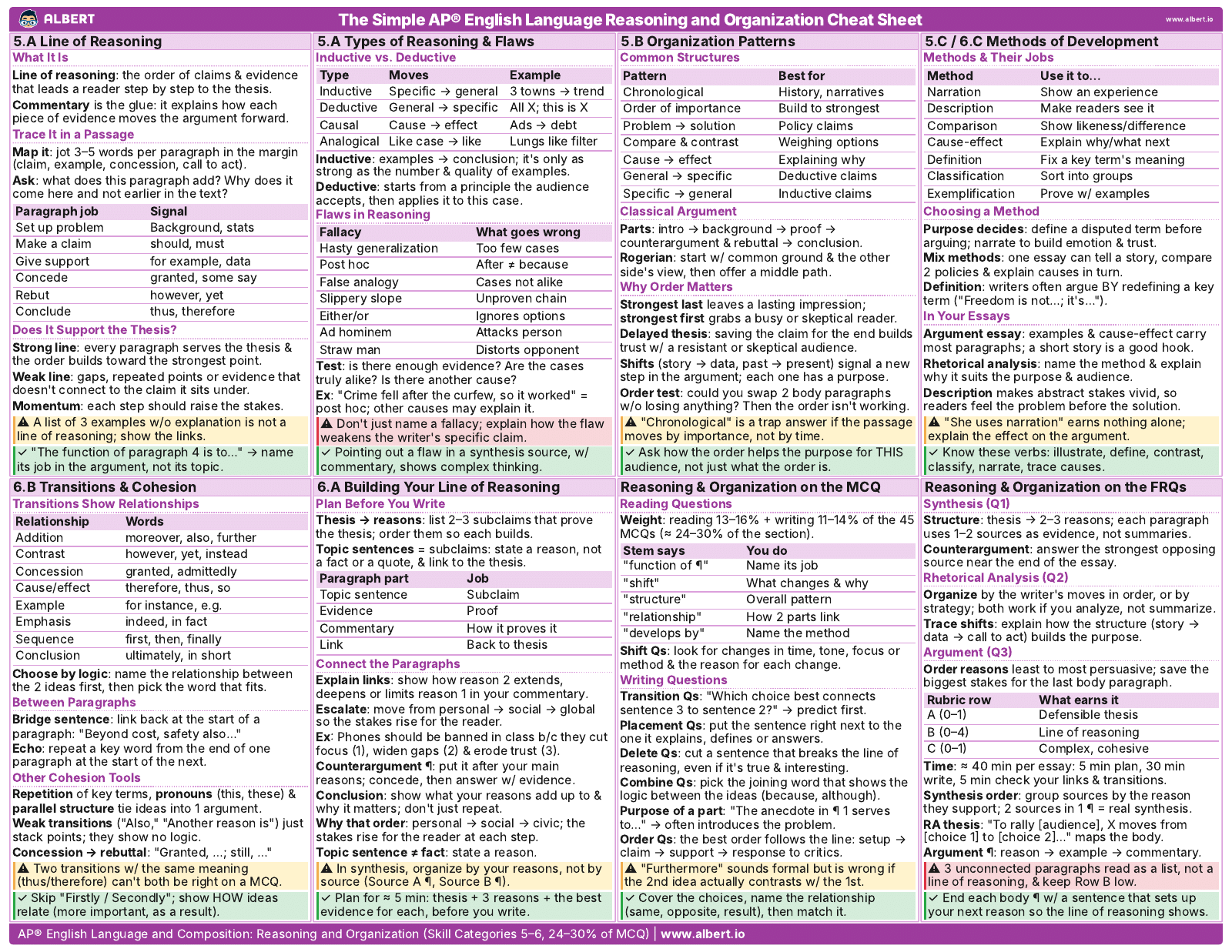
This AP Lang reasoning and organization cheat sheet covers how arguments hold together: the line of reasoning, inductive and deductive thinking, organizational patterns, methods of development, and transitions. Reasoning and Organization skills make up about 24% to 30% of the multiple-choice section and shape your Row B score on every essay. Choose the Simple version for the essentials or the Ultimate version for every pattern, flaw, and question type.
Practice AP® English Language & Composite questions on Albert
What’s on the AP Lang Reasoning and Organization Cheat Sheet?
Both versions follow the Reasoning and Organization big idea in the College Board’s AP® English Language and Composition Course and Exam Description. The cards are labeled by the course skills they support: describing a line of reasoning (5.A), explaining how organization affects an argument (5.B), recognizing methods of development (5.C and 6.C), using transitions (6.B), and building your own line of reasoning (6.A). The last two cards show how these skills appear on the multiple-choice section and the three essays.
The Simple version gives you a table of paragraph jobs and their signal words, the four types of reasoning, seven common fallacies, seven organizational patterns, seven methods of development, the main transition families, and a paragraph plan for your own essays.
The Ultimate version adds classical and Rogerian structures, where to place counterarguments and delayed theses, how to spot shifts, cause-effect chains, bridge sentences and other cohesion tools, the Row B language for line of reasoning, and question types such as placement, delete, and combine. Start with Simple, then move to Ultimate when you are practicing timed essays.
AP Lang Reasoning and Organization at a Glance
| Skill | What you do |
|---|---|
| 5.A | Describe the line of reasoning and explain whether it supports the thesis |
| 5.B | Explain how the organization of a text creates unity and coherence and reflects a line of reasoning |
| 5.C | Recognize and explain the use of methods of development to accomplish a purpose |
| 6.A | Develop a line of reasoning and commentary that explains it throughout an argument |
| 6.B | Use transitional elements to guide the reader through the line of reasoning |
| 6.C | Use appropriate methods of development to advance an argument |
On the multiple-choice section, Reasoning and Organization reading questions (Skill Category 5) count for 13% to 16% and writing questions (Skill Category 6) count for 11% to 14%, out of 45 questions in 60 minutes. On the free-response section, Row B rewards commentary that explains a line of reasoning, so these skills decide most of your essay score.
Key Concepts in Reasoning and Organization
1. The Line of Reasoning
A line of reasoning is the order of claims and evidence that leads a reader step by step to the thesis. Each claim builds on the one before it, and commentary explains how each piece of evidence moves the argument forward. Without commentary, three good examples are only a list.
To trace a line of reasoning in a passage, write three to five words beside each paragraph that name its job: set up the problem, make a claim, give support, concede, rebut, or conclude. Then ask why each paragraph comes where it does.
Worked example: In “Letter from Birmingham Jail,” King answers the clergymen’s objections in roughly the order they raised them: that he is an outsider, that the protests are untimely, and that he breaks laws. The structure itself tells readers he is taking each criticism seriously.
Exam tip: When a question asks for the function of a paragraph, answer with its job in the argument, not its topic.
2. Types of Reasoning and Common Flaws
Inductive reasoning moves from specific examples to a general conclusion, so it is only as strong as the number and quality of its examples. Deductive reasoning starts from a principle the audience accepts and applies it to a case. Causal reasoning argues that one thing leads to another, and analogical reasoning argues that two cases are alike enough to share a conclusion.
Each type has a matching flaw. Too few examples produce a hasty generalization. Assuming that one event caused another because it came first is post hoc reasoning. A comparison between cases that differ in important ways is a false analogy. Other flaws include slippery slope, either/or thinking, ad hominem attacks, and straw man arguments.
Worked example: “Crime fell the year after the curfew began, so the curfew worked.” The claim assumes the curfew caused the drop. Other causes, such as a new policing program or a statewide trend, could explain it.
Exam tip: Don’t just name a fallacy in an essay. Explain how the flaw weakens the writer’s specific claim.
3. Organization Patterns
Common patterns include chronological order, order of importance, problem and solution, comparison and contrast, cause and effect, general to specific, and specific to general. The classical argument moves from introduction to background, proof, refutation, and conclusion. A Rogerian argument starts with common ground and the other side’s view before offering a middle path, which suits a hostile audience.
Order matters. Placing the strongest point last leaves a lasting impression, while placing it first grabs a busy or skeptical reader. A writer facing a resistant audience may delay the thesis until trust is built. Shifts in structure, such as a move from a personal story to statistics, signal a new step in the argument.
Exam tip: On organization questions, ask how the order helps the writer’s purpose for this audience, not just what the pattern is called.
4. Methods of Development
Methods of development are the ways a writer builds a point: narration, description, comparison, cause and effect, definition, classification, and exemplification. The purpose decides the method. A writer who needs to settle the meaning of a disputed term uses definition; a writer who needs to build emotion and trust may narrate an experience.
Writers often mix methods in a single essay and sometimes argue by redefining a key word, as in “Freedom is not doing whatever you want; it is choosing what you owe others.”
Exam tip: Naming the method (“she uses narration”) earns nothing by itself. Explain its effect on the argument and the audience.
5. Transitions and Cohesion
Transitions show how ideas relate: addition (moreover), contrast (however), concession (granted), cause and effect (therefore), example (for instance), emphasis (in fact), sequence (then), and conclusion (ultimately). Choose a transition by naming the relationship between two ideas first. Between paragraphs, a bridge sentence such as “Beyond cost, safety also matters” links back to the last point. Repeated key terms, pronouns like “this,” and parallel structure also tie ideas together.
Exam tip: If two answer choices are transitions with the same meaning, such as “thus” and “therefore,” neither can be the single correct answer.
How Reasoning and Organization Shows Up on the Exam
Reading questions ask about the function of a paragraph, a shift in the passage, the overall structure, the relationship between two parts, or the method a writer uses to develop a point. Writing questions ask you to choose the best transition, decide where a sentence belongs, delete a sentence that breaks the line of reasoning, combine sentences, or put sentences in the most logical order.
On the essays, organize the synthesis essay by your own reasons rather than by source, and answer the strongest opposing source near the end. In the rhetorical analysis essay, you can follow the writer’s moves in order or group them by strategy, as long as you analyze rather than summarize. In the argument essay, order your reasons from least to most persuasive. Row B gives up to 4 points when commentary consistently explains how your evidence supports a line of reasoning.
Common Mistakes in Reasoning and Organization
- Writing three disconnected paragraphs. Fix: end each body paragraph with a sentence that sets up the next reason.
- Organizing a synthesis essay by source. Fix: group sources under the reasons they support.
- Choosing transitions by sound. Fix: name the relationship (same, opposite, result, example) before looking at the choices.
- Labeling methods or fallacies without explanation. Fix: explain the effect of the choice on the argument.
- Calling every structure chronological. Fix: check whether the passage moves by time or by importance.
Frequently Asked Questions
Can I use this cheat sheet on the exam?
No. Notes aren’t allowed on the AP® English Language exam. Use the cheat sheet while you practice so the patterns and transitions come to you automatically on test day.
Should I start with the Simple or the Ultimate version?
Start with the Simple version of the AP Lang reasoning and organization cheat sheet if you are still learning to trace a line of reasoning. Move to Ultimate once you are writing timed essays and want structures, question types, and rubric language.
What is the difference between a line of reasoning and organization?
The line of reasoning is the logic connecting your claims. Organization is the order you present them in. A strong essay uses an order that makes the logic easy to follow.
How many body paragraphs should an AP Lang essay have?
There is no required number. Most strong essays use two or three body paragraphs, each proving one reason, with commentary that links them.
Do transitions affect my essay score?
Not directly, but transitions that show how ideas relate make your line of reasoning visible, which is what Row B rewards.