
Maximize your score with these resources:
- Albert.io AP® English Language question banks
- Free AP® English Language study guides
- Free AP® English Language score calculator
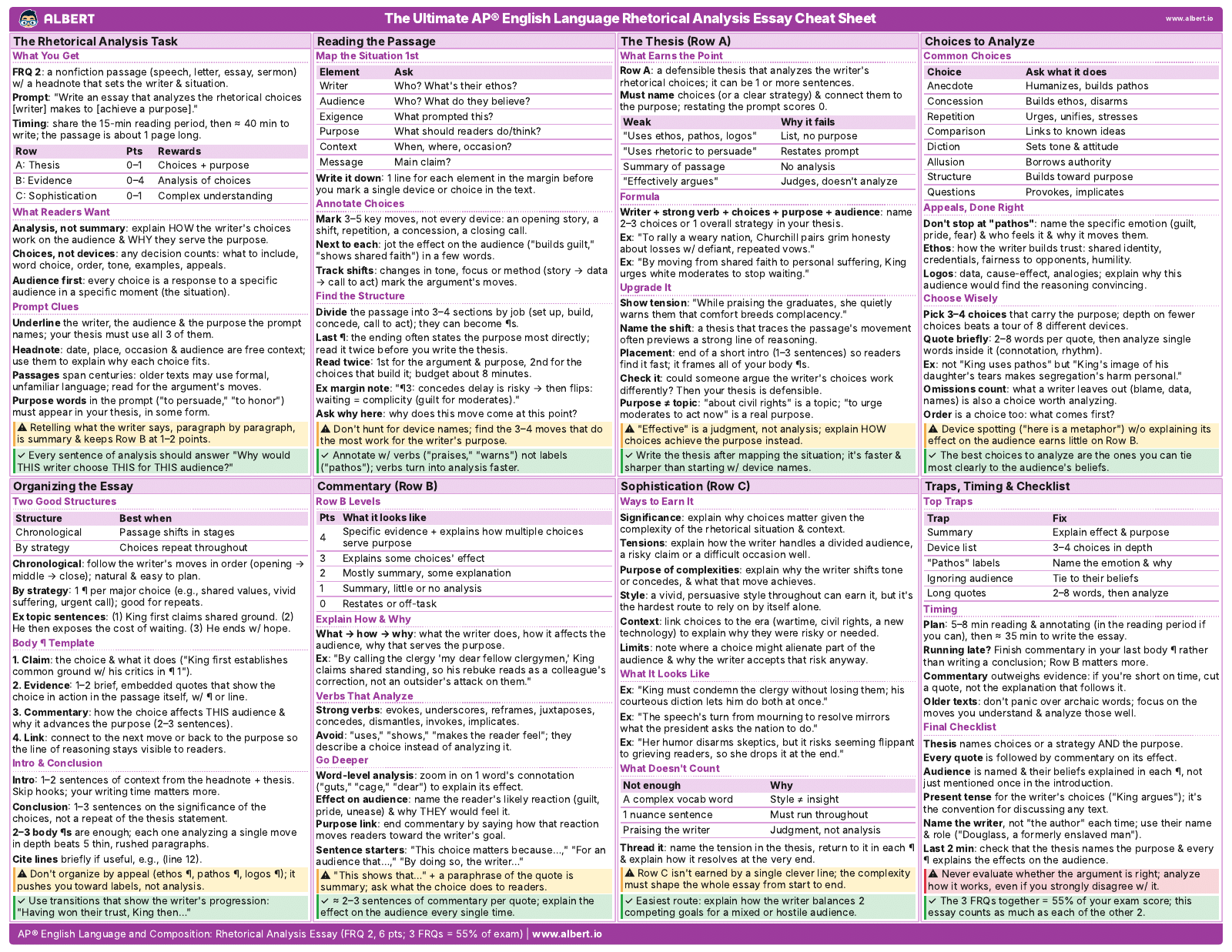
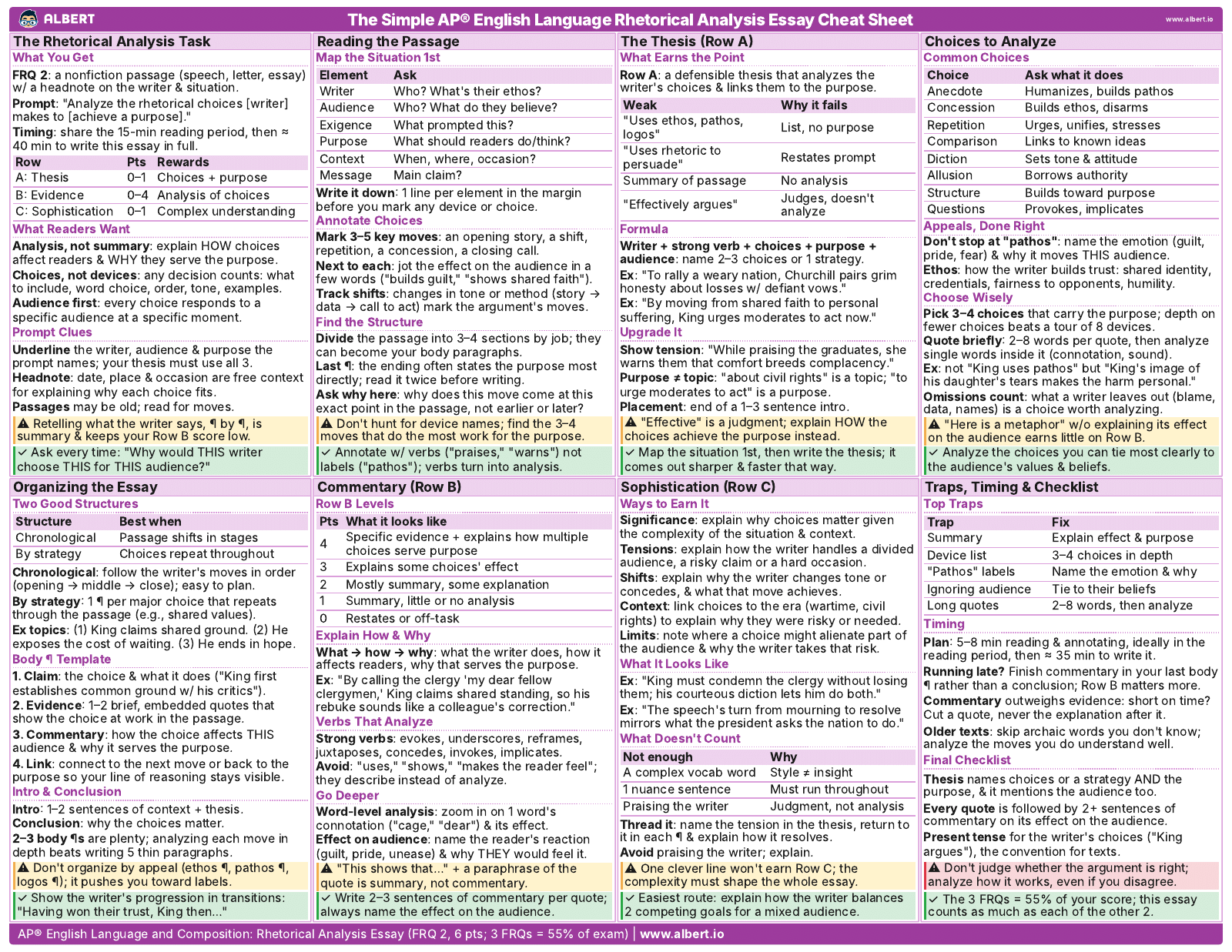
This AP Lang rhetorical analysis essay cheat sheet walks you through Free-Response Question 2: mapping the rhetorical situation, choosing which moves to analyze, writing a thesis that names choices and purpose, organizing body paragraphs, and writing commentary that explains how each choice works on the audience. The essay is scored out of 6 points. Choose the Simple version for the core plan or the Ultimate version for every template, example, and trap.
Practice AP® English Language & Composite questions on Albert
What’s on the AP Lang Rhetorical Analysis Essay Cheat Sheet?
Both versions follow the rhetorical analysis question as described in the College Board’s AP® English Language and Composition Course and Exam Description and on the AP Lang exam page. Eight cards cover the task, reading the passage, the thesis (Row A), which choices to analyze, organizing the essay, commentary (Row B), sophistication (Row C), and a final card of traps, timing, and a checklist.
The Simple version gives you the rubric rows, a rhetorical situation map, a thesis formula, a table of common choices and what they do, a body paragraph template, the Row B score levels, and a final checklist.
The Ultimate version adds how to read the headnote and older passages, margin-note examples, weak thesis patterns, how to analyze appeals precisely, sample topic sentences, word-level commentary, sentence starters, and worked examples of the moves that earn sophistication. Start with Simple, then use Ultimate when you practice timed essays.
AP Lang Rhetorical Analysis Essay at a Glance
| Feature | What to know |
|---|---|
| Position on the exam | Free-Response Question 2 of 3 |
| Passage | One nonfiction text, such as a speech, letter, or essay, with a headnote giving the writer and situation |
| Task | Analyze the rhetorical choices the writer makes to achieve a purpose |
| Timing | 15-minute reading period for all essays, then about 40 minutes of writing for this one |
| Scoring | 6 points: Thesis (0 to 1), Evidence and Commentary (0 to 4), Sophistication (0 to 1) |
| Weight | The three essays together are 55% of the exam score |
Key Concepts for the Rhetorical Analysis Essay
1. Map the Rhetorical Situation First
Before you mark a single device, write one line each for the writer, audience, exigence, purpose, context, and message. The headnote gives you much of this for free: the date, the place, the occasion, and often the audience. Every choice you analyze later should connect back to this map, because rhetorical choices are responses to a specific audience in a specific moment.
Worked example: For Martin Luther King Jr.’s “Letter from Birmingham Jail,” the map might read: writer, a jailed civil rights leader; audience, eight white clergymen and white moderates more broadly; exigence, their public statement calling the protests “unwise and untimely”; purpose, to persuade moderates that waiting is no longer acceptable.
Exam tip: Annotate with verbs such as “praises,” “warns,” or “concedes” rather than labels like “pathos.” Verbs turn into analysis much faster.
2. Choose the Moves That Matter
Rhetorical choices are any decisions a writer makes: what to include, which words to use, how to order ideas, which examples to tell, when to concede, and how to close. Pick three or four moves that do the most work for the purpose. Depth on a few choices beats a quick tour of eight devices.
When you discuss appeals, go past the label. Instead of “King uses pathos,” name the emotion and the audience: “King’s image of his young daughter’s tears makes segregation’s harm personal for parents who had never seen it up close.”
Exam tip: Quote two to eight words at a time, then analyze single words inside the quotation.
3. Write a Thesis That Names Choices and Purpose
Row A gives 1 point for a defensible thesis that analyzes the writer’s rhetorical choices. A useful formula is writer + strong verb + choices + purpose + audience. “The author uses ethos, pathos, and logos to persuade” earns 0 because it lists devices without a purpose. Calling the writing “effective” is a judgment, not analysis.
Worked example: “By moving from shared faith to personal suffering, King urges white moderates to stop waiting and act now.” A stronger version shows tension: “While praising the graduates, the speaker quietly warns them that comfort breeds complacency.”
4. Organize Around the Writer’s Moves
Two structures work well. A chronological structure follows the writer’s moves in order, which suits passages that shift in stages. A strategy structure gives one paragraph to each major choice, which suits passages where a choice repeats. Avoid organizing by appeal (an ethos paragraph, a pathos paragraph, a logos paragraph), which pushes you toward labels instead of analysis.
Inside each body paragraph, state the choice and what it does, give one or two short embedded quotations, explain how the choice affects this audience and serves the purpose, and link to the next move.
Exam tip: Use transitions that show the writer’s progression, such as “Having won their trust, King then…”
5. Write Commentary That Explains How and Why
Row B gives up to 4 points. A 4 requires specific evidence and commentary that consistently explains how multiple choices contribute to the writer’s purpose. Commentary follows a simple path: what the writer does, how it affects the audience, and why that serves the purpose. “This shows that…” followed by a paraphrase of the quotation is summary.
Worked example: “By calling the clergy ‘my dear fellow clergymen,’ King claims shared standing, so his rebuke reads as a colleague’s correction rather than an outsider’s attack.”
Exam tip: Replace “uses,” “shows,” and “makes the reader feel” with verbs such as evokes, underscores, reframes, concedes, and implicates.
6. Earn the Sophistication Point
Row C rewards a complex understanding of the rhetorical situation. Reliable routes include explaining the significance of choices in their historical context, explaining how a writer handles tensions such as a divided audience or a risky claim, and explaining why a writer shifts tone or concedes. The complexity must run through the essay, not appear in one clever sentence.
Worked example: “King must condemn the clergy without losing them; his courteous diction lets him do both at once.”
A Sample Body Paragraph
Here is how the template looks in practice, using King’s letter. Claim: “King first disarms his critics by claiming common ground with them.” Evidence: he opens by addressing them as “my dear fellow clergymen” and says he wants to answer their statement “in patient and reasonable terms.” Commentary: “Because his audience sees him as an outside agitator, King presents himself as a fellow minister who shares their values and their respect for careful reasoning. The courteous tone makes his later criticism harder to dismiss as anger, since he has already shown he is willing to engage them as equals.” Link: “Having established that shared standing, King can then turn to the cost of their advice to wait.”
Notice that the commentary is longer than the evidence. That balance is what moves an essay from 2 or 3 points to 4 on Row B.
How the Rhetorical Analysis Essay Is Scored
Readers score the essay as a whole. Row A checks for a thesis that analyzes choices and links them to purpose. Row B is where most points are won or lost, and it depends on commentary, not on how many devices you name. Row C rewards sustained insight into the situation or a consistently vivid style. Because the three essays together make up 55% of the exam, this essay is worth as much as each of the other two.
Common Mistakes on the Rhetorical Analysis Essay
- Summarizing the passage. Fix: explain the effect and purpose of each choice instead of retelling what the writer says.
- Listing devices. Fix: analyze three or four choices in depth.
- Stopping at “pathos.” Fix: name the emotion and explain why this audience would feel it.
- Ignoring the audience. Fix: tie each choice to the audience’s beliefs and values.
- Evaluating the argument. Fix: analyze how it works, even if you disagree with it.
Frequently Asked Questions
Can I use this cheat sheet on the exam?
No. Notes aren’t allowed on the AP® English Language exam. Practice with the cheat sheet so the structure and commentary moves are automatic by test day.
Should I start with the Simple or the Ultimate version?
Start with the Simple version of the AP Lang rhetorical analysis essay cheat sheet if you are writing your first rhetorical analysis essays. Move to Ultimate once you want templates, worked examples, and sophistication strategies.
How many rhetorical choices should I analyze?
Three or four, each with clear commentary, is usually enough. Readers reward depth of analysis, not the number of devices you can name.
What if the passage is old or hard to read?
Focus on the moves you understand. You don’t need to explain every sentence; analyze the parts you can connect clearly to the writer’s purpose.
Do I need to know the names of rhetorical devices?
Knowing the common names helps you notice choices quickly, but the name alone earns nothing. Readers score your explanation of what a choice does for this audience and how it serves the purpose. If you forget a term, describe the move in plain words, such as “the writer repeats the same opening phrase in three sentences,” and then explain its effect. Clear analysis without the label beats a correct label without analysis.
Should I write in present tense?
Yes. Present tense (“King argues,” “Churchill warns”) is the convention for discussing texts.