
Maximize your score with these resources:
- Albert.io AP® English Language question banks
- Free AP® English Language study guides
- Free AP® English Language score calculator
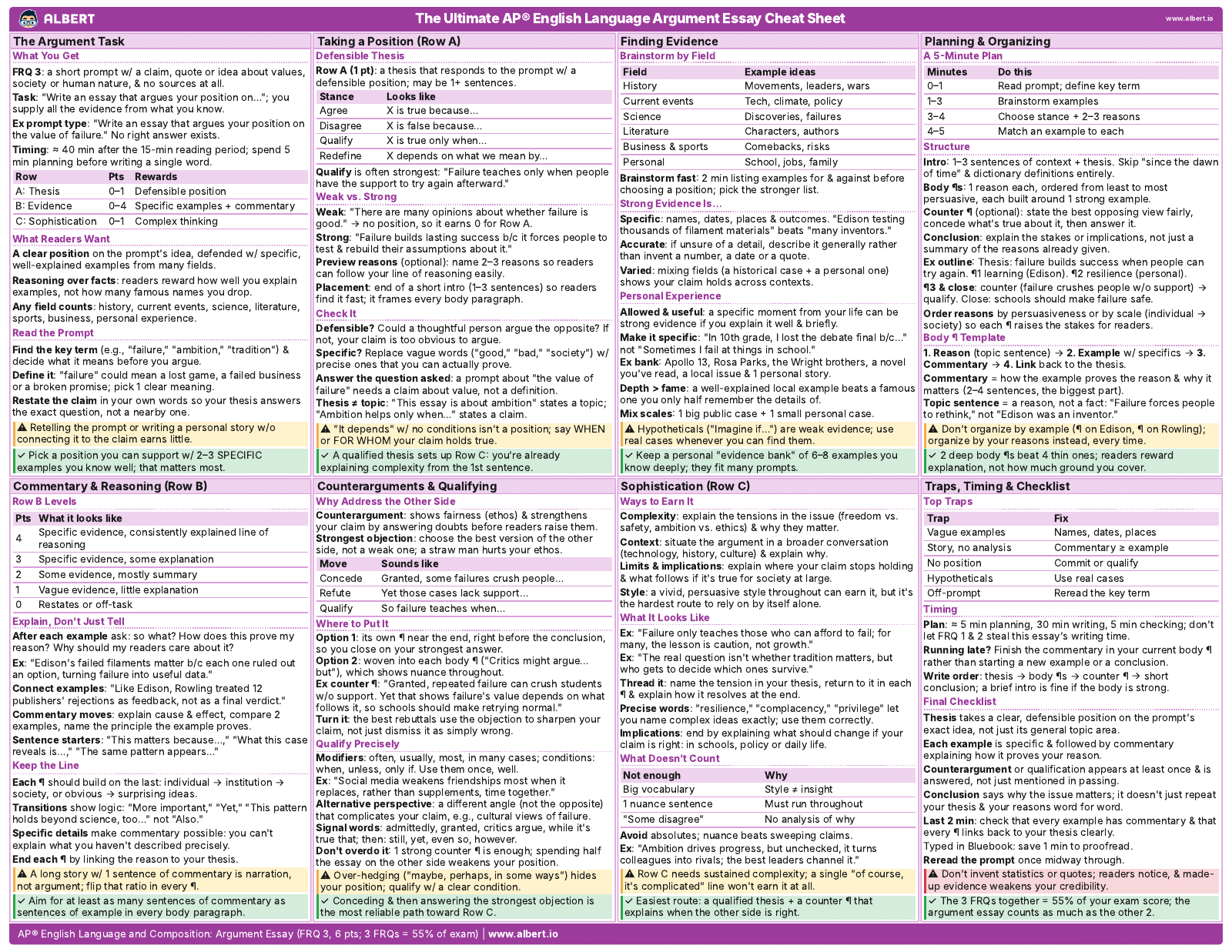
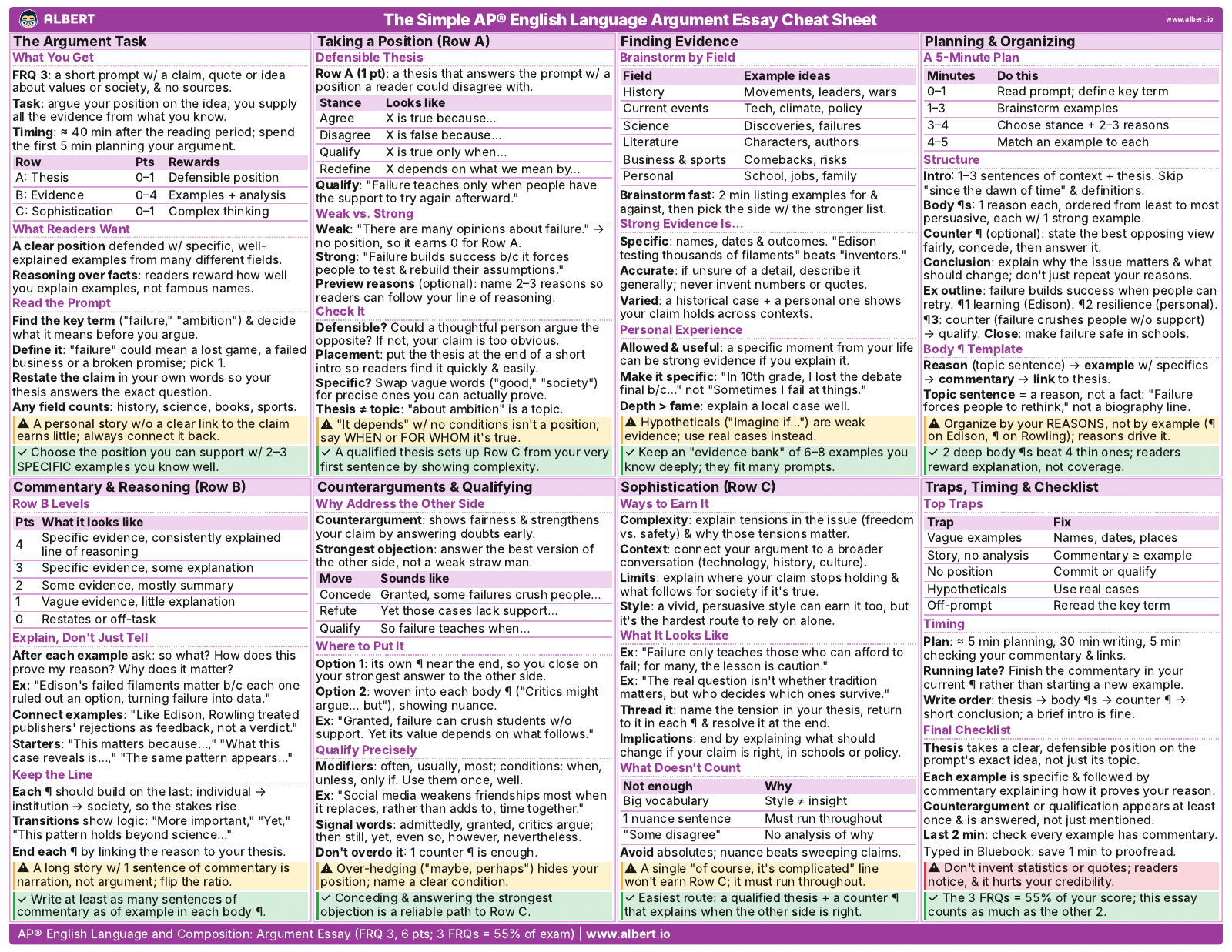
This AP Lang argument essay cheat sheet walks you through Free-Response Question 3: reading the prompt, taking a defensible position, choosing specific evidence from what you know, organizing by reasons, writing commentary, answering counterarguments, and earning the sophistication point. The essay is scored out of 6 points. Choose the Simple version for the core plan or the Ultimate version for every template, example, and trap.
Practice AP® English Language & Composite questions on Albert
What’s on the AP Lang Argument Essay Cheat Sheet?
Both versions follow the argument question as described in the College Board’s AP® English Language and Composition Course and Exam Description and on the AP Lang exam page. Eight cards cover the task, the thesis (Row A), finding evidence, planning and organizing, commentary (Row B), counterarguments and qualifying, sophistication (Row C), and a final card of traps, timing, and a checklist.
The Simple version gives you the rubric rows, four thesis stances, a table of evidence fields, a five-minute plan, a body paragraph template, the Row B score levels, and a final checklist.
The Ultimate version adds how to define the prompt’s key term, a sample evidence bank, a full sample outline, commentary moves and sentence starters, a worked counterargument paragraph, signal words for concession and rebuttal, and specific moves that earn sophistication. Start with Simple, then use Ultimate when you practice timed essays.
AP Lang Argument Essay at a Glance
| Feature | What to know |
|---|---|
| Position on the exam | Free-Response Question 3 of 3 |
| Prompt | A short claim, quotation, or idea about values, society, or human nature, with no sources |
| Task | Argue your position, using evidence you supply from your own knowledge and experience |
| Timing | About 40 minutes of writing after the shared 15-minute reading period |
| Scoring | 6 points: Thesis (0 to 1), Evidence and Commentary (0 to 4), Sophistication (0 to 1) |
| Weight | The three essays together are 55% of the exam score |
Key Concepts for the Argument Essay
1. Read the Prompt and Define the Key Term
Argument prompts center on a big idea such as failure, ambition, tradition, or individuality. Before you choose a side, decide what the key term means in your essay. “Failure” could mean losing a game, a business collapsing, or breaking a promise, and each meaning leads to a different argument. Restate the prompt’s claim in your own words so your thesis answers the exact question.
Exam tip: Spend two minutes brainstorming examples for and against the claim before you pick a position. Choose the side with the stronger list, not the side you would argue at dinner.
2. Take a Defensible Position
Row A gives 1 point for a thesis that responds to the prompt with a position a thoughtful person could disagree with. You can agree, disagree, qualify, or argue that the answer depends on how the key term is defined. “There are many opinions about failure” takes no position and earns 0. “It depends,” without saying when or for whom, isn’t a position either.
Worked example: Strong: “Failure builds lasting success because it forces people to test and rebuild their assumptions.” Qualified: “Failure teaches only when people have the support to try again.” A qualified thesis often sets up the sophistication point from the start.
3. Choose Specific, Accurate Evidence
The argument essay has no sources, so evidence comes from what you know: history, current events, science, literature, business, sports, and personal experience. Readers reward specific examples with names, places, and outcomes. “Edison tested thousands of filament materials” is stronger than “many inventors fail.” Mixing a public example with a personal one shows that your claim holds across contexts.
If you are unsure of a detail, describe it generally rather than invent a number, date, or quotation. Made-up evidence damages your credibility. Hypothetical situations (“Imagine if…”) are weaker than real cases.
Exam tip: Build a personal evidence bank of six to eight examples you know deeply. Most of them will fit several different prompts.
4. Organize by Reasons
Plan for about five minutes: define the key term, brainstorm, choose a stance with two or three reasons, and match one strong example to each reason. Each body paragraph should present one reason, not one example, and paragraphs should build from least to most persuasive. A short introduction with context and your thesis is enough; skip openings like “since the dawn of time.”
Worked example: Thesis: failure builds success when people can try again. Paragraph 1: failure as learning (Edison’s experiments). Paragraph 2: failure as resilience (a personal example). Paragraph 3: the counterargument that failure crushes people without support, answered with a qualification. Conclusion: schools should make it safe to fail and retry.
5. Write Commentary That Proves Your Reasons
Row B gives up to 4 points for specific evidence and commentary that consistently explains a line of reasoning. After every example, ask: so what? How does this prove my reason, and why does it matter? A long story with one sentence of commentary is narration, not argument.
Worked example: “Edison’s failed filaments matter because each one ruled out an option, turning failure into data. Like Edison, J.K. Rowling treated publishers’ rejections as feedback rather than a final verdict, which suggests the pattern holds well beyond science.”
Exam tip: Write at least as many sentences of commentary as sentences describing your example.
6. Answer Counterarguments and Qualify
Addressing the strongest opposing view shows fairness and strengthens your claim. Concede what is true, then refute or qualify: “Granted, repeated failure can crush students without support. Yet that shows its value depends on what follows it.” Place the counterargument in its own paragraph near the end or weave it into each body paragraph. Qualify with precise conditions (“when,” “unless,” “only if”) rather than vague hedges like “maybe” or “perhaps.”
7. Earn the Sophistication Point
Row C rewards sustained complex thinking. Reliable routes include explaining the tensions in the issue, connecting your argument to a broader context, explaining where your claim stops holding, and discussing its implications. A single “of course, it’s complicated” will not earn it.
Worked example: “Failure only teaches those who can afford to fail; for many people, the lesson it teaches is caution, not growth.”
How the Argument Essay Is Scored
Readers score the essay as a whole using the three rows. Row A checks for a defensible thesis that responds to the prompt. Row B is where most points are won or lost: a 4 requires specific evidence and commentary that explains how that evidence supports a line of reasoning throughout the essay, while vague examples or summary without explanation keep the score at 2 or lower. Row C rewards complexity that runs through the essay, or a consistently vivid and persuasive style. Because the three essays together make up 55% of the exam, this essay is worth as much as each of the other two, so protect its 40 minutes.
Building an Evidence Bank Before Test Day
Strong argument essays usually come from students who walk in with examples ready. Choose six to eight examples you know in detail: two from history, one or two from current events, one from science or technology, one from a book you have studied, and one or two from your own life. For each, write down the key names, dates, and outcomes, and list three or four big ideas it could support, such as failure, courage, ambition, or the role of tradition. Practice adapting the same example to different prompts so you can explain it quickly and accurately under time pressure.
Common Mistakes on the Argument Essay
- Vague examples. Fix: include names, dates, places, and outcomes.
- Stories without analysis. Fix: explain how each example proves your reason.
- No clear position. Fix: commit to a side or a specific qualification.
- Organizing by example. Fix: give each paragraph a reason and use examples as evidence.
- Inventing facts. Fix: describe uncertain details generally.
Frequently Asked Questions
Can I use this cheat sheet on the exam?
No. Notes aren’t allowed on the AP® English Language exam. Practice with the cheat sheet so the plan and the rubric are second nature on test day.
Should I start with the Simple or the Ultimate version?
Start with the Simple version of the AP Lang argument essay cheat sheet if you are writing your first argument essays. Move to Ultimate when you want sample outlines, commentary moves, and sophistication strategies.
Can I use personal experience as evidence?
Yes. A specific moment from your own life can be strong evidence, as long as you explain how it proves your reason. Pairing it with a public example usually makes the argument stronger.
How many examples do I need?
Two or three well-explained examples are usually enough. Depth of commentary matters more than the number of examples.
What if I don’t know much about the prompt’s topic?
Argument prompts are written about broad ideas, not specialized facts, so you rarely need expert knowledge. Reread the key term and ask which examples from your evidence bank connect to it. A story about a failed science project, a historical setback, or a character from a novel you studied can all support a claim about failure or persistence. What matters is how clearly you explain the connection, not how much outside information you know.
Is it okay to qualify instead of fully agreeing or disagreeing?
Yes. A precise qualification is a defensible position, and it often helps you show the complex thinking that earns Row C.