
Maximize your score with these resources:
- Albert.io AP® Calculus question banks
- Free AP® Calculus study guides
- Free AP® Calculus score calculator
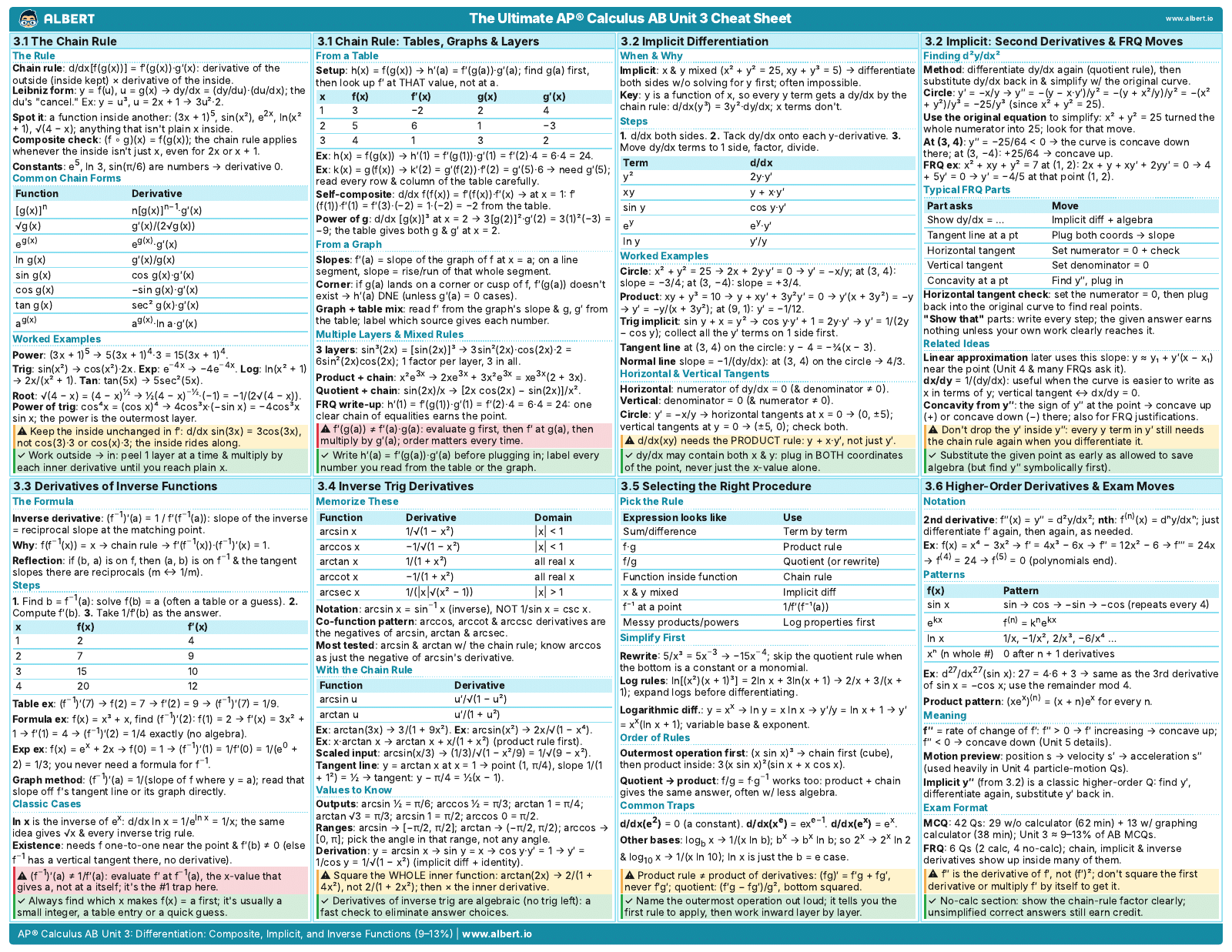
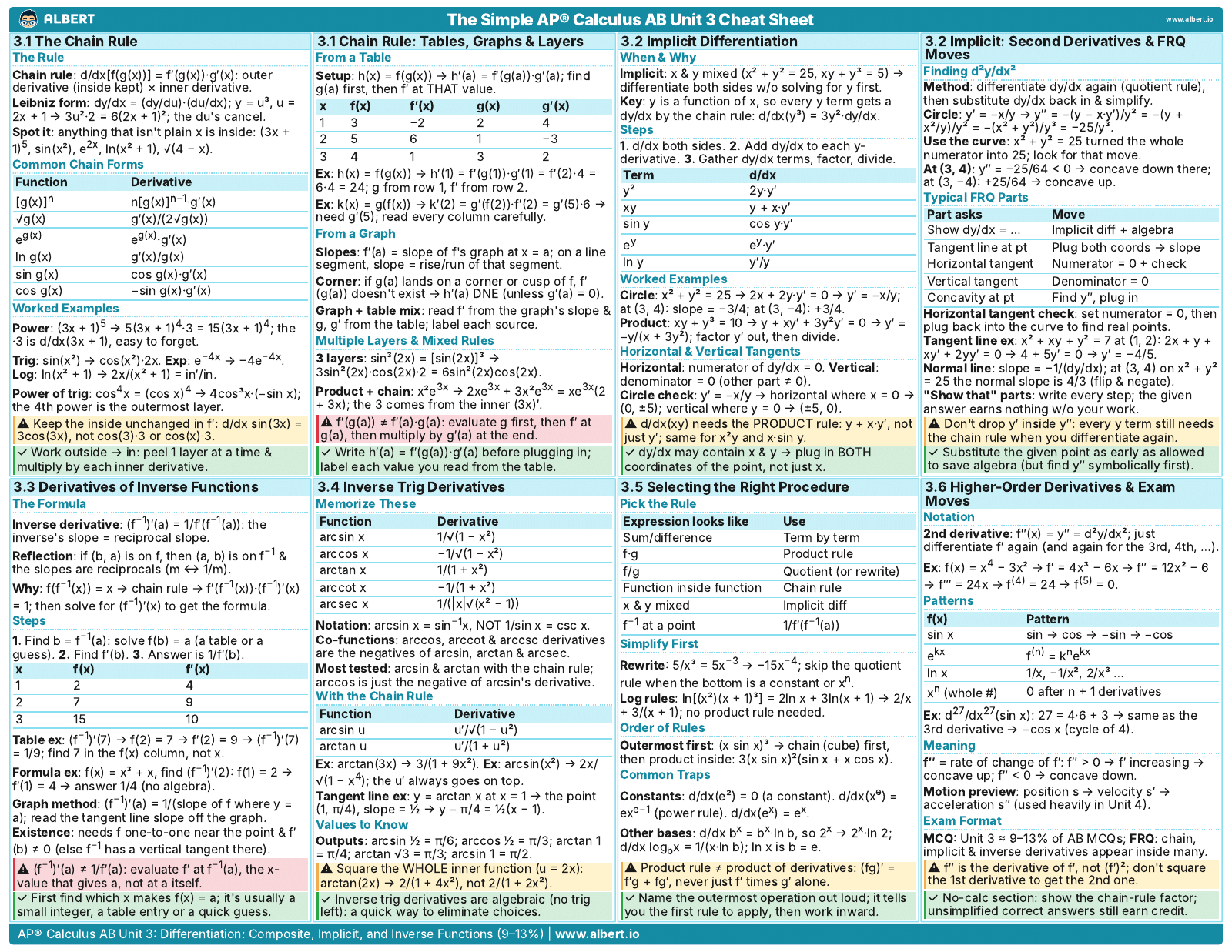
This AP Calc AB Unit 3 cheat sheet covers the chain rule, implicit differentiation, inverse function derivatives, inverse trig derivatives, choosing the right rule, and higher-order derivatives. Unit 3 makes up about 9–13% of the multiple-choice score, but its rules power almost every later FRQ. Pick the Simple version for a first pass or the Ultimate version for dense review.
Practice AP® Calculus AB Unit 3 questions on Albert
What’s on the AP Calc AB Unit 3 Cheat Sheet?
Both versions follow the six topics of Unit 3 in the AP® Calculus AB Course and Exam Description, laid out across eight cards on one landscape page. The chain rule gets two cards (rules and forms, then tables, graphs and nested layers), implicit differentiation gets two (first derivatives, then second derivatives and FRQ moves), and inverse functions, inverse trig, choosing a procedure and higher-order derivatives get one each.
Simple is for students meeting these rules for the first time or rebuilding after a rough quiz. It keeps the core formulas, one or two worked examples per card, and a warning and a tip in every section. Ultimate is for the final weeks before the exam. It adds more table and graph examples, three-layer compositions, the full inverse trig family, logarithmic differentiation, derivative patterns for sin x, ekx and ln x, and the specific moves FRQ scorers look for. Both print on a single page.
AP® Calculus AB Unit 3 at a Glance
Unit 3 is short on the calendar but heavy in use. Expect roughly 9–13% of multiple-choice questions to target it directly, and expect its rules inside related rates, motion, and implicit-curve FRQs later in the course.
| Topic | Name | Focus |
|---|---|---|
| 3.1 | The Chain Rule | Differentiate compositions, including from tables and graphs |
| 3.2 | Implicit Differentiation | Find dy/dx (and d²y/dx²) when x and y are mixed |
| 3.3 | Differentiating Inverse Functions | (f−1)′(a) = 1/f′(f−1(a)) |
| 3.4 | Differentiating Inverse Trigonometric Functions | arcsin, arccos, arctan and their chain-rule forms |
| 3.5 | Selecting Procedures for Calculating Derivatives | Choosing and ordering the rules |
| 3.6 | Calculating Higher-Order Derivatives | f″, f‴ and repeating patterns |
Key Concepts in Unit 3: Differentiation: Composite, Implicit, and Inverse Functions
The Chain Rule (3.1)
The chain rule says d/dx[f(g(x))] = f′(g(x))·g′(x). Read it as “derivative of the outside, with the inside left alone, times the derivative of the inside.” The hard part is rarely the formula. It is spotting the inside. Anything that is not plain x is an inside function: the 3x + 1 in (3x + 1)5, the x² in sin(x²), the −4x in e−4x.
Worked example: the table gives g(1) = 2, g′(1) = 4 and f′(2) = 6. For h(x) = f(g(x)), h′(1) = f′(g(1))·g′(1) = f′(2)·4 = 6·4 = 24. Notice the order: find g(1) first, then look up f′ at that value, not at 1.
For nested functions, peel one layer at a time. sin³(2x) is [sin(2x)]³, so its derivative is 3sin²(2x)·cos(2x)·2. Each layer contributes one factor.
Exam tip: on table and graph questions, write h′(a) = f′(g(a))·g′(a) symbolically before you plug in anything. Most wrong answers come from evaluating f′ at a instead of at g(a).
Implicit Differentiation (3.2)
When an equation mixes x and y, such as x² + y² = 25 or xy + y³ = 10, you differentiate both sides with respect to x without solving for y. Because y is a function of x, every term containing y picks up a dy/dx through the chain rule: d/dx(y³) = 3y²·dy/dx. Then collect the dy/dx terms on one side, factor, and divide.
Worked example: for xy + y³ = 10, the product rule on xy gives y + x·y′, so y + xy′ + 3y²y′ = 0. Factoring gives y′(x + 3y²) = −y, so y′ = −y/(x + 3y²).
Second derivatives are a favorite FRQ follow-up. On the circle, y′ = −x/y. Differentiating with the quotient rule gives y″ = −(y − x·y′)/y². Substituting y′ = −x/y and simplifying turns the numerator into x² + y², which equals 25 on the curve, so y″ = −25/y³. At (3, 4), y″ = −25/64, so the curve is concave down there.
Exam tip: horizontal tangents happen where the numerator of dy/dx is 0, vertical tangents where the denominator is 0. Always plug the candidate back into the original equation to find real points.
Derivatives of Inverse Functions (3.3)
If f and f−1 are inverses, their graphs are reflections over y = x, and the slopes at matching points are reciprocals. That gives (f−1)′(a) = 1/f′(f−1(a)). You can derive it in one line: differentiate f(f−1(x)) = x with the chain rule and solve.
Worked example: let f(x) = x³ + x. Find (f−1)′(2). You can’t easily solve for f−1, and you don’t need to. Find the x that gives 2: f(1) = 2. Then f′(x) = 3x² + 1, so f′(1) = 4, and (f−1)′(2) = 1/4.
Exam tip: the input to f′ is f−1(a), the x-value that produces a, never a itself. On table questions, find a in the f(x) column, not the x column.
Inverse Trig Derivatives (3.4)
Memorize three: d/dx arcsin x = 1/√(1 − x²), d/dx arccos x = −1/√(1 − x²), and d/dx arctan x = 1/(1 + x²). The co-functions are negatives of their partners. With the chain rule, put u′ on top: d/dx arctan(u) = u′/(1 + u²).
Worked example: d/dx arctan(3x) = 3/(1 + 9x²). The 3 on top comes from the chain rule, and the 9x² is (3x)². A tangent line problem combines this with known values: y = arctan x at x = 1 passes through (1, π/4) with slope 1/2, so the line is y − π/4 = ½(x − 1).
Exam tip: these derivatives contain no trig functions. If an answer choice for the derivative of arcsin(x²) still has a sine in it, eliminate it.
Selecting Procedures (3.5)
By Topic 3.5, you have every rule you need, and the question becomes which to use first. Find the outermost operation. For (x sin x)³, the outermost operation is cubing, so the chain rule comes first, then the product rule inside: 3(x sin x)²(sin x + x cos x).
Worked example: to differentiate ln[(x²)(x + 1)³], expand with log rules before you differentiate: 2ln x + 3ln(x + 1), whose derivative is 2/x + 3/(x + 1). That skips a product rule and a chain rule. Likewise, rewrite 5/x³ as 5x−3 instead of using the quotient rule.
Exam tip: watch constants in disguise. d/dx(e²) = 0, d/dx(xe) = exe−1, and d/dx(ex) = ex. Each looks similar and each takes a different rule.
Higher-Order Derivatives (3.6)
The second derivative is the derivative of the first: f″(x) = d²y/dx². Keep going for f‴ and beyond. For polynomials, xn reaches 0 after n + 1 derivatives. For sin x, the derivatives cycle every four: cos x, −sin x, −cos x, sin x.
Worked example: the 27th derivative of sin x. Since 27 = 4·6 + 3, it matches the 3rd derivative, −cos x.
Exam tip: f″ describes how f′ changes. Positive f″ means f′ is increasing and the graph is concave up. In Unit 4, the same chain becomes position, velocity and acceleration.
How Unit 3 Shows Up on the Exam
The AP® Calculus AB exam has 42 multiple-choice questions (29 without a calculator, 13 with a graphing calculator) and 6 free-response questions (2 with a calculator, 4 without). Direct Unit 3 multiple-choice questions usually look like one of four types: a chain-rule derivative from a table, a slope from an implicit equation at a given point, (f−1)′(a) from a table or formula, or the derivative of an inverse trig composition.
On the free-response section, Unit 3 rarely gets its own question, but it sits inside many. Implicit-curve FRQs ask you to verify dy/dx, write a tangent line, find where the tangent is horizontal or vertical, and determine concavity with d²y/dx². Table-based FRQs ask for h′(a) where h is a composition. Scorers reward the correct setup shown in writing. An unsimplified correct answer usually earns full credit, while a correct number with no supporting work often earns nothing on “show that” parts.
Keep the AP Calc AB Unit 3 cheat sheet next to you for the first few sets, then put it away. For more AP Calc AB Unit 3 practice, work mixed sets so you learn to choose the rule, not just apply it.
Common Mistakes in Unit 3
- Changing the inside. Writing d/dx sin(3x) = cos(x)·3. Fix: the outer derivative keeps the inside exactly as it was: 3cos(3x).
- Evaluating f′ at the wrong place. Using f′(a) instead of f′(g(a)), or f′(a) instead of f′(f−1(a)). Fix: find the inner value first and circle it before using f′.
- Forgetting the product rule on xy. Writing d/dx(xy) = x·y′. Fix: xy is a product, so its derivative is y + x·y′.
- Dropping y′ in the second derivative. When differentiating y′ = −x/y, the y in the denominator still needs its own y′. Fix: treat every y as a function of x again, then substitute.
- Squaring only part of the inside. Writing arctan(2x) → 2/(1 + 2x²). Fix: u² means (2x)² = 4x².
Frequently Asked Questions
Can I use this cheat sheet on the exam?
No. The AP® Calculus AB exam does not allow notes or formula sheets of any kind. This sheet is a study tool for review sessions and practice sets, and the goal is to know everything on it before test day.
Should I start with the Simple or Ultimate version?
Start with Simple if the chain rule or implicit differentiation still feels shaky. It focuses on the core rules with one or two clean examples each. Move to Ultimate once you can do those without looking, since it adds the table, graph, three-layer and FRQ-style cases that separate a 4 from a 5.
Is Unit 3 on the AB and BC exams?
Yes. The same six topics appear in AP® Calculus BC, where Unit 3 carries a smaller share (4–7%) of the multiple-choice score. BC students use these rules constantly in parametric, polar and series work.
Which Unit 3 topic is tested most?
The chain rule. It appears directly in Topic 3.1 and indirectly in every other topic of the unit, since implicit differentiation, inverse function derivatives and inverse trig derivatives all depend on it.
How should I use this as a Unit 3 study guide?
Print the AP Calc AB Unit 3 cheat sheet, cover one card, work its examples from memory, then check. Do this for two or three cards a day and follow each session with ten mixed practice problems so you practice choosing the rule.