
Maximize your score with these resources:
- Albert.io AP® European History question banks
- Free AP® European History study guides
- Free AP® European History score calculator
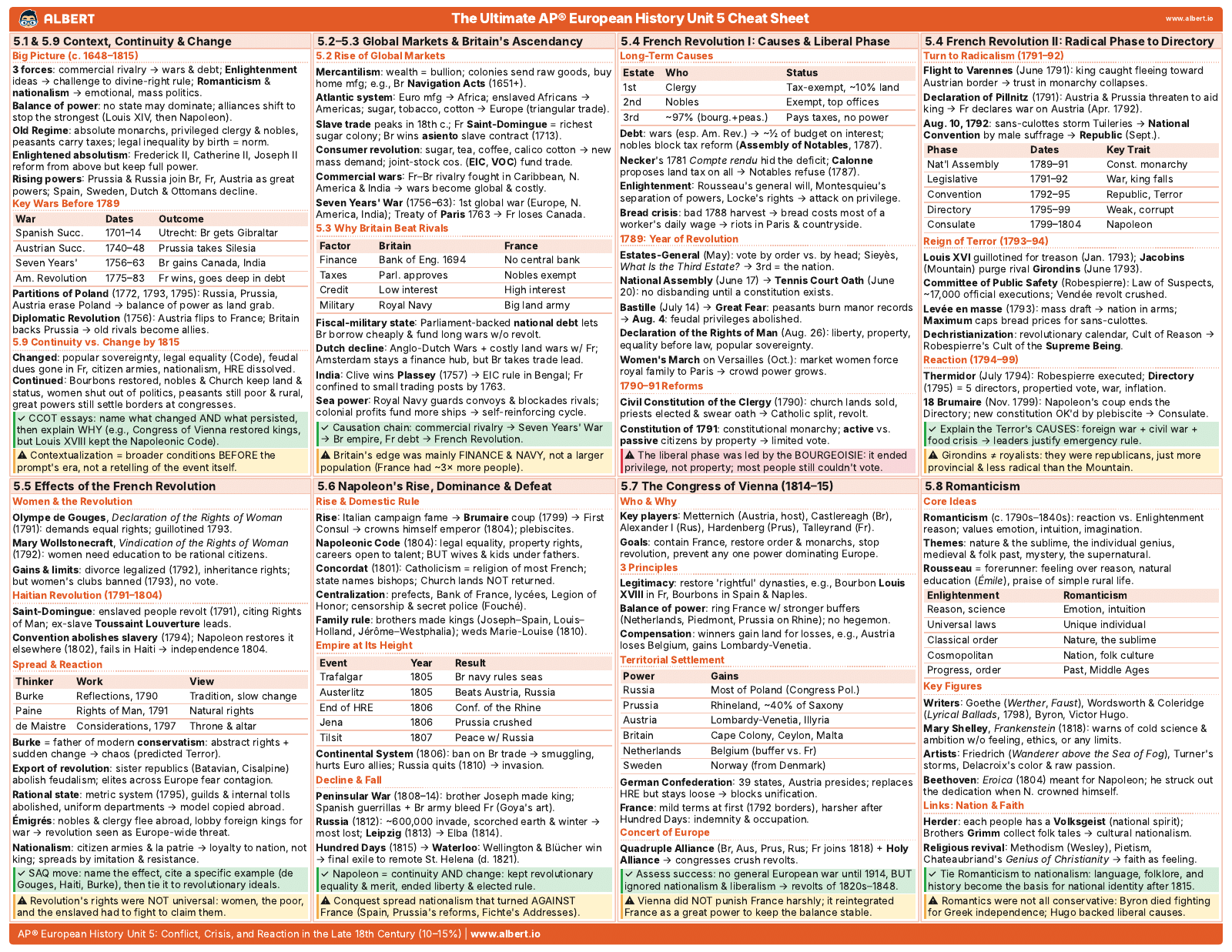
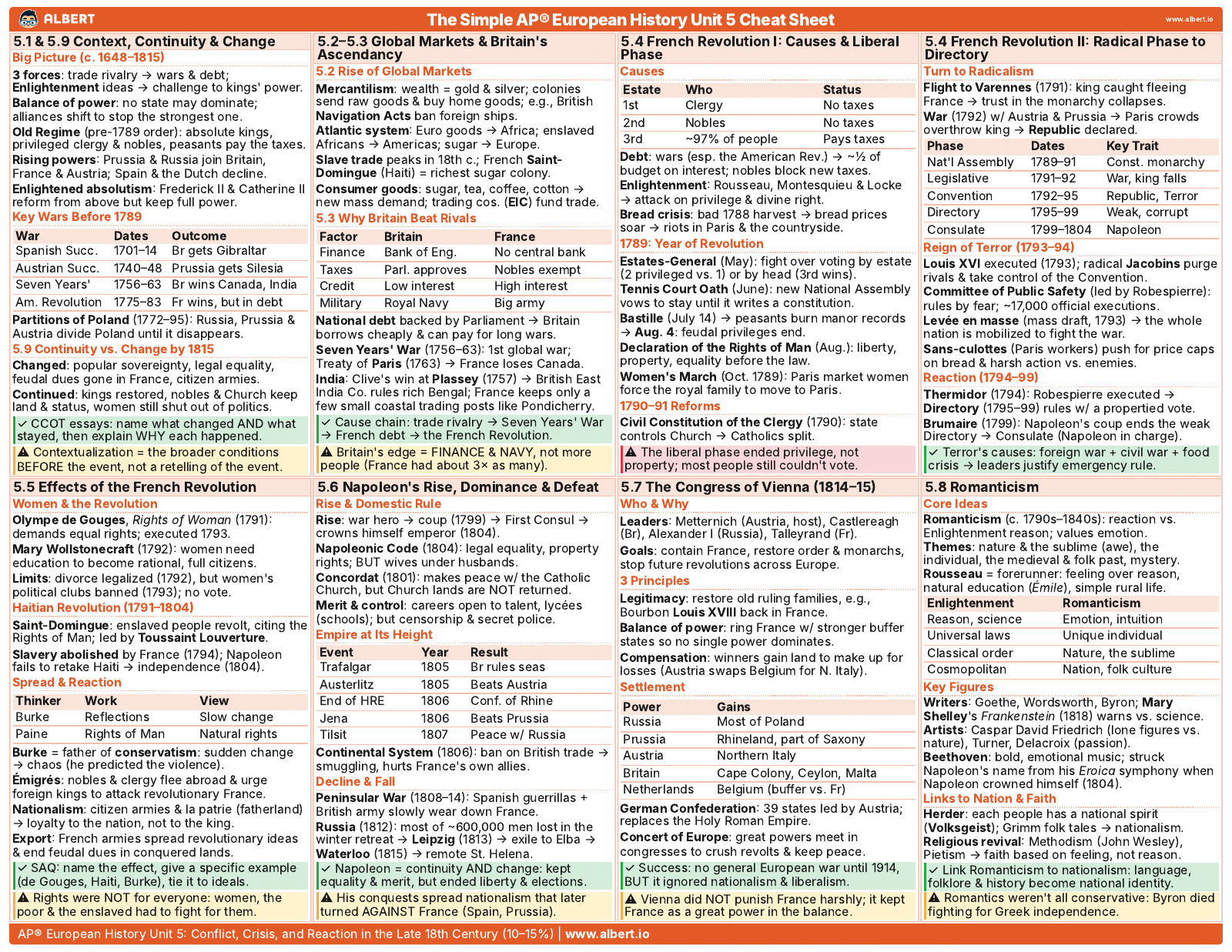
This AP Euro Unit 5 cheat sheet covers Conflict, Crisis, and Reaction in the Late 18th Century, from Britain’s rise and the French Revolution to Napoleon, the Congress of Vienna, and Romanticism. Unit 5 makes up 10–15% of the AP® European History exam’s multiple-choice section. Pick Simple for a fast review or Ultimate for the full set of essay evidence.
Practice AP® European History Unit 5 questions on Albert
What’s on the AP Euro Unit 5 Cheat Sheet?
The sheet comes in two versions, and both cover the same eight cards: context and continuity (5.1 and 5.9), global markets and Britain’s rise (5.2–5.3), two cards on the French Revolution (5.4), the Revolution’s effects (5.5), Napoleon (5.6), the Congress of Vienna (5.7), and Romanticism (5.8).
The Simple version is for first-pass review or for students who want the spine of the unit without the detail. It keeps the key dates, the big cause-and-effect chains, and one main trap per topic, with a few words of context the first time a term appears.
The Ultimate version is built for students aiming for a 4 or 5. It adds the material that separates a specific essay from a vague one: the Diplomatic Revolution, the Bank of England versus French credit, Necker and Calonne, the active and passive citizen split, the Law of Suspects, Napoleon’s family kingdoms, the full Vienna settlement, and named Romantic writers, artists, and composers. Both versions end every card with a strategy tip and a common mistake, so you can use either one as an AP® European History Unit 5 review before a unit test or as a Conflict, Crisis, and Reaction study guide in the weeks before May.
AP® European History Unit 5 at a Glance
Unit 5 covers c. 1648 to c. 1815 and carries 10–15% of the multiple-choice score. It overlaps in time with Unit 4, but Unit 4 is about ideas (the Scientific Revolution and the Enlightenment) while Unit 5 is about what happened when those ideas met war, debt, and hunger.
| Topic | Name | Focus |
|---|---|---|
| 5.1 | Contextualizing 18th-Century States | Commercial rivalry, Enlightenment challenges, and emotion in politics |
| 5.2 | The Rise of Global Markets | Mercantilism, the Atlantic system, the slave trade, consumer goods |
| 5.3 | Britain’s Ascendancy | Why Britain beat France and the Dutch for trade and empire |
| 5.4 | The French Revolution | Causes, the liberal phase, the radical phase, the Directory |
| 5.5 | The French Revolution’s Effects | Women’s rights claims, Haiti, conservatism, nationalism |
| 5.6 | Napoleon’s Rise, Dominance, and Defeat | Domestic reforms, conquest, the Continental System, collapse |
| 5.7 | The Congress of Vienna | Legitimacy, balance of power, compensation, the Concert of Europe |
| 5.8 | Romanticism | Emotion, nature, and the folk past as a reply to the Enlightenment |
| 5.9 | Continuity and Change in 18th-Century States | What 1789–1815 changed for good and what survived |
The French Revolution and Napoleon are the center of gravity. If your time is short, put it there first, then Vienna, then Romanticism.
Key Concepts in Unit 5: Conflict, Crisis, and Reaction in the Late 18th Century
Global Markets and Britain’s Ascendancy (5.1–5.3)
Eighteenth-century European states fought over trade as much as territory. Under mercantilism, a state measured its wealth in bullion and treated colonies as suppliers of raw goods and buyers of finished ones. Britain’s Navigation Acts, which kept foreign ships out of its colonial trade, are the standard example. The Atlantic system tied this together: European manufactured goods went to Africa, enslaved Africans were carried to the Americas, and sugar, tobacco, and cotton came back to Europe. French Saint-Domingue was the richest sugar colony in the world, which matters again in 5.5.
Britain won the century-long contest with France because of money and ships, not population. France had roughly three times as many people, but Britain had the Bank of England (1694), taxes approved by Parliament, and a national debt that lenders trusted. That meant cheaper borrowing and the ability to fund long wars. France’s nobles and clergy were largely exempt from direct taxes, so the crown borrowed at higher rates and could not fix the problem without a political fight.
Worked example: An SAQ asks you to explain one cause of Britain’s growing global power in the 18th century. A strong answer: “Britain’s Parliament-backed national debt let it borrow cheaply, so it could keep fleets and armies in the field during the Seven Years’ War; as a result, the Treaty of Paris (1763) gave Britain Canada and left France with only a few trading posts in India.” That is a cause, a mechanism, and a specific result in two sentences.
Exam tip: Practice the chain commercial rivalry → Seven Years’ War → French debt → French Revolution. It links three topics and works as contextualization for any essay on 1789.
Causes and the Liberal Phase of the French Revolution (5.4)
Three pressures met in 1788–89. The crown was close to bankrupt, with about half its spending going to interest after the Seven Years’ War and the American Revolution. Enlightenment ideas (Locke’s natural rights, Montesquieu’s separation of powers, Rousseau’s general will) gave critics a language to attack privilege. And a bad 1788 harvest pushed bread prices so high that urban workers could barely eat.
When the Assembly of Notables refused Calonne’s tax on all land, Louis XVI called the Estates-General for May 1789. The fight over voting by order or by head led the Third Estate to declare itself the National Assembly and swear the Tennis Court Oath. The storming of the Bastille, the Great Fear in the countryside, the August 4 decrees ending feudal privileges, and the Declaration of the Rights of Man and of the Citizen followed within weeks. The Civil Constitution of the Clergy (1790) and the Constitution of 1791 set up a constitutional monarchy, but split Catholics and limited voting to “active” citizens who paid enough tax.
Worked example: In January 1789 the Abbé Sieyès asked, “What is the Third Estate? Everything.” If a source like this appears on the exam, its historical situation is the debt crisis and the coming Estates-General, and its purpose is to argue that the Third Estate alone is the nation, so the privileged orders should not be able to outvote it.
Exam tip: Call this phase liberal, not democratic. It ended legal privilege by birth but protected property, and most men still could not vote.
The Radical Phase and the Directory (5.4)
The king’s Flight to Varennes in June 1791 destroyed trust in the monarchy. The Declaration of Pillnitz led France to declare war on Austria in April 1792, and military defeats plus Paris crowds brought down the king on August 10, 1792. The National Convention, elected by broad male suffrage, declared a republic and executed Louis XVI in January 1793.
Facing foreign war, the Vendée revolt, and food shortages, the Jacobins purged the Girondins, and the Committee of Public Safety under Robespierre ran the Reign of Terror: the Law of Suspects, the Maximum on bread prices, the levée en masse, dechristianization, and about 17,000 official executions. After Thermidor (July 1794), the Directory ruled with a property-based vote until Napoleon’s coup of 18 Brumaire in 1799.
Worked example: A prompt asks you to explain why the Revolution radicalized after 1791. Name the war first, because it created the emergency that justified the Terror, then add the king’s betrayal at Varennes and the sans-culottes’ pressure over bread. Three causes, each with a date.
Exam tip: The Girondins were republicans, not royalists. They lost to the more radical Mountain, and mixing them up with royalists costs accuracy on MCQs.
Effects of the Revolution (5.5)
The Revolution’s language of rights was quickly claimed by people it left out. Olympe de Gouges answered the Declaration with her Declaration of the Rights of Woman (1791) and was executed in 1793. Mary Wollstonecraft argued in A Vindication of the Rights of Woman (1792) that women needed education to be rational citizens. The Revolution legalized divorce, then banned women’s political clubs. In Saint-Domingue, enslaved people revolted in 1791 under leaders including Toussaint Louverture; the Convention abolished slavery in 1794, Napoleon tried to restore it, and Haiti won independence in 1804.
Abroad, the reaction split. Edmund Burke’s Reflections on the Revolution in France (1790) defended tradition and gradual change and became the founding text of modern conservatism. Thomas Paine replied with Rights of Man. Meanwhile, citizen armies and the idea of la patrie turned loyalty from king to nation.
Worked example: For an SAQ on how the Revolution affected people outside France, write: “The Revolution’s Declaration of the Rights of Man inspired enslaved people in Saint-Domingue to revolt in 1791, which led to the abolition of slavery in 1794 and Haitian independence in 1804.” Effect, example, link to revolutionary ideals.
Exam tip: Effects questions reward range. Have one example each for women, the colonies, conservatives, and nationalism.
Napoleon (5.6)
Napoleon rose through military fame, took power in 1799, and crowned himself emperor in 1804. At home he kept parts of the Revolution and dropped others. The Napoleonic Code (1804) guaranteed legal equality and property rights and opened careers to talent, but placed wives and children under the authority of fathers. The Concordat (1801) made peace with the Catholic Church without returning its lands. Censorship, a secret police, and plebiscites replaced real elections.
Abroad he won at Austerlitz (1805) and Jena (1806), ended the Holy Roman Empire, and put his brothers on thrones. Trafalgar (1805) left Britain in control of the seas, so he tried economic war through the Continental System, which hurt his allies more than Britain. The Peninsular War in Spain, the disastrous invasion of Russia in 1812, Leipzig (1813), and Waterloo (1815) ended the empire.
Worked example: “To what extent did Napoleon preserve the Revolution?” Argue both sides: he preserved legal equality and merit (the Code, the end of feudal privilege), but he ended political liberty and elected government (censorship, emperor by self-coronation). Then make a judgment about which mattered more.
Exam tip: Napoleon’s conquests spread nationalism, and that nationalism turned against him in Spain and in Prussia. Use this as a turning-point argument.
The Congress of Vienna and Romanticism (5.7–5.8)
The Congress of Vienna (1814–15), led by Metternich, Castlereagh, Alexander I, Hardenberg, and Talleyrand, rebuilt Europe on three principles: legitimacy (restoring the Bourbons under Louis XVIII), balance of power (stronger buffer states around France), and compensation (Austria gave up Belgium and gained Lombardy-Venetia). Russia took most of Poland, Prussia gained the Rhineland, and a loose German Confederation replaced the Holy Roman Empire. The Concert of Europe then met in congresses to suppress revolutions. There was no general European war until 1914, but the settlement ignored nationalism and liberalism, which exploded in the 1820s, 1830, and 1848.
Romanticism (c. 1790s–1840s) pushed back against Enlightenment reason with emotion, nature, the sublime, the individual, and the medieval and folk past. Rousseau was its forerunner; Goethe, Wordsworth, Byron, and Mary Shelley wrote it; Caspar David Friedrich painted it; Beethoven scored it. Herder’s idea of a Volksgeist and the Grimm brothers’ folk tales tied Romanticism directly to cultural nationalism.
Worked example: A Friedrich painting of a lone figure facing a vast landscape appears as an SAQ stimulus. Identify the Romantic traits (emotion, the sublime power of nature, the individual) and contrast them with Enlightenment rationalism.
Exam tip: Don’t call Vienna a harsh peace. It brought France back in as a great power on purpose, to keep the balance stable.
How Unit 5 Shows Up on the Exam
Expect Unit 5 material in multiple-choice sets built around primary sources (revolutionary declarations, Burke, de Gouges, Napoleonic decrees) and secondary interpretations of the Revolution. Questions usually test causation, so ask yourself what led to the source and what it led to.
Starting with the May 2027 exam, all three short-answer questions include a source: question 1 a secondary text, question 2 a primary text, and question 3 a non-text source such as an image, map, or chart. A Romantic painting, a chart of French debt, or a map of the Vienna settlement would all fit this unit. Each part is one point, so answer directly, name a specific piece of evidence, and explain it.
On the long essay and the document-based question, Unit 5 supports causation (causes of the Revolution, the radical turn), continuity and change (Old Regime to 1815), and comparison (the liberal and radical phases, or Burke and Paine). Scorers reward a defensible thesis, contextualization drawn from conditions before the period, specific evidence, and complex reasoning such as weighing multiple causes. Check the current format on the College Board’s AP® European History exam page.
Common Mistakes in Unit 5
- Treating 1789–1799 as one event. Fix: separate the liberal phase (1789–91), the radical phase (1792–94), and the Directory (1795–99), each with its own goals and leaders.
- Calling the Revolution democratic from the start. Fix: the 1791 constitution limited voting to active citizens; broad male suffrage came only with the Convention in 1792.
- Explaining the Terror as Robespierre’s personality. Fix: start with foreign war, civil war in the Vendée, and food shortages, then explain how leaders used that emergency.
- Making Napoleon purely revolutionary or purely reactionary. Fix: he kept legal equality and merit but ended political liberty. Say both.
- Writing contextualization as a summary of the event. Fix: describe the conditions before it, such as the debt from the Seven Years’ War and the spread of Enlightenment ideas.
Frequently Asked Questions
Can I use this cheat sheet on the exam?
No. The AP® European History exam does not allow notes or reference sheets. The AP Euro Unit 5 cheat sheet is a study tool for review and self-quizzing before test day.
Should I start with the Simple or the Ultimate version?
Start with Simple if you are reviewing the unit for the first time or want the main storyline quickly. Move to Ultimate once you know the outline and need the specific evidence that earns essay points.
What is the most important topic in Unit 5?
The French Revolution (5.4–5.5). It connects backward to the Enlightenment and the debt from 18th-century wars, and forward to Napoleon, Vienna, conservatism, and nationalism, so it supports essays from several directions.
How should I practice Unit 5?
Pair the AP Euro Unit 5 cheat sheet with AP Euro Unit 5 practice questions, and for each card write one causation sentence that connects it to the card before or after it. That habit builds the reasoning the essays reward.