
Maximize your score with these resources:
- Albert.io AP® World History question banks
- Free AP® World History study guides
- Free AP® World History score calculator
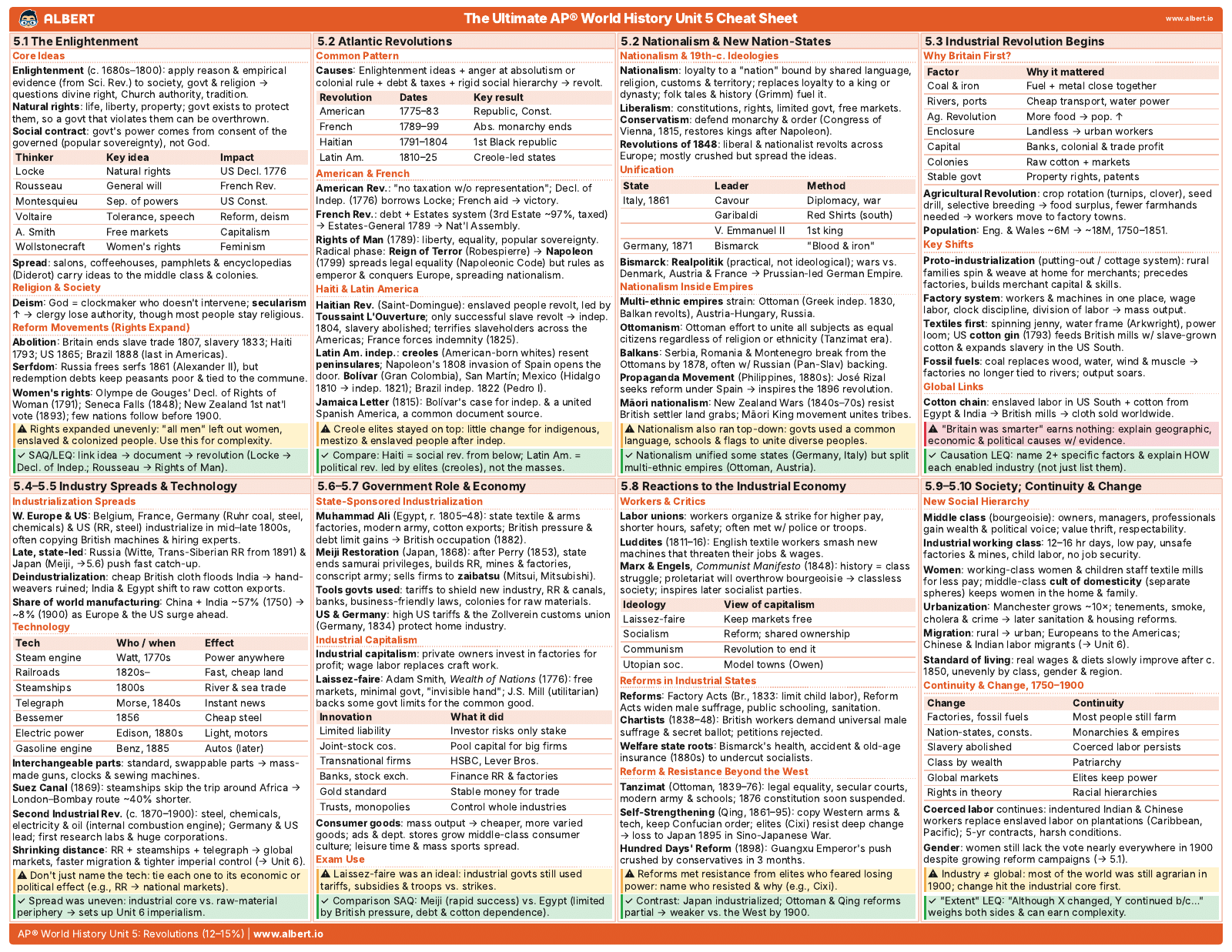
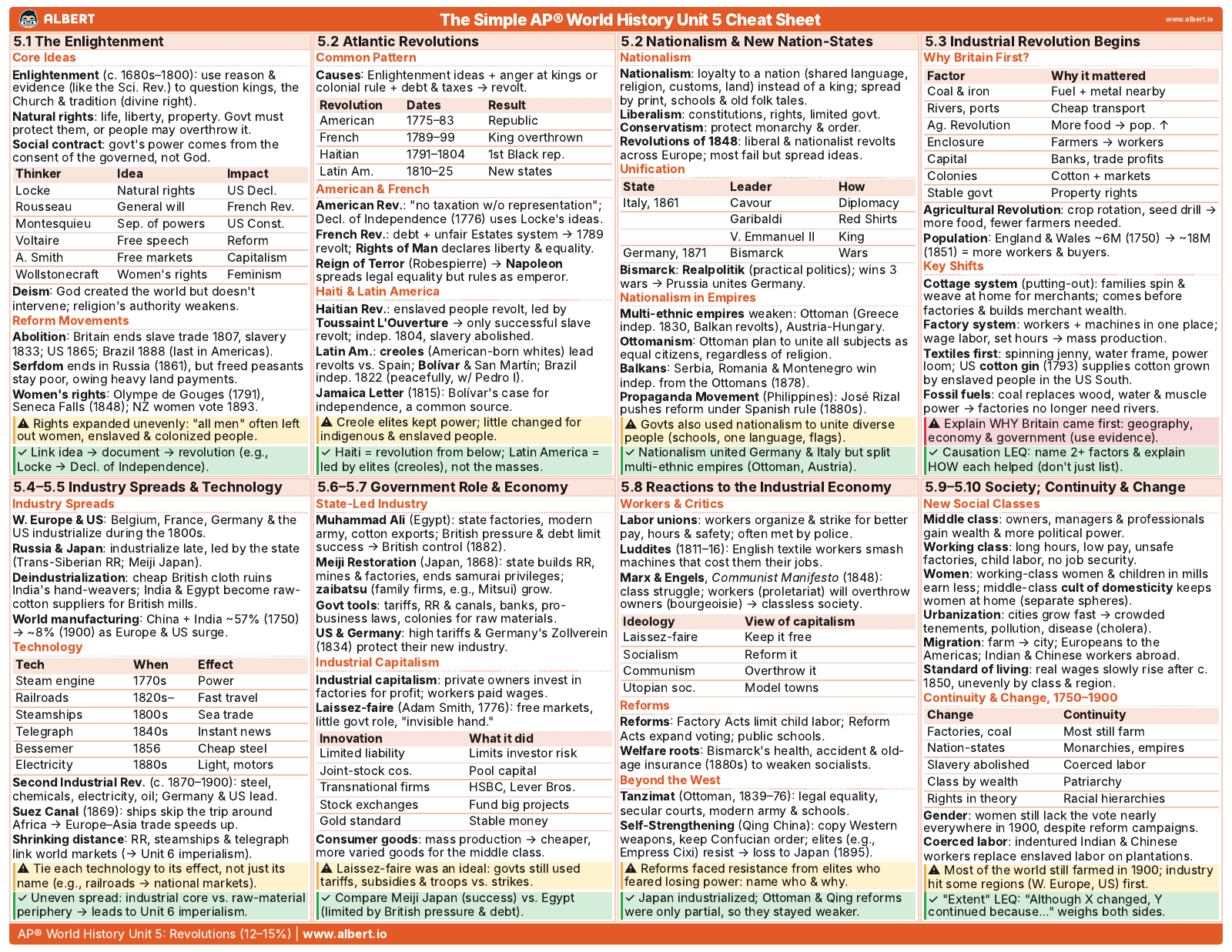
Revolutions in politics and production define the years c. 1750–1900, and this AP World Unit 5 cheat sheet puts them on one page: the Enlightenment, the Atlantic revolutions, nationalism and the Industrial Revolution. Unit 5 is 12–15% of the AP® World History: Modern exam. Download the Simple version for a first pass and the Ultimate version for dense final review.
Practice AP® World History Unit 5 questions on Albert
What’s on the AP World Unit 5 Cheat Sheet?
Both versions follow the same eight cards, in CED order: the Enlightenment (5.1), the Atlantic revolutions and nationalism (5.2, split across two cards), the start of industrialization in Britain (5.3), its spread and technology (5.4–5.5), government’s role and the new economy (5.6–5.7), reactions to industrial capitalism (5.8), and society plus continuity and change (5.9–5.10). Every card ends with a warning about a common trap and a tip for the free-response section.
Simple is for students meeting the unit for the first time or rebuilding it after a weak progress check. It keeps the core facts, adds a few words of context when a term first appears, and uses a larger font. Ultimate is for the last weeks before the exam. It adds the details that turn a vague answer into a specific one: Olympe de Gouges, the Jamaica Letter, the Zollverein, the Chartists, the Hundred Days’ Reform, indentured labor contracts, and the shift in world manufacturing away from China and India. If you can explain every line on Ultimate, you have more than enough evidence for any Unit 5 essay.
AP® World History Unit 5 at a Glance
Unit 5 opens the period c. 1750–c. 1900 and carries 12–15% of the exam score. The College Board’s Course and Exam Description (CED) splits it into ten topics. The first two are political, the next six are economic, and the last two pull everything together.
| Topic | Name | Focus |
|---|---|---|
| 5.1 | The Enlightenment | New ideas about rights and government; reform movements |
| 5.2 | Nationalism and Revolutions | American, French, Haitian and Latin American revolutions; nationalism and unification |
| 5.3 | Industrial Revolution Begins | Why Britain industrialized first; the factory system |
| 5.4 | Industrialization Spreads | Western Europe, the US, Russia, Japan; decline of manufacturing elsewhere |
| 5.5 | Technology of the Industrial Age | Steam, railroads, steamships, telegraph, the second industrial revolution |
| 5.6 | Industrialization: Government’s Role | State-sponsored industry in Egypt, Japan and Russia |
| 5.7 | Economic Developments and Innovations | Laissez-faire, limited liability, transnational businesses |
| 5.8 | Reactions to the Industrial Economy | Unions, Marx, reforms; Tanzimat and Self-Strengthening |
| 5.9 | Society and the Industrial Age | New classes, women’s work, urbanization |
| 5.10 | Continuity and Change in the Industrial Age | How much really changed, 1750–1900 |
Imperialism belongs to Unit 6, which covers the same years. Unit 5 explains why industrial states gained the power to expand; Unit 6 explains how they used it. Keep that line clear and your evidence will land in the right essay.
Key Concepts in Unit 5: Revolutions
The Enlightenment and Expanding Rights (5.1)
Enlightenment thinkers applied the reasoning of the Scientific Revolution to government and society. Locke argued that people have natural rights to life, liberty and property, and that a government which violates them can be replaced. Rousseau grounded authority in the general will. Montesquieu called for separated powers. These ideas did not stay in salons: they became founding documents, and they powered reform movements for abolition, the end of serfdom and women’s rights.
Worked example (source reading): Article 1 of the French Declaration of the Rights of Man and of the Citizen (1789) states that “men are born and remain free and equal in rights.” For sourcing, note the audience: deputies of the National Assembly justifying their break with absolute monarchy to the French public. For complexity, note who was left out. Olympe de Gouges answered in 1791 with a Declaration of the Rights of Woman, and the National Assembly was slow to apply equality to free people of color and the enslaved in Saint-Domingue.
Exam tip: connect an idea to a document to a revolution in one sentence (Locke → the Declaration of Independence → the American Revolution). That chain is exactly the causation scorers look for.
The Atlantic Revolutions (5.2)
The American, French, Haitian and Latin American revolutions share a pattern: Enlightenment ideas, resentment of absolute or colonial rule, and a fiscal or political crisis that opened the door. They differ sharply in who led them and who gained.
Worked example (comparison): an SAQ asks for one difference between the Haitian Revolution and the Latin American independence movements. A strong answer: “The Haitian Revolution was led by enslaved people under leaders like Toussaint L’Ouverture and abolished slavery, while creole elites such as Simón Bolívar led most Latin American movements and kept much of the existing social hierarchy in place.” That answer names a specific actor on each side, states the difference in one clause, and explains its effect.
Napoleon is the hinge between the two halves of 5.2. His Napoleonic Code spread legal equality across Europe, his invasion of Spain in 1808 weakened Spanish control of its colonies, and his conquests provoked the nationalism that later unified Germany and Italy.
Exam tip: do not treat “revolution” as automatically democratic. Haiti was a social revolution; much of Latin America changed who held political power without changing who held land.
Nationalism and New Nation-States (5.2)
Nationalism is loyalty to a people defined by shared language, religion, customs and territory. In the nineteenth century it worked in two directions. It unified Italy (1861) and Germany (1871), and it pulled apart multi-ethnic empires such as the Ottoman Empire and Austria-Hungary. Governments also used it from the top down, spreading a common language, schools and symbols to bind diverse populations to the state. The Ottoman policy of Ottomanism, which tried to make every subject an equal citizen regardless of religion, is the clearest example.
Worked example (source reading): in an 1862 speech, Otto von Bismarck said that the great questions of the day would be decided “not by speeches and majority decisions” but by “iron and blood.” Point of view: a Prussian minister-president who wanted army reform past a liberal parliament. Historical situation: the failure of the 1848 revolutions to unify Germany through liberal assemblies. The quote is evidence of Realpolitik, and the three wars that followed against Denmark, Austria and France prove he meant it.
Exam tip: reach beyond Europe for evidence. José Rizal’s Propaganda Movement in the Philippines and Māori resistance in the New Zealand Wars are both CED examples, and global evidence reads stronger to a scorer.
Why Industrialization Began in Britain (5.3)
Britain combined coal and iron close together, rivers and ports for cheap transport, an agricultural revolution that fed a growing population, enclosure that pushed rural workers toward towns, banks and colonial profits to invest, colonies that supplied raw cotton and bought finished cloth, and a government that protected property and patents. Textiles mechanized first, then the factory system and fossil fuels changed how and where goods were made.
Worked example (LEQ thesis): “Britain industrialized first mainly because of its geography and its overseas empire: coal deposits near navigable rivers lowered the cost of fuel and transport, while colonies supplied raw cotton and markets for British textiles.” That thesis is defensible, names two categories of cause, and previews the evidence for two body paragraphs.
Exam tip: listing six factors earns less than explaining how two of them worked. Say what each factor made possible, such as cheap coal letting factories run steam engines away from rivers.
Spread, Technology and State-Led Industry (5.4–5.7)
Industrialization spread to Belgium, France, Germany and the United States, then, with heavy state direction, to Russia and Japan. Steam engines, railroads, steamships and the telegraph shrank distances; after about 1870 the second industrial revolution added steel, chemicals, electricity and oil. Some governments drove the process themselves: Muhammad Ali built state factories in Egypt, and Meiji Japan built railroads, mines and factories before selling many of them to the zaibatsu. New business tools followed, including limited liability, joint-stock companies and transnational firms such as HSBC.
Worked example (data): economic historian Paul Bairoch estimated that China and India together produced roughly 57% of the world’s manufactured goods in 1750 and about 8% by 1900. One accurate claim from that data: industrialization did not just add output in Europe; cheap machine-made imports also cut manufacturing in Asia, which is what “deindustrialization” means in 5.4.
Exam tip: compare state-led cases. Japan’s industrialization succeeded on a large scale, while Egypt’s stalled under British competition and debt and ended in British occupation in 1882. That contrast fits a comparison SAQ or an LEQ on government’s role.
Reactions, Society and Continuity (5.8–5.10)
Workers formed unions and went on strike; Marx and Engels argued in the Communist Manifesto (1848) that class struggle would end capitalism; reformers won Factory Acts, wider voting rights and public schooling. Outside the West, the Ottoman Tanzimat and the Qing Self-Strengthening Movement tried to adopt Western tools without giving up existing power structures, and conservative elites limited both. Society reorganized around a new middle class and an industrial working class, cities grew fast, and middle-class women were pushed toward a “cult of domesticity” while working-class women and children filled the mills.
Worked example (continuity and change): “Although industrialization replaced artisan work with wage labor in factories, coerced labor continued: as slavery was abolished across the Americas, indentured workers from India and China were recruited for plantations in the Caribbean and the Pacific.” That sentence weighs change against continuity, which is what topic 5.10 asks for.
Exam tip: remember the limits of change. Most people in 1900 still farmed, and most of the world had not industrialized.
How Unit 5 Shows Up on the Exam
Unit 5 appears across every section. Multiple-choice questions come in sets of three or four built around a source: an excerpt from Locke or Marx, a factory report, a political cartoon, or a graph of industrial output.
From May 2027, the College Board’s exam updates make all three short-answer questions required and source-based: SAQ 1 uses a secondary text source, SAQ 2 a primary text source, and SAQ 3 a primary or secondary non-text source, each from a different period. A Unit 5 source could land in any of them. The long essay is now a single required question with choice built into the prompt, so you pick your own focus and need at least two pieces of specific evidence. The DBQ covers a wider chronological range, so Unit 5 evidence can help even when the prompt spans more than one period.
The rubrics have not changed. On the DBQ and LEQ, scorers reward a defensible thesis, contextualization, specific evidence, and historical reasoning (causation, comparison, or continuity and change). The complexity point goes to essays that show nuance, such as explaining both the gains and the limits of rights in the Atlantic revolutions. The official course framework is on the College Board’s AP® World History: Modern page.
Common Mistakes in Unit 5
- Mistake: treating Enlightenment rights as universal. Fix: name who was excluded (women, enslaved people, colonized peoples) and use it for complexity.
- Mistake: calling every revolution democratic. Fix: state who led it and who gained. Latin American independence kept creole elites on top.
- Mistake: listing reasons Britain industrialized first. Fix: explain how each factor worked, with a specific detail such as coal near rivers or colonial cotton.
- Mistake: using imperialism as Unit 5 evidence. Fix: keep imperialism for Unit 6 and use state-led industrialization, reform movements and economic change here.
- Mistake: saying industrialization changed everything. Fix: pair each change with a continuity, such as persistent coerced labor and patriarchy.
Frequently Asked Questions
Can I use this cheat sheet on the exam?
No. The AP® World History: Modern exam does not allow notes or reference materials of any kind. This AP World Unit 5 cheat sheet is a study tool: use it to review, quiz yourself and plan essays before test day.
Which version should I start with, Simple or Ultimate?
Start with Simple if Unit 5 is new to you or your last unit test went badly; it gives you the framework without overload. Move to Ultimate once you can explain every line on Simple. Ultimate supplies the specific names, dates and examples that earn evidence points.
How much of the exam is Unit 5?
The CED weights Unit 5 at 12–15% of the exam score, roughly seven or eight of the 55 multiple-choice questions, plus possible appearances in the SAQs, DBQ and LEQ.
How is Unit 5 different from Unit 6?
Both cover c. 1750–1900. Unit 5 explains the revolutions and the rise of industry; Unit 6 covers what followed, mainly imperialism, resistance to it and global migration. Use this AP World Unit 5 cheat sheet for causes and Unit 6 review for consequences.