
Maximize your score with these resources:
- Albert.io AP® World History question banks
- Free AP® World History study guides
- Free AP® World History score calculator
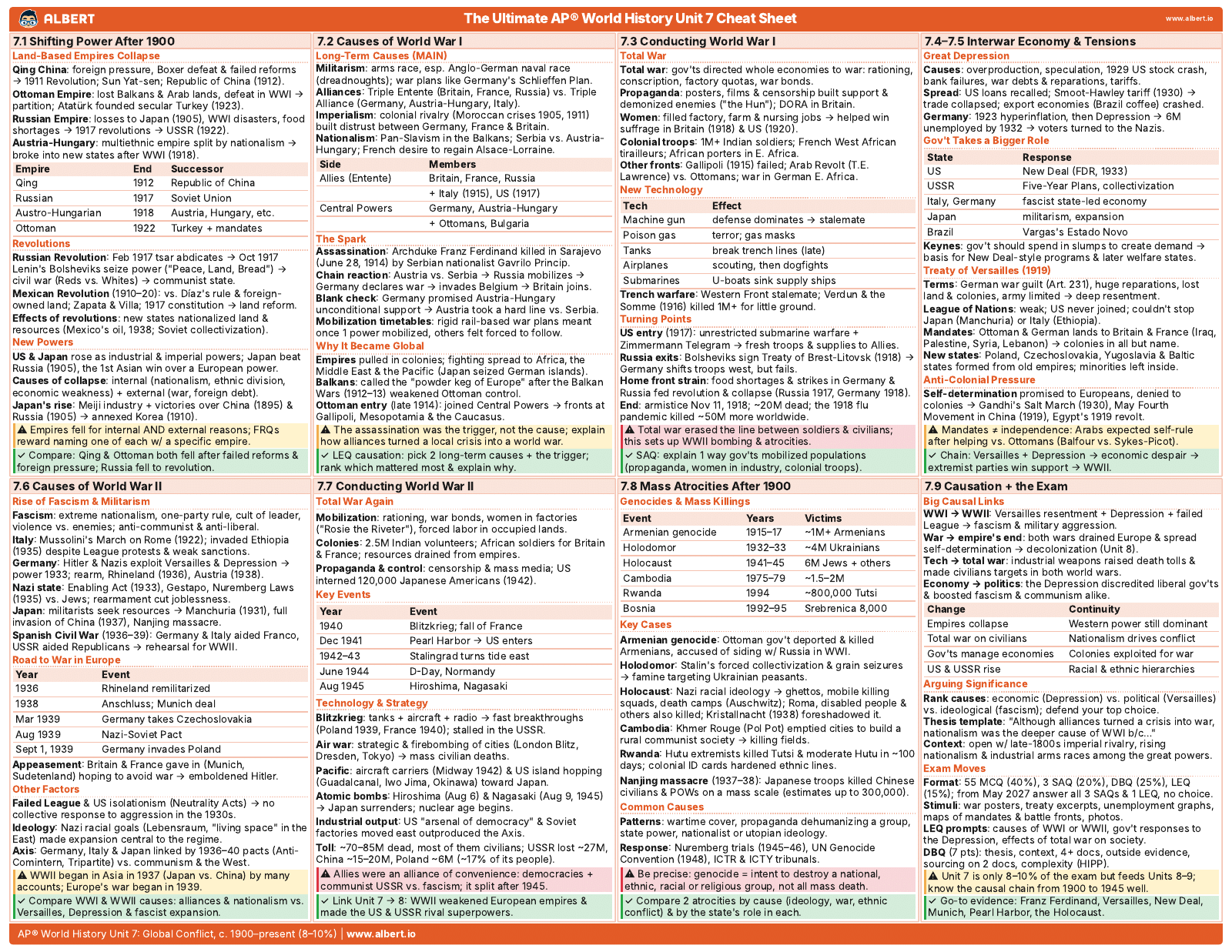
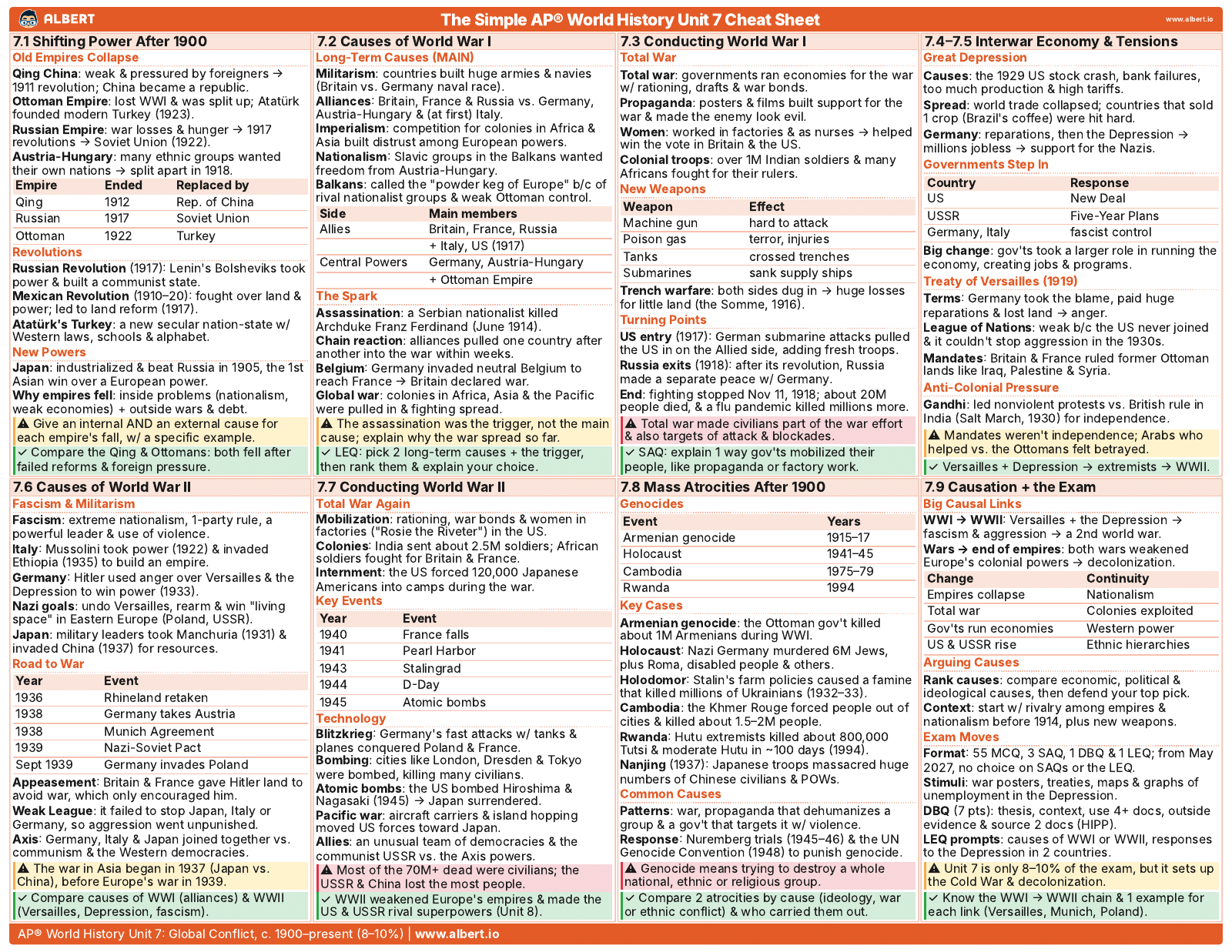
This AP World Unit 7 cheat sheet covers global conflict from c. 1900 to the present: the collapse of empires, the causes and conduct of both world wars, the Great Depression, the Treaty of Versailles, and mass atrocities. Unit 7 makes up 8–10% of the AP® World History: Modern exam. Use Simple for the essentials or Ultimate for full essay evidence.
Practice AP® World History Unit 7 questions on Albert
What’s on the AP World Unit 7 Cheat Sheet?
Both versions follow Unit 7 of the College Board’s AP® World History: Modern course. Card 1 covers the collapse of land-based empires and the revolutions after 1900 (7.1). Cards 2 and 3 cover the causes and conduct of World War I (7.2 and 7.3). Card 4 covers the interwar economy and the tensions left by the peace settlement (7.4 and 7.5). Cards 5 and 6 cover the causes and conduct of World War II (7.6 and 7.7), card 7 covers mass atrocities after 1900 (7.8), and card 8 ties the unit together with causation (7.9) and the exam moves you need.
The Simple version gives you the empires that fell, the MAIN causes of World War I, total war, the Great Depression, Versailles, the road to World War II, key battles, and the major genocides, each with a clear example.
The Ultimate version adds the detail that earns essay points: the blank check and mobilization timetables, Gallipoli and the Arab Revolt, the Zimmermann Telegram, Keynes and the New Deal, mandates and the Balfour Declaration, the Spanish Civil War, Nazi law and rearmament, the Pacific campaign, and the legal response to genocide.
AP World Unit 7 at a Glance
Unit 7 covers c. 1900 to the present and makes up 8% to 10% of the multiple-choice section. It is one of the smaller units, but it sets up both the Cold War and decolonization in Units 8 and 9.
| Topic | Name | Focus |
|---|---|---|
| 7.1 | Shifting Power After 1900 | Collapse of the Qing, Ottoman, and Russian empires; revolutions |
| 7.2 | Causes of World War I | Militarism, alliances, imperialism, nationalism, and the spark |
| 7.3 | Conducting World War I | Total war, propaganda, colonial troops, new technology |
| 7.4 | Economy in the Interwar Period | The Great Depression and government responses |
| 7.5 | Unresolved Tensions After World War I | Versailles, mandates, and anti-colonial movements |
| 7.6 | Causes of World War II | Fascism, militarism, appeasement, and the failure of the League |
| 7.7 | Conducting World War II | Mobilization, technology, and the scale of the war |
| 7.8 | Mass Atrocities After 1900 | The Armenian genocide, Holocaust, Holodomor, Cambodia, Rwanda |
| 7.9 | Causation in Global Conflict | How the world wars connect and what they changed |
Key Concepts in Unit 7: Global Conflict
Empires Fall and Revolutions Begin
Between 1911 and 1922, four large land-based empires collapsed. The Qing fell to revolution in 1911 after foreign pressure and failed reforms. Russia’s losses in war and food shortages brought the 1917 revolutions and, eventually, the Soviet Union. Austria-Hungary broke apart along national lines after defeat in 1918, and the Ottoman Empire was partitioned after World War I, with Atatürk founding the Republic of Turkey in 1923. In Mexico, a revolution beginning in 1910 overthrew Porfirio Díaz and produced a 1917 constitution promising land reform.
Exam tip: Give one internal and one external cause for an empire’s collapse. For the Qing, internal unrest and failed reforms combined with foreign spheres of influence and military defeats.
World War I: Causes and Conduct
Long-term causes are often remembered as MAIN: militarism, alliances, imperialism, and nationalism. The assassination of Archduke Franz Ferdinand in Sarajevo in June 1914 was the spark, and alliances and rigid mobilization plans turned a Balkan crisis into a world war within weeks. The war became total war: governments ran their economies for military production, used propaganda and conscription, and brought women into factories. Britain and France drew heavily on colonial soldiers and labor, including more than a million Indian troops.
New technology such as machine guns, poison gas, and artillery made the Western Front a deadly stalemate of trenches. The United States entered in 1917 after German submarine attacks and the Zimmermann Telegram, and the war ended with the armistice of November 11, 1918, after about 20 million deaths.
Worked example: An LEQ asks you to evaluate the most significant cause of World War I. A strong thesis: “Although the assassination of Franz Ferdinand triggered the war, the alliance system was the most significant cause because it turned a regional conflict between Austria-Hungary and Serbia into a war among all the major powers.”
Between the Wars
The Treaty of Versailles blamed Germany for the war, imposed reparations, and took territory and colonies, which created lasting resentment. The League of Nations lacked US membership and could not stop aggression. Former Ottoman lands became British and French mandates, frustrating Arab hopes for independence, while colonized peoples who had served in the war pushed for self-rule, as in Gandhi’s campaigns in India and the May Fourth Movement in China.
The Great Depression began with the 1929 US stock market crash and spread through bank failures, collapsing trade, and high tariffs. Governments took a much larger role in their economies: the New Deal in the United States, Five-Year Plans in the Soviet Union, and state-directed economies in fascist Italy and Germany.
Worked example: An SAQ asks you to explain one way governments responded to the Great Depression. A full answer: “In the United States, Franklin Roosevelt’s New Deal created public works programs and new regulations, expanding the government’s role in the economy to reduce unemployment.”
World War II: Causes and Conduct
Economic crisis helped fascist and militarist governments gain power. Mussolini took control in Italy in 1922 and invaded Ethiopia in 1935. Hitler came to power in Germany in 1933, rearmed, remilitarized the Rhineland, and annexed Austria. Japan seized Manchuria in 1931 and invaded China in 1937. Britain and France followed a policy of appeasement, most famously at Munich in 1938, and the Nazi-Soviet Pact cleared the way for Germany’s invasion of Poland on September 1, 1939.
World War II was again a total war, with massive mobilization, colonial troops, and new technology including blitzkrieg tactics, aircraft carriers, strategic bombing, and the atomic bombs dropped on Hiroshima and Nagasaki. About 70 to 85 million people died, most of them civilians.
Exam tip: When comparing the two wars, show how the outcome of the first created conditions for the second, especially through Versailles and the Depression.
Mass Atrocities
The twentieth century saw repeated mass atrocities. The Ottoman government killed about a million Armenians during World War I. Stalin’s policies caused the Holodomor famine in Ukraine. Nazi Germany murdered six million Jews along with Roma, disabled people, and others in the Holocaust. Later, the Khmer Rouge killed about 1.5 to 2 million Cambodians, and Hutu extremists killed about 800,000 Tutsi and moderate Hutu in Rwanda in 1994. Common factors include war, propaganda that dehumanizes a group, and state power directed against it. The Nuremberg trials and the 1948 UN Genocide Convention were early international responses.
How Unit 7 Shows Up on the Exam
The AP® World History: Modern exam has 55 multiple-choice questions, 3 short-answer questions, 1 document-based question, and 1 long essay question. Starting with the May 2027 exam, students answer all three short-answer questions and one long essay question with no choice; course content and scoring rubrics are unchanged. Unit 7 stimuli include war propaganda posters, treaty excerpts, maps of mandates and battle lines, and graphs of unemployment during the Depression.
Essay prompts often ask about the causes of the world wars, government responses to the Depression, or the effects of total war. On the DBQ, scorers reward a defensible thesis, contextualization, use of at least four documents, outside evidence, sourcing for two documents, and complex reasoning such as weighing several causes against one another.
Common Mistakes in Unit 7
- Mistake: Calling the assassination of Franz Ferdinand the cause of World War I. Fix: Treat it as the trigger and explain the long-term causes.
- Mistake: Treating mandates as independence. Fix: Explain that Britain and France ruled them much like colonies.
- Mistake: Starting World War II only in 1939. Fix: Note that the war in Asia began with Japan’s invasion of China in 1937.
- Mistake: Using “genocide” for every mass death. Fix: Genocide means intent to destroy a national, ethnic, racial, or religious group.
- Mistake: Leaving out the colonial world. Fix: Show how colonial troops, resources, and anti-colonial movements shaped both wars.
Frequently Asked Questions
Can I use this cheat sheet on the exam?
No. Notes are not allowed on the AP® World History: Modern exam. This AP World Unit 7 cheat sheet is a study tool for reviewing before practice questions, unit tests, and the exam.
Should I start with the Simple or the Ultimate version?
Start with Simple to learn the main events in order. Move to Ultimate when you are writing practice essays and need specific evidence.
How much of the exam is Unit 7?
Unit 7 is 8% to 10% of the multiple-choice section. It is smaller than earlier units, but its causes and effects run through Units 8 and 9.
How does Unit 7 connect to Unit 8?
World War II weakened European empires and left the United States and the Soviet Union as rival superpowers, which set up both the Cold War and decolonization in Unit 8.