
Maximize your score with these resources:
- Albert.io AP® Chemistry question banks
- Free AP® Chemistry study guides
- Free AP® Chemistry score calculator
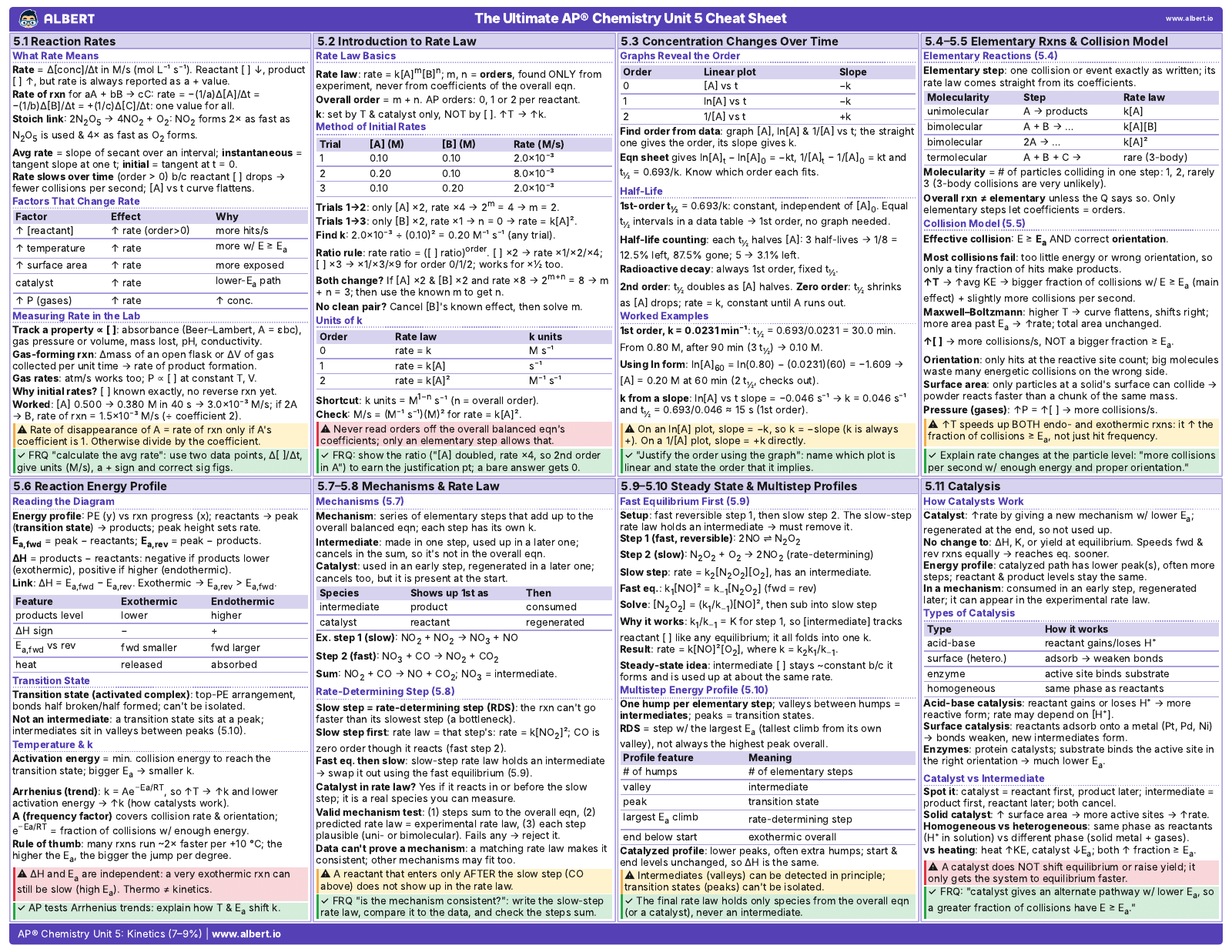
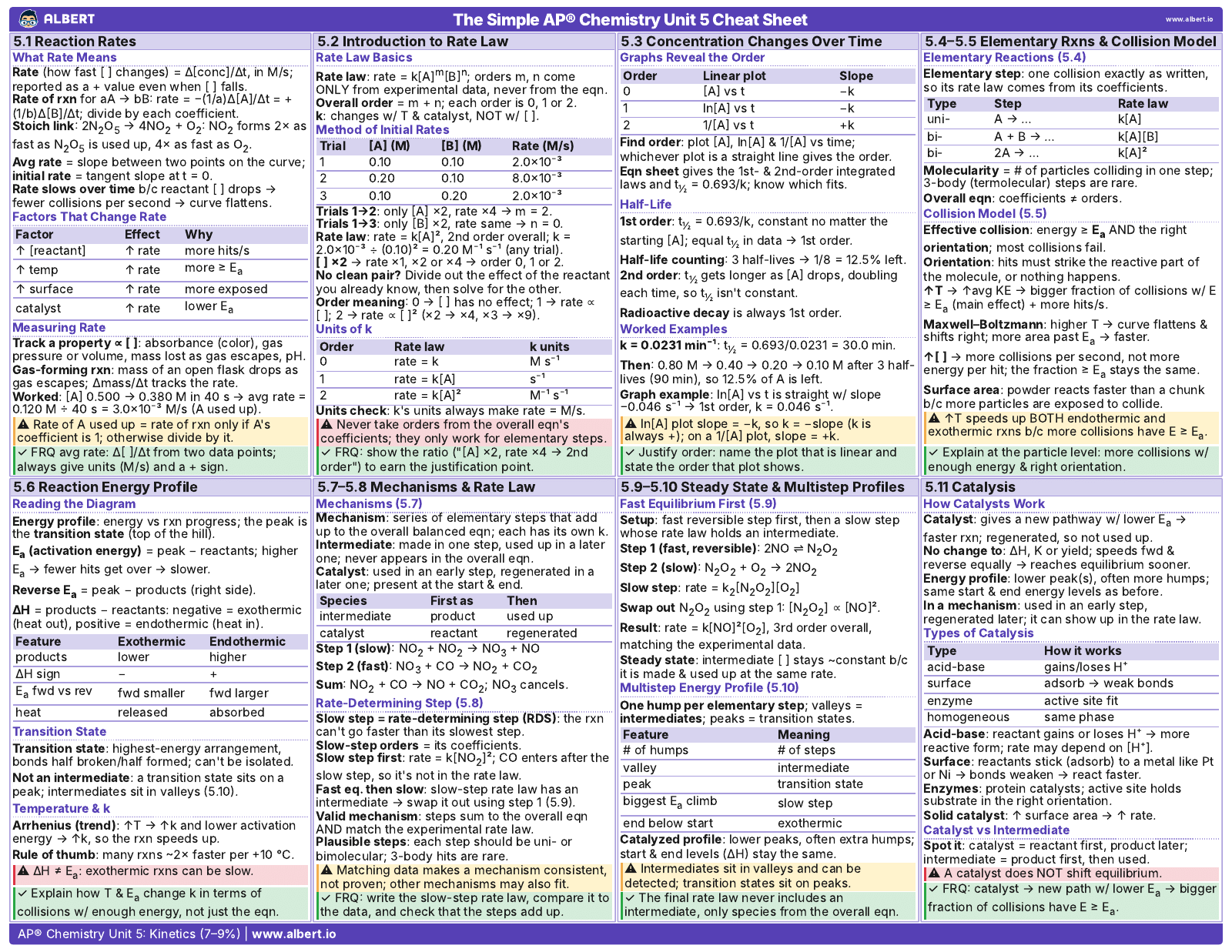
Every question in this AP Chem Unit 5 cheat sheet comes back to one idea: how fast a reaction goes, and what controls that speed. It covers all eleven topics of AP® Chemistry Unit 5: Kinetics, which makes up 7–9% of the multiple-choice section. Pick the Simple version for a first pass or the Ultimate version for full exam prep.
Practice AP® Chemistry Unit 5 questions on Albert
What’s on the AP Chem Unit 5 Cheat Sheet?
Both versions follow the College Board’s Course and Exam Description topic by topic, on one landscape page with eight cards: reaction rates, rate laws, concentration changes over time, elementary reactions and the collision model, energy profiles, mechanisms and the rate-determining step, fast equilibria with multistep energy profiles, and catalysis.
The Simple version is for students meeting kinetics for the first time or reviewing after a long gap. It keeps the core ideas, one worked example per topic, and the single most common trap on each card, with a few words of context when a term first appears.
The Ultimate version is for students aiming at a 4 or 5. It adds more worked calculations, the units of k for every order, Maxwell–Boltzmann reasoning, the full fast-equilibrium derivation, and the scoring language free-response graders look for. Since you get the AP® Chemistry equations sheet on exam day, neither version wastes space copying it. Both focus on when to use each equation and how to justify your answer.
AP® Chemistry Unit 5 at a Glance
Unit 5 is worth 7–9% of the multiple-choice section, roughly four or five of the 60 questions. Kinetics also turns up regularly in the free-response section, often as part of a long question built around a data table or graph.
| Topic | Name | Focus |
|---|---|---|
| 5.1 | Reaction Rates | Rate as change in concentration over time; factors that change rate |
| 5.2 | Introduction to Rate Law | Rate laws, reaction order and k from initial-rate data |
| 5.3 | Concentration Changes Over Time | Integrated rate laws, linear plots and half-life |
| 5.4 | Elementary Reactions | Molecularity and rate laws for single steps |
| 5.5 | Collision Model | Energy and orientation of collisions |
| 5.6 | Reaction Energy Profile | Activation energy, transition state and temperature |
| 5.7 | Introduction to Reaction Mechanisms | Elementary steps, intermediates and catalysts |
| 5.8 | Reaction Mechanism and Rate Law | The rate-determining step sets the rate law |
| 5.9 | Steady-State Approximation | Removing intermediates using a fast equilibrium |
| 5.10 | Multistep Reaction Energy Profile | Reading humps, valleys and the slow step |
| 5.11 | Catalysis | Lower activation energy through a new mechanism |
The skill the exam leans on most here is mathematical routines: pulling orders out of data, finding k, and working with half-life. The second is explanation: using particle-level reasoning to say why a rate changed.
Key Concepts in Unit 5: Kinetics
Reaction Rates and Rate Laws (5.1–5.2)
Rate is the change in concentration per unit time, in M/s. For a reaction like aA → bB, the rate of the reaction is −(1/a)Δ[A]/Δt = (1/b)Δ[B]/Δt, so a species with a coefficient of 2 changes twice as fast as the reaction rate itself. Higher concentration, higher temperature, more surface area and a catalyst all speed a reaction up.
A rate law has the form rate = k[A]m[B]n. The orders m and n come from experiment, never from the balanced equation. The standard method is initial rates.
Worked example. For 2NO + O2 → 2NO2, three trials give: trial 1, [NO] = 0.010 M, [O2] = 0.010 M, rate = 2.5×10⁻⁵ M/s; trial 2, [NO] = 0.020 M, same [O2], rate = 1.0×10⁻⁴ M/s; trial 3, [NO] = 0.010 M, [O2] = 0.020 M, rate = 5.0×10⁻⁵ M/s. Doubling [NO] multiplies the rate by 4, so the reaction is second order in NO. Doubling [O2] doubles the rate, so it is first order in O2. The rate law is rate = k[NO]2[O2], and trial 1 gives k = 2.5×10⁻⁵ ÷ [(0.010)2(0.010)] = 25 M−2 s−1.
Exam tip: write the comparison in words (“[NO] doubled while [O2] stayed constant, and the rate quadrupled”). That sentence is what earns the justification point.
Integrated Rate Laws and Half-Life (5.3)
Integrated rate laws connect concentration to time. The fastest way to find the order is graphical: a zero-order reaction gives a straight line for [A] vs t, first order for ln[A] vs t, and second order for 1/[A] vs t. For the first two the slope is −k; for the 1/[A] plot the slope is +k.
First-order reactions have a constant half-life, t½ = 0.693/k, no matter how much reactant you start with. Radioactive decay is the classic example. If a data table shows equal time intervals for each halving of concentration, that is your evidence of first order.
Worked example. A first-order decomposition has k = 6.93×10⁻³ s−1, so t½ = 0.693 ÷ 6.93×10−3 = 100 s. Starting at 0.400 M, three half-lives (300 s) leave 0.400 → 0.200 → 0.100 → 0.0500 M. For a time that isn’t a whole number of half-lives, use the equation: at 150 s, ln[A] = ln(0.400) − (6.93×10⁻³)(150) = −1.956, so [A] = 0.141 M.
Exam tip: when a question asks you to justify the order from a graph, name the plot that is linear and state the order it shows. A correct order with no reference to the plot often misses the point.
Elementary Reactions and the Collision Model (5.4–5.5)
An elementary reaction happens in a single collision, exactly as written. That is the one case where coefficients become orders: A + B → products has rate = k[A][B], and 2A → products has rate = k[A]2. Most steps are unimolecular or bimolecular, because three particles almost never collide at the same instant.
The collision model says a collision only produces products if the particles hit with enough energy (at least the activation energy, Ea) and with the right orientation. Most collisions fail one test or the other.
Worked example. Why does raising the temperature speed up a reaction? Higher temperature raises the average kinetic energy of the particles. On a Maxwell–Boltzmann distribution the curve flattens and shifts right, so a larger fraction of collisions have energy at or above Ea. Particles also collide slightly more often, but the bigger fraction of energetic collisions is the main reason. Raising concentration works differently: it increases the number of collisions per second without changing the fraction that have enough energy.
Exam tip: free-response explanations need particle-level language. “More collisions per second with enough energy and the correct orientation” earns credit; “the particles move faster” alone usually does not.
Reaction Energy Profiles (5.6)
An energy profile plots potential energy against reaction progress. The peak is the transition state, the short-lived arrangement where bonds are partly broken and partly formed. The forward activation energy is the height from reactants to the peak, the reverse activation energy is the height from products to the peak, and ΔH is products minus reactants.
Worked example. Reactants sit at 50 kJ/mol, the peak at 120 kJ/mol and products at 20 kJ/mol. The forward Ea is 70 kJ/mol, the reverse Ea is 100 kJ/mol, and ΔH = 20 − 50 = −30 kJ/mol, so the reaction is exothermic. Check: forward Ea minus reverse Ea also gives −30 kJ/mol.
The Arrhenius equation, k = Ae−Ea/RT, gives you the trends: a higher temperature or a lower activation energy produces a larger k. Know how each change affects k and be ready to explain it with collisions.
Exam tip: keep thermodynamics and kinetics apart. A very exothermic reaction can still be slow if its activation energy is high.
Mechanisms, the Rate-Determining Step and Fast Equilibria (5.7–5.10)
A mechanism is a series of elementary steps that add up to the overall equation. An intermediate is made in one step and used up in a later one, so it cancels out of the sum. The slowest step is the rate-determining step, and the rate law of the whole reaction comes from it.
If the slow step comes first, its rate law is the answer. If a fast, reversible step comes first, the slow step’s rate law usually contains an intermediate, which can never appear in the final rate law. You remove it using the fast equilibrium.
Worked example. A proposed mechanism for 2NO + O2 → 2NO2 is step 1: 2NO ⇌ N2O2 (fast equilibrium), then step 2: N2O2 + O2 → 2NO2 (slow). The slow step gives rate = k2[N2O2][O2], but N2O2 is an intermediate. Setting the forward and reverse rates of step 1 equal gives [N2O2] = (k1/k−1)[NO]2. Substituting gives rate = k[NO]2[O2], which matches the experimental rate law from the initial-rates example, so the mechanism is consistent with the data.
On a multistep energy profile, each hump is one elementary step, each valley between humps is an intermediate, and the step with the largest activation energy is the slow step.
Exam tip: a matching rate law makes a mechanism consistent, not proven. Say “consistent with” in your answer and check that the steps add up to the overall equation.
Catalysis (5.11)
A catalyst speeds up a reaction by providing a new mechanism with a lower activation energy. It is used in an early step and regenerated in a later one, so it is not consumed. It does not change ΔH, the equilibrium constant or the yield; it speeds up the forward and reverse reactions equally, so equilibrium arrives sooner. The course names three types: acid-base catalysis (a reactant gains or loses H+), surface catalysis (reactants adsorb onto a solid such as platinum) and enzyme catalysis.
Worked example. Iodide ions catalyze the decomposition of hydrogen peroxide. Step 1 (slow): H2O2 + I− → H2O + IO−. Step 2 (fast): H2O2 + IO− → H2O + O2 + I−. I− enters first and comes back at the end, so it is the catalyst. IO− is made and then used, so it is the intermediate. The rate law comes from step 1: rate = k[H2O2][I−], which shows a catalyst can appear in a rate law.
Exam tip: the full-credit explanation is “the catalyst provides an alternate pathway with a lower activation energy, so a greater fraction of collisions have enough energy to react.”
How Unit 5 Shows Up on the AP® Chemistry Exam
The AP® Chemistry exam has 60 multiple-choice questions in 90 minutes and seven free-response questions (three long, four short) in 105 minutes, each section worth 50%. You get a periodic table and the AP® Chemistry equations and constants sheet for both sections, and a calculator is recommended for both.
In the multiple-choice section, kinetics questions usually come in sets built on a data table, a concentration-time graph or an energy profile. Expect to find an order from initial rates, identify which plot is linear, count half-lives, pick out the intermediate or catalyst in a mechanism, or match a Maxwell–Boltzmann diagram to a temperature change.
In the free-response section, kinetics often fills several parts of a long question. Scorers reward three things: calculations with the setup shown and correct units, justifications that point to specific data (which trials, which plot), and explanations that use collisions, activation energy and orientation rather than vague phrases. The College Board’s AP® Chemistry course page has past free-response questions and scoring guidelines to practice with.
Common Mistakes in Unit 5
- Reading orders from the balanced equation. Coefficients only give orders for an elementary step. For any overall reaction, take orders from data.
- Forgetting the sign of the slope. On an ln[A] vs t plot the slope is −k. Report k as a positive number.
- Saying a catalyst shifts equilibrium. It does not change K or the yield. It only gets the reaction to equilibrium faster.
- Leaving an intermediate in the rate law. If your slow step contains an intermediate, replace it using the fast equilibrium before giving the final answer.
- Explaining temperature with collision frequency alone. The main effect of higher temperature is a larger fraction of collisions with energy at or above Ea. Mention it explicitly.
Frequently Asked Questions
Can I use this cheat sheet on the exam?
No. It is a study tool for the weeks before the exam. On exam day you get only the official periodic table and the AP® Chemistry equations and constants sheet, which is why the cheat sheet focuses on how to apply those equations rather than repeating them.
Should I start with the Simple or the Ultimate version?
Start with Simple if rate laws and mechanisms still feel shaky. It gives you the core of each topic without the extra detail. Move to Ultimate once you can do an initial-rates problem from start to finish, since its added examples and traps are what separate a 4 from a 5.
Do I need to memorize the integrated rate laws?
No. The first- and second-order integrated rate laws and the first-order half-life equation are on the equations sheet. What you need is to recognize which one a problem calls for, usually from a linear plot or a constant half-life.
How much of the AP® Chemistry exam is kinetics?
Unit 5 accounts for 7–9% of the multiple-choice section. It also appears often in free response, and its ideas return in Unit 7, where equilibrium is the point at which forward and reverse rates are equal.
What is the best way to review AP Chem Unit 5?
Work through the AP Chem Unit 5 cheat sheet one card at a time, then do practice problems that use real data: initial-rates tables, concentration-time graphs and proposed mechanisms. For each one, write the justification sentence as if you were answering a free-response question.