

Maximize your score with these resources:
- Albert.io AP® Calculus question banks
- Free AP® Calculus cheat sheets
- Free AP® Calculus score calculator
When you study infinite series in AP® Calculus BC, one of the most important distinctions you need to master is the difference between absolute convergence and conditional convergence. This distinction determines how “well-behaved” a convergent series really is — and the AP exam tests it directly. Understanding whether a series converges absolutely or only conditionally affects which operations you can safely perform on that series and how confidently you can work with its sum.
What We Review
Recap: What Is a Series?
Definition of a Series
A series is the sum of infinitely many terms, written as:
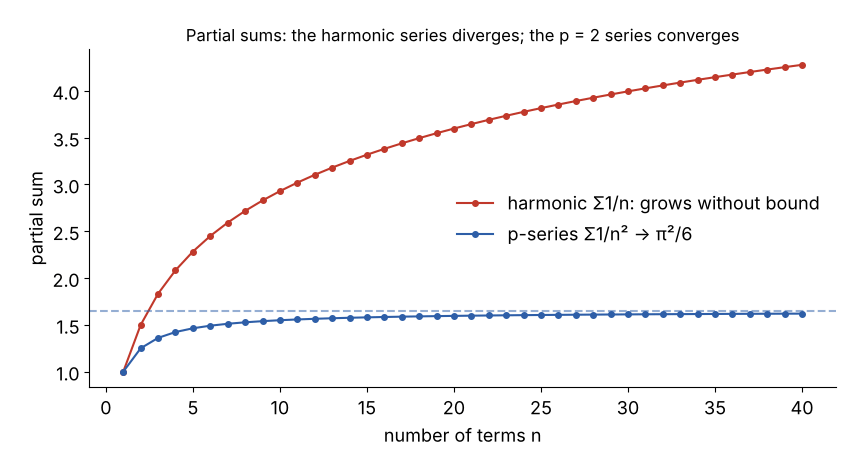
\(\sum_{n=1}^{\infty} a_n\)Here, \(a_n\) represents the \(n\)th term in the sequence. A series either converges (approaches a finite value) or diverges (grows without bound or oscillates without settling).
Common Tests for Convergence (High-Level Recap)
You have several tools in your convergence-testing toolkit:
- Comparison Test — compare your series term-by-term against a known convergent or divergent series
- Ratio Test — examine \(\lim_{n \to \infty} \left| \frac{a_{n+1}}{a_n} \right|\) to determine convergence
- Root Test — examine \(\lim_{n \to \infty} \sqrt[n]{|a_n|}\) to determine convergence
- Alternating Series Test — specifically designed for series with terms that alternate in sign
These tests help you determine whether a series converges. But the question of absolute vs. conditional convergence goes further: it asks how strongly the series converges.
Absolute Convergence
Definition
A series \(\sum_{n=1}^{\infty} a_n\) converges absolutely if the series of absolute values also converges:
\(\sum_{n=1}^{\infty} |a_n| \text{ converges}\)In plain terms: strip the sign from every term and add them all up. If that positive-only series converges, then the original series converges absolutely. This is the stronger form of convergence.
A critical theorem to remember: absolute convergence implies convergence. If \(\sum |a_n|\) converges, then \(\sum a_n\) also converges — guaranteed, no further testing needed.
Importance
Absolute convergence matters because it guarantees stability:
- Rearrangement safety — you can rearrange the terms of an absolutely convergent series in any order without changing the sum. This is not true for conditionally convergent series.
- Stronger analytical power — many theorems in calculus (including those about power series and term-by-term differentiation/integration) require absolute convergence to work.
- Exam confidence — once you’ve shown absolute convergence, you know the series converges. Period. No additional tests required.
Example Problem (Step-by-Step)
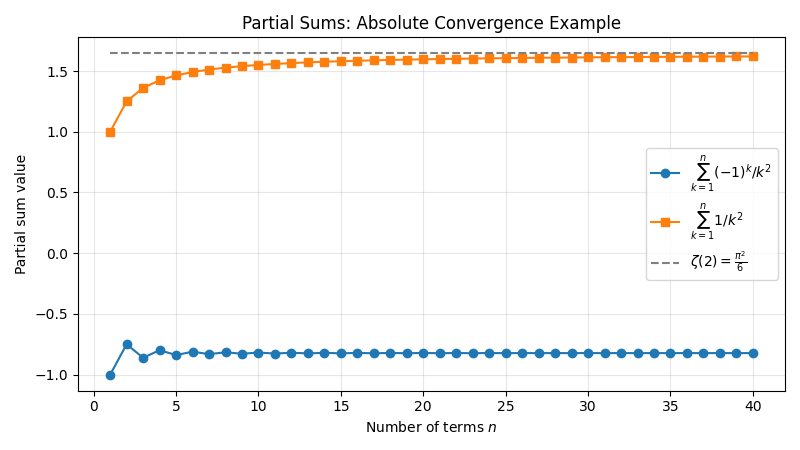
Determine whether \(\sum_{n=1}^{\infty} \frac{(-1)^n}{n^2}\) converges absolutely, conditionally, or diverges.
Step 1: Take the absolute value of each term:
\(\sum_{n=1}^{\infty} \left| \frac{(-1)^n}{n^2} \right| = \sum_{n=1}^{\infty} \frac{1}{n^2}\)Step 2: Recognize this as a p-series with \(p = 2\). Since \(p > 1\), this series converges.
Step 3: Because the absolute value series converges, the original series \(\sum_{n=1}^{\infty} \frac{(-1)^n}{n^2}\) converges absolutely.
Key insight: you never even needed the Alternating Series Test here. Absolute convergence is the stronger result, and it immediately tells you the original series converges too.
Conditional Convergence
Definition
A series is conditionally convergent if it converges in its original form but does not converge absolutely. That means:
- \(\sum_{n=1}^{\infty} a_n\) converges
- \(\sum_{n=1}^{\infty} |a_n|\) diverges
The series “barely” converges — it relies on the cancellation between positive and negative terms to keep the partial sums in check. Remove those sign changes (by taking absolute values), and the series blows up.
Implications
Conditionally convergent series are mathematically fragile in important ways:
- Riemann Rearrangement Theorem — you can rearrange the terms of a conditionally convergent series to make it converge to any real number you want, or even make it diverge. This is a surprising and counterintuitive result that the AP exam occasionally references.
- Delicate handling required — because the convergence depends on sign cancellation, operations like term-by-term multiplication or regrouping can destroy convergence.
On the AP exam, recognizing conditional convergence tells you that the series needs to be treated more carefully in any follow-up analysis.
Example Problem (Step-by-Step)
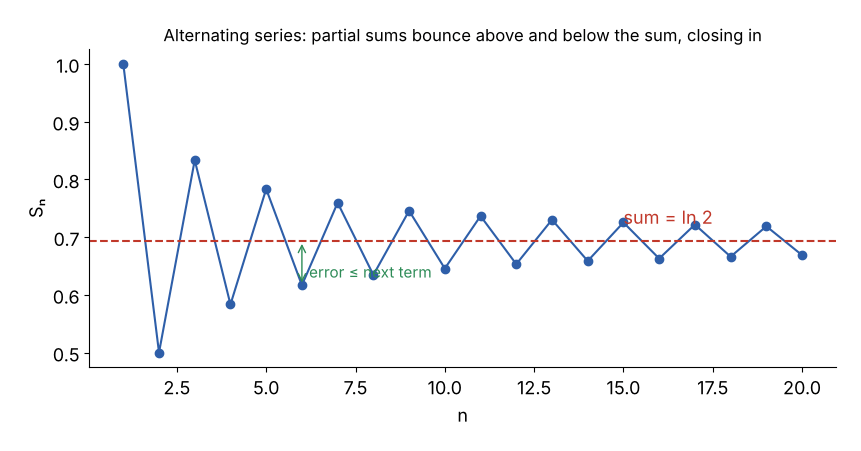
Determine whether \(\sum_{n=1}^{\infty} \frac{(-1)^{n+1}}{n}\) (the alternating harmonic series) converges absolutely, conditionally, or diverges.
Step 1: Check for absolute convergence. Take the absolute value of each term:
\(\sum_{n=1}^{\infty} \left| \frac{(-1)^{n+1}}{n} \right| = \sum_{n=1}^{\infty} \frac{1}{n}\)This is the harmonic series, which diverges. So the series does not converge absolutely.
Step 2: Check for conditional convergence. Apply the Alternating Series Test:
- The terms \(b_n = \frac{1}{n}\) are positive
- The terms are decreasing: \(\frac{1}{n+1} < \frac{1}{n}\)
- \(\lim_{n \to \infty} \frac{1}{n} = 0\)
All three conditions are met, so the alternating harmonic series converges by the Alternating Series Test.
Step 3: Conclusion. The series converges but not absolutely. Therefore, \(\sum_{n=1}^{\infty} \frac{(-1)^{n+1}}{n}\) is conditionally convergent.
Comparing Absolute vs Conditional Convergence
Summary of Key Differences
| Feature | Absolute Convergence | Conditional Convergence |
| \(\sum |a_n|\) converges? | Yes | No |
| \(\sum a_n\) converges? | Yes (guaranteed) | Yes |
| Rearrangement changes sum? | No — sum is stable | Yes — sum can change to anything |
| How terms typically behave | Shrink fast (e.g., \(\frac{1}{n^2}\)) | Shrink slowly (e.g., \(\frac{1}{n}\)) |
| Strength of convergence | Strong | Weak / fragile |
| Classic example | \(\sum \frac{(-1)^n}{n^2}\) | \(\sum \frac{(-1)^{n+1}}{n}\) |
Real-World/Conceptual Cases
These concepts appear frequently beyond the AP exam:
- Power series — at the endpoints of the interval of convergence, you often need to determine whether the series converges absolutely or conditionally. This is a direct AP exam question type.
- Numerical computation — conditionally convergent series are unreliable for approximation because rearranging terms changes the sum. Absolutely convergent series are safe to truncate and compute partial sums in any order.
- Fourier series and physics — in engineering and physics applications, absolute convergence guarantees that operations on infinite series (like differentiating term by term) produce valid results.
Quick Reference Chart: Important Vocabulary and Definitions
| Term | Definition |
| Absolute Convergence | A series \(\sum a_n\) converges absolutely if \(\sum |a_n|\) also converges. |
| Conditional Convergence | A series converges but not absolutely — \(\sum a_n\) converges while \(\sum |a_n|\) diverges. |
| Divergence | A series fails to settle on a finite sum. |
| Ratio Test | Compute \(L = \lim_{n \to \infty} \left| \frac{a_{n+1}}{a_n} \right|\). If \(L < 1\), absolutely convergent. If \(L > 1\), divergent. If \(L = 1\), inconclusive. |
| Root Test | Compute \(L = \lim_{n \to \infty} \sqrt[n]{|a_n|}\). Same conclusions as the Ratio Test. |
| Alternating Series Test | If terms alternate in sign, decrease in magnitude, and approach zero, the series converges. |
| Riemann Rearrangement Theorem | Any conditionally convergent series can be rearranged to converge to any real number — or to diverge. |
Test-Taking Strategies
Here’s how to handle absolute vs. conditional convergence questions efficiently on exam day.
The “ACD” Decision Framework — when a question asks “does this series converge absolutely, conditionally, or diverge?”, always follow this order:
- A — Absolute first. Test \(\sum |a_n|\) for convergence. If it converges, you’re done — the answer is “absolutely convergent” and you don’t need to check anything else.
- C — Conditional second. If \(\sum |a_n|\) diverges, test the original series \(\sum a_n\) (usually with the Alternating Series Test). If it converges, the answer is “conditionally convergent.”
- D — Divergent last. If even the original series doesn’t converge, the answer is “divergent.”
Remember: A-C-D = Absolutely, Conditionally, Divergent. Always test in this order.
Cross-topic connections you’ll see on the AP exam:
- Power series endpoints — when you find the radius of convergence using the Ratio Test, you must check the endpoints separately. At each endpoint, the question is almost always: “does the series converge absolutely, conditionally, or diverge?” This is where these concepts get tested most frequently.
- p-series as your benchmark — the most common absolute convergence test is recognizing a p-series with \(p > 1\). The most common conditional convergence scenario is an alternating series with \(b_n = \frac{1}{n^p}\) where \(p \leq 1\).
- Error bounds — the Alternating Series Error Bound only applies to convergent alternating series. If a series converges absolutely via a non-alternating test, you may need the Lagrange Error Bound instead.
Common question formats:
- “Determine whether the series converges absolutely, converges conditionally, or diverges” — the most direct format. Use the A-C-D framework.
- “At \(x = 3\), the series…” — a power series endpoint question. Substitute the value, simplify, then apply A-C-D.
- “Which of the following series converge conditionally?” — multiple-choice with 3-4 series to classify. Work quickly by recognizing p-series patterns.
Frequent student mistakes:
- Stopping at the Alternating Series Test. If you show a series converges by the AST but don’t test \(\sum |a_n|\), you haven’t determined whether the convergence is absolute or conditional. The exam specifically asks you to distinguish between them.
- Confusing the direction of implication. Absolute convergence implies convergence (always true). But convergence does NOT imply absolute convergence. Don’t go backwards.
- Forgetting that \(\sum \frac{1}{n}\) diverges. The harmonic series is the key reference — it’s what makes \(\sum \frac{(-1)^{n+1}}{n}\) conditionally (not absolutely) convergent.
- Misapplying the Ratio Test conclusion. If the Ratio Test gives \(L = 1\), it’s inconclusive — you need a different test. Students often incorrectly conclude convergence or divergence from \(L = 1\).
Instant classification shortcut for alternating \(\frac{1}{n^p}\) series:
- \(p > 1\) — absolutely convergent (the p-series converges)
- \(0 < p \leq 1\) — conditionally convergent (p-series diverges, but AST works)
- \(p \leq 0\) — divergent (terms don’t approach zero)
Time management: Classification questions should take about 90 seconds each on the MCQ section. If you’ve memorized the A-C-D framework and the p-series cutoffs, you can answer without writing any work. On the FRQ, budget 2-3 minutes and write out each step explicitly — show that you tested absolute convergence first, then conditional.
Check for Understanding
Think you’ve got it? Complete the quiz below to make sure.