
Maximize your score with these resources:
- Albert.io AP® US History question banks
- Free AP® US History cheat sheets
- Free AP® US History score calculator
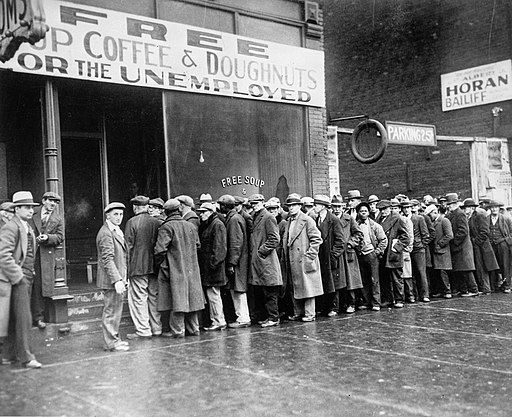
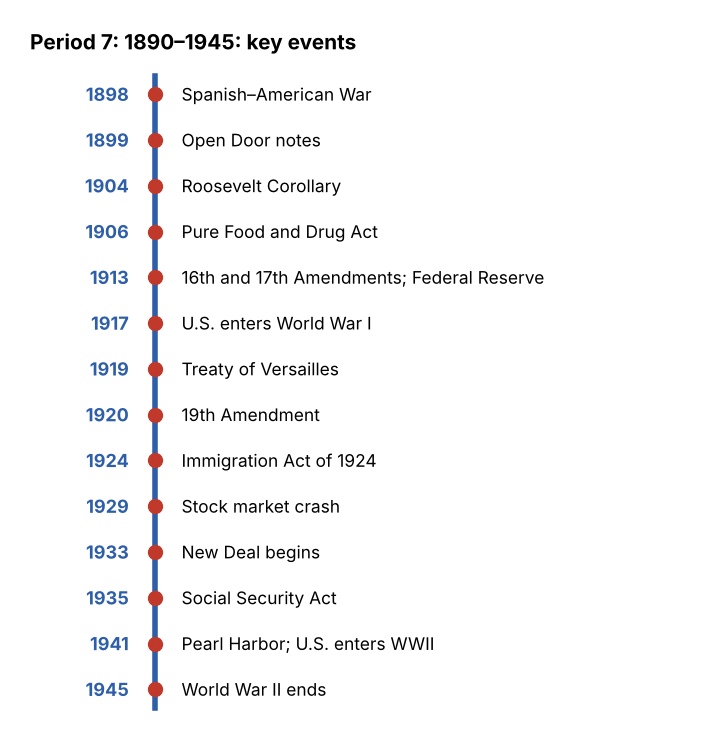
Period 7 begins with Americans debating whether to take colonies in the Caribbean and Pacific and ends with the United States as a superpower with troops on every continent. It begins with a federal government that rarely regulated business and ends with one that managed wages, prices, and retirement. In between, the country went through two world wars, a decade of boom, and the worst depression in its history. Topic 7.15 asks you to step back and compare how Americans responded to these crises.
This article covers Topic 7.15: Comparison of the Period in Period 7, 1890 to 1945. The topic asks you to compare the relative significance of major events in this period, such as the Progressive Era, the New Deal, and the world wars, in shaping American society, politics, and foreign policy.
By the end, you should be able to:
- Compare the Progressive Era and the New Deal as reform movements.
- Compare the home fronts of World War I and World War II.
- Compare U.S. foreign policy after each world war.
- Build a comparison argument for an LEQ or DBQ.

What We Review
The Comparison Skill
A strong comparison does more than list similarities and differences. It explains why they exist and what they reveal. On the AP rubric, you earn the complexity point partly by explaining both similarities and differences, or by showing how a comparison holds in one area but not another.
Comparison 1: Progressive Era vs. New Deal
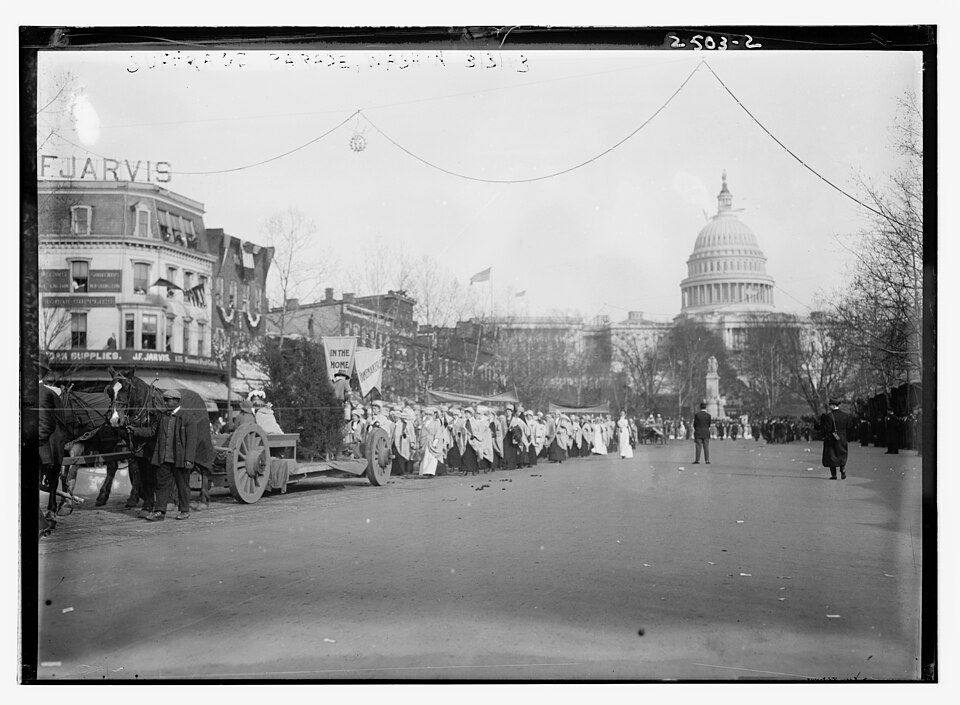
| Feature | Progressive Era (about 1890 to 1920) | New Deal (1933 to 1939) |
|---|---|---|
| Trigger | Industrial abuses, urban poverty, and political corruption | The Great Depression |
| Leadership | Middle-class reformers, journalists, and state and local officials, plus presidents like Theodore Roosevelt and Woodrow Wilson | The federal government, led by Franklin Roosevelt |
| Main goals | Regulate monopolies, clean up government, protect consumers and workers | Relief, recovery, and reform |
| Key measures | Meat Inspection Act, Federal Reserve, 16th to 19th Amendments | FDIC, Social Security, Wagner Act, WPA |
| Role of federal government | Referee: regulated business | Manager and safety net: directly employed people and guaranteed benefits |
| Blind spots | Largely ignored racial justice and accepted segregation | Many programs excluded or underserved African Americans |
The argument: Both movements expanded government to manage the effects of industrial capitalism. The New Deal went much further, shifting the federal government from regulator to provider of economic security.
Comparison 2: The Two Home Fronts
| Feature | World War I (1917 to 1918) | World War II (1941 to 1945) |
|---|---|---|
| Economic mobilization | War Industries Board, mostly voluntary | War Production Board, price controls, and rationing |
| Economic effect | Short boom, then a sharp postwar recession | Ended the Great Depression |
| Civil liberties | Espionage and Sedition Acts, prosecution of dissenters | Japanese American incarceration |
| Women | New jobs and the push for the 19th Amendment | Six million new workers, “Rosie the Riveter” |
| African Americans | The Great Migration begins, followed by the “Red Summer” of 1919 | Second Great Migration, Executive Order 8802, the “Double V” campaign |
The argument: Both wars expanded federal power, opened opportunities, and restricted civil liberties. World War II’s mobilization was larger, lasted longer, and had more lasting effects on the economy and civil rights.
Comparison 3: Foreign Policy After Each War
| Feature | After World War I | After World War II |
|---|---|---|
| International organization | Senate rejected the League of Nations | U.S. led the founding of the United Nations |
| Economic role | High tariffs, demands for war-debt repayment | Bretton Woods, the IMF, the World Bank, and later the Marshall Plan |
| Alliances | Avoided military commitments | Soon joined NATO, its first peacetime military alliance since the 1700s |
| Overall stance | Selective isolationism | Global leadership and containment |
The argument: Americans drew opposite lessons from the two wars. After World War I, many concluded that involvement had been a mistake. After World War II, most concluded that withdrawal had allowed aggression to grow.
Writing a Comparison Thesis
- Name both subjects and the basis of comparison. “The Progressive Era and the New Deal both expanded the role of the federal government…”
- State the key similarity or difference. “…but the New Deal went much further by creating permanent programs of economic security.”
- Add a reason. “…because the Depression’s scale overwhelmed the local and voluntary solutions Progressives had relied on.”
Why does this matter? Comparison is one of the three reasoning processes the LEQ and DBQ test. With a single required LEQ starting in May 2027, you can’t choose the prompt that suits you best, so practicing comparison across the whole period is the safest way to prepare.
Test-Taking Strategies
Mnemonic Devices and Memory Shortcuts
- “Referee, then provider.” Progressives regulated. The New Deal provided security.
- “Two wars, opposite lessons.” Isolation after World War I, leadership after World War II.
- “Similar, different, why.” The three parts of every strong comparison.
Cross-Topic Connections
- Topic 7.4: The Progressive Era supplies half of the reform comparison. See our review of the Progressive Era.
- Topic 7.10: The New Deal supplies the other half.
- Topics 7.6 and 7.12: The two home fronts.
- Topic 7.8: The 1920s show a conservative reaction between the reform eras. See our review of 1920s cultural and political controversies.
Common Question Formats
- Comparison SAQ. You explain one similarity and one difference between two reform movements.
- Stimulus MCQ. Two sources from different decades, and you identify what changed.
- DBQ. Documents spanning several decades, and you evaluate how the federal role changed.
- LEQ. You compare U.S. foreign policy after World War I and World War II.
Frequent Student Mistakes
- Listing without explaining. Graders want the reason behind each similarity or difference.
- Treating periods as identical. The New Deal and Progressivism differed sharply in scale.
- Forgetting the 1920s. The decade between the reform eras makes comparisons richer.
- Only describing differences. Showing both similarity and difference helps earn complexity.
Test-Day Shortcuts
- Use a two-column sketch. Jot quick columns before writing to organize evidence.
- Anchor with laws. One law per side keeps comparisons specific.
- End with significance. Explain why the comparison matters for later periods.
Time Management Tips
- Multiple choice: Section IA has 55 questions in 55 minutes, about 1 minute each. Comparison stems often hinge on one key word like “similar” or “unlike.”
- Short answer: Section IB has 3 required questions in 40 minutes, roughly 13 minutes each. Give one specific example for each side of a comparison.
- Essays: The DBQ gets 60 minutes, including a 15-minute reading period, and the single required LEQ gets 40 minutes. Spend 5 minutes planning your comparison before writing.
Check for Understanding
Think you’ve got it? Complete the quiz below to make sure. Download your results at the end.