
Maximize your score with these resources:
- Albert.io AP® US Government question banks
- Free AP® US Government cheat sheets
- Free AP® US Government score calculator
Social movements have been the primary engine of civil rights expansion in the United States. Rather than waiting for legislatures to act, activists have used litigation, protest, and public pressure to compel the government to interpret and enforce the 14th Amendment’s Equal Protection Clause more broadly. This article covers Topic 3.10: Social Movements and Equal Protection (Learning Objective PRD-2.A), which appears regularly on the AP® US Government exam as both multiple-choice questions and free-response questions. Understanding how the civil rights movement, women’s rights movement, LGBTQ rights movement, and disability rights movement have reshaped American law is essential for demonstrating mastery of civil liberties and civil rights.
This article examines four major social movements and the specific mechanisms (legislation, court decisions, and protest) through which they expanded equal protection. You’ll learn the historical arc of each movement, the key legal victories that shifted constitutional interpretation, and how to connect these movements to broader patterns of social change on the AP exam.
The Civil Rights Movement and the Expansion of Equal Protection
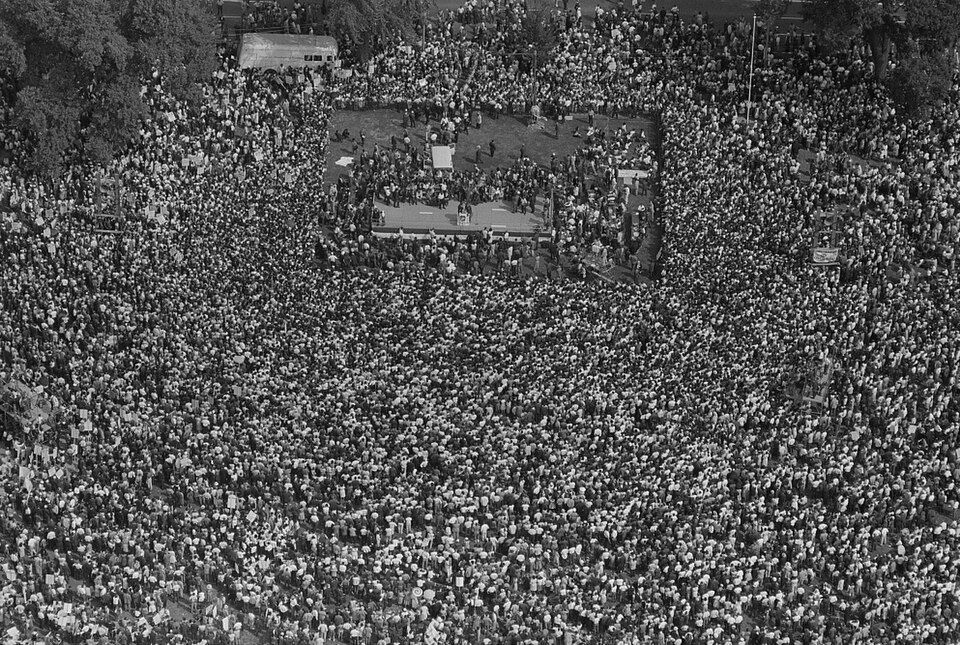
The civil rights movement of the 1950s and 1960s directly challenged Jim Crow segregation and forced the Supreme Court and Congress to reinterpret the 14th Amendment. Rather than accept “separate but equal” doctrine, activists used a three-pronged strategy: they filed lawsuits attacking segregation directly, organized mass protests that put moral pressure on elected officials, and shifted public opinion through dramatic displays of injustice.
Key Legal Victories:
- Brown v. Board of Education (1954) — The Supreme Court ruled that “separate educational facilities are inherently unequal” and violated the Equal Protection Clause. This overturned Plessy v. Ferguson (1896), which had permitted “separate but equal.” The decision didn’t end segregation immediately, but it established the legal principle that racial segregation in public schools is unconstitutional. Brown II (1955) ordered desegregation “with all deliberate speed,” a deliberately vague phrase that allowed massive resistance in Southern states for over a decade.
- Civil Rights Act of 1964 — This legislation prohibited discrimination in public accommodations (hotels, restaurants, theaters), employment, and federally funded programs. Unlike court decisions, which apply narrowly, statutes apply broadly across the entire country. The Act was passed after the 1963 March on Washington for Jobs and Freedom, where Martin Luther King Jr. delivered the “I Have a Dream” speech. This demonstrates how protest directly shapes legislative outcomes.
- Voting Rights Act of 1965 — This act suspended literacy tests and sent federal examiners to oversee voter registration in Southern states with histories of discrimination. It directly addressed the 15th Amendment (voting rights regardless of race) and used federal power to override state laws that had effectively disenfranchised Black voters. The Act followed the 1965 Selma to Montgomery marches, where state police beat voting rights activists in a nationally televised event (“Bloody Sunday”).
Why This Matters: The civil rights movement established the pattern for all subsequent social movements: litigation (Brown), protest (March on Washington, Selma marches), and legislation (Civil Rights Act, Voting Rights Act) work together. Understand that the movement operated at all three levels—courts, legislatures, and the streets—simultaneously. This is crucial for FRQ responses that ask you to explain how social movements expand rights.
The Women’s Rights Movement and Gender Discrimination
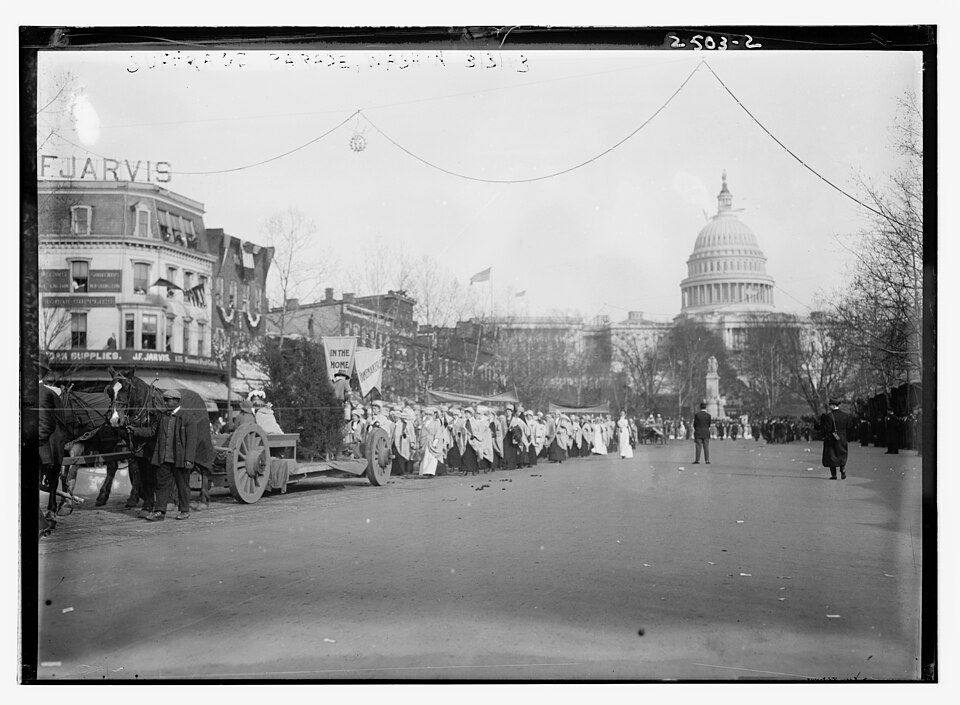
The women’s rights movement pursued equal protection on the basis of gender through constitutional amendments, legislation, and court decisions. Unlike racial discrimination, which the Supreme Court eventually recognized as inherently suspect, gender discrimination took longer to reach strict scrutiny. The movement also pursued the failed Equal Rights Amendment, demonstrating that not all social movements achieve their full constitutional goals.
Constitutional and Legislative Victories:
- 19th Amendment (1920) — Granted women the right to vote. Notably, women’s suffrage advocates had to propose an amendment rather than convince the Supreme Court that voting restrictions based on gender violated the 14th Amendment’s Equal Protection Clause. This shows the limits of litigation alone: sometimes social movements must amend the Constitution itself.
- Title IX of the Education Amendments Act (1972) — Prohibited sex discrimination in education. This statute has been interpreted broadly to cover athletics, sexual harassment, and access to STEM programs. Title IX is a legislative tool (not a constitutional amendment) that demonstrates how statutes can be written broadly enough to adapt to unforeseen problems—courts have expanded Title IX’s application far beyond its original intent.
- Equal Rights Amendment (proposed 1972, failed 1982) — The ERA would have prohibited sex discrimination explicitly. It passed Congress and was sent to the states, but fell three states short of ratification. This illustrates a critical point: not all social movements succeed in achieving their formal constitutional goals, even when they have substantial public support. The failure to ratify the ERA means gender discrimination is not subject to strict scrutiny under the Equal Protection Clause; it receives intermediate scrutiny instead.
Court Decisions on Gender and Equal Protection:
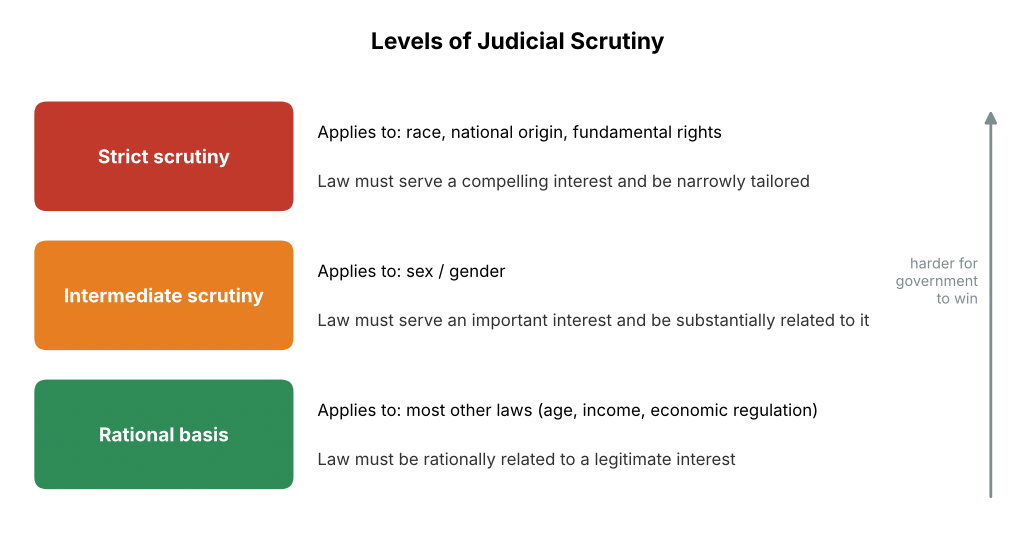
The Supreme Court initially deferred to legislatures on gender classifications. In cases like Muller v. Oregon (1908), the Court upheld paternalistic restrictions on women’s working hours. However, the modern women’s rights movement prompted the Court to reconsider. In Craig v. Boren (1976), the Court struck down an Oklahoma law that set different legal drinking ages for men (21) and women (18), applying intermediate scrutiny to gender classifications. This is a mid-level standard: stricter than rational basis review (which applies to most classifications), but not as strict as strict scrutiny (which applies to race). Intermediate scrutiny requires the government to show that a gender-based classification serves an important governmental objective and is substantially related to achieving that objective. This gives the women’s rights movement a legal tool, but one less powerful than what the civil rights movement achieved for racial classifications.
Why This Matters: The women’s rights movement shows both successes and limitations. Title IX and the 19th Amendment are clear victories. But the failed ERA and intermediate scrutiny for gender (rather than strict scrutiny) show that social movements face structural obstacles. On the exam, be prepared to explain why gender and race receive different constitutional scrutiny and how this affects equal protection analysis.
The LGBTQ Rights Movement and the Evolution of Equal Protection
The LGBTQ rights movement pursued equal protection through litigation, protest, and legislation, building on strategies from the civil rights and women’s rights movements. However, the movement faced a unique challenge: the Supreme Court initially treated same-sex discrimination as a non-issue (Bowers v. Hardwick, 1986) before reconsidering entirely.
The Shift from Criminal Law to Marriage Equality:
- Bowers v. Hardwick (1986) — The Supreme Court upheld a Georgia statute criminalizing sodomy. This decision effectively said that equal protection did not protect gay men and lesbians from criminalization based on their sexual conduct. This was the legal baseline when the modern LGBTQ rights movement intensified in the 1990s and 2000s.
- Lawrence v. Texas (2003) — The Supreme Court overturned Bowers, striking down anti-sodomy laws nationwide. The Court ruled that laws criminalizing same-sex conduct violated the Due Process Clause (right to privacy and liberty), and implicitly relied on equal protection reasoning. This was a major judicial victory that decriminalized homosexuality, but it stopped short of addressing employment discrimination or marriage equality.
- Obergefell v. Hodges (2015) — The Supreme Court recognized a constitutional right to same-sex marriage under both the Due Process Clause and the Equal Protection Clause. The decision struck down all state bans on same-sex marriage, affirming that denying marriage licenses to same-sex couples violated equal protection. This was the culmination of a 30-year litigation strategy and parallel public opinion shift. Note that this decision relied on both due process (liberty interest in marriage) and equal protection (discrimination based on sexual orientation), giving it multiple constitutional anchors.
Litigation as Primary Strategy: Unlike the civil rights movement, which paired litigation with massive street protests and federal legislation, the LGBTQ rights movement in the late 20th and early 21st centuries relied heavily on strategic litigation. Organizations like Lambda Legal and the ACLU litigated cases up to the Supreme Court, testing and shifting constitutional doctrine. This shows that different movements emphasize different tools depending on their political context and goals.
Why This Matters: The LGBTQ rights movement demonstrates that equal protection doctrine is not static. The Supreme Court changed its interpretation of equal protection significantly within living memory (from Bowers to Obergefell). On the exam, you should be able to explain how litigation can shift constitutional interpretation and why this movement relied less heavily on protest and legislation than earlier civil rights movements.
The Disability Rights Movement and the ADA
The disability rights movement pursued accessibility and non-discrimination through legislation and court challenges. Unlike other movements, which focused primarily on voting rights and employment discrimination, the disability rights movement emphasized structural access to public life.
The Americans with Disabilities Act (1990):
- The ADA is the most comprehensive civil rights statute for a protected class since the Civil Rights Act of 1964. It prohibits discrimination based on disability in employment, public accommodations, transportation, and telecommunications.
- The ADA went further than previous civil rights legislation by requiring affirmative accommodations (e.g., wheelchair ramps, sign language interpreters) rather than merely prohibiting discrimination. This reflects the movement’s insight that equal protection sometimes requires not just equal treatment, but equal access.
- The Act has been interpreted and expanded through litigation. In Olmstead v. L.C. (1999), the Supreme Court ruled that the ADA requires states to provide services in community settings rather than exclusively in institutions. This expands equal protection beyond formal non-discrimination to include a right to integrate into community life.
Why This Matters: The disability rights movement shows that equal protection can mean different things in different contexts. For racial and gender discrimination, the focus is on removing barriers to equal treatment. For disability discrimination, equal protection includes affirmative obligations to provide accommodations. This reflects the political power and moral arguments of the disability rights movement.
Comparing the Strategies and Outcomes of Social Movements
Each movement used a combination of litigation, legislation, and protest, but in different proportions and sequences. Understanding these differences is crucial for AP exam success.
| Movement | Primary Legal Tool | Secondary Tools | Key Constraint | Outcome |
|---|---|---|---|---|
| Civil Rights (1950s-1960s) | Supreme Court (Brown), Congressional legislation (Civil Rights Act 1964, Voting Rights Act 1965) | Mass protest (March on Washington, Selma marches), Civil disobedience | Federal enforcement and Southern resistance required sustained pressure and legislation | Overturned “separate but equal,” banned discrimination in public accommodations and voting, established strict scrutiny for racial classifications |
| Women’s Rights (1920s, then 1970s-present) | Constitutional amendment (19th), Congressional legislation (Title IX 1972), Court cases (Craig v. Boren 1976) | Suffrage movement, Second Wave feminism, litigation strategy | Failed to ratify ERA, limited to intermediate scrutiny for gender (not strict scrutiny) | Secured voting rights, educational non-discrimination, but gender still receives lower scrutiny than race |
| LGBTQ Rights (1990s-2015) | Strategic litigation (Lawrence v. Texas 2003, Obergefell v. Hodges 2015) | Modest public protest early on, but movement increasingly litigation-focused | Public opinion initially hostile; Court reluctant to intervene (Bowers 1986). Litigation strategy required waiting for Court composition to shift. | Decriminalized homosexuality, secured marriage equality, won Title VII employment protection (Bostock v. Clayton County 2020), but no comprehensive non-discrimination statute (Title IX analogue) yet |
| Disability Rights (1980s-1990s) | Congressional legislation (ADA 1990), Court interpretation (Olmstead 1999) | Advocacy and activism (but less disruptive protest than earlier movements) | Framed as universal access issue; less polarized than race or gender | Comprehensive federal statute requiring affirmative accommodations, not just non-discrimination |
Why This Matters: The table above is a study guide in itself. Notice that successful social movements use multiple tools, but the mix depends on the political context. When courts are receptive (civil rights), litigation succeeds. When courts are hostile (LGBTQ rights in 1986), the movement must wait or shift to state-by-state action. When Congress is receptive (disability rights, ADA), legislation is the primary tool. On the AP exam, you should be able to analyze a hypothetical social movement and explain which tools (litigation, legislation, protest) would be most effective given the political context.
Test-Taking Strategies
Mnemonic Devices and Memory Shortcuts:
Use “CLWD” to remember the major social movements covered in this topic: Civil rights, LGBTQ (alternatively: “L”), Women’s rights, Disability rights. For each movement, ask: What was the key legal victory? Was it a court decision, a statute, or an amendment? This helps you answer both specific questions (“Which amendment addressed women’s voting rights?”) and comparative questions (“Compare the strategies of the civil rights and LGBTQ rights movements”).
For the civil rights movement specifically, remember “Brown-CRA-VRA” as the legal progression: Brown v. Board (judicial), Civil Rights Act 1964 (legislative), Voting Rights Act 1965 (legislative). This shows how a single movement uses multiple branches of government.
Cross-Topic Connections:
- Topic 3.7 (Selective Incorporation) — The 14th Amendment’s Due Process Clause is the vehicle for incorporating Bill of Rights protections against the states, while its Equal Protection Clause applies to the states directly. Understanding how the 14th Amendment is the vehicle for protecting civil rights is fundamental. Social movements rely on the incorporation doctrine to apply constitutional protections everywhere, not just in federal law.
- Topic 3.6 (Balancing Individual Freedom with Public Order and Safety) — Many social movements involved civil disobedience (sit-ins, marches), which raised questions about whether individuals can break laws to protest unjust ones. The exam may ask you to weigh the individual freedom to protest against public order concerns. Civil rights activists (especially in the South) were arrested for sit-ins and Freedom Rides; their willingness to accept arrest brought national attention to segregation.
- Topic 5.1 (Voting Rights and Models of Voting Behavior) — The Voting Rights Act of 1965 is a direct response to disenfranchisement. Understanding how social movements expanded voting rights is essential for explaining both the legal changes and their political consequences (the Southern Strategy, realignment toward the Republican Party, etc.).
Common Question Formats:
- Multiple-Choice Stimulus-Based: You’ll see a photo of a sit-in or the March on Washington, a quote from MLK or a Supreme Court opinion, or a description of a statute. The question asks you to identify the movement, the goal, or the mechanism (litigation vs. protest vs. legislation). Know the visual and textual landmarks: “I Have a Dream” speech (1963 March on Washington), images of the sit-ins at segregated lunch counters (1960), the Selma to Montgomery marches (1965), the Stonewall riots (1969, beginning of modern LGBTQ activism).
- Comparative FRQ: “Explain how the civil rights movement and the women’s rights movement used similar and different strategies to expand equal protection under the 14th Amendment.” You should explain that both used litigation and legislation, but the women’s rights movement also pursued a constitutional amendment (19th) and failed to achieve a second one (ERA). Explain the outcomes: civil rights achieved strict scrutiny for race; women’s rights achieved intermediate scrutiny for gender.
- Causation FRQ: “Why did the LGBTQ rights movement rely more heavily on litigation and less heavily on mass protest than the civil rights movement?” Answer: Initially, LGBTQ people faced criminalization and social stigma, making mass protest riskier. As public opinion shifted and the Supreme Court became more receptive (after judicial appointments in the 1980s and 1990s), strategic litigation became more viable. This shows how political context shapes movement strategy.
Frequent Student Mistakes:
- Mistake 1: Thinking social movements are purely about protest. Correction: Successful movements combine protest, litigation, and legislation. Protest brings attention and moral pressure; litigation changes legal doctrine; legislation applies rights broadly. Missing any one tool limits your explanation. The exam rewards answers that show this three-fold strategy.
- Mistake 2: Assuming all social movements succeeded equally. Correction: The civil rights movement achieved strict scrutiny for race and won major legislation. The women’s rights movement achieved intermediate scrutiny (not strict) and won the 19th Amendment but failed the ERA. The LGBTQ rights movement won Obergefell and Bostock v. Clayton County (2020), which applied Title VII’s ban on employment discrimination to sexual orientation and gender identity, but hasn’t achieved a comprehensive non-discrimination statute. Explaining these different outcomes—why race gets stricter scrutiny than gender, why marriage equality doesn’t automatically guarantee employment non-discrimination—shows exam-level understanding.
- Mistake 3: Confusing the focus of different movements. Correction: The civil rights movement focused initially on voting rights and segregation (access to public accommodations, education, voting booths). The women’s rights movement focused on voting and education (suffrage, then Title IX). The LGBTQ movement focused on criminalization (Lawrence), then family law (marriage). The disability movement focused on physical access and affirmative accommodation. Each movement’s specific goals shaped which legal tools were most effective.
Test-Day Shortcuts:
- For chronology questions: Remember that the civil rights movement’s major victories came in a burst: Brown (1954), March on Washington (1963), Civil Rights Act (1964), Voting Rights Act (1965). If a question asks when a particular law passed or when a protest occurred, these five years are critical. Women’s suffrage (1920 for the 19th Amendment) is earlier; Title IX is 1972 (post-Civil Rights Act); Obergefell is 2015 (recent).
- For mechanism questions: If the question asks “Which tool—litigation, protest, or legislation—was most important?” The answer is usually “all three, but in this context…” For Brown, emphasize litigation. For the Civil Rights Act and Voting Rights Act, emphasize legislation and protest together (the March on Washington led to the Civil Rights Act; Selma marches led to Voting Rights Act). For Obergefell, emphasize strategic litigation over two decades. This shows nuance.
Time Management Tips:
- On an FRQ comparing social movements, allocate your time as follows: 1 minute organizing your thoughts (identifying similarities and differences), 2-3 minutes on the civil rights movement (it’s the baseline), 2-3 minutes on the second movement you’re comparing, and 1 minute on synthesis (explaining why the differences matter). Don’t spend more than 8-10 minutes total on this question; you have 1 hour 40 minutes for all four FRQs.
- On multiple-choice stimulus-based questions, read the stimulus carefully for clues: dates, names of leaders, descriptions of events. A photo of a lunch counter sit-in points to the civil rights movement (1960). A quote about marriage equality points to Obergefell (2015) or United States v. Windsor (2013). Clues in the stimulus often give you the answer without needing complete recall.
Check for Understanding
Think you’ve got it? Complete the quiz below to make sure. Download your results at the end.